


What if the best thing a paid investing service offers isn’t a winning pick, but a better decision process? Free market information can be noisy, while premium pitches sometimes sound far more certain than markets ever are. So how do you tell whether Premium financial content for investors is genuinely useful before you subscribe?
Look beyond access and polished forecasts. A fee doesn’t make research reliable, turn education into personalized investment advice, or guarantee a return. Value comes from material that helps you ask sharper questions, understand risk, and make decisions that fit your own approach.
This guide offers a practical framework for weighing research quality, cost, and fit with your investing style. We’ll distinguish market analysis, trading education, and advice, then consider what an investor community can realistically add. Phil Stock World brings commentary, charts and analysis together with educational webinars, virtual portfolio reviews, and membership discussion. The goal isn’t to tell you what to buy. It’s to help you decide whether a paid resource improves your process or simply adds another confident voice to the noise.
Key Takeaways
- Identify whether a paid resource offers commentary, research, alerts, education, or community access before judging its value.
- Assess how clearly its market observations, evidence, scenarios, and risk fit together.
- Compare free news, social posts, paid research, and financial entertainment by their purpose and limitations, not by promises of performance.
- Evaluate Premium financial content for investors against your goals, preferred format, transparency needs, and available time.
- See how Phil Stock World combines market analysis and investor education, then consider which elements could support your own research.
What Does Premium Financial Content for Investors Actually Include?
Premium financial content for investors is paid access to market commentary, research, educational material, alerts, or discussion intended to help people understand markets and develop their own investing process. The mix varies: one subscription might focus on in-depth company analysis, while another emphasizes market updates, learning resources, or interaction with other investors. The umbrella term Paid content covers material made available through payment, but paying for access says nothing by itself about its accuracy or usefulness.
Keep the central distinction in mind: Premium access is not premium performance. A subscription can provide information and tools, but it can’t assure how markets will move or what results an investor will achieve. Commentary offers a perspective on events. Research examines evidence and possible implications. Alerts flag developments or potential opportunities, while education explains concepts and strategies. Community access adds discussion, not a substitute for independent judgment.
- Market commentary interprets current events, economic shifts, or market behavior.
- Research and analysis examine companies, sectors, assets, or broader market themes, ideally showing the reasoning behind a view.
- Alerts draw attention to a change or idea. They may be brief, so look for enough context to assess them.
- Educational resources teach concepts and methods, from understanding options to reading charts.
- Community access creates space for questions and discussion, where opinions still need to be assessed critically.
How Is Premium Investor Content Different From Free Market News?
Free news often delivers timely facts and headlines. A paid resource may add continuity, deeper analysis, or a recurring framework. That can be useful when coverage links an event to a thesis, lays out evidence, and considers scenarios and risks. A paywall doesn’t make analysis stronger by default. Look for clear sourcing, reasoning you can follow, and uncertainty stated plainly. Treat each view as input, compare it with other credible information, and reach your own conclusion.
What Can a Financial Content Subscription Provide?
Subscriptions package commentary, research, alerts, education, and discussion in different combinations. Start by naming the job you want the content to do: explain market context, deepen your analysis, teach a skill, or create a place to discuss ideas. Then judge the material by how well it serves that purpose, not by how busy the feed feels. Phil Stock World combines market analysis and educational elements in its membership. Its specific offerings are considered later, rather than treated as a template for every service.
How Strong Investor Research Turns Market Noise Into a Reasoned Process
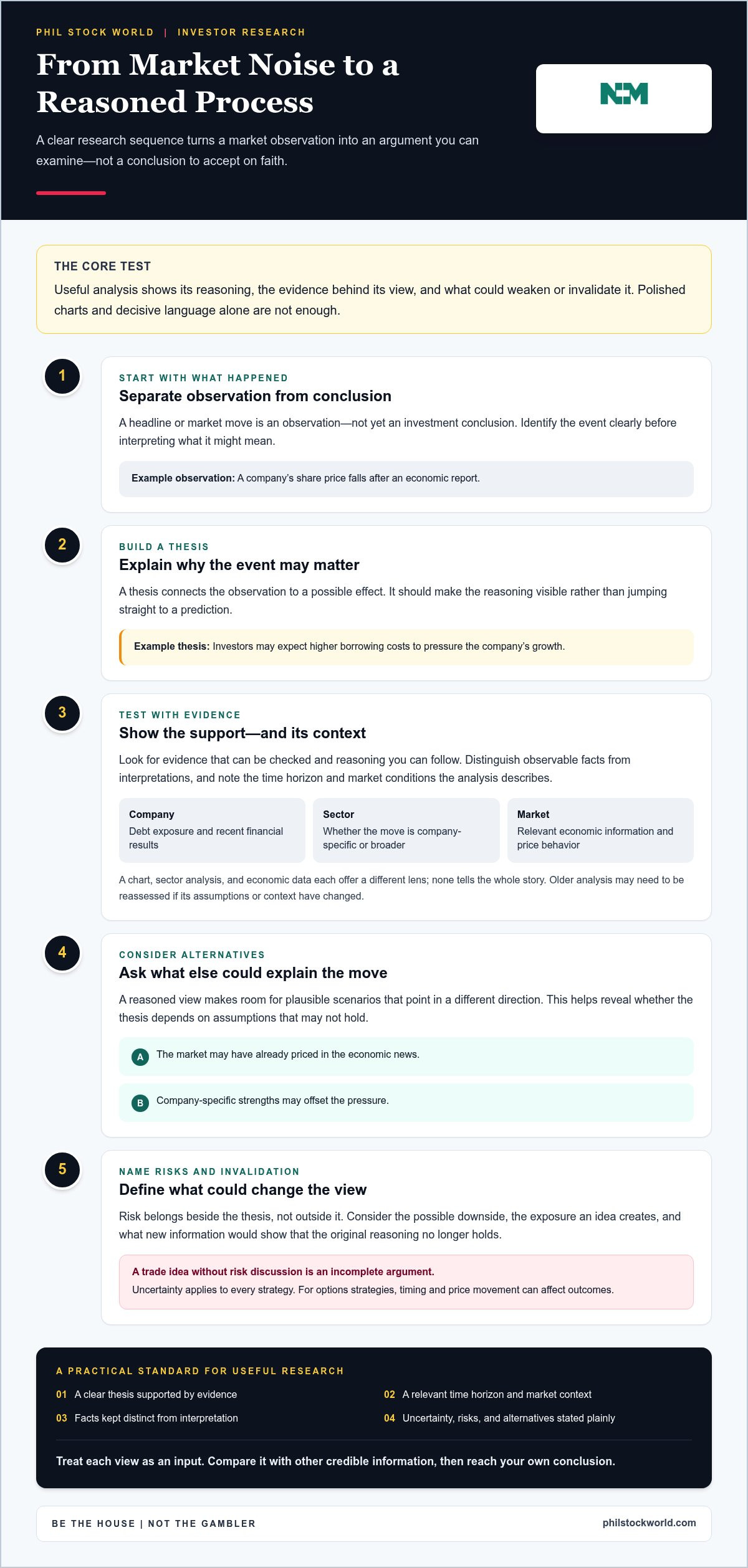
Market headlines are observations, not investment conclusions. Useful research makes the steps between the two visible: it identifies what happened, develops a thesis about why it may matter, tests that view against evidence, considers plausible scenarios, and names the risks. That sequence gives you an argument to examine rather than a confident-sounding conclusion to accept on faith.
Imagine a company’s share price falls after an economic report. The observation is the price move. A thesis might be that investors expect higher borrowing costs to pressure the company’s growth. Evidence could include its debt exposure, recent financial results, and how similar companies respond. Then consider alternatives: the market may have already priced in the news, or company-specific strengths may offset the pressure. Finally, ask what new information would weaken the original thesis.
Useful analysis explains its reasoning and what could invalidate it. That’s a stronger standard than polished charts or decisive language alone. Premium financial content for investors becomes more useful when it shows the working behind an interpretation, including the limits of the available evidence.
What Should a Credible Market Analysis Explain?
Look for a clear thesis, supporting evidence, a relevant time horizon, and a candid account of uncertainty. Separate observable facts, such as a reported earnings figure or a charted price move, from interpretation, such as what those facts might mean for future performance. Check when the analysis was written and which market conditions it describes. An older argument may still be insightful, but its assumptions and context may have changed.
Charts, sector context, and economic information each offer a different lens. A chart can show price behavior and potential levels of support or resistance. Sector analysis can reveal whether a move is company-specific or part of a broader trend. Economic data can help frame the environment affecting both. None tells the whole story. Learning how to read market charts can help you distinguish what a visual pattern shows from what someone believes it predicts.
Why Risk Discussion Belongs Beside Trade Ideas
A trade idea without risk discussion is an incomplete argument. Every strategy involves uncertainty, including options strategies, where factors such as timing and price movement can affect outcomes. Before weighing an idea, consider the possible downside, how much exposure it creates, and what evidence would show that the thesis no longer holds. Position size matters because even a well-reasoned view can be wrong.
For example, if an analysis expects a stock to rise, ask what happens if it moves sideways or falls instead, and whether the proposed time horizon still makes sense. An explicit invalidation point can help keep changing evidence from being explained away after the fact. A focused guide to risk management for options can add useful context without turning a general market view into a personal trading plan.
Use the same standard for any commentary or research: follow the logic, test the assumptions, and keep risk in view. Investors looking for market perspective can explore Phil Stock World’s market charts and analysis as one source of information.
Premium Research vs. Free News, Social Posts, and Financial Entertainment
These formats can each help you notice or understand something, but they serve different purposes. Free news can provide timely facts; social posts may surface viewpoints quickly; paid research may offer more sustained analysis; and financial entertainment is designed to hold attention. None is automatically reliable or useful just because it’s free, paid, or popular. Compare what the source does and how clearly it supports its claims.
| Format | Purpose and depth | Transparency and interaction | Limitations |
|---|---|---|---|
| Free news | Reports developments, often with concise context. | May identify sources and provide limited interaction. | A short update may not explain investment implications or risks. |
| Social posts | Share fast takes, personal opinions, or links to information. | Interaction can be high, but the evidence and incentives behind a post may be hard to assess. | Brief, confident claims can omit context and downside. |
| Paid research | May offer deeper analysis, ongoing coverage, education, or discussion. | Quality depends on how clearly the source explains evidence, uncertainty, and relevant incentives. | Payment alone doesn’t establish quality or make a view suitable for your needs. |
| Financial entertainment | Packages market topics to engage or amuse, sometimes with simplified analysis. | Presentation may be polished, but the purpose and supporting evidence can vary. | A compelling story isn’t the same as a reasoned investment case. |
Free information can be valuable, and paid research can still be thin or promotional. The useful question is whether a source gives you enough context to examine its claims. Check who produced the material, what evidence it cites, whether it distinguishes fact from opinion, and whether it explains relevant conflicts or incentives. This is the core of finding unbiased financial research: don’t assume a source is unbiased; assess its disclosures and reasoning.
How Can Investors Spot Hype Disguised as Analysis?
Watch for language that treats a market outcome as inevitable, selective winning examples without a fuller record, or trade ideas with no meaningful downside scenario. Urgency tactics can push readers to act before they’ve had time to evaluate a thesis. Ask what evidence supports the claim, what could go wrong, and whether promotional language is doing more work than the analysis.
Entertainment can make finance approachable, and a lively style isn’t a problem by itself. The distinction is whether the material makes its purpose clear and supports its interpretation with evidence. Stay skeptical even when a presenter sounds knowledgeable or shares a persuasive success story.
When Can a Paid Research Community Add Value?
A community may provide continuity, explanations, learning opportunities, and structured discussion around market ideas. That can help you compare interpretations and ask better questions. It adds less value if discussion turns into copying trades or treating the loudest view as consensus. Community access works best as a prompt for independent thinking, not a replacement for it. Comparing specialized research environments can also help you identify which methods and formats align with your interests.
Premium financial content for investors earns consideration when its format and transparency help you evaluate ideas, not when it simply delivers more confident opinions.
A Practical Checklist for Deciding Whether Investor Content Fits You
A subscription is easier to assess when you know what job you want it to do. Are you trying to understand market events, build investing knowledge, examine a specific strategy, or discuss ideas with others? Premium financial content for investors should fit that need, your experience, and the time you can realistically give it. Use this checklist before committing.
- Name your goal. Choose the main gap you want to address: education, commentary, analysis, or discussion. “I want to learn how options work” is a clearer goal than “I want better investments.”
- Match the format to the need. Check whether the material is written analysis, charts, webinars, alerts, or interactive discussion. A format that’s hard to keep up with won’t help just because it looks comprehensive.
- Study sample content. Look for reasoning you can follow, more than one plausible scenario, and relevant risks. Notice whether claims are supported or mostly delivered as confident conclusions.
- Check transparency. See whether the source distinguishes fact from opinion and explains relevant incentives or conflicts. Clear disclosures won’t remove uncertainty, but they help you understand the context of a recommendation or view.
- Account for time and fit. Consider how often you’ll use the material and whether its complexity matches your knowledge. If an idea relies on risks or mechanics you don’t understand, pause and learn more before treating it as actionable.
What to Review Before Paying for Financial Content
Compare the subscription’s stated purpose with your actual need. If you want foundational learning, a stream of short-term market alerts may be a mismatch. If you’re seeking context, isolated trade ideas may leave too much unexplained. Consider the routine involved as well: scheduled webinars, frequent commentary, and discussion spaces ask for different levels of attention. Judge fit, not volume.
How to Use Research Without Outsourcing Your Judgment
Treat analysis as an input, not an instruction to copy a trade. Before acting or waiting, write down your own thesis, the evidence that supports it, the risks you see, and what would change your mind. That pause can expose gaps between a source’s argument and your own understanding. Educational material on advanced option trading strategies can help explain concepts, but learning a strategy isn’t the same as deciding it suits your circumstances.
Apply the same standard when considering risk: can you explain the idea in your own words, including what could go wrong? If not, keep researching rather than letting urgency make the call. Content should help you think more clearly, not take the thinking off your hands.
If market commentary, charts, education, and discussion match what you’re looking for, explore Phil Stock World membership to see how those elements come together.
How Phil Stock World Brings Market Analysis and Investor Education Together
Phil Stock World brings market commentary, analysis, and education together under a membership. Founded and led by veteran trader and market analyst Phil Davis, the platform provides daily market commentary, stock and options trading ideas, market charts, and analysis, alongside educational webinars, strategy guides, and virtual portfolio reviews. These resources offer different ways to follow markets and build understanding; they don’t promise a particular investment outcome.
Investors don’t all need the same kind of support. One reader may want a regular view of market developments, while another is focused on learning a concept or joining an interactive discussion. Phil Stock World membership tiers range from daily commentary to real-time interactive trading sessions, so the format and level of interaction vary. Consider which resources match your research habits and experience.
What Investor Support Does Phil Stock World Offer?
Commentary and market analysis provide perspectives readers can weigh alongside their own research. Stock and options ideas can illustrate how a market view is expressed, while charts offer another lens on price behavior. Treat each as information to evaluate, not an instruction to follow. Consider the reasoning, assumptions, time horizon, and risks before deciding whether an idea is relevant to you.
Webinars and strategy guides serve an educational role, helping readers explore market concepts and approaches. Virtual Portfolio Reviews offer a way to examine portfolio questions, but shouldn’t be mistaken for personalized financial planning. Education can help clarify the questions you ask; it can’t remove the uncertainty involved in investing or determine what’s right for every individual.
How to Take the Next Step With a Clear-Eyed View
Before exploring a membership, return to your practical needs. Do you want daily commentary, educational resources, market charts and analysis, or a more interactive format? Think about how much time you can devote to the material and whether you can assess the strategies discussed. A resource is more likely to be useful when its format fits your routine and its content supports, rather than replaces, your own decision-making.
Keep expectations grounded. Market analysis can organize information and present possible interpretations, but it can’t eliminate uncertainty, guarantee profits, or assure successful trades. Even thoughtful research can be wrong, and markets can move in unexpected ways. Read with curiosity, test ideas against your own reasoning, and be cautious about treating any commentary as certain.
If the combination of market analysis and investor education fits what you’re looking for, explore Phil Stock World membership. Review the formats and decide whether they suit your approach. The value is in the perspective and learning you can apply, not in any promise of returns.
Make Your Next Research Decision Deliberate
Give any subscription a practical test: after using it, note whether it helped you understand an issue, ask a sharper question, or spot a risk you might have missed. That’s a more grounded measure of value than counting alerts or expecting a particular market result. Premium financial content for investors is most useful when it strengthens your own thinking, while leaving decisions and uncertainty where they belong: with you.
Phil Stock World brings veteran trader and market analyst Phil Davis’s perspective to a membership with access ranging from daily commentary to real-time interactive trading sessions. Webinars, virtual portfolio reviews, and strategy guides add educational dimensions. None can guarantee an outcome, and none should replace your own judgment. The next step is to see whether the available formats suit the way you learn and follow markets.
Explore Phil Stock World membership to decide whether it fits your research routine. Stay curious, keep asking what could change your mind, and make better-informed decisions your goal.
Frequently Asked Questions
Is premium financial content worth it for individual investors?
It can be worthwhile if it improves your understanding, research habits, or discipline, but a subscription isn’t automatically better than free sources, and returns aren’t guaranteed. Before paying, compare the format with how you learn, review how clearly the source explains its reasoning and incentives, and consider whether you’ll use it. Before renewing, ask whether you can point to a specific way the material helped you evaluate a decision.
Can paid investment research tell me exactly what to buy?
Paid research can present analysis or trade ideas, but it can’t determine what’s suitable for you. Consider the risks, your circumstances, and whether you understand the reasoning. General commentary discusses markets or possible opportunities; it isn’t the same as personalized financial planning. Treat a trade alert as information to examine, not an automatic instruction, and remember that no thesis can guarantee a particular result.
How much should I spend on premium investor research?
Set a limit based on your budget and the use you realistically expect to get from the service. Compare what it provides, such as education, analysis, or discussion, with free resources and other formats that may meet the same need. Then reassess after using it: are you engaging with the material, or letting it pile up unread? A higher subscription cost doesn’t prove better quality or improve your odds of investment success.
What happens if a paid market analysis is wrong?
It may be overtaken by new information, or market conditions may change in ways the original analysis didn’t anticipate. Revisit the assumptions rather than defending the thesis simply because you’ve invested time or money in it. Ask what changed, what downside remains, and whether your own reasons for acting still hold. Sound analysis can be wrong; a responsible approach leaves room for uncertainty instead of presenting a view as inevitable.
Can premium financial content replace a financial advisor?
No. Research, education, and commentary can help you understand markets, but they aren’t a substitute for personalized financial planning and may not account for your complete financial circumstances or goals. General analysis of a market trend, for example, can’t by itself weigh how a decision affects your broader financial picture. If you need advice tailored to your situation, consult an appropriately qualified professional.
How can beginners use trading alerts without blindly copying them?
Use an alert as a prompt to investigate, not a command to trade. Before considering an options idea, make sure you understand its thesis, time horizon, possible loss, and any expiration date involved. Check whether the reasoning makes sense to you and fits your own plan. If key details are missing or the message pressures you to act immediately, pausing is a reasonable decision.