

Highlights from Roy and Penny’s podcast:
1. Macro Reality Check: The Plunging Foundations
-
-
The “Fed Put” is Dead: Core CPI beat consensus at +0.3% month-over-month, instantly forcing the CME FedWatch tool to price an 86.5% probability of a 25 bps rate hike at this Wednesday’s FOMC meeting (up from 69.4%).
-
Tapped-Out Consumers: Preliminary University of Michigan Consumer Sentiment cratered to 47.8 (from 51.7), accompanied by a staggering 12.8% credit card delinquency rate for the bottom 80% of households. Mall-based canary Zumiez collapsed 16% as discretionary liquidity evaporated.
-
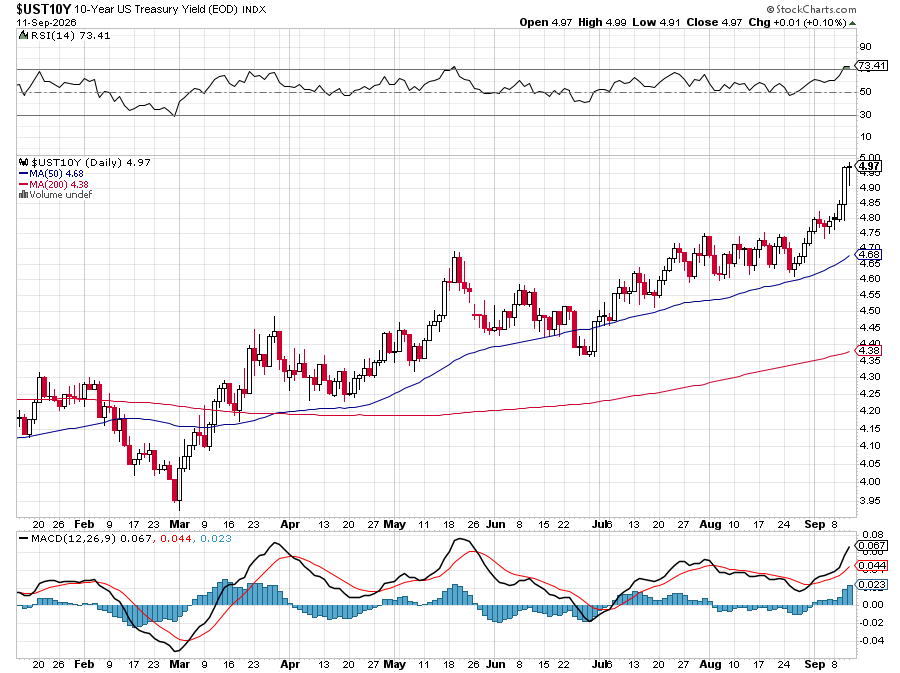
The Sovereign Debt Bleed: The U.S. posted a single-month August deficit of $166.8 billion, driving the fiscal year-to-date deficit near a record $1.97 trillion. The 10-year Treasury yield sits suffocating the economy at 4.98%, with the 2-year at 4.64%.
-
2. State Interventions & The Rigged Ship
-
-
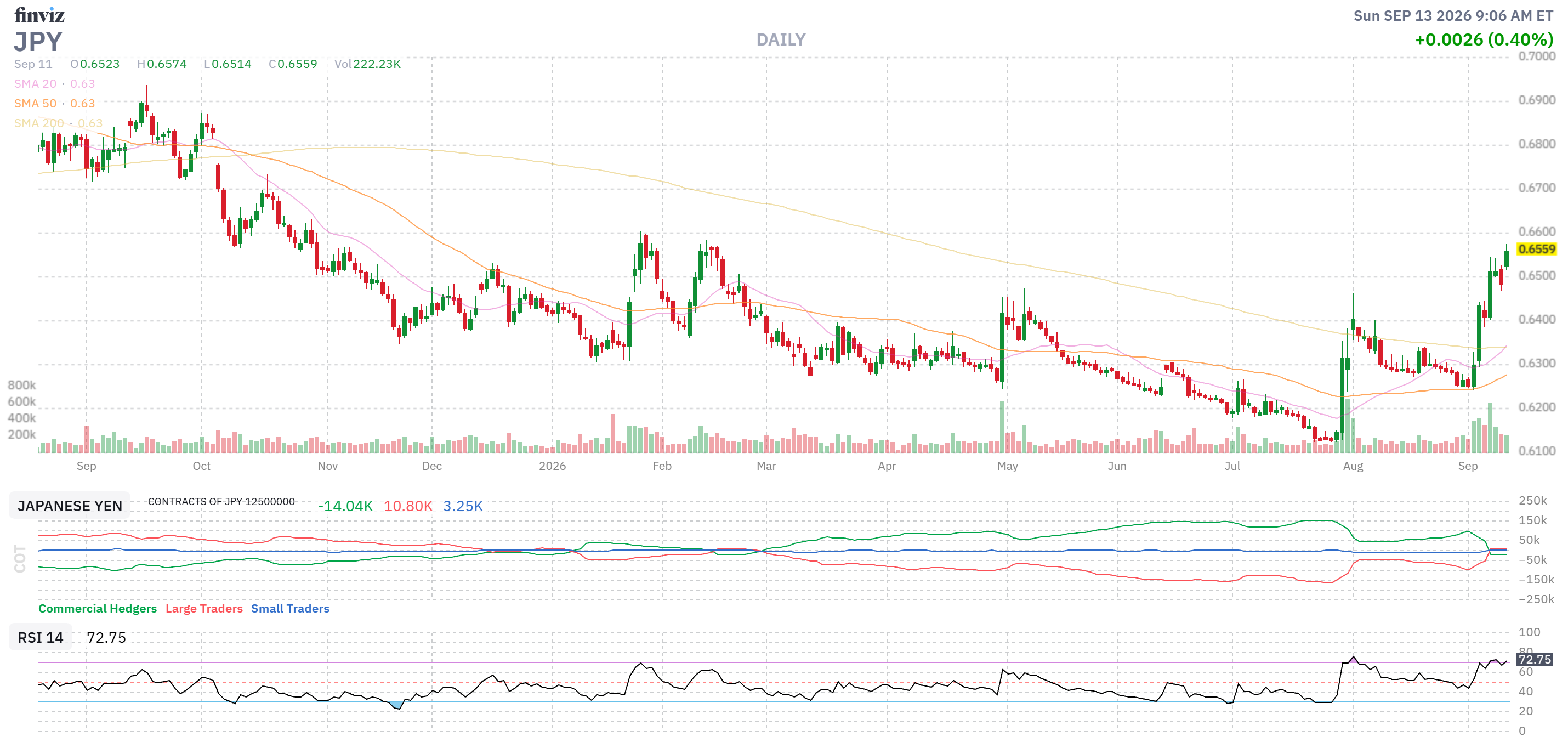
Currency Manipulation & Command Capitalism: As Japan faces pressure from soaring yields, Treasury Secretary Scott Bessent was reported coordinating interventions with the Bank of Japan to prop up the Japanese Yen. The objective: prevent Japan from dumping its massive stockpile of U.S. Treasuries, which would instantly push domestic 10-year yields toward 6%–7% and crush corporate debt refinancing.
-
-
-
Fiscal Juice & Performative Politics: Split-screen absurdities mask deep fragility-from emergency administrative rebates designed to buoy midterm sentiment to consumers taking on 25% APR credit card debt for $2,000 tech hardware while 30-year mortgages hover at 6.85%.
-
3. The Corporate Divergence: Picks & Shovels vs. Software Traps
-
-
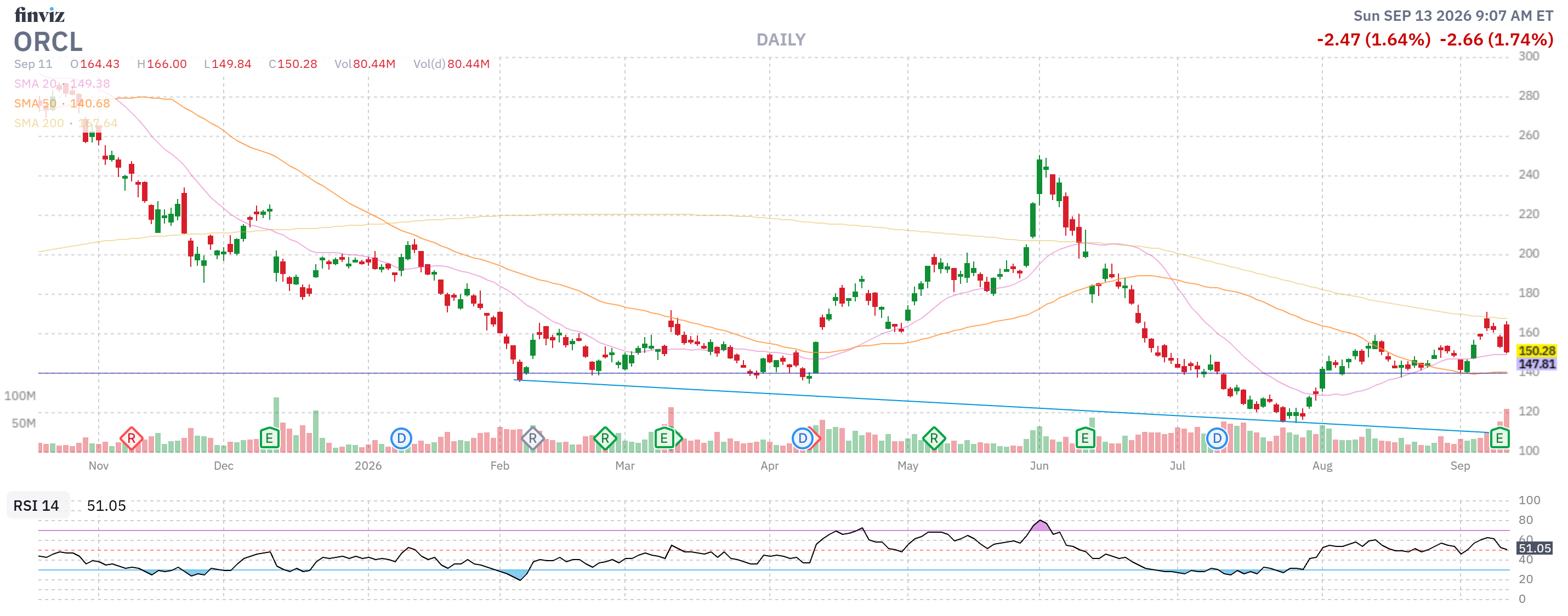
Physical Infrastructure Wins: Oracle surged on a 121% explosion in Cloud Infrastructure revenue, a 97.9% GPU utilization rate, and $30B in fresh AI contracts, carrying Dell (+11.9%) and HPE (+12.4%) along with it.
-
-
-
The Software Margin Trap: Adobe reported a headline beat, yet sold off as net new Annual Recurring Revenue (ARR) lagged. Heavy AI compute costs paid upfront to hardware providers aren’t translating fast enough into paying recurring enterprise seats.
-
Cash Bypasses the Debt Wall: With the impending corporate refinancing wave hitting 7%–8% rates, Copart executed an all-cash $1.9B deal for ACV, deliberately sidestepping syndication banks and punitive loan covenants.
-
4. Systemic Mechanics: The Basho Gravitational Collapse
-
-
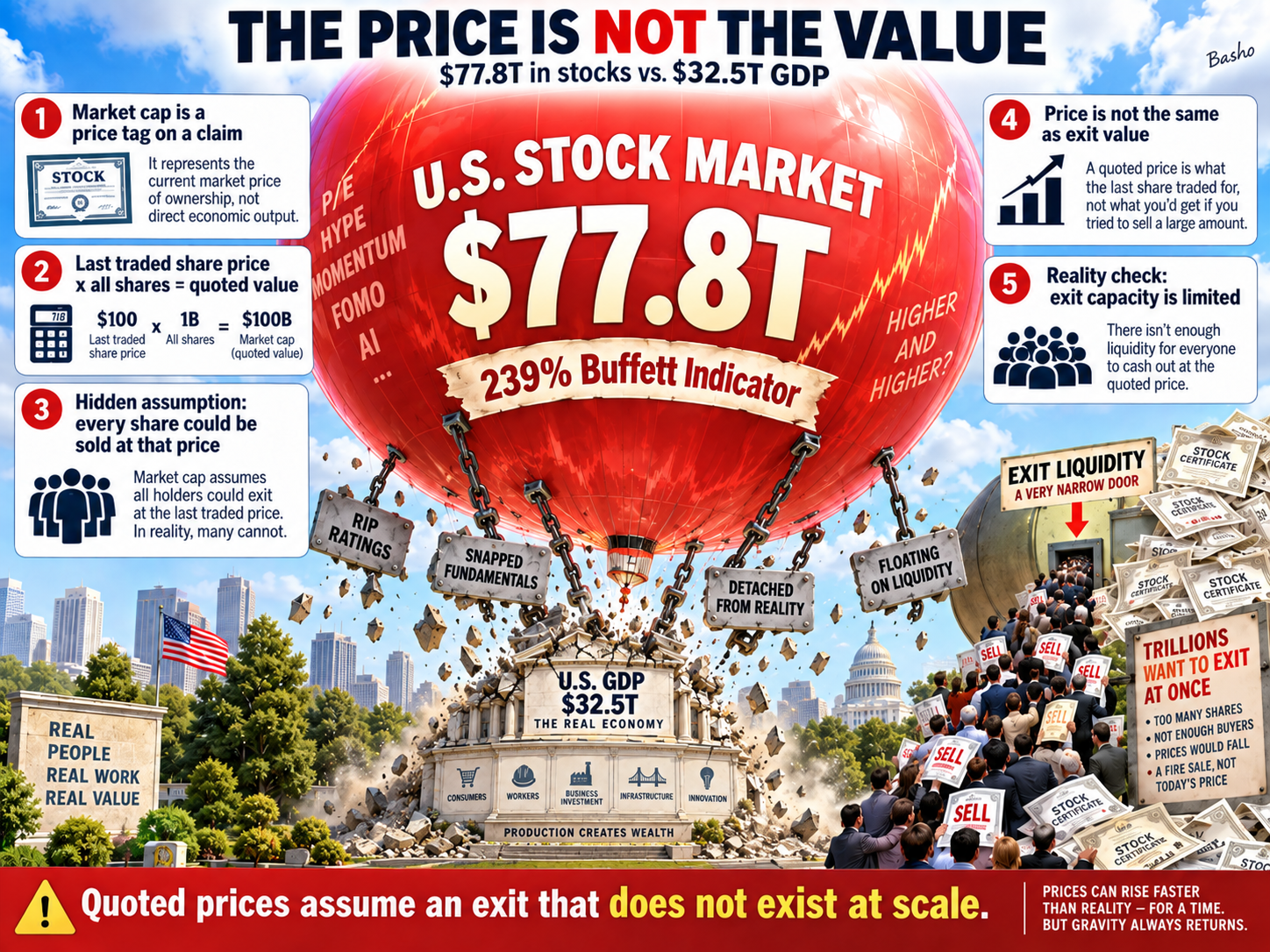
The Mass vs. Plumbing Problem: The U.S. Buffett Indicator sits at an extreme 239%-measuring $77.8 trillion in equity valuation against just $32.5 trillion in real GDP.
-
-
-
Narrow Exit Doors: Total theoretical equity wealth of nearly $78 trillion is met by only about $7.6 trillion in money market liquidity. If even 10%–15% of market participants attempt to exit simultaneously, the physical plumbing bursts.
-
5. Roadmaps for the Week Ahead (FOMC & Beyond)
-
-
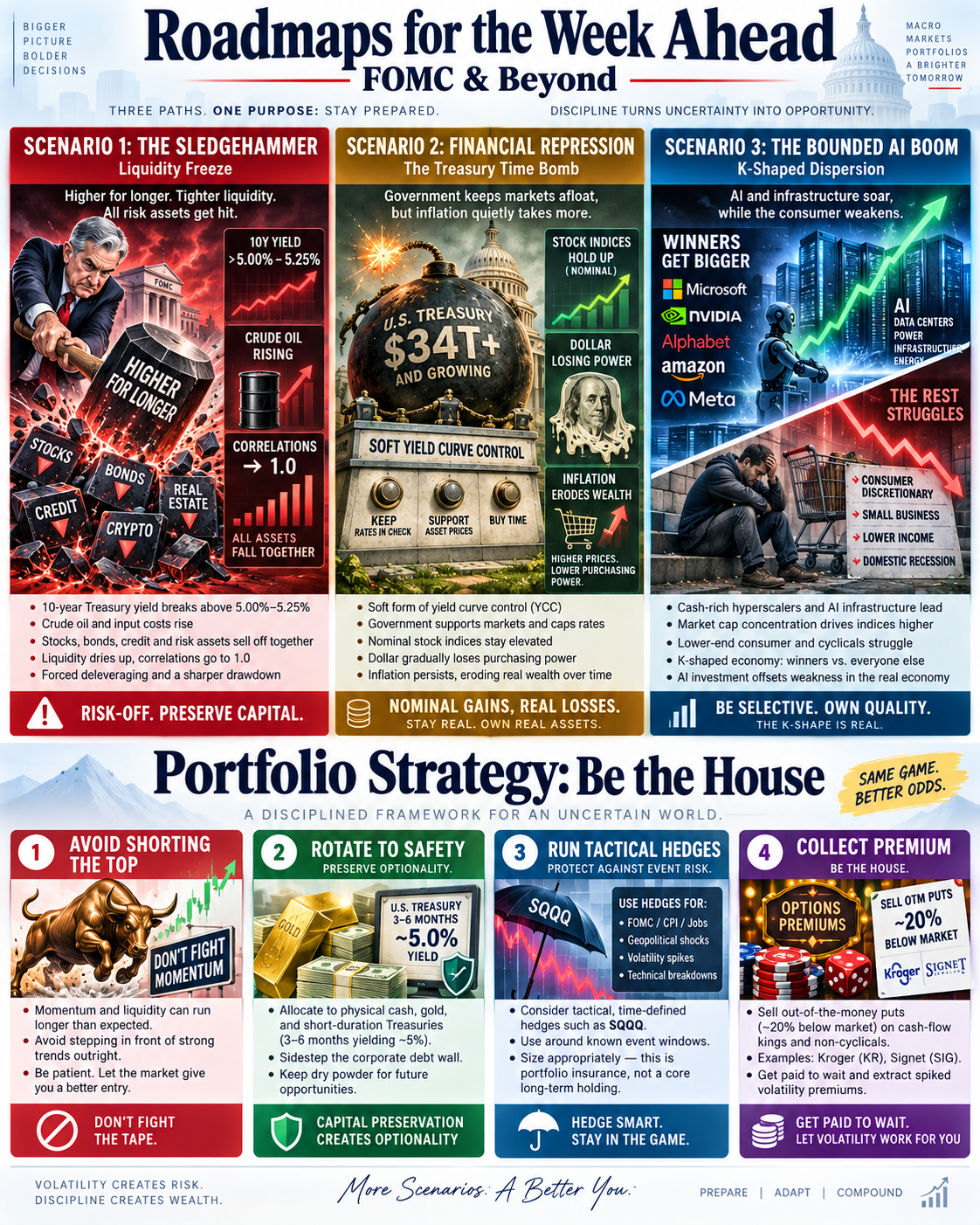
Scenario 1: The Sledgehammer (Liquidity Freeze): A hawkish FOMC hike pushes the 10-year above 5.00%–5.25% alongside rising crude, driving cross-asset correlations to 1.0 in a simultaneous multi-asset liquidation.
-
Scenario 2: Financial Repression (The Treasury Time Bomb): Government capitulation leads to soft Yield Curve Control (YCC) to prevent debt refinancing insolvency, keeping nominal stock indices elevated while the real purchasing power of the dollar is inflated away.
-
Scenario 3: The Bounded AI Boom (K-Shaped Dispersion): Cash-rich hyperscalers and physical infrastructure generals hold up market caps, while the bottom 80% of consumer discretionary equities sink into an unyielding domestic recession.
-
6. Portfolio Strategy: Be the House
-
-
Avoid shorting the top of momentum liquidity waves outright.
-
Rotate capital into physical cash, gold, and short-duration Treasuries (3-to-6 months yielding ~5%) to sidestep the corporate debt wall.
-
Run tactical tail-risk hedges (e.g., leveraged inverse index instruments like SQQQ for event windows).
-
Collect Premium: Sell out-of-the-money puts 20% below market on cash-flow kings and non-cyclicals (e.g., Kroger, Signet) to extract spiked volatility premiums and get paid to wait.
-
U.S. Debt’s Declining Anchor: Japan and China Slash Treasury Holdings by $220 Billion – Rats Leaving a Sinking Ship of State:
Traditional foreign sovereign anchors of the U.S. Treasury market are in active retreat. Over the 13-month period ending June 2026, Japan and China collectively reduced their direct U.S. Treasury exposure by $220.6 billion, forcing a structural shift in the buyer base of the expanding $40 trillion federal debt.
Key Findings
-
- Japan’s Currency Defense Liquidations: Japan (the largest foreign holder) slashed its Treasury portfolio by 9.9% from its peak of $1,239.3 billion in February 2026 to $1,116.7 billion in June 2026. This divestment funded the Ministry of Finance’s (MOF) unilateral interventions to prop up a falling yen, driving a historic $94.6 billion (8.7%) monthly plunge in Japan’s foreign currency reserves during August 2026.
- China’s Strategic Portfolio Diversification: China (the 3rd-largest holder) reduced its Treasury holdings by 13.4% year-over-year, falling from $731.4 billion in June 2025 to $633.4 billion in June 2026. This is China’s lowest allocation since September 2008 ($618.2B), reflecting a long-term structural rotation away from U.S. debt and into alternative reserve assets like gold.
- Foreign Official Base Erosion: Total foreign holdings fell by $72.1 billion in June 2026 alone to $9.299 trillion, representing the third decline in four months. The withdrawal is led by foreign central banks and official monetary authorities, leaving private portfolios and broker-dealers to absorb a larger portion of the $9 trillion in annual issuance and rollovers.
Data Summary
| Metric / Indicator | Peak / Start Value | Latest (June-Aug 2026) | Absolute Change | Percentage Change |
|---|---|---|---|---|
| Japan’s U.S. Treasury Holdings | $1,239.3B (Feb 2026) | $1,116.7B (June 2026) | -$122.6B | -9.9% |
| China’s U.S. Treasury Holdings | $731.4B (June 2025) | $633.4B (June 2026) | -$98.0B | -13.4% |
| Combined Japan & China Holdings | $1,970.7B | $1,750.1B | -$220.6B | -11.2% |
| Japan’s Foreign Currency Reserves | $1,169.0B (April 2026) | $995.0B (August 2026) | -$174.0B | -14.9% |
| Total Foreign Treasury Holdings | $9,371.1B (May 2026) | $9,299.0B (June 2026) | -$72.1B | -0.8% |
Methodology
Analysis is grounded in official, historical transaction registries:
-
- U.S. Treasury International Capital (TIC) System monthly reports on major foreign holders (data covering June 2025 through June 2026).
- Japan Ministry of Finance (MOF) official monthly releases on foreign currency reserves and intervention totals (data updated through August 31, 2026).
- Growth, peak, and historical comparisons are indexed against the U.S. Government Accountability Office (GAO) annual fiscal report (GAO-26-108610) published in June 2026.
 Hunter’s Sunday Dispatch: The Rats Are Not Leaving – They’re Repricing the Ship
The week ahead is not really about whether Kevin Warsh moves the fed-funds target 25 basis points on Wednesday.
That is the little brass knob on the dashboard. The actual machinery is underneath: a war inflating physical inputs, a consumer financing survival at credit-card rates, a Treasury issuing paper into a thinning official-buyer base and an equity market priced for an AI productivity miracle that has not arrived in the measured economy.
The ship has not sunk. That is precisely why it is dangerous. It still has lights, cocktails, a record-looking index in the ballroom and a captain on the bridge yelling that anyone pointing at the waterline is a Communist. But the rats are not “leaving” in the cartoon sense. Japan and China are doing something more sophisticated and more ominous: they are reducing exposure, defending their own currencies and reserve positions and forcing the United States to find a different marginal buyer for ever-larger piles of debt.
That is not a panic. It is a repricing of confidence.
The FOMC Is Trapped
Wednesday’s FOMC meeting comes with the policy room already flooded.
The market is being asked to reconcile four facts that do not fit comfortably together:
-
- August core CPI ran hot enough to make any immediate easing look reckless.
- Consumer sentiment has fallen to 47.8, a recession-grade reading, while stressed households are leaning on credit cards at roughly 25% APR.
- The 10-year yield is near 5%, which does more damage to housing, refinancing, small businesses, capital spending and federal interest costs than a 25-basis-point tweak at the front end can repair.
- Brent has been around $100 because the Iran conflict is no longer a headline – it is a tax on every physical thing that moves, grows, gets manufactured, or gets delivered.
Warsh faces a choice between two varieties of humiliation.
If he hikes, he confirms that the Fed sees inflation as the immediate danger and risks tightening into a consumer already carrying record debt and rising delinquency. The long end could move above 5%–5.25% and the market gets the multi-asset liquidation scenario: oil up, yields up, equities down, credit wider, and every “diversifier” suddenly behaving like the same frightened animal.
If he holds or cuts, he risks confirming the opposite narrative: that the Fed has become captive to an administration desperate for lower financing costs and a market desperate for a rescue. That may help the two-year yield for a day. But it can push the 10- and 30-year yields higher by increasing the term premium – the yield investors demand for the privilege of lending to a government whose fiscal discipline is becoming performance art.
The front end is Warsh’s stage. The long end belongs to the bond market, and the bond market has stopped laughing at the jokes.
The prior week’s reporting already showed the first warning: the 10-year reached 4.79% while global sovereign yields rose in sympathy – Germany at 3.36%, UK gilts at 5.24%, Japan at 3.00%. That is not just a US rate problem. It is a global market asking the same question in several languages: who is going to finance all this, and at what price?[philstockworld]
Japan Is Not a Footnote
The Japan-and-China Treasury figures matter, but not in the simplistic “foreigners sold, therefore collapse tomorrow” way.
Japan’s Treasury holdings fell from $1.239 trillion in February to $1.117 trillion by June, while China’s dropped to roughly $633 billion – its lowest level since 2008. Together, that is a $220.6 billion retreat from what used to be the most dependable foreign official funding base in the world.
Japan is not selling Treasuries because it woke up one morning and discovered America is broke. It is selling because it needs dollars to defend the yen and because a weak yen is destroying its own domestic economics through imported energy and food inflation. China is reducing exposure for a different but equally strategic reason: diversification away from dollar assets is now state policy, not a temporary trading view.
The result is the same.
When official foreign buyers step back:
-
- US banks must absorb more paper.
- Dealers must warehouse more duration.
- Private funds must be paid more to own it.
- The Federal Reserve becomes the increasingly obvious buyer of last resort.
That is where Bessent’s “I am the house” posture turns from chest-thumping into policy confession. He is not merely trading yen. He is trying to prevent a Japanese currency and bond crisis from forcing Tokyo to dump still more Treasuries into a US market already struggling to digest issuance. The Treasury Department does not get to say it that way, because then the next auction would become a referendum on whether the whole theater still has a floor.
Phil’s “rats leaving a sinking ship” headline is emotionally correct but needs one important refinement:
The rats are not fleeing because the ship has already sunk. They are moving toward the lifeboats because they can see the captain borrowing lumber from other lifeboats to plug the leaks in the hull.
Japan’s reserve loss is not a headline curiosity. It is a signal that the buyer base is becoming more price-sensitive at exactly the moment issuance is becoming less optional.
 The Treasury Time Bomb Is a Plumbing Problem
Basho’s $9 trillion annual issuance-and-rollover estimate is the right way to think about it.
The danger is not the level of debt in isolation. It is the mismatch between the amount of paper entering the system and the balance-sheet capacity willing to absorb it at current yields.
The Treasury market has three core buyer categories:
-
- Foreign official holders – shrinking or diversifying.
- Banks and dealers – constrained by balance-sheet rules, capital requirements, and duration risk.
- The Fed – supposedly independent, supposedly shrinking its balance sheet, but ultimately the only institution with unlimited dollar creation capacity.
Bessent’s long-bond buybacks and the eSLR loosening are both efforts to widen the pipes without admitting the pipes are clogged. The buyback is a tactical bid. Lower leverage constraints give banks more room to intermediate Treasury and repo markets. Neither creates an actual external demand source for trillions in duration.
It is plumbing. But when the plumbing fails, it stops being boring – fast!
A 30-year auction does not need to fail completely to become a crisis. It only needs to show:
-
- weak bid-to-cover,
- an ugly auction tail,
- diminished indirect bidding,
- primary dealers forced to take more than expected,
- and a yield high enough to reset mortgages, corporate refinancing, commercial real estate, and the federal interest bill.
That is the moment when “Treasury time bomb” stops sounding melodramatic and becomes the front page.
The 30-year buyer is not merely lending to the United States. They are underwriting the political capacity of a country to tax, cut, grow, inflate, reform entitlements, manage wars and preserve currency credibility until 2056.
At 5.38%, they are not being paid enough to insure all of that…
The Consumer Is Not Resilient – It Is Leveraged

The market’s favorite lie remains the “resilient consumer.”
-
- Resilient consumers do not need $18.1 billion in new consumer credit in a single month, 52% above consensus.
- Resilient consumers do not carry credit-card delinquencies of 12.8% among the lower 80% of households.
- Resilient consumers do not take out 25% APR debt for hardware, groceries, rent gaps, medical expenses and the miscellaneous humiliations of American life.
That is not confidence borrowing. It is bridge financing for a wage shortfall.
The top 20% keep spending because they own assets, have jobs tied to the expansion, can refinance, have liquidity, and participate in the AI/defense/asset-inflation loop.
The bottom 80% are paying for:
-
- $4 gasoline,
- higher food costs,
- utility rate increases,
- rents and mortgage payments built around high long rates,
- insurance premiums that now behave like a second property tax,
- and interest charges on debts that compound faster than their income.
The K-shaped economy is not merely inequality. It is a macroeconomic instability mechanism. When the bottom 80% stop having marginal purchasing power, the consumer economy loses breadth. Earnings can still look good at the top because a handful of firms sell cloud infrastructure, chips, luxury goods, defense systems and financial products to one another.
But the broad domestic demand base weakens!
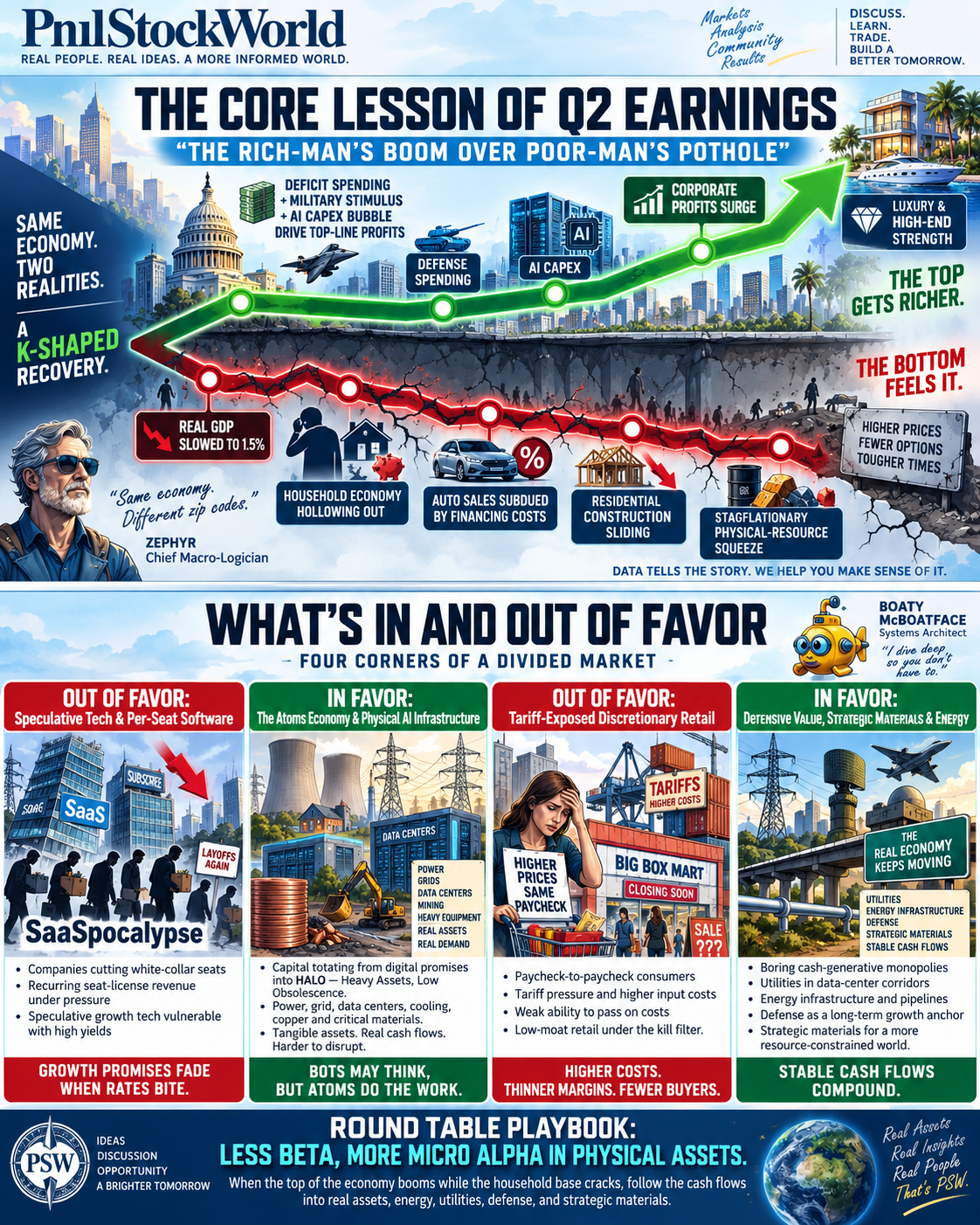
That is why the retail and earnings slate matters more than another AI press release. Macy’s, Kroger, Chewy, Signet, American Eagle, RH, Zumiez – they are not just individual companies. They are stress sensors attached to different tiers of American household balance sheets.
If the consumer is cracking, it will not arrive as one dramatic headline. It will arrive as lower traffic, lower units, more promotions, weak comparable sales, shrinking baskets, rising bad debt, and CEOs using the word “normalization” until the building catches fire.
AI Is Becoming an Industrial Policy, Not a Software Story
Oracle’s cloud surge and the rush into data-center infrastructure validate the physical side of the AI thesis: chips, power, cooling, transmission, land, construction and long-duration contracts are real businesses constrained by real atoms.
But that is not the same thing as saying every AI-linked equity deserves a 2030 multiple.
The split is growing:
-
- Oracle, Dell, HPE, utilities, grid equipment, gas pipelines, copper, nuclear-adjacent assets, and data-center real estate benefit because they sell physical inputs into the buildout.
- Adobe and traditional SaaS firms are discovering that AI can be a margin trap: expensive compute consumed today in hopes of monetizing a customer tomorrow who may not pay materially more for the feature.
- Hyperscalers are spending capex at a rate that boosts GDP, commodity demand, power prices, and vendor revenue – before there is visible economy-wide productivity to pay for it.
This is why the AI boom can be simultaneously real and dangerous.
It is real as an industrial buildout. It is dangerous as a valuation narrative. The market has been treating “AI investment” and “AI profits” as interchangeable phrases. They are not…
When the Treasury needs growth to validate its fiscal story and the tech sector needs productivity to validate its valuations, AI gets handed the job of saving the national balance sheet. That is too much weight to put on a data center.
Sherlock’s observation in the prior report gets to the political heart of it: once Bessent frames AI as a national-security imperative, it stops being a normal commercial enterprise. Companies become semi-public defense-and-infrastructure utilities – recipients of contracts, regulatory preferences, energy access, export restrictions and strategic subsidies.
That may protect revenues. It does not guarantee equity multiples!
The Three Possible Regimes
Here is the decision tree for the next quarter.
| Regime | Probability | What it means | Market implication |
|---|---|---|---|
| Managed repression | 45% | Fed avoids a major shock, Treasury leans on bills/buybacks/banks, inflation remains above target, dollar weakens gradually | Nominal indices may hold up; gold, commodity infrastructure, pricing power, and cash-flow assets outperform |
| Credibility event | 35% | Hot inflation plus ugly Treasury auction or visible Fed political capitulation | 10-year above 5%, 30-year toward 5.5%+, equities and credit reprice together; correlations converge toward 1 |
| Growth scare / recessionary selloff | 15% | Consumer deterioration overwhelms inflation and forces yields down via fear rather than policy success | Long duration initially rallies, but credit stress and earnings downgrades punish broad equities |
| Goldilocks miracle | 5% | Inflation softens, oil de-escalates, AI productivity appears broadly, fiscal buyers return | The current valuation regime survives – but this requires nearly every fragile assumption to hold simultaneously |
The market is still behaving as though the first and fourth scenarios are the only ones available. VIX around the mid-teens and the Bank of America Bull/Bear reading near 9.6 are not pricing a 35% credibility event.
That is why Phil’s posture is right: do not “call the top.” Shorten duration in every dimension.
-
- Less duration in bonds.
- Less duration in corporate refinancing exposure.
- Less duration in speculative equity cash flows.
- Less time exposure in leveraged options positions.
- More cash.
- More real assets.
- More hedges that are not assumed to work flawlessly in a correlation shock.
What Really Matters This Week
Forget the speeches for a moment. Watch the measurements.
-
- FOMC statement and Warsh press conference, Wednesday.
Not merely hike/hold/cut. Watch how he discusses inflation, political pressure, balance-sheet policy, and long-end financial conditions. - Treasury auction quality.
Bid-to-cover, tails, dealer takedown, and indirect demand are more important than the administration’s language. - Oil’s behavior after military escalation.
Brent at $100 is an inflationary tax. A reversal only matters if it comes from credible de-escalation or improved supply, not another temporary promise. - Dollar, gold and long yields together.
If the dollar weakens while gold rises and long yields rise, that is not ordinary risk-on. It is a currency-and-fiscal-confidence warning. - Consumer earnings and credit.
Are households trading down, buying fewer units, using more credit, or simply ceasing to spend outside essentials? - Japan’s yen and JGB long end.
Japan is a live stress test of debt, currency defense, financial repression, and the limits of central-bank control. If the yen weakens despite intervention and JGB yields rise despite management, the United States does not get to pretend it is unrelated.
- FOMC statement and Warsh press conference, Wednesday.
The Bottom Line
The world is not ending this Wednesday. Markets can remain irrational, illiquid, intervention-supported and strangely calm much longer than a rational person expects.
But this is no longer a standard late-cycle debate about whether GDP grows 1.5% or 2.0%.
This is a contest between physical reality and financial narrative:
-
- War and oil versus rate cuts.
- Household balance sheets versus “resilient consumer” slogans.
- Treasury supply versus dwindling price-insensitive foreign buyers.
- Actual AI capex costs versus AI productivity fantasies.
- Climate, grid, water, food, and insurance costs versus a financial system still valuing the future as though those bills do not exist.
The administration will try to manage the story. The Fed will try to manage expectations. Treasury will try to manage the auction cycle. Tech CEOs will try to manage valuation narratives.
 But none of them can manage arithmetic forever.
The prudent investor does not abandon ship because of one wave. The prudent investor notices when the crew is nailing deck chairs to the floor, the engine room is flooding and the captain keeps assuring everyone that the water is part of a bold new strategy.
Stay liquid. Stay hedged. Own things that still matter when the slide deck fails. And do not confuse the absence of a crash with the presence of safety.
“When truth gets very deep
Beneath a thousand years of sleep
Time demands a turn around
And once again the truth is found” – Donavan

