


What should an Exclusive trading content platform deliver beyond a steady stream of alerts? If market commentary is pulling you in five directions, or a trade idea leaves you unsure about the reasoning or risk, more information may not help. Better context can.
Look past bold claims and ask whether a membership helps you make your own decisions. This guide explains how to compare platforms by research quality, risk context, education, and member access, so you can decide what fits your trading habits before subscribing.
Commentary, charts, webinars, and community features serve different needs. As you compare them, check whether trade ideas include a rationale, relevant risks, and conditions that could change the view. We’ll also clarify the difference between a content and education membership, such as Phil Stock World, and a brokerage or asset management service. The aim isn’t to find a magic signal. It’s to find resources you can use alongside your own research and risk discipline.
Key Takeaways
- Separate research and education memberships from brokerages, asset managers, and financial advisers so you know what a subscription provides.
- Check whether analysis explains its thesis, assumptions, time horizon, and what could invalidate it, rather than relying on alerts without context.
- Compare an Exclusive trading content platform by research depth, update cadence, interaction, education, and access format. Look for evidence behind its claims.
- Weigh membership cost against how often you’ll use the material. Paid content can’t guarantee profitable decisions or outcomes.
- Consider whether Phil Stock World’s commentary, trade ideas, charts, sector insights, discussion, webinars, and virtual portfolio reviews fit your research habits.
What Should an Exclusive Trading Content Platform Actually Deliver?
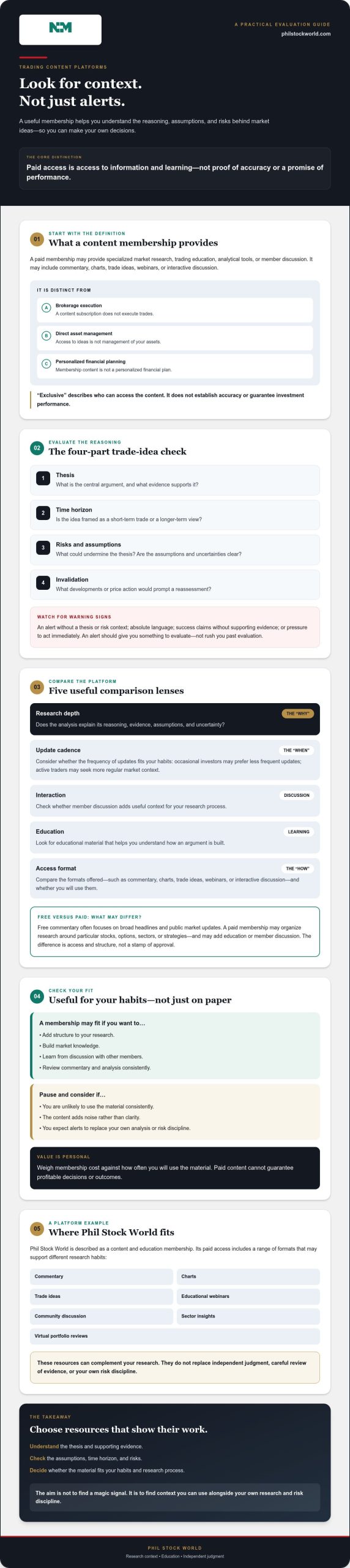
Featured-snippet definition: An Exclusive trading content platform is a paid membership that gives users access to specialized market research, trading education, analytical tools, or member discussion. It provides information and learning resources, not brokerage execution, direct asset management, or personalized financial planning.
That distinction matters. A subscription may include market commentary, charts, trade ideas, webinars, or interactive discussion, but access to these features doesn’t prove that the analysis is accurate or suited to your circumstances. Useful research explains its reasoning and acknowledges uncertainty. A ticker or alert without a thesis, assumptions, or risk context is a reason to investigate, not a shortcut to a decision.
Good platform content can also help you understand how an argument is built. Financial analysis, for example, examines factors such as profitability, solvency, and liquidity. A platform may present analysis in different formats, but you still need to assess the evidence and decide whether it supports your own conclusions.
How is an exclusive trading platform different from free market commentary?
Free commentary often focuses on broad headlines and public market updates. A paid membership may organize research around particular stocks, options, sectors, or strategies, and may add educational material or member discussions. The difference is the type of access and structure, not a stamp of approval. “Exclusive” describes who can access the content. It doesn’t establish accuracy or promise investment performance.
Treat paid commentary as one input among several. Check its underlying claims, compare them with other reliable information, and decide whether the reasoning fits your approach. A useful membership supports independent judgment rather than asking you to follow an alert on faith.
Which types of trader may benefit from membership content?
Membership content may suit readers who want more structure in their research, are building market knowledge, or value discussion with other members. For instance, Phil Stock World offers paid access to commentary, charts, trade ideas, educational webinars, and community discussion. These formats can support different research habits, but they don’t replace your own analysis.
How to Evaluate Research, Alerts, and Education Before You Subscribe
A polished chart or fast-moving alert can look convincing at first glance. The real test is whether the material shows its work. Before paying for an Exclusive trading content platform, review sample analysis and ask whether you can follow the reasoning, identify the assumptions, and understand what might change the conclusion.
- Thesis: What’s the central argument, and what evidence supports it?
- Time horizon: Is the idea framed for a short-term trade or a longer-term view?
- Risks: What could undermine the thesis, and are those risks made clear?
- Invalidation: What developments or price action would prompt a reassessment?
These questions help you judge whether analysis is useful to your process, rather than simply persuasive in the moment. For a broader due diligence mindset, FINRA’s guidance on vetting an investment professional offers questions to consider when researching financial providers. Content memberships aren’t the same as professional advice, but careful questions still matter.
What makes a trade alert informative rather than promotional?
An informative alert explains why an idea is being discussed, the conditions behind it, and the risks that could change the view. Check whether examples clearly distinguish hypothetical analysis from current or completed positions. Be cautious of absolute language, success claims without supporting evidence, or pressure to act immediately. An alert should give you something to evaluate, not rush you past evaluation.
Look for follow-up context, too. Does the provider explain how its view changes as new information arrives, or is the alert presented without meaningful updates? A list of features is easy to publish. The clarity and consistency of the analysis take closer review.
How can educational resources strengthen research value?
Webinars and strategy guides are most useful when they explain concepts and decision-making, rather than simply repeat trade calls. Charts should come with interpretation: what the indicators show, what they leave out, and how the chosen time frame affects the picture. To build your chart-reading skills, see this guide on how to read market charts.
Match the access format to the time you can realistically commit. Daily commentary may suit someone who regularly follows markets; webinars or discussion may be more useful if you learn through explanation and interaction. Check current membership access terms before subscribing. If charts are central to your research routine, you can explore Phil Stock World’s market charts and analysis as part of your comparison.
Compare Trading Platforms by Features, Access, and Transparency
Once you know what kind of research you need, compare the actual membership experience, not just the feature list. Ask the same questions about each Exclusive trading content platform, then separate what the provider says it offers from what you can verify in sample content, published explanations, and membership terms.
| Comparison area | What to check | Evidence to look for |
|---|---|---|
| Research depth | Does material explain the thesis, relevant assumptions, and risks? | Review sample analysis for clear reasoning, not just conclusions or trade ideas. |
| Update cadence | Is content periodic, daily, or tied to interactive sessions? | Check published access terms and examples of how analysis is updated. |
| Interaction | Are discussion forums or live sessions included? | Confirm what members can participate in and how access varies by membership. |
| Education | Are webinars, guides, or other learning resources available? | Look for explanations that build understanding beyond a particular trade idea. |
| Access format | How is material delivered, and can you use it with your routine? | Confirm current formats and terms directly with the provider. |
A feature claim and proof of quality aren’t the same thing. “Daily research” describes cadence; it doesn’t show whether the analysis is well supported. Inspect examples for transparent reasoning, consistent risk discussion, and enough context to understand how an argument develops. Treat performance claims carefully, and look for clear explanations of what’s being measured and over what period.
Which membership features matter most for different research habits?
Daily commentary can suit readers who want regular market context without constant interaction. Real-time sessions may appeal to members who value discussion and timely analysis, but faster access doesn’t imply better decisions or outcomes. Phil Stock World membership options span daily commentary to real-time interactive sessions. Check current access terms to see what each option includes. Charts, sector insights, and alerts can complement your research, but none should be treated as a standalone signal. For adjacent context, compare how paid stock picking services differ in their approach and member access.
How should you judge community access and responsiveness?
Before subscribing, find out what discussion forums and interactive sessions involve. Consider whether members can ask questions and take part in evidence-based debate, including respectful disagreement. Community access can add perspective, but it isn’t individualized financial advice, portfolio management, or a guarantee of a response. Choose a format you’ll realistically use, then verify the details rather than assuming every membership includes the same level of participation. If your focus is on decentralized markets and educational discussions, you can discover Moonstream Finance to see how dedicated crypto trading communities approach peer learning.
Is a Paid Trading Content Platform Worth It for Your Situation?
Paid research can’t guarantee profitable decisions or trading outcomes. Markets remain uncertain, and a membership can’t remove the possibility of loss. Its potential value is practical: organized analysis, educational resources, charts, or discussion may help you research more consistently, provided you use them thoughtfully.
There are trade-offs. A recurring subscription adds an ongoing expense, and a steady stream of commentary can create information overload if you don’t have time to assess it. Alerts may also tempt you to act before doing your own research. A membership is more likely to fit if it fills a specific gap in your routine, rather than adding noise to an already crowded feed.
What are the benefits and limitations of paid trading research?
An Exclusive trading content platform may bring analysis, education, and member discussion together in one place. That organization can be useful if you regularly review the material and learn how its reasoning applies to your process. But access isn’t the same as value. Unused features still contribute to the subscription expense, and over-reliance on alerts can weaken independent judgment. No content service eliminates market uncertainty or investment losses.
Keep your own research and risk limits in the driver’s seat. Use member content to generate questions or explore an argument, then decide independently whether the evidence supports your view and whether the idea fits your risk tolerance.
How can you check whether a membership fits your needs?
Before committing, write down what you want the service to help you do. Then compare its current features and terms with your actual habits, not an idealized version of your schedule.
- Name the gap: Do you need clearer market context, educational material, charts, or a place for discussion?
- Check the details: Confirm current membership features, access terms, and subscription price directly with the provider.
- Estimate real use: Which resources will you review, and how often can you realistically engage with them?
- Compare alternatives: Consider whether the membership adds something useful beyond your existing research routine or a self-directed approach.
- Keep your boundaries: Decide how you’ll verify ideas and apply your own risk limits before acting on any commentary.
If you can’t identify a clear research or learning need, or don’t have time to use the resources, the fit may be poor. If you’ve identified a specific gap, explore Phil Stock World’s Premium Membership and verify its current access details before deciding whether it suits your routine.
How Phil Stock World Membership Fits an Informed Platform Search
Phil Stock World offers a useful case study for comparing an Exclusive trading content platform against the criteria that matter to you. Its paid membership includes stock and options commentary, trade ideas, market charts and analysis, sector insights, and member discussion. The business also offers educational webinars and virtual portfolio reviews, giving readers different ways to engage with market information and learning resources.
Access varies across membership tiers, from daily commentary to real-time interactive sessions. Those formats suit different routines: one member may want regular written context, while another may value opportunities to participate in discussion. Neither format is a shortcut to a trading decision. Access to commentary or portfolio review also shouldn’t be confused with brokerage services, direct asset management, or personalized financial planning.
What can readers review before choosing a Phil Stock World membership?
Start with the current tier descriptions. Confirm which commentary, analysis, charts, discussion, and sessions are included, and check whether the format fits the time you can realistically spend reviewing material. Access terms can change, so verify current details directly rather than relying on old comparisons or assumptions about what a tier includes.
The Phil Stock World membership guide offers additional membership context. As you review it, consider whether the mix of commentary, education, charts, and discussion supports your research process. For example, a reader who learns best through explanation may place more weight on webinars, while someone who regularly studies market data may value charts and analysis. The right emphasis depends on your needs, not the length of the feature list.
What are sensible next steps before joining a trading platform?
Make the decision concrete. Write down your research goals and the features you’re most likely to use. Then compare those needs with current membership terms, including the access format and subscription price, which you should check directly before subscribing.
- Identify your gap: Decide whether you’re looking for market context, educational resources, charts, or discussion.
- Check practical fit: Consider how often you’ll review the material and whether it complements your existing research routine.
- Keep expectations grounded: Membership content can inform your research, but it can’t ensure profitable decisions or remove market risk.
If the features match a clear need, explore Phil Stock World membership options and review the current terms before choosing an access level. Let fit, not urgency, make the call.
Choose a Membership That Supports Your Research Process
The right Exclusive trading content platform isn’t the one with the loudest alerts or longest feature list. Look for analysis that explains its reasoning and risks, then compare the education, updates, and member access with the time you can realistically commit. Paid content can inform your decisions, but it can’t guarantee outcomes or replace your own research and risk discipline.
Phil Stock World, founded in 2006 and led by veteran trader and market analyst Phil Davis, offers membership access to market commentary, educational resources, charts, and community discussion. Check the current membership options and access terms to see whether those resources align with your goals and habits.
Explore Phil Stock World membership options and make your next move with clear expectations. A thoughtful comparison is a strong first step toward more informed independent research.
Frequently Asked Questions
What is an exclusive trading content platform?
An exclusive trading content platform is a paid membership that provides access to specialized market research, trading education, charts, trade ideas, or member discussion. It sells information and learning resources, not necessarily the ability to place trades. Unlike a brokerage, it doesn’t execute orders; unlike an asset manager, it doesn’t manage investments for you. Treat its content as research input, and assess the reasoning and risks for yourself.
How do I choose a trading content platform?
Choose by matching the service to your research habits, not by counting features. Review sample analysis to see whether it explains its thesis, assumptions, time horizon, and risks. Compare update frequency, educational resources, interaction, and access format, then confirm current membership terms and pricing directly. The right Exclusive trading content platform should address a specific need without asking you to rely on alerts or promotional claims instead of independent judgment.
Are paid trading alerts worth it?
Paid trading alerts may be useful if they provide clear reasoning, relevant risks, and conditions that could change the idea. A ticker or action without context offers little help in evaluating whether it fits your research or risk limits. Before subscribing, review examples and consider how often you’ll use them. Alerts don’t guarantee good decisions or outcomes, and they shouldn’t replace your own analysis.
Can a trading platform guarantee profitable trades?
No. A trading content platform can’t guarantee profitable trades or prevent losses. Markets are uncertain, and an analysis or alert can be wrong even when its reasoning is explained clearly. Be wary of claims that present profits as certain or pressure you to act without evaluating the risks. Use platform material as one research input, and make decisions according to your own analysis and risk tolerance.
How much does an exclusive trading content platform cost?
Costs vary by provider, membership tier, and the access included. A plan with commentary may differ from one that includes interactive sessions or additional research. Check the provider’s current pricing and terms directly, including what features are included and whether subscription conditions suit your needs. Don’t pay for access you’re unlikely to use, and remember that a higher-priced membership doesn’t guarantee better analysis or trading results.
What is the difference between a trading newsletter and a live trading room?
A trading newsletter generally delivers market commentary or research in written form, often on a scheduled basis. A live trading room centers on real-time sessions or interaction, though exactly what members can access varies by provider. The key difference is format and cadence, not necessarily research quality or outcomes. Check whether sessions include discussion, analysis, or alerts, and choose the format that fits your schedule and learning style.
Does a trading content membership provide personalized financial advice?
Not necessarily. A content membership typically provides general research, education, commentary, or community discussion, rather than personalized financial planning or direct asset management. Phil Stock World offers educational webinars and virtual portfolio reviews, but these shouldn’t be assumed to be personalized financial planning. Review the provider’s descriptions and terms so you understand what a membership includes, and make investment decisions using your own judgment and risk limits.

