



Rolling can give you more time to keep your shares, but it does not eliminate assignment risk. Rolling covered calls to avoid stock assignment means buying back the current call and selling a replacement with a different strike, a later expiration, or both. To remove the assignment obligation on the current call, close it before it is assigned.
As expiration approaches and your call moves in the money, it is natural to focus on whether your shares could be called away. Compare the cost of closing the option with the terms of the replacement call instead of chasing extra time or a tempting credit. This guide explains how rolling works, why assignment risk can rise near expiration, and what changes when you roll up, out, or both, so you can make a more deliberate decision about the shares and the trade.
Key Takeaways
- A roll closes your current short call and opens a replacement, giving you a chance to change its strike, expiration, or both.
- As expiration approaches, an in-the-money call with little remaining time value can put your shares at greater risk of being called away.
- Compare the cost to close with the replacement call’s strike, expiration, and premium before deciding whether a roll fits your goal of keeping the shares.
- Rolling can postpone assignment, but repeated rolls may add losses; understand the trade’s changing risk and potential outcome before extending it.
What Does “Rolling” a Covered Call Mean?
Rolling means closing an existing short call and opening another with a changed strike, expiration, or both. For an investor holding 100 shares, that adjustment can change the potential sale price and give the stock more time.
Adjusting the Strike and Expiration
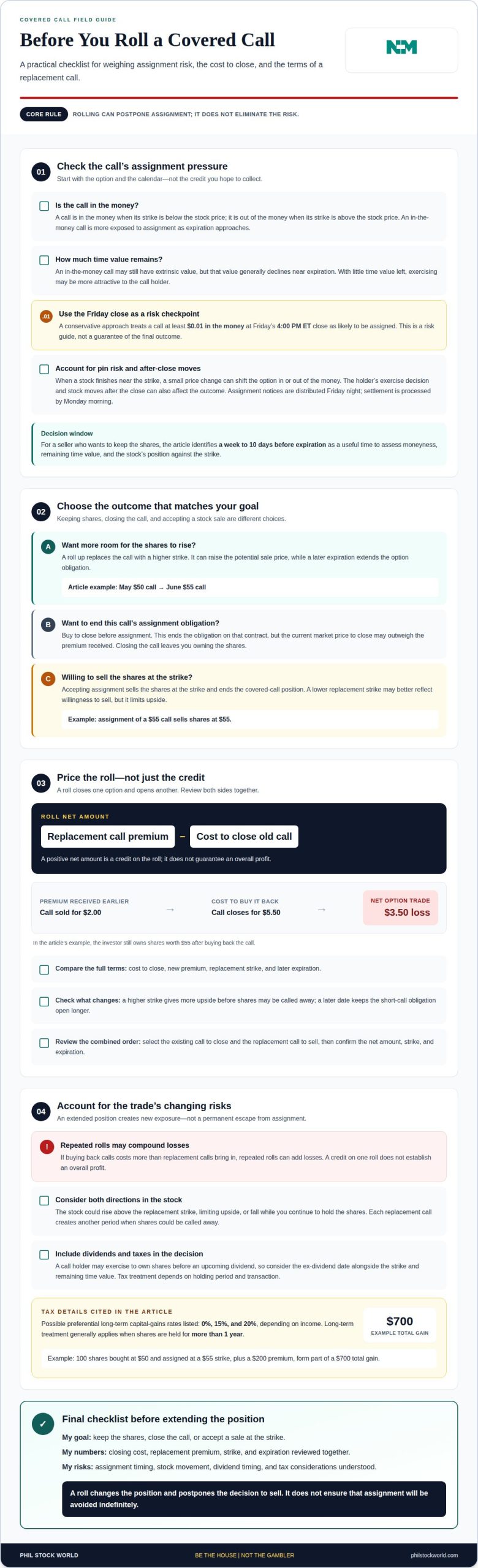
Rolling up means replacing a call with one at a higher strike price, often with a later expiration. For example, a May $50 call can be replaced by a June $55 call. The higher strike gives the shares more upside before they can be called away, while the later date extends the option obligation. A roll can also move only the expiration, keeping the same strike.
Closing the Call to Retain Shares
Buying to close means purchasing the short call before expiration, ending that contract’s assignment obligation. It’s the sure way to avoid assignment on that call, but the cost can outweigh the premium received. For example, buying back a call for $5.50 after receiving $2.00 creates a $3.50 net loss on the option trade. The investor still owns shares worth $55 in that example.
Changing a Position as Objectives Shift
A roll can reshape a covered call when an investor’s forecast or goal changes. If a trader holding 100 shares wants more room for a rising stock, moving a May $50 call to a June $55 call raises the possible sale price and extends the position. If keeping the shares is no longer the priority, a lower strike may better reflect a willingness to sell, though it limits upside.
Roll Costs and Brokerage Steps
A roll’s net amount is the replacement call’s premium minus the cost of closing the old call. In your brokerage account, select the existing call to close and a replacement call to sell, then review the combined order and net amount before submitting it. Check the new strike and expiration carefully.
Assignment risk near expiration
Assignment risk depends on the call’s moneyness, remaining time value, and how close it is to expiration. As expiration approaches, these factors can make the outcome less predictable for a covered-call seller.
Moneyness at Expiration
An in-the-money call has a strike below the stock price; an out-of-the-money call has a strike above it. That distinction matters because an in-the-money call is more exposed to assignment as expiration arrives. A conservative approach treats a call at least $0.01 in the money at Friday’s 4:00 PM ET close as likely to be assigned.
Time value adds another consideration. An in-the-money call may still have extrinsic value, but that value generally declines as expiration gets closer. When little time value remains, exercising may be more attractive to the call holder.
Expiration Timing and Pin Risk
Pin risk describes uncertainty when the stock finishes near a call’s strike at expiration. A small price move can change whether the option is in or out of the money, while a holder’s exercise decision can affect the final outcome. For a $50 call, a stock ending just above $50 differs materially from one ending just below it.
Friday timing matters. Exercise timing can affect the outcome after the market closes. The stock price at the close may therefore not tell the whole story if it moves afterward. Expiring-call assignment notices are distributed Friday night, with settlement processed by Monday morning.
For a seller who wants to keep the shares, a week to 10 days before expiration is a useful decision window. At that point, whether the call is in or out of the money helps frame the next move. An active strategy weighs remaining time value and the stock’s position against the strike, rather than treating premium income as the only purpose.
How to Avoid Assignments in Covered Calls?
Keeping shares, closing a call, and accepting a stock sale are separate choices. Rolling changes the option position, but it does not remove the trade’s risks or tax considerations.
Assignment and Stock Exit Choices
Rolling extends or changes the option position; buying back the call closes it, while assignment sells shares at the strike. Choose based on whether retaining the stock or completing the sale better fits your objective. For example, if a $55 call is assigned, you sell shares at $55. Closing instead keeps the shares but costs the call’s current market price.
A later expiration gives the stock more time to move, but keeps a short call open for longer. Accepting assignment ends the covered-call position and may realize a gain on the stock. Buying back the call removes its assignment obligation, but the cost may reduce or erase the premium you received.
Risks of Rolling Instead of Accepting Assignment
Repeated rolls can compound losses if buying back calls costs more than the replacement calls bring in. Each new call also creates another period when your shares could be called away. The stock could rise above the replacement strike, limiting your upside, or fall while you continue to hold the shares. A credit on the roll does not guarantee an overall profit.
Evaluate the closing cost, new premium, replacement strike, and later expiration together. If the stock price changes, the replacement call’s value can change too. Rolling postpones the decision to sell; it does not ensure that you avoid assignment indefinitely.
Tax treatment depends on the stock’s holding period and the transaction. The Internal Revenue Service lists 0%, 15%, and 20% as possible preferential long-term capital-gains tax rates, depending on income. Long-term treatment generally applies when shares are held for more than 1 year. In a covered-call example, a $200 premium forms part of a $700 total gain when 100 shares bought at $50 are assigned at a $55 strike.
Rolling can delay a taxable stock sale that assignment might trigger, but it doesn’t make tax considerations disappear. Dividend timing can affect assignment decisions because a call holder may exercise to own shares before an upcoming dividend. Consider the ex-dividend date alongside the strike and remaining time value.
Rolling to avoid assignment
Rolling can postpone the sale of shares when a short call is in the money, but it replaces one obligation with another. The practical goal is to find terms that better fit your outlook for the stock, not simply to collect another premium.
Consider a stock trading at $92 with a short $90 call near expiration. If you roll that option to a later date at a higher strike price, you pay to close the old contract and open a new one. But the new call still carries assignment risk through its later expiration.
The credit is only one part of the position. Compare the buyback cost with the new premium, then consider whether the replacement strike matches the price at which you would actually sell the stock. If the new strike is close to the current price, the roll may leave little room for further upside. A later expiration also keeps your shares committed for longer, which matters if your reason for holding them changes.
Assess the entire roll as a single options transaction. Review the bid-ask spread, net debit or credit, new strike, and additional time. A credit can offset some of the closing cost, but it does not eliminate the possibility of limited upside or future assignment. Rolling covered calls to avoid stock assignment is a trade-off, not a guarantee that the shares will stay in your account.
Use a roll when its new terms suit your position better than selling shares at the current strike. If retaining the stock is no longer the priority, accepting assignment can be the cleaner outcome. For more perspective on options trading and market setups, explore covered-call analysis.
Phil Stock World
Phil Stock World offers market commentary and educational resources for investors considering a covered-call roll instead of assignment. Market Charts and Analysis can help you put the strike, expiration, and changing outlook for the stock in context. Educational Webinars cover trading strategies, and a Virtual Portfolio Review lets you examine portfolio positions. Premium Membership provides access to member content and market insights.
These resources support learning and analysis; they do not place trades or manage assets for you. Use them to build a clearer framework for evaluating a roll, its potential credit or debit, and the continuing assignment risk. If you want ongoing market commentary and trading ideas, consider whether Premium Membership fits your learning needs.
Contact Phil Stock World to learn more.
Make Your Next Call Fit Your Plan
Before opening another call, decide what role the shares play in your portfolio. If you would welcome selling them at a particular price, assignment may fit your plan. If keeping them matters more, make that priority clear when choosing a strike and deciding whether a future roll still makes sense.
That clarity can keep a short-term options decision from quietly shaping a longer-term investment. Write down what would change your outlook, which trade-offs you are willing to accept, and what would make you stop extending the position. Then assess each potential roll against those criteria instead of treating a credit as the whole story. A thoughtful approach to rolling covered calls to avoid stock assignment starts with knowing which outcome you want.
For more perspective as you develop your approach, connect with Phil Stock World. Keep refining your process, and let your next options decision reflect the investor you intend to be.
Frequently Asked Questions
What Does “Getting Assigned” Actually Mean?
Assignment occurs when the call holder exercises the option, requiring the covered-call seller to sell shares at the strike price. For a covered call, assignment fulfills the seller’s obligation rather than creating a new short-stock position. The holder may exercise before expiration, so assignment is not limited to the final day.
What Happens When You Get Assigned on a Covered Call?
When assignment occurs, the shares are sold at the call’s strike price, and the short call is removed from the account. The proceeds from the stock sale depend on the strike and the number of shares delivered; the premium received remains part of the trade’s result. If you planned to keep the stock, assignment changes your position and may affect your next investment decision.
What’s The Best Strike Price to Avoid Assignment?
There’s no single strike that eliminates assignment risk while preserving attractive premium. A call farther out of the money gives the stock more room to rise before reaching the strike, though its premium may be smaller. Traders focused on retaining shares often consider calls around .20-.30 delta. Treat delta as a selection input, not a promise about the eventual outcome.
How does rolling a covered call work?
Rolling combines closing the existing short call with opening a replacement call. In the order ticket, the first leg is a buy to close, and the second is a sell to open. Before submitting the order, review the combined net debit or credit and how the replacement’s strike and expiration change your position. The shares remain in your account unless they are separately sold or assigned.
When should you roll a covered call to avoid assignment?
Consider rolling when you want to keep the shares but the existing call’s strike no longer fits your plan. For example, if your outlook turns more bullish while the stock is near the strike, a later call with a higher strike may leave more room for gains. Weigh that potential benefit against the buyback cost and the replacement call’s assignment risk.
How do you roll a covered call up and out?
Buy to close the current call, then sell a call with both a higher strike and a later expiration. For example, moving from a May $50 call to a June $55 call raises the possible sale price and extends the position. Check the combined order’s net debit or credit, and remember the replacement call can still be assigned.