


Option premiums are payment for taking on risk, not a dependable paycheck. To understand how to use options for income, start with two strategies: sell a cash-secured put if you’re willing to buy shares at the strike price, or sell a covered call on shares you already own. A standard stock option contract represents 100 shares, so each trade can carry a meaningful obligation.
The appeal of using options for income is clear: you collect a premium up front, and time decay can reduce an option’s value as expiration approaches. But a market move can turn that apparent income into a costly trade. A sharp change in the share price, rising volatility, or unexpected assignment can outweigh the premium.
This guide explains four ways to assess an options trade before selling: the obligation each strategy creates, how time and expiration affect the premium, and which market conditions can undermine the setup. Start by assessing the obligation and potential downside, then decide whether the premium justifies taking on that risk.
Key Takeaways
- Before selling a cash-secured put, decide whether you’re comfortable buying the shares at the strike price and setting aside the required cash.
- With a covered call, weigh the premium against the possibility of selling your shares at the strike and giving up further gains.
- Compare the premium with the time remaining and the option’s expiration; time decay can help, but it doesn’t remove the trade’s risk.
- Assess volatility and the stock’s potential for a sharp move before selling, since changing market conditions can overwhelm the income you collect.
1. What is a Cash Secured Put?
A cash-secured put pairs a short put with cash reserved to buy shares if assignment occurs. The seller collects a premium and agrees to buy at a set price, called the strike. This strategy may suit an investor who wants to own the stock at that price or collect a premium while waiting. The seller benefits if the stock stays above the strike, but must be prepared to buy if it falls below.
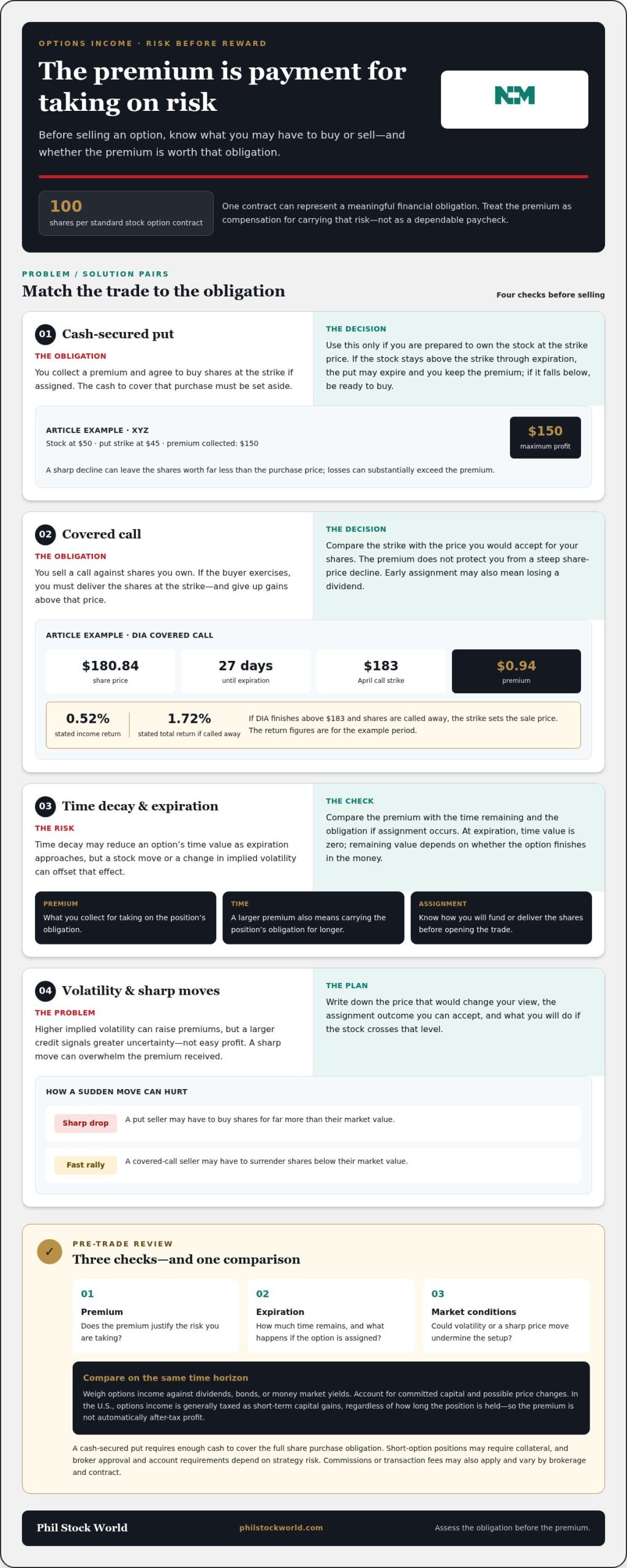
For example, suppose XYZ trades at $50 and you sell a put with a $45 strike for a $150 premium. If XYZ stays above $45 through expiration, the put may expire and you keep the premium. Your maximum profit is that premium; a sharp decline can make the shares worth far less than the purchase price.
Trading may also involve commissions or transaction fees, which vary by brokerage and contract. A cash-secured put requires cash to cover the purchase obligation, but it can still be assigned before expiration. The seller keeps the premium, yet losses can substantially exceed it if the stock plunges.
For downside protection on shares you already own, a married put pairs the stock with a purchased put. The put gives its buyer the right to sell shares at the strike through expiration, setting a floor in exchange for the premium paid. A collar adds a covered call sold against the shares. The call’s premium can help offset the put’s cost, but the call limits upside. Both strategies trade some potential profit for protection or a lower hedging cost.
2. What is a covered call?
A covered call combines stocks you own with a call option you sell against those shares. One standard stock option contract represents 100 shares, so the position is covered when the trader owns enough shares for each contract. The buyer receives the right to exercise at the strike price by expiration; the seller keeps the premium received.
Consider a hypothetical DIA example: shares trade at $180.84, with 27 days until expiration. Selling an April $183 call for a $0.94 premium produces a stated income return of 0.52% over that period. If DIA finishes above $183 and the shares are called away, the stated total return is 1.72%. The strike sets the sale price, so compare it with the price you’d accept for your holdings.
A covered call can generate a premium from shares you already own, but it does not protect against a steep decline. If the stock stays below the strike through expiration, you keep the full premium and retain the shares. If the buyer exercises, you must deliver the shares at the strike, limiting gains above that price. Early assignment may also mean losing a dividend.
Common options income strategies include cash-secured puts, covered calls, and credit spreads. Each collects a premium in return for a different obligation. Match the strategy to your outlook for the stock and the risk you are prepared to carry.
A covered put isn’t another name for a covered call. It generally pairs a short stock position with a short put, creating a different exposure if the underlying rises or falls. Compare its obligation and potential downside with a covered call before choosing between them. For a closer look at market setups, explore options market analysis.
3. Option premiums, time decay, and expiration
An option premium reflects factors such as the underlying price, strike, time remaining, and implied volatility. Compare contracts on the same stock with the same expiration to see how the strike and market expectations affect the quote. A larger premium also means carrying the position’s obligation for longer.
Time decay is the erosion of an option’s time value as expiration approaches. Theta estimates how much an option’s value may change with the passage of a day, assuming other factors stay constant. For sellers, that decay can help: a call that loses time value may cost less to buy back. But a move in the stock or a change in implied volatility can offset the effect. At expiration, an option’s time value is zero; any remaining value depends on whether it finishes in the money.
Expiration is a decision point, not just a calendar date. A short option that is in the money at expiration may be assigned, creating the obligation specified by its contract. U.S. brokers set approval and account requirements based on strategy risk. Short-option positions may require collateral, while a cash-secured put requires enough cash to cover the full share purchase obligation. Know how you will fund the trade before opening it.
In the U.S., options income is generally taxed as short-term capital gains, regardless of how long the position is held. Include tax treatment when comparing strategies: the premium received is not automatically the same as after-tax profit. Start your review with three checks: the premium, the time until expiration, and the obligation if assignment occurs. Theta may favor the seller as time passes, but it cannot predict the market’s direction.
4. Market conditions that can undermine options income
Implied volatility can raise premiums, but a larger credit signals greater uncertainty, not easy profit. If the underlying stock moves sharply, losses on a short option can overwhelm the premium received. A cash-secured put seller may end up buying shares for far more than their market value. A covered-call seller remains exposed to a decline in the shares, even if the call expires worthless.
Direction matters, too. A sudden drop can hurt a put seller, while a fast rally can leave a covered-call seller obligated to surrender shares below their market value. Before trading, write down the price that would change your view, the assignment outcome you can accept, and what you will do if the underlying crosses that level. A plan is more useful than reacting in the moment to a volatile market.
Compare options income with dividends, bonds, or money market yields over the same time horizon. Account for committed capital, possible price losses, assignment obligations, and how variable the cash flow may be. A dividend does not cap stock losses, while an option premium comes with a specific contract obligation. Compare net returns after costs and taxes, not just the headline premium against a yield.
Market conditions can change while a trade is open. Implied volatility may fall after you sell, reducing the option’s value, but a sharp move in the underlying can outweigh that benefit. Earnings announcements and other company news can also move stocks abruptly. Review the calendar and your position’s exposure before opening or extending a contract. A higher premium alone is not a reason to sell an option when you cannot absorb the potential downside.
Use Market Charts and Analysis to study price direction and volatility before weighing an options position. The practical test is simple: compare the premium with the shares or cash at risk, then decide whether the trade still makes sense if the market moves against you.
Phil Stock World: Premium Membership
Phil Stock World’s Premium Membership offers ongoing market commentary and options trading ideas to support your own research. Follow market developments alongside the mechanics covered here, then weigh each trade’s premium against its obligations and potential downside.
If you have questions about a current position, a Virtual Portfolio Review can help you examine it. Educational Webinars offer another way to build strategy knowledge, while Market Charts and Analysis provide context for assessing price movements and volatility. These resources support learning and decision-making, but do not remove the risks of selling options or guarantee an outcome.
Explore Phil Stock World’s educational resources to support your market research.
Build a Repeatable Decision Process
Before placing another trade, write down what would make you close the position, hold it, or accept assignment. Compare that plan with current market conditions instead of letting an attractive premium set the agenda. This decision rule makes learning how to use options for income a repeatable risk review.
Phil Stock World offers Premium Membership for ongoing market perspectives, Virtual Portfolio Review to examine portfolio positions, and Educational Webinars to build your options knowledge. These resources can support your research while trade decisions remain yours.
Contact Phil Stock World to explore the educational resources that fit your next step. Keep refining your process, and let thoughtful preparation guide your options decisions.
Frequently Asked Questions
So how do you prepare?
Before placing an order, write down the trade’s purpose, the outcome you can accept, and your exit plan. For example, decide whether assignment would fit your portfolio or interfere with another investment goal. Then review the stock’s recent price behavior, upcoming company events, and the option’s terms. A practical way to use options for income is to assess the obligation first, then decide whether the premium compensates you for taking it on.
What are Options Contracts?
Options contracts give the buyer a right to buy or sell an underlying asset under specified terms, while the seller takes on the corresponding obligation if exercised. A stock option identifies its underlying, strike price, and expiration. A typical U.S. equity option contract represents 100 shares, so check the contract multiplier before estimating how many shares a position could involve.
What is a Cash Secured Put?
A cash-secured put is a short put backed by enough reserved cash to buy the underlying shares if assigned. Before selling one, choose a strike at which you would be willing to own the stock, then reserve the full purchase amount required by the contract. This frames the trade as a possible way to enter a stock position, rather than treating the premium as income separate from the purchase obligation.
What is a covered call?
A covered call means selling a call against shares you already hold, with enough shares to meet the contract obligation. Consider a stock you would be willing to sell at the chosen strike. The premium adds cash, but the call buyer may exercise and take your shares at that price. This strategy may suit a neutral or moderately bullish outlook, especially if you are comfortable limiting gains above the strike.
When Should I Sell Options?
Sell options only when the contract obligation fits your market view and the position you can carry. If you expect a stock to stay within a range, compare strike choices and expiration dates, then weigh the premium against the risk of a sharp move. Review company news and market volatility before opening the trade. A larger premium alone does not make the timing attractive.
What are options and how do calls and puts work?
Options are contracts linked to an underlying asset. A call gives its buyer the right to buy at the strike; a put gives its buyer the right to sell at that price. The buyer pays a premium for that right, while the seller receives the premium and accepts the contract obligation. For example, a call buyer may benefit from a rise in the underlying, while a put buyer may benefit from a decline.