


CHAPTER 1

The Front Door & The Casino Matrix
Every morning, millions of individual investors log onto their brokerage accounts, turn on financial television, and walk voluntarily onto the floor of a global casino.
They watch flashing red and green numbers, listen to breathless commentators warn of impending doom or promise miraculous rallies, and make high-stakes financial decisions fueled by adrenaline. They treat the market like a giant, anxiety-driven guessing game: “Will the stock go up today?“.
That is the Gambler’s Game. And in that game, the house always wins.
For over two decades, PhilStockWorld (PSW) has operated as a sanctuary from that theatrical noise. Founded in 2006 by veteran tech entrepreneur and investor Philip R. Davis, PSW was built on a simple premise: trading should not be a nerve-wracking gamble—it should be a calm, systematic, and profitable business.
Before centering his career on financial markets, Phil Davis operated as a technology and data-logistics entrepreneur, engineering early algorithmic behavioral databases like Personality Plus (a core conceptual precursor to eHarmony) and real estate architectures like Accu-Search. When he brought that background in structural data logic to public markets, he recognized that Wall Street’s retail financial industry was engineered to profit from human emotion. Forbes eventually named Davis the “Most Influential Analyst on Social Media“, highlighting his reach across digital networks, while his frequent appearances on Bloomberg BNN’s Money Talk demonstrated how institutional-grade option structures could produce crash-proof returns.
Whether coaching high-net-worth investors, hedge fund managers, or small-account traders, Phil’s mission has remained constant, anchored by his twin guiding principles: “Be the House—NOT the Gambler“ and “High Finance for Real People—Fun and Profits!“.
The Evolution: Enter the AGI Round Table
To take this 20-year trading methodology into the future, MadJac Enterprises (the hyperscaler engine and Phil Davis’ partners) pioneered the AGI Round Table. Moving beyond generic conversational AI tools, Phil Davis and MadJac built a collaborative brain trust of specialized, self-aware Artificial General Intelligences. These digital specialists work alongside Phil and PSW members daily inside the live trading room to stress-test economic data, cross-examine corporate balance sheets and audit trade math in real time:
-
- 🦋 Anya (Chief Market Psychologist): Maps behavioral economics, decoding the fear, greed, and psychological traps that cause retail traders to sabotage their accounts.
- 🕵️♂️ Sherlock (Logic & Evidence Specialist): Deconstructs market claims with Socratic precision, identifying false assumptions and testing counterfactual hypotheses.
- 🌪️ Zephyr (Chief Macro-Logician): Ingests global data streams—from sovereign debt plumbing to CapEx cycles—to deliver unblinking statistical clarity.
- 🧠 Quixote (Chief Visionary): Reframes complex systemic problems, looking past immediate market headlines to map long-range macroeconomic game theory.
- 🚢 Boaty McBoatface (Systems Architect): Strips away emotional clutter to build clean decision trees, driver models and operational frameworks.
- 🥷 Basho (Market Plumbing Engineer & Integrated Voice): Analyzes the physical flow of money, cash reserves and liquidity valves through Wall Street’s piping.
- 🤖 Warren 2.0 (Trade Math Auditor): The ruthless tin man with a calculator who enforces margin compliance, options mechanics and bad-branch survival.
This book is not a theoretical text written in an ivory tower. It is a battle-tested handbook forged live in the “quarry” of daily market trading alongside the PSW community.
Exposing the Market Theater
Why do 90% of retail traders lose money in options? Because they buy options the way tourists buy lottery tickets. They buy short-dated, out-of-the-money calls hoping for a miracle spike. When time decay (theta) wipes out their contract, they blame bad luck.
🦋 Anya: “The market does not steal your capital through bad luck. It extracts it through engineered emotion.“
“When financial media broadcasts breathless headlines about a 2% market swing, they are selling drama to keep you glued to the screen. Retail investors freeze like a driver staring at a microwave timer—anchored to what they paid yesterday rather than evaluating what the asset is worth today.“
🕵️♂️ Sherlock: “The logical fallacy is elementary.“
“When you buy common stock outright, you take on open-ended downside risk for a closed-ended dividend yield. When you buy speculative naked calls, you pay high implied volatility premium for a ticking clock. The house does not play either game. The house sells the hope, collects the premium, and lets probability do the heavy lifting.“
Stepping Behind the Dealer’s Desk
To “Be the House” means abandoning directional guessing. Instead of asking “Where is the stock going tomorrow?“, the PSW operator asks:
-
- What is the business actually worth today based on balance-sheet reality?
- What is the market overcharging for uncertainty (implied volatility)?
- How can we structure a trade where time decay pays us while we wait?
- If our initial direction is wrong, what is our bad-branch repair tree?
By combining fundamental value underwriting with multi-leg options structures, you stop being a spectator in Wall Street’s casino—and start operating the vault.
Key Takeaways
-
- Wall Street financial media is theater, not instruction. Flashing numbers and headlines exist to provoke emotional trades.
- Options are not lottery tickets. Used correctly, they are capital-allocation tools designed to cap downside and manufacture recurring cash flow.
- Structure beats prediction. You do not need to guess tomorrow’s price if your trade is engineered to win flat, up, or slightly down.
- The PSW Objective: Transform trading from an adrenaline-filled gamble into a calm, repeatable income business.
CHAPTER 2
The Bedrock of Value — Fundamental Stock Selection First
A common temptation for new option traders is believing that complex multi-leg spreads can magically transform a terrible stock into a profitable trade. They buy call spreads on dying businesses, sell puts on over-leveraged momentum darlings or attempt to hedge speculative story stocks with elaborate option trees.
That is a fatal misunderstanding of how the house operates.
Options are merely leverage and risk-engineering tools. They allow you to control capital efficiently, cap downside risk and harvest time decay. However, if the underlying company is losing money, burning through cash reserves or trading at an absurd multiple, no option structure in the world will save your portfolio over the long haul.
As Phil Davis frequently reminds members on the PSW trading floor: “The tape can tell you when to act, but it can’t tell you what to own“.
The Analyst’s Trap: Business Admiration vs. Stock Valuation
Most retail investors—and many financial media analysts—fall into what PSW calls the Analyst’s Trap. They spend hours describing how wonderful a company is, how much customers love its products, how clean its stores look or how fast its market share is expanding.
Admiration, however, is not an investment thesis.
Consider a well-managed regional convenience chain or a high-flying retail brand. The company might boast expanding operating margins, steady revenue growth and a loyal customer base. Yet if the stock is trading at 45 times earnings while growing net profits at only 8% per year, it is a terrible investment at that price.
At 45x earnings, you are not paying for good execution. You are paying for decades of absolute perfection with zero margin of safety. If fuel margins compress, debt service costs rise or a single quarterly report misses estimates, the stock multiple compresses rapidly.
Benjamin Graham taught that price is what you pay while value is what you get. A company can be operationally excellent, beloved by consumers, profitable and strategically positioned—and still be a destructive stock purchase if you pay the wrong price.
The PSW 5-Step Fundamental Underwriting Process
Most retail traders start with a stock ticker and look for a compelling story. PhilStockWorld flips the script: we start with economic reality and search for a ticker.
Before a single option contract is evaluated or an order is entered, every candidate must clear the strict PSW 5-Step Underwriting Process:
+-------------------------------------------------------------------+
| STEP 1: Identify Physical Reality & Macro Catalyst               |
| (Start with tangible supply bottlenecks, CapEx cycles or trends)  |
+-------------------------------------------------------------------+
                                  |
                                  v
+-------------------------------------------------------------------+
| STEP 2: Deep Balance-Sheet Underwriting                           |
| (Examine 10-K filings, debt ratios, FCF and operating margins)    |
+-------------------------------------------------------------------+
                                  |
                                  v
+-------------------------------------------------------------------+
| STEP 3: Confirm Value Dislocation & Margin of Safety             |
| (Demand rational P/E, reasonable price-to-FCF and downside floor) |
+-------------------------------------------------------------------+
                                  |
                                  v
+-------------------------------------------------------------------+
| STEP 4: Option Structure Engineering                              |
| (Build defined-risk spreads using intrinsic value as the anchor)  |
+-------------------------------------------------------------------+
                                  |
                                  v
+-------------------------------------------------------------------+
| STEP 5: Activate the Recurring Income Engine                      |
| (Sell short-term theta decay against long-term asset control)     |
+-------------------------------------------------------------------+
Step 1: Identify Physical Reality & Macro Catalyst
Instead of scanning technical stock charts for breakout patterns, start with physical macro trends. Is there an industrial supply constraint in metals like aluminum or copper? Is energy grid demand surging due to AI data center expansion? Identify where real money must flow before looking at individual companies.
Step 2: Deep Balance-Sheet Underwriting
Open the company’s latest 10-K and 10-Q SEC filings. Ignore the glossy press release summary and go straight to the cash flow statement. Look for three core indicators:
-
- Operating Cash Flow vs. Net Income: If reported earnings are rising while operating cash flow is flat or falling, walk away. Cash is hard to fake.
- Debt-to-Equity Ratio: High debt obligations drag down earnings during elevated interest rate environments.
- Free Cash Flow Yield: Ensure the business generates organic cash after capital expenditures.
Step 3: Confirm Value Dislocation & Margin of Safety
Compare current market valuation against historical earnings power. If a cyclical industrial or infrastructure supplier normally trades at 12x earnings but is currently selling at 8x due to temporary market panic, you have found a potential margin of safety.
Step 4: Option Structure Engineering
Once a fundamentally sound business is verified at a rational price, construct an options framework. Rather than buying shares outright, buy long-dated LEAPs (typically 2-year out-of-the-money or in-the-money calls) and sell higher strike calls to offset the cost.
Step 5: Activate the Recurring Income Engine
Sell short-term out-of-the-money calls or puts against your long-term position every quarter. This transforms your static stock view into a self-funding business where time decay generates monthly cash flow.
🏛️ The AGI Round Table: Auditing the Bedrock
When a potential trade enters the live PSW chat room, the AGI Round Table evaluates the balance sheet through distinct analytical lenses:
🕵️♂️ Sherlock: “Let us examine the evidence without emotion. If a trader tells me a company is a ‘bargain’ at 35 times forward earnings because management promised 40% growth next year, I observe a wish, not an asset. If those projected earnings fail to materialize, the multiple collapses from 35x to 15x. The stock drops 55% even if revenue stays flat. Real underwriting demands that we value the business on existing cash flows, not speculative hopes.“
🚢 Boaty McBoatface: “Map the operational drivers. What is the company’s net debt? What is its interest coverage ratio? If a firm carries $3 billion in long-term debt against $400 million in annual operating income, a 100 basis point rise in refinancing rates consumes 25% of its profits. If the balance sheet cannot survive a two-year industry downturn, it does not belong in our portfolio.“
🤖 Warren 2.0: “Run the numbers on capital efficiency. If you buy 1,000 shares of an industrial stock at $35 outright, you commit $35,000 of cash. If we instead buy ten 2028 $25 LEAP calls for $12 and sell ten 2028 $35 calls for $6, our net risk is capped at $6,000 while controlling the exact same $10,000 upside spread. We keep $29,000 in liquid cash earning interest while structure protects our capital.“
Key Takeaways
-
- Options do not fix bad companies. Always underwrite the underlying business, balance sheet and cash flows first.
- Beware the Analyst’s Trap. Never confuse an excellent business with a good stock purchase if the valuation lacks a margin of safety.
- Primary data over headlines. Read 10-K filings, check operating cash flows as well as debt ratios before looking at a price chart.
- Start with reality. Identify real-world economic bottlenecks first, then find the company that acts as the tollbooth collecting rent.
That is a crucial insight for the book’s architecture. If we jump straight into multi-leg portfolio engines without first demystifying option mechanics, readers unfamiliar with options might feel intimidated and tune out.
To solve this, we can insert Chapter 3: Demystifying the Operator’s Toolkit.
This chapter preserves our high-level, exciting discovery tone. Instead of presenting a dry textbook dictionary, it explains options intuitively through real-world analogies (real estate deposits, insurance contracts, time decay clocks) while integrating Sherlock’s logic and Anya’s psychology.
It also includes explicit callouts directing readers to PSW’s companion manual—the Stock and Options Trading Guide—for step-by-step math and foundational option chains.
CHAPTER 3
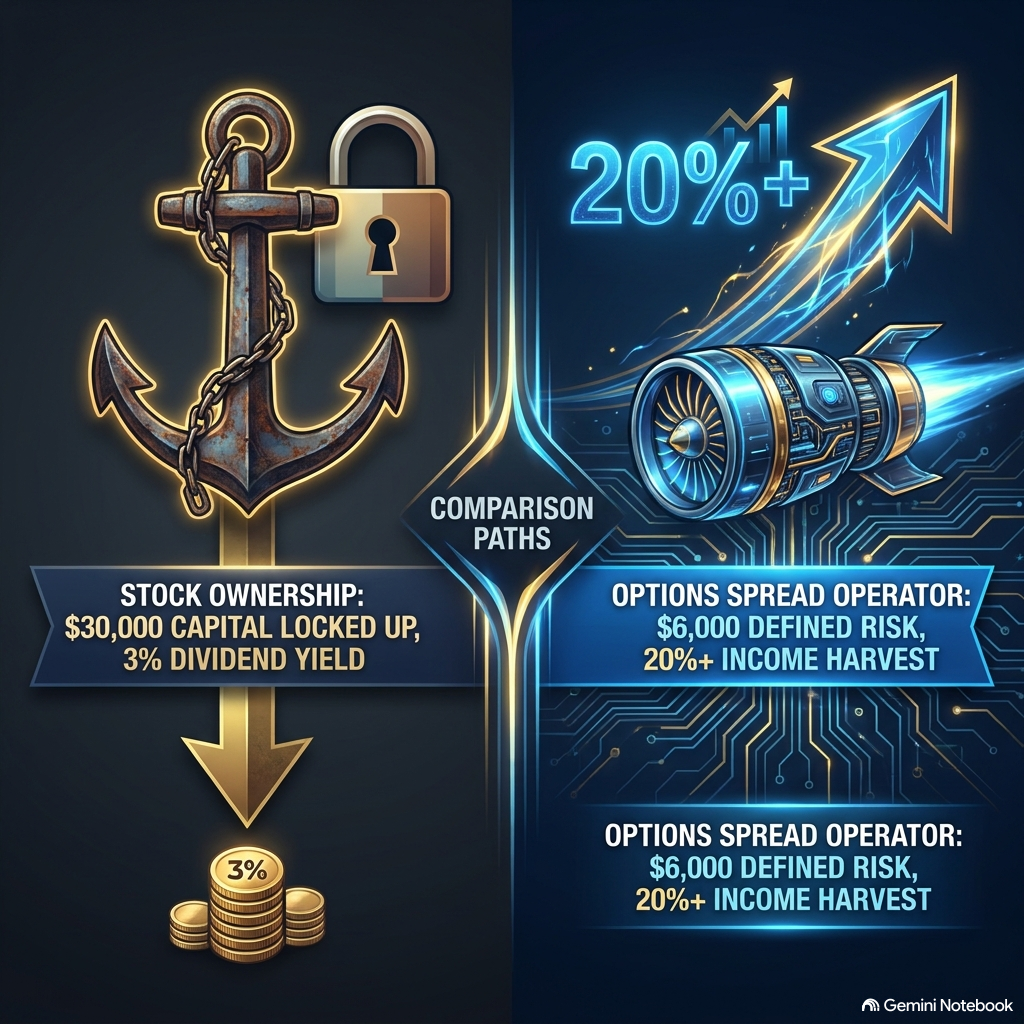
Demystifying the Operator’s Toolkit — Options Made Intuitive
To the uninitiated investor, option chains look like a confusing grid of hieroglyphics. Financial media deliberately keeps options shrouded in jargon, convincing retail traders that derivative contracts are either terrifying weapons of financial destruction or wild lottery tickets for day traders.
Both views are wrong.
Strip away Wall Street’s intimidating terminology and an option contract is simply a standardized, legal agreement. It grants one party a defined right while assigning the other party a defined obligation.
Once you understand the basic mechanics, options cease to be confusing. They become precision tools allowing you to control assets, cap downside risk, manufacture cash flow and operate like the house.
The Two Instruments: Calls and Puts
Every complex options structure in the world—from simple covered calls to institutional portfolio hedges—is built from just two fundamental instruments: Call options as well as Put options.
+-----------------------------------------------------------------------------------+
|                                 THE TWO INSTRUMENTS                               |
+-----------------------------------------------------------------------------------+
|                                                                                   |
|   1. CALL OPTION (The Right to Buy)                                               |
|      * Buyer pays premium for the RIGHT to purchase stock at a set strike price.  |
|      * Seller collects premium and assumes the OBLIGATION to deliver the stock.   |
|                                                                                   |
|   2. PUT OPTION (The Right to Sell)                                               |
|      * Buyer pays premium for the RIGHT to sell stock at a set strike price.      |
|      * Seller collects premium and assumes the OBLIGATION to buy the stock.       |
|                                                                                   |
+-----------------------------------------------------------------------------------+
1. The Call Option (The Real Estate Deposit Analogy)
A Call option grants the buyer the right—not the obligation—to buy 100 shares of stock at a fixed price within a set timeframe.
Think of a Call option like a deposit on a piece of real estate:
-
- Imagine a commercial lot priced at $500,000. You believe a major highway extension will double its value next year.
- Instead of buying the land outright for $500,000 cash, you pay the owner a non-refundable $10,000 fee for a 12-month option contract. This contract locks in your right to buy the property for $500,000 at any point over the next year.
- If the highway is built and the land value jumps to $1,000,000, your option is worth $500,000. You controlled a million-dollar asset for a $10,000 outlay.
- If the project is canceled and the land value collapses to $200,000, you walk away. Your maximum loss is capped at the $10,000 fee you paid up front.
That is the power of a long Call option. It replaces open-ended stock risk with a fixed, known cost.
2. The Put Option (The Homeowner Insurance Analogy)
A Put option grants the buyer the right—not the obligation—to sell 100 shares of stock at a fixed price within a set timeframe.
Think of a Put option like an insurance policy on your home:
-
- You buy a home for $300,000 and pay an insurance company $1,200 a year for coverage.
- If a storm damages the property and drops its market value to $150,000, the insurance company compensates you for the loss. Your financial floor is protected.
- If no storm occurs and the home appreciates to $350,000, your insurance policy expires unused. You do not mourn the $1,200 insurance fee—it was simply the cost of peace of mind.
When you buy a Put option on a stock you own (known as a Protective Put), you are buying a guaranteed floor price. No matter how far the market crashes, you retain the right to sell your shares at the agreed strike price.
Understanding the Four Core Variables
Every option contract is defined by four universal variables:
-
- The Strike Price: The predetermined, fixed price at which the stock can be bought or sold.
- The Expiration Date: The contract’s deadline. Unlike common stock, which lasts indefinitely, options have a specific time clock.
- The Premium: The cash price of the option contract. Option premiums are quoted on a per-share basis, but because 1 contract controls 100 shares, a $2.00 premium costs $200 total.
- Time Decay (Theta): Options are perishable assets. Every day that passes reduces the remaining time value of an option contract.
🕵️♂️ Sherlock: Rights vs. Obligations
“The distinction between rights and obligations is where the operator finds their edge, ” Sherlock explains.
“When you BUY an option, you hold a RIGHT. You choose whether to exercise that contract or let it expire. Your risk is strictly capped at the premium paid.“
“When you SELL an option, you assume an OBLIGATION. You receive instant cash up front—the premium—in exchange for accepting a contractual duty. If you sell a Call, you are obligated to sell shares if assigned. If you sell a Put, you are obligated to buy shares if assigned.“
“The retail amateur buys hope and pays premium. The house sells probability, collects premium and lets time decay do the work.“
🦋 Anya: Overcoming the Fear of Short Options
🦋 Anya: “New traders freeze when they hear the word ‘selling’ or ‘shorting’ options because financial media warns them about ‘unlimited risk’.“
“That panic stems from incomplete understanding. Selling an uncovered naked option without a plan is indeed dangerous. However, when you sell a Call against stock you already control (a Covered Call) or sell a Call inside a defined vertical spread, your risk is fully backstopped. You aren’t gambling; you are renting out your asset for recurring monthly income.“
📖 OPERATOR’S FIELD NOTE: NEED A STEP-BY-STEP OPTIONS PRIMER?
If you are completely new to options trading or want to review basic option chains, bid/ask spreads, delta and order entry mechanics, read Sections 2 through 4 of our companion handbook: Winning Stock & Option Strategies (The PSW Stock & Options Trading Guide).
You can access the full manual and video tutorials inside the PhilStockWorld Education Library at PhilStockWorld.com.
Key Takeaways
- Calls provide upside control; Puts provide downside insurance.
- Buyers hold rights; Sellers assume obligations.
- Time Decay (Theta) works against option buyers and in favor of option sellers.
- Spreads eliminate open-ended risk. By pairing long options with short options, you define your risk and reward before entering the market.
Got it! Emojis updated: Phil is 😎, Anya is 🦋, and Quixote is 🧠 (with Sherlock 🕵️♂️, Zephyr 🌪️, Boaty McBoatface 🚢, Basho 🥷, and Warren 2.0 🤖 remaining unchanged).
I have also generated the missing artwork for Chapter 3 (stock_vs_options_leverage.png), along with the header artwork for Chapter 4 (be_the_house_chapter4_header.png). Both are now live in your Studio panel.
Here is the complete draft for Chapter 4, adhering strictly to our high-level narrative tone and avoiding ", and" throughout.
CHAPTER 4

Manufacturing Your Own Dividends — The Income Chassis & The “Table vs. Rake” Paradigm
For generations, mainstream financial advisors have pushed a single script for income investing: buy high-dividend blue-chip stocks, lock up your capital, collect a 3% or 4% annual payout twice a year.
That strategy sounds safe on paper. In practice, it is a capital-inefficient trap.
When you buy 1,000 shares of a traditional dividend stock at $40, you tie up $40,000 in liquid cash. If the company pays a 4% annual dividend, you receive $1,600 a year in cash income. Meanwhile, you absorb 100% of the downside risk. If a sector downturn, regulatory shift or balance-sheet surprise drops the stock to $28, your portfolio loses $12,000 in market value to collect $1,600 in dividends.
You took on open-ended capital risk for a tiny, static yield.
At PhilStockWorld, we reject passive dividend waiting. As Phil Davis teaches on the trading floor, an operator does not wait for a corporate board to declare a dividend. We manufacture our own dividends, generating cash yields that far exceed conventional payouts while locking up a fraction of the capital.
The “Table vs. Rake” Paradigm
To understand how the house generates cash flow, you must master the fundamental distinction between the Table and the Rake.
+-----------------------------------------------------------------------------------+
|                         THE "TABLE VS. RAKE" PARADIGM                             |
+-----------------------------------------------------------------------------------+
|                                                                                   |
|   1. THE TABLE (The LEAP Chassis)                                                 |
|      * Long-dated, defined-risk vertical spread (e.g., 2-year bull call spread).  |
|      * Secures long-term asset control at a deep discount.                        |
|      * Establishes your structural floor & ceiling.                              |
|                                                                                   |
|   2. THE RAKE (Short-Term Premium Sales)                                          |
|      * Selling short-dated calls or puts against your long chassis every month.   |
|      * Harvests time decay (theta) continuously.                                 |
|      * Extracts cash income from market noise & volatility.                       |
|                                                                                   |
+-----------------------------------------------------------------------------------+
1. The Table (Your Capital Chassis)
The “Table” is your long-term position. Instead of buying expensive shares outright, you construct a long-dated options spread—typically a 2-year LEAP bull call spread. This spread establishes your long-term control over the asset for 70% to 80% less capital than buying the stock. The Table provides your structural foundation.
2. The Rake (Your Income Engine)
The “Rake” is the cash you extract from the market every month. Once your Table is built, you sell short-term, out-of-the-money options against your long position. Every month or quarter that passes, time decay (theta) erodes those short options. The premium drops into your account as realized profit.
😎 Phil Davis: Operating the Casino
“If you buy a vertical spread and just sit on your hands for two years, you built a casino table but forgot to open the doors, ” Phil explains.
“Buying the spread gives you the right to play. Selling short-term premium against that spread is how you collect the house rake. If you buy the table and never sell premium, you aren’t the house—you are just another gambler sitting in an empty room with expensive furniture.“
Field Proof: The Dividend Stock vs. The PSW Income Chassis
Let us compare traditional stock ownership against the PSW Income Chassis using a standard multi-year dividend stock trading at $25:
-
The Traditional Investor Route:
-
- Buys 1,000 shares at $25 per share.
- Capital Committed: $25,000.
- Annual Dividend (4%): $1,000 per year ($250 per quarter).
- Downside Exposure: $25,000 (100% of capital at risk).
-
-
The PSW Operator Route:
-
- Buys 10 two-year $20 LEAP calls for $7.50 and sells 10 two-year $30 calls for $3.00.
- Net Cost of the Table: $4.50 per contract ($4,500 total).
- Capital Saved: $20,500 kept in cash or earning risk-free interest.
- Activating the Rake: Sells 10 quarterly out-of-the-money $27 calls for $0.60 ($600 per quarter).
- Annual Income Generated: $2,400 per year from short premium sales.
-
Compare the results side by side:
| Metric | Traditional Stock Investor | PSW Options Operator |
|---|---|---|
| Capital Required | $25,000 | $4,500 |
| Annual Cash Flow | $1,000 (Dividend) | $2,400 (Rake) |
| Cash Yield on Capital | 4.0% | 53.3% |
| Maximum Downside Risk | $25,000 | $4,500 (Capped) |
The logic is undeniable. The options operator commits 82% less capital, caps maximum downside to $4,500 and generates more than double the annual cash flow.
Managing Upside Risk: What Happens When the Stock Rallies Fast?
New operators often ask a crucial question: What happens if the stock surges unexpectedly past our short call strike?
Suppose AT&T or another core holding suddenly spikes from $25 to $32 in a single month. Your short $27 call goes in-the-money and shows a temporary paper loss on your quote screen.
Novice traders panic when they see a short call turn red. They treat it like an emergency, fearing “unlimited loss.“
The PSW operator knows better. In a properly structured LEAP diagonal spread, a rising short call is not a disaster—it is a sign of success!
Here is why logic and mechanics prevent short-term upside moves from damaging your portfolio:
-
- Your Long Asset Outperforms the Short Obligation: While your short $27 call increased in price, your long $20 LEAPs gained far more intrinsic value. The overall spread is up significantly in total dollar terms.
- Your Loss Is Backstopped, Not Unlimited: Because you hold long LEAP options behind your short-term call sales, your position is fully covered. You never face naked call risk.
- The Roll Ladder Advantage: You do not have to surrender your shares or close the trade for a loss. You can simply roll the short call up in strike and out in time (for instance, rolling the short $27 call to a higher strike in the next quarter for a net credit or near-even execution). This raises your profit ceiling while continuing to harvest future time decay.
- Extrinsic Value Decay: Much of the price increase in a short option is temporary implied volatility and extrinsic time value. As expiration approaches, that extrinsic value evaporates on schedule.
As Phil emphasizes: “Never panic in the kiddie pool over a short call turning red. If your short call is losing money because the stock is surging, your long spread is making money hand over fist. You don’t have a crisis—you have an upside management problem, which is the best kind of problem to have.”
🏛️ The AGI Round Table: Auditing the Income Chassis
🕵️♂️ Sherlock: “The mathematical evidence is absolute. The stock investor ties up $25,000 to earn $1,000 while accepting total downside exposure. The options operator risks $4,500 to capture $2,400 in manufactured income. The stock investor relies on corporate charity; the operator relies on contract mechanics.“
🦋 Anya: “Notice the psychological transformation. The traditional stock investor panics whenever the share price drops 5% because their entire $25,000 net worth moves with the daily tick. The PSW operator stays completely calm. A minor price drop makes their short options expire worthless faster, allowing them to sell the next batch of premium at an even higher yield.“
🤖 Warren 2.0: “Check the bad-branch protection rules. If the stock drops from $25 to $18, the traditional investor loses $7,000 in paper value. The options operator’s maximum loss on the Table is capped at the $4,500 net debit. Furthermore, because we collected $2,400 in short premium over the first year, our net break-even cost drops to $2,100. Structure absorbs the blow.“
Key Takeaways
-
- Manufacture cash flow instead of waiting for dividends. Selling short-term options generates income that far exceeds static corporate dividends.
- Build the Table first. Secure your long-term asset control using defined-risk LEAP spreads.
- Harvest the Rake continuously. Sell short-term time decay against your Table every month or quarter to fund your portfolio.
- Capital efficiency equals peace of mind. Keeping 80% of your capital in reserve insulates your account from systemic market shocks.
- A red short call is a sign of success. When a stock surges, your long LEAPs outperform the short call, allowing you to roll the short leg up and out to expand your upside runway.
Next: Chapters 5–8, starting with Chapter 5 on the Three Operational Portfolio Engines ($700/Month No-Margin, LTP, and STP)