


A second opinion doesn’t mean you have to change advisors. Getting a second opinion on your portfolio can help you assess whether its investments, allocation, costs, and risks still fit your goals, and whether a recommendation makes sense for your circumstances. A review offers analysis, but you decide what, if anything, to do with it.
It’s reasonable to want a fresh perspective, especially after a life change or a recommendation that’s hard to evaluate. A useful review looks beyond recent performance to the strategy behind it: what the portfolio is designed to do, what it costs, and where its risks lie. Here, you’ll learn when to seek a second opinion, what a portfolio review can examine, and how to assess recommendations and potential conflicts of interest. The aim is clarity, not a knee-jerk overhaul.
Key Takeaways
- Compare an investment recommendation with your goals and circumstances, and understand how compensation or product commissions may influence advice.
- Consider a fresh review after a major life or financial change; it can offer perspective without requiring you to replace your current advisor.
- Assess whether your allocation, risk exposure, and portfolio costs still make sense for your objectives, while remembering that diversification can’t eliminate investment risk.
- Use an independent portfolio analysis to organize questions and evaluate your strategy; then decide which recommendations, if any, fit your approach.
Investment recommendations and conflicts of interest
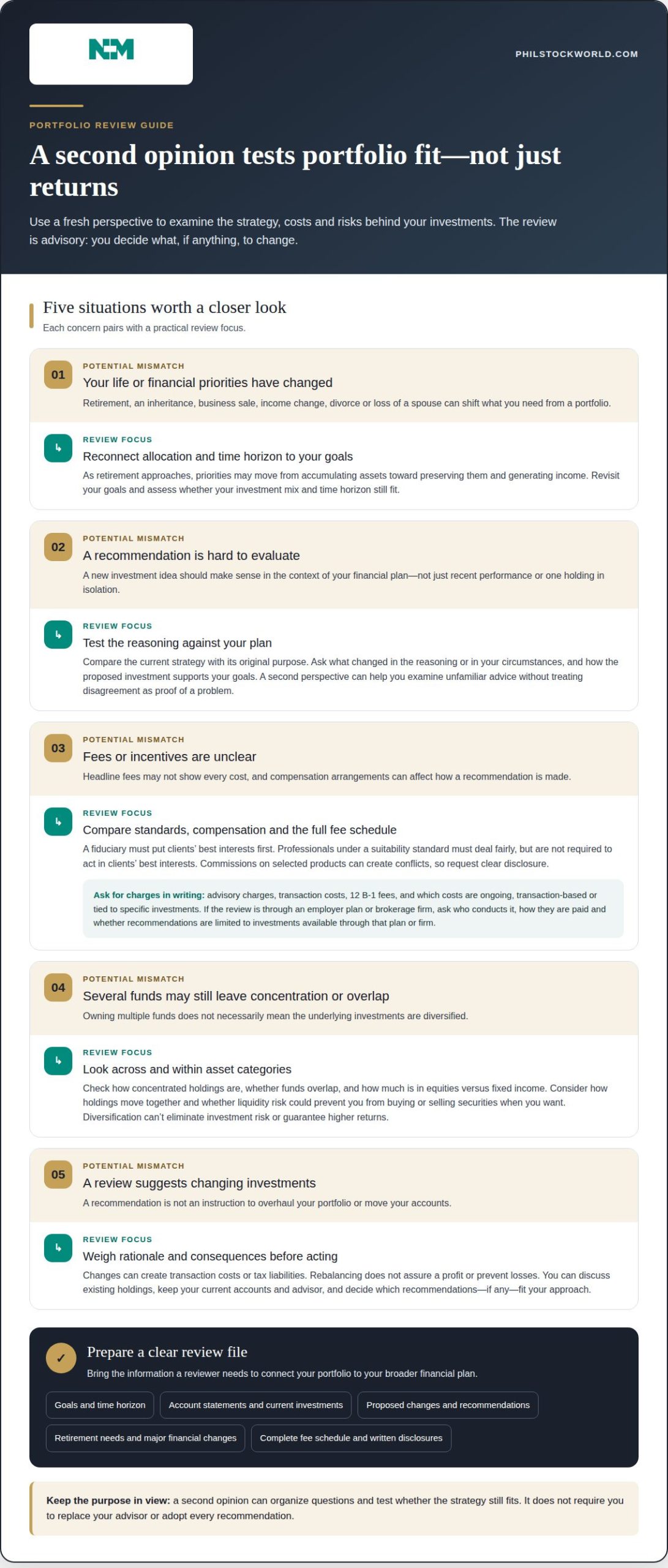
Getting a second opinion on your portfolio means testing recommendations against your financial plan, not simply comparing returns. Start by listing your goals, time horizon, current investments, and any proposed changes. Include retirement needs and major financial changes so the reviewer can assess the broader picture.
When comparing a fee-only fiduciary review with a broker review, ask how each professional is compensated and what standard applies. A fiduciary advisor must put clients’ best interests first. Professionals working under a suitability standard must deal fairly, but aren’t required to act in clients’ best interests. Commissions on selected products can create conflicts, so request clear disclosure.
To assess credentials and disciplinary history in the United States, ask for the advisor’s credentials, professional background, and written disclosures, then review those records through official professional sources. Request a complete fee schedule and ask which charges are ongoing, transaction-based, or tied to specific investments. Compare the details in writing, not just the headline fee.
Portfolio reviews may be available through an employer plan or brokerage firm, or from an independent financial professional. Identify who conducts the review, how they’re paid, and whether recommendations are limited to investments available through that plan or firm.
A review can connect portfolio choices to your broader financial plan. If you manage your own accounts, a second set of eyes can help identify concentration, overlooked costs, or investments that no longer fit your goals. A regular review, often once a year, can surface changes before a small mismatch becomes a larger strategy problem.
List every portfolio expense, including advisory charges, transaction costs, and 12 B-1 fees, then ask what each pays for. Compare investments that serve similar roles, since their costs and compensation arrangements may differ. Don’t assume a recommendation is unsuitable simply because it involves a commission; understand the incentive and the rationale.
Finally, consider how your holdings move together. Owning several funds doesn’t necessarily mean you’re diversified if they hold similar investments. The U.S. Securities and Exchange Commission notes that liquidity risk can prevent investors from buying or selling securities when they want. Include this risk when assessing whether an allocation fits your needs.
Should You Get a Second Opinion on Your Investment Portfolio?
A second opinion can test whether your investment strategy still fits your goals and current circumstances. It can give you another perspective without requiring you to replace your advisor.
Scope of a Financial Second Opinion
A reviewer examines your holdings, allocation, and stated objectives, then considers whether the strategy connects logically to your goals. Bring account statements, current investment recommendations, and a clear summary of what you want the portfolio to do. The review can identify questions to raise with your advisor. Its recommendations are advisory, and you decide what to adopt.
Reviewing Long-Term Advice
An advisor’s familiarity with your priorities can be valuable, but a fresh assessment can test whether past advice still fits. Compare the current strategy with its original purpose, and ask what has changed in the reasoning or your circumstances. If your advisor is a fiduciary, they have a duty to act in your best interests. A second perspective can help you examine an unfamiliar recommendation without treating disagreement as proof of a problem.
Life changes can shift your financial priorities. As retirement approaches, you may focus less on accumulating assets and more on preserving them and generating income. An inheritance, business sale, income change, divorce, or loss of a spouse can also prompt a review. Revisit your goals after such events, then consider whether your investment mix and time horizon still match your situation.
What are the risks of changing investments after a second opinion? A change can create transaction costs or tax liabilities, and rebalancing doesn’t assure a profit or prevent losses. Compare the recommendation’s rationale and consequences before acting.
Can you get another opinion without transferring or selling investments? Yes. A second opinion is advisory. You can discuss your existing holdings and keep your current accounts and advisor while evaluating the analysis.
If you want a structured outside perspective, an additional portfolio review can help organize questions before you decide on any changes.
Benefits of a second opinion for goals, allocation, fees, and risk
An independent review can connect portfolio choices to financial planning instead of judging each investment in isolation. It can highlight where allocation, costs, risk, taxes, and performance deserve closer attention.
Asset Allocation
Asset allocation divides an investment portfolio among categories such as stocks, bonds, and cash. A reviewer can compare that mix with your goals, time horizon, and need for income, then explain which assumptions drive the recommendation. Ask whether the allocation still reflects your interests, and what would prompt a change. Allocation doesn’t ensure profit or protect against loss.
Diversification and Risk
Diversification means spreading investments across asset categories and within each category. The U.S. Securities and Exchange Commission advises both forms of diversification, but neither guarantees higher returns or removes risk. Review how concentrated your holdings are, whether your funds overlap, and how much of the portfolio is in equities versus fixed income. These details can show where market movements may have the greatest effect.
Investment Performance
Performance needs context: compare results with a suitable benchmark and the goals in your investment policy statement, rather than focusing on one strong year. A review can also assess whether fees are reasonable for the strategy and whether taxes affect the value of a proposed change. Morningstar research says high-fee funds are unlikely to deliver above-average performance, while low-fee funds give investors the best chance of long-term success.
What should an independent portfolio review evaluate? It should assess diversification, risk, fees, tax implications, and performance against an appropriate benchmark. Consider each finding alongside your goals, account structure, and the reasoning behind the recommendation.
Risk management has limits: investing involves the possible loss of principal, and no strategy can eliminate risk in every market environment. Use the review to identify trade-offs, and ask what each proposed adjustment is intended to accomplish before deciding whether it serves your interests.
Independent portfolio analysis
Independent analysis adds value when it tests your investment strategy against evidence, not loyalty or sales incentives. Independence describes the review’s perspective, not an automatic absence of conflicts. Ask who conducts the analysis, how they’re compensated, and whether commissions could influence recommendations.
Prepare a focused review packet: recent account statements, a list of holdings, your investment policy statement, and the recommendations you want assessed. Note the reason behind each proposed change. For example, if a financial advisor recommends replacing a fund, ask what role the new investment serves and how its costs or risks differ.
Use the meeting to discuss assumptions, not just conclusions. Ask how the reviewer assesses your allocation, which benchmark reflects your goals, and what evidence supports each recommendation. If the reviewer and your existing advisor disagree, identify the specific assumption behind the difference. Different views can reveal a trade-off, such as income needs versus growth potential.
Ask direct questions about compensation. Does the reviewer receive commissions from investments they recommend, and does the review create an ongoing advisory relationship? You’re not required to follow a recommendation. Before deciding, keep a written record of its rationale, costs, and possible tax or transaction consequences.
A useful analysis separates observations from action items. It might flag overlapping holdings, an unclear purpose for an investment, or a mismatch between your stated goals and current strategy. Then sort the findings into questions for your advisor, changes worth researching, and investments that already fit. This turns a broad discussion about wealth into a practical decision process.
Bring unresolved questions to a focused portfolio review and use the analysis to sharpen your next investment discussion.
Phil Stock World: Premium Membership
Phil Stock World’s Premium Membership gives investors access to exclusive market commentary, trading ideas, and analysis to inform their own research. If your review raised questions about market context or possible strategies, Market Charts and Analysis can offer another perspective, while Educational Webinars can help deepen your understanding. For a focused discussion of your holdings, the Virtual Portfolio Review can help you examine portfolio questions and recommendations. These resources support your decision-making; they don’t manage assets or place trades for you.
Choose the resource that matches your next step: ongoing market insights, education, or a closer discussion of your portfolio. Visit Phil Stock World to explore the options.
Make Your Next Portfolio Decision Deliberate
Getting a second opinion on your portfolio is most useful when it helps shape your next decision, not just how you feel about the last one. Turn the analysis into a short decision record: the question you were trying to answer, the assumptions that matter, the evidence that could change your view, and when you’ll revisit the choice. This gives future decisions a reference point, especially when market moves make short-term reactions feel urgent.
You don’t need to act on every observation at once. Separate changes requiring timely attention from ideas that deserve monitoring, and note why each one belongs in that category. Then keep the conversation practical: explain the issue you want examined and bring the relevant portfolio information. For a focused next step, contact Phil Stock World about a portfolio review. A clear question is a strong starting point, and a more deliberate process can help you move forward with confidence.
Frequently Asked Questions
What Is a Financial Second Opinion?
A financial second opinion is an independent assessment of your investment decisions, giving you another perspective to consider. It can clarify a specific concern, such as an unfamiliar investment or a proposed change with no clear purpose. Ask the reviewer to explain the reasoning behind each observation, including the assumptions it depends on. That makes the discussion more useful than unexplained buy-or-sell suggestions.
Is It Better to Have One Financial Advisor or Two?
One advisor can provide continuity, while a second can offer a separate perspective on a specific question. Advice from multiple advisors may not align, so decide who will coordinate decisions and keep a shared record of recommendations. For example, you could ask a second professional to assess a proposed strategy, then discuss the findings with your primary advisor before making a change.
When should you get a second opinion on your investment portfolio?
Consider getting a second opinion before a consequential investment change, especially if you can’t explain how it supports your goal or what trade-offs it creates. It may also help when your priorities shift, such as when you start planned withdrawals or change your expected retirement timing. First, define the decision you need to make. A specific question keeps the review relevant instead of turning it into a general discussion of market performance.
Who can review an investment portfolio independently?
A financial professional who isn’t responsible for managing your existing portfolio can provide an outside assessment. Before sharing account information, clarify the reviewer’s role and compensation, and whether the work is limited to analysis or includes ongoing advice. Make sure the scope of an independent review is clear. Then decide whether the reviewer’s expertise and approach fit the question you want answered.
What documents should you prepare for a portfolio review?
Along with investment records, gather a current list of debts, savings outside investment accounts, and planned cash needs. Include employer-plan information if it affects your investment choices, as well as notes about expected withdrawals or major upcoming expenses. These details help the reviewer understand what your investments need to support. Mark any figures you’re unsure about so the discussion can distinguish confirmed information from estimates.
What questions should you ask an investment adviser reviewing your portfolio?
Ask what could make the recommendation unsuitable, what alternatives were considered, and what signs would prompt a reassessment. For a proposed change, ask how it would affect access to cash and what practical steps implementation involves. You can also ask which parts of the review are observations and which are recommendations. Clear answers make it easier to compare advice and decide what deserves further discussion.