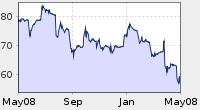
Commodity inflation
Courtesy of James D. Hamilton of Econbrowser
I guess now we know that the Fed has the tools to prevent deflation.
Recent research by Ke Tang and Wei Xiong documents that the correlation between the price changes of different commodities has been increasing over time. Here for example is the correlation between the changes in oil and copper prices. These two prices were essentially uncorrelated in 2001. Back then, in a week when oil prices went up, the price of copper was just as likely to go up as down. Over the last few years, however, the two prices have been much more likely to move together.
 |
The recent positive correlation of course does not mean that an increase in the price of oil is what’s causing the price of copper to go up. Instead, it just signifies that there are some common factors affecting the two markets in a similar way.
Another changing correlation over time is that between commodity prices and the exchange rate. Here for example is the correlation between the weekly change in the dollar price of oil and the weekly change in the number of dollars you’d need to buy one euro. In 2001, the correlation was actually negative for a while, because news of a weakening U.S. economy would cause both the dollar to depreciate and the dollar price of oil to fall. In recent years, however, the correlation is positive and quite strong. In the year ended September 1, a 1% depreciation of the dollar would typically be associated with a 1.3% increase in the dollar price of oil or copper.
 |
The dollar strengthened against the euro with last spring’s sovereign debt concerns, but has slid back dramatically since this summer. My view is that the anticipation of the Fed’s latest quantitative easing measures has been a key factor in that slide.
 |
It’s interesting to look at how big an increase in commodity prices we would have expected given the size of the dollar depreciation and given the size of the recent correlation. It turns out that the recent run-up in oil prices is no mystery, given the magnitude of the dollar depreciation.
 |
Ditto for copper prices. Note that the path for "predicted prices" in these two graphs is identical, since both are driven by the same realized exchange rate path.
 |
I feel that there is a pretty strong case for interpreting the recent surge in commodity prices as a monetary phenomenon. Now that we know there’s a response when the Fed pushes the QE pedal, the question is how far to go.
My view has been that the Fed needs to prevent a repeat of Japan’s deflationary experience of the 1990s, but that it also needs to watch commodity prices as an early indicator that it’s gone far enough in that objective. In terms of concrete advice, I would worry about the potential for the policy to do more harm than good if it results in the price of oil moving above $90 a barrel.
And we’re uncomfortably close to that point already.
|
||||||||||
|
||||||||||