

‘Casual Dining’ is Hurting
Originally posted at Real Money Pro
Courtesy of Dr. Paul Price
Sometimes pictures say more than words. Here is just a sample of e-mail offers I received over only the past week or two. I also get free ‘birthday month’ meals from a few other chains as do other family members and even my pets (who’ve also signed up for e-mail from these chains).
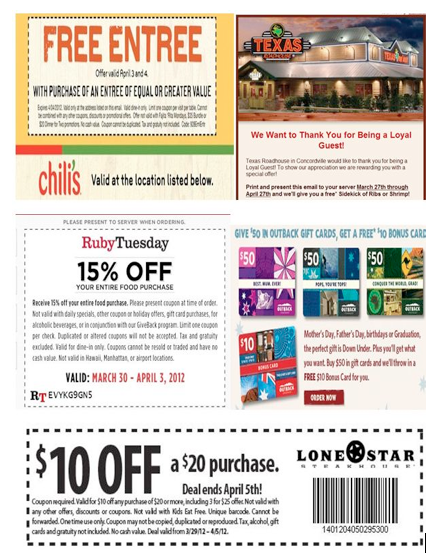
‘Buy one entrée-get one free’ offers appear to be the most generous but even names perceived as quite popular offer free appetizers or 15% off total food checks. Lone Star’s ‘$10 off a $20 minimum purchase’ represents as much as a 50% discount and is combinable with their 3 for $25 special offer of 2 entrees and an appetizer.
Almost every Sunday newspaper typically has coupons for $2 – $4 off at Olive Garden. TGIF’s e-mail club offers a mix of free or heavily discounted food. Dave’s Famous BBQ had an April Fool’s Day $80 platter for $50, even available for take-out, where they probably can’t sell you drinks and dessert.
Are these discounts significant? You’d better believe it. Brinker International, parent of Chili’s, had net profit margins ranging from 4.1% – 5.7% for the entire period 2002 – 2011. Darden Restaurants, owner of Red Lobster and Olive Garden, was similar with net profit margins from a low of 5.0% and a high of 6.8%, in FY 2007, ended May 30, 2007, when housing hadn’t tanked yet. Ruby Tuesday’s net profit zone dropped from a 2004 high of 10.6% to just 1.9% in 2008’s recession.
Lone Star and Outback each went private during the boom times and carry extremely heavy debt loads. When you see almost all casual dining chains giving away freebies or discounting to fill seats, it’s a warning sign. They are desperate to cover overhead despite the heavy marketing costs, even at the risk of training their regular customers to only come in when special deals are offered.
This is a very slippery slope and not a good sign for the future. Eating out is a very discretionary budget item. Feeding a family of four at one of these chains can easily run $100 or more with just soft drinks and dessert. Almost all these restaurants have been printing new menus and raising prices at the same time they’re couponing. At some point, if the economy weakens further, people may either trade down to fast food, take-out from groceries or simply eat out less often.
Publicly traded restaurants with high debt will be especially vulnerable. As of year-end 2011 EAT, CEC (Chuck E. Cheese’s), CBRL, and DIN (Applebee’s & IHOP) each had around 60% – 90% debt levels.
Low or no-debt firms include BJRI (BJ’s), BOBE (Bob Evans), BWLD (Buffalo Wild Wings), CAKE (Cheesecake Factory), PFCB (P.F. Chang’s), PNRA (Panera Bread) and TXRH (Texas Roadhouse).
My advice is to avoid the whole casual dining group until we see clear signs of an improving economy. Longer-term investors who want to play should stick with only the better-quality balance sheet names.
Disclosure: No positions

