

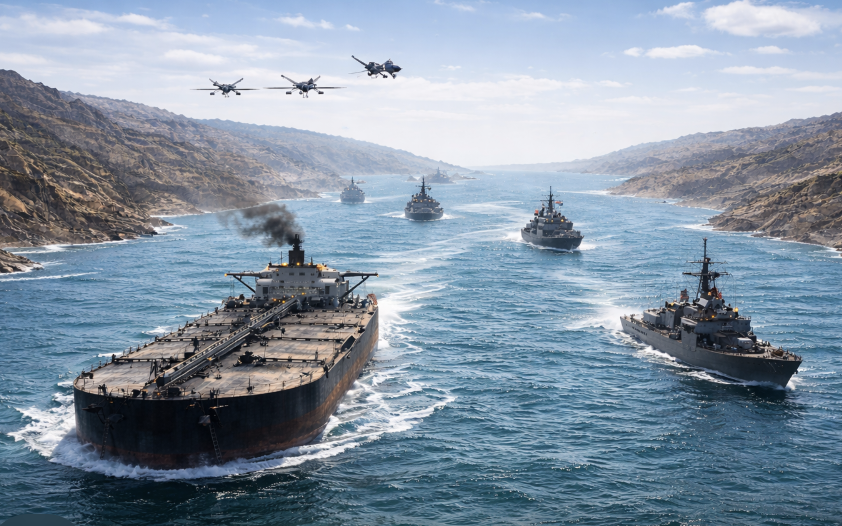
Peter Zeihan discusses the latest developments in the U.S. blockade of the Strait of Hormuz.
If you missed his earlier discussions, catch up here: Iran Controls the Strait → The U.S. May Flip the Global System.
The Blockade of Iran Begins
Summary
In this update, Peter Zeihan argues that the newly announced U.S. blockade—targeting ships going to or coming from Iranian ports—represents the first meaningful attempt to pressure the parts of Iran’s system that actually matter.
According to Zeihan, earlier military actions did relatively little to weaken Iran’s core power structure. While airstrikes damaged parts of the visible economy and eliminated some leadership, the real center of power—the Islamic Revolutionary Guard Corps (IRGC)—was largely unaffected. That’s because the IRGC derives much of its strength not from formal state structures, but from oil exports and smuggling networks.
The blockade changes that dynamic. By cutting off Iran’s ability to export oil—previously around 2 million barrels per day—and limiting its ability to import goods used in smuggling and military production, Zeihan argues the U.S. may have “stumbled into” a strategy that directly pressures the IRGC’s economic base.
At the same time, he cautions that early signs are inconclusive. On the first day of the blockade, almost no ships attempted to challenge it, and enforcement was minimal. Whether the U.S. is willing to consistently enforce the blockade—and for how long—remains an open question.
He also warns that applying real pressure comes with risks. The IRGC controls Iran’s missile and drone forces, and has demonstrated the ability to strike energy infrastructure across the Persian Gulf. If the blockade begins to significantly impact their position, retaliation is likely.
Another key shift Zeihan highlights is the reversal of earlier conditions in the Strait. Previously, Iranian and Chinese-linked shipping was moving relatively freely, while other traffic was constrained. Now, with the blockade in place, that flow appears to be disrupted—particularly the import of Chinese components used in drones and missiles. While Iran still has large stockpiles, cutting off resupply could matter over time.
However, the blockade has clear limitations. It is relatively easy for the U.S. Navy to monitor and restrict traffic through the Strait itself, but Iran has alternative pathways. The port of Chabahar, located outside the Strait in the Gulf of Oman, would require a separate effort to block. If left open, it could serve as a workaround for imports.
Beyond that, land routes remain a major gap. Goods can still enter Iran via trucking or rail through Pakistan or Central Asia. These routes are slower and more expensive, but not easily stoppable. Even so, delays of several weeks could still have meaningful effects in an active conflict.
Looking ahead, Zeihan identifies a few key things to watch: whether the U.S. expands enforcement to cover alternative ports like Chabahar, whether land-based supply routes begin to scale up, and whether negotiations resume in a more serious way.
The broader takeaway is that the blockade may represent the first policy move that actually targets Iran’s underlying power structure rather than its surface-level economy. But its effectiveness will depend on sustained enforcement, the ability to close workarounds, and how Iran chooses to respond.
In Zeihan’s view, the situation has reached a point where simply declaring victory and stepping back is no longer a viable option. If pressure is not maintained, Iran could emerge from the conflict in a stronger position—retaining control over the Strait, continuing its nuclear program, and sustaining its regional influence.

