


What if the safest-looking place for your money is quietly making it worth less? That’s the tension behind capital preservation strategies: limiting market losses matters, but so does protecting what your savings can buy. U.S. CPI inflation was 3.4% for the 12 months ending in August 2026, a reminder that a stable account balance doesn’t necessarily mean stable purchasing power.
If you’re wary of market swings and unsure when you’ll need your money, caution makes sense. But conservative investments aren’t all alike, and “low risk” doesn’t mean risk-free. Some offer quick access but may struggle to keep pace with inflation. Others can restrict access or expose you to losses if you need to sell at the wrong time.
This guide compares common conservative assets by principal risk, liquidity, and inflation exposure, then lays out a practical review process based on your time horizon and cash needs. The goal isn’t to eliminate every risk. It’s to understand which risks you’re accepting, and why.
Key Takeaways
- Separate protecting your account balance from preserving the purchasing power that balance represents.
- Use your time horizon and cash needs to weigh liquidity, market risk, inflation risk, and reinvestment risk.
- Compare capital preservation strategies by access, principal fluctuation, inflation exposure, and account terms.
- Build a review checklist around each dollar’s purpose, when you may need it, and how often to revisit your assumptions.
- Use market analysis and an educational virtual portfolio review to examine how your current approach aligns with your stated goals.
What Capital Preservation Strategies Aim to Protect
Capital preservation strategies prioritize limiting principal losses over maximizing investment growth. The aim is to reduce the chance that money set aside for a particular purpose will lose value, especially when there may be little time to recover before you need it. This focus can make an account feel more stable, but it doesn’t make every conservative investment risk-free.
Principal protection is an effort to limit losses, not a guarantee that your money can never lose value. A strategy may help steady an account’s stated balance while leaving it exposed to inflation, changing interest rates, or other risks. Start by defining what “protecting your money” means to you: keeping the same number of dollars, or maintaining what those dollars can buy?
Nominal principal versus real purchasing power
Nominal value is the dollar balance shown on an account statement. Real purchasing power is what that balance can buy after changes in prices are taken into account. The two can move in different directions: a balance may stay flat while everyday expenses rise, gradually shrinking the useful value of the money.
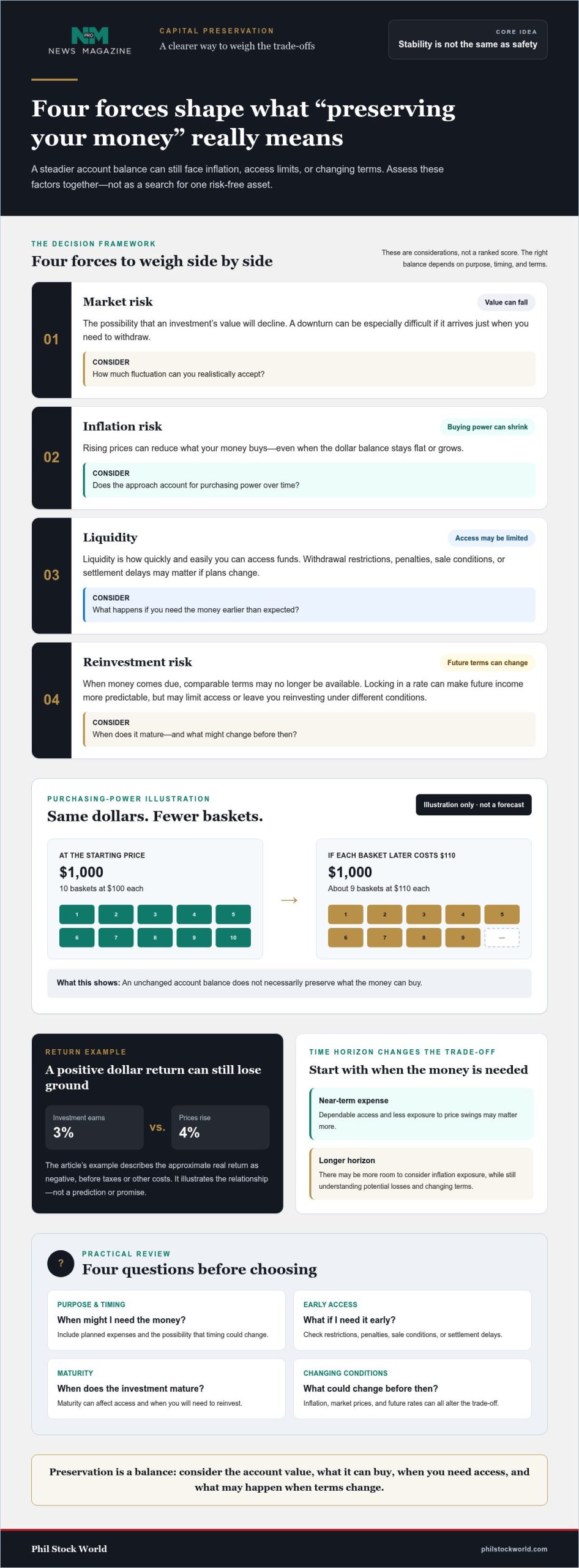
Imagine, purely as an illustration, that $1,000 buys ten baskets of goods priced at $100 each. If the same basket later costs $110, that unchanged $1,000 buys about nine baskets instead. The account balance hasn’t fallen, but its purchasing power has. This isn’t a forecast. It shows why a steady number on a statement doesn’t tell the whole story.
Some approaches explicitly consider purchasing power over time. The Fail-Safe Investing strategy, for example, is discussed in terms of preserving or increasing purchasing power, bringing inflation into the conversation alongside principal stability. That distinction is useful, but no strategy can remove every uncertainty or promise a particular outcome.
Who may consider a capital-preservation approach?
A preservation-focused approach may be relevant if you’re preparing for a known expense, such as tuition, a home purchase, or another planned cash need, and a sudden drop in value could disrupt the timing. It may also suit someone who places a high value on balance stability and would find market swings difficult to tolerate. Those priorities deserve a place in the decision, not dismissal as mere nervousness.
Still, “conservative” isn’t a one-size-fits-all setting. Someone who expects to use funds soon may care more about access and short-term stability. Someone with a longer horizon may weigh inflation and growth differently. Age alone can’t settle the question. Consider when each portion of your money may be needed, how much fluctuation you can realistically accept, and what trade-offs you’re willing to make for greater stability. Those answers define the job your investments need to do.
How Capital Preservation Strategies Balance Risk, Time, and Inflation
Preservation is a balancing act, not a hunt for a magic asset. An option that keeps an account value relatively steady may limit access, lose ground to rising prices, or create uncertainty when it’s time to reinvest. To judge whether it fits, consider four forces together: market risk, inflation risk, liquidity needs, and reinvestment risk.
Market risk is the possibility that an investment’s value will fall. Inflation risk is the chance that rising prices will weaken what your money can buy. Liquidity is how quickly and easily you can access funds. Reinvestment risk arises when money comes due and comparable terms may no longer be available. These risks interact. Locking in a rate may make future income more predictable, for example, but it can limit access or leave you reinvesting under different conditions later.
Why a lower-risk choice can still lose ground
Lower volatility does not automatically preserve purchasing power. An account balance can rise and still buy less if prices rise faster. The nominal return is the percentage increase in dollars; the real return reflects what remains after inflation. If an investment earns 3% while prices rise 4%, its approximate real return is negative, before considering taxes or other costs. This illustrates the relationship, not a prediction or promise of any result.
A smoother ride and a positive real return are separate goals. A lower-volatility option may reduce visible fluctuations, but it doesn’t guarantee that your money will keep pace with living costs. Finance Strategists’ overview of capital preservation also discusses inflation and interest-rate risk, two forces that can complicate otherwise conservative choices.
Match the approach to when the money is needed
Start with the purpose of the funds. Money earmarked for a near-term expense may call for dependable access and less exposure to price swings, since a downturn could arrive just when you need to withdraw. Capital intended for a longer horizon may leave more room to consider inflation exposure, but that doesn’t remove the need to understand potential losses or changing terms.
Before choosing an option, ask:
- When might I need the money? Consider planned expenses and the possibility that timing could change.
- What happens if I need it early? Check withdrawal restrictions, penalties, sale conditions, or settlement delays.
- When does the investment mature? A maturity date can affect both access and when you’ll need to reinvest.
- What could change before then? Inflation, market prices, and future rates can all alter the trade-off.
There’s no universal timeline or allocation that suits everyone. List each fund’s purpose and access date, then compare the terms with the risks you can accept. Reviewing market commentary can help you revisit assumptions as conditions change. Phil Stock World’s market analysis offers an educational perspective to consider as part of that process.
Comparing Capital Preservation Investments by Liquidity and Risk
Labels like “cash equivalent” and “conservative” can blur important differences. Compare what each option lets you do, what could make its value change, and how inflation might affect its purchasing power. Use the table as a starting point, not a ranking: terms vary by account, issuer, and investment.
| Option | Access | Principal fluctuation | Inflation exposure and key conditions |
|---|---|---|---|
| Savings account | Generally accessible, subject to account terms. | Balance is typically stable; eligible deposits may have FDIC coverage within limits. | Rates can change, so earnings may not keep pace with inflation. |
| Money market deposit account | Access depends on the account’s terms. | A bank deposit account, not an investment fund; eligible deposits may have FDIC coverage. | Rates can change. Review fees, withdrawal terms, and coverage eligibility. |
| Money market fund | Shares are generally redeemable, subject to fund and account procedures. | An investment fund, not a bank deposit; its value and income aren’t FDIC-insured. | Returns can change, and the fund doesn’t guarantee a positive real return. |
| Certificate of deposit (CD) | Funds are generally committed until maturity; early access may involve a penalty. | Value is typically stable if held to maturity under its terms; selling early may change the outcome. | A fixed rate can lose ground to inflation. Check maturity, early-withdrawal conditions, and deposit coverage. |
| Treasury bills and short-term bonds | Treasury bills mature on set dates; access before maturity may require selling. Bond access depends on the holding. | Market prices can fluctuate before maturity, particularly when sold early. | Yields and terms differ. Selling before maturity can mean receiving less than expected. |
| Treasury Inflation-Protected Securities (TIPS) | Have set maturities; selling beforehand exposes the investor to market pricing. | Market value can fluctuate before maturity. | Principal is linked to inflation measures, but price, income, and tax treatment require closer review. |
Cash accounts, money market funds, and CDs
A money market deposit account is held at a bank; a money market fund pools investments and is not a deposit account. Eligible bank deposits, including qualifying savings accounts, money market deposit accounts, and CDs, are covered by FDIC insurance up to $250,000 per depositor, per insured bank, for each account ownership category. Funds and securities aren’t FDIC-insured. For CDs, weigh the stated rate against the maturity date and the cost of early access.
Treasury securities, short-term bonds, and TIPS
Treasury bills are short-term U.S. government debt securities. Short-term bonds and Treasury securities can still fluctuate in market price if sold before maturity. TIPS are Treasury securities with principal linked to inflation; that feature doesn’t prevent market-price changes or settle every tax question. Review the details before deciding how they fit your needs.
These capital preservation strategies differ in access, price stability, inflation exposure, and protection. Before acting, verify current account or security terms, FDIC eligibility and limits, and tax treatment. Don’t assume a familiar label means a guarantee.
A Practical Checklist for Evaluating Capital Preservation Strategies
A useful review starts with the job each dollar needs to do, not with the product offering the most appealing rate. Separate emergency reserves, money set aside for planned spending, and funds intended for a longer horizon. They may need different levels of access and stability, so treating them as one undifferentiated pool can hide important trade-offs.
Work through this sequence before settling on an approach:
- Define the purpose. Name the expense or goal these funds support. Distinguish money for unexpected needs from cash earmarked for a known purchase or held for longer-term objectives.
- Set access needs. Note when you might need the money and whether that date can move. Consider how quickly funds must be available if circumstances change.
- Identify the risks. Look beyond market fluctuations. Consider inflation exposure, issuer or institution risk, early-withdrawal conditions, and whether any stated protection applies to the specific account or security.
- Compare the terms. Review rates, maturity dates, withdrawal restrictions, fees, taxes, and what happens if you need to exit early. A headline yield matters less if the conditions don’t fit the job.
- Schedule a review. Choose a reminder tied to a meaningful date or change in circumstances. Recheck whether the original purpose, access needs, and assumptions still hold.
Questions to answer before choosing an approach
Get specific about timing: When might you need the funds, and how flexible is that date? Then consider your comfort with a temporary balance decline, especially if selling early could lock in a loss. List the fine print to examine, including account protections, issuer details, taxes, fees, maturity terms, and withdrawal limits. If an answer is unclear, treat it as an open question rather than a detail to gloss over.
Review assumptions as conditions change
A plan is built on assumptions, and life can revise them. A change in income, a new expense, a postponed purchase, or shifting inflation can alter how much access or stability matters. Revisit your choices periodically and when a material change occurs; there’s no single review schedule that fits everyone. If the facts have changed, reassess the balance of risks rather than sticking with an old decision by default.
Keep a short record of each holding’s purpose, access conditions, and the reason you selected it. That makes future reviews less about reacting to headlines and more about checking whether the original logic still fits. For an educational perspective on changing market conditions, explore Phil Stock World’s market analysis as one input to your ongoing review.
How Phil Stock World Can Support More Informed Portfolio Decisions
Capital preservation isn’t a one-time setting. Market conditions shift, assumptions age, and a portfolio that once matched your priorities may deserve a fresh look. Phil Stock World provides market commentary, analysis, and virtual portfolio reviews to help readers think through those changes and examine how their approach aligns with their stated goals.
Use market analysis to question assumptions
Market commentary can provide context for reconsidering assumptions about volatility, diversification, and the risks held across a portfolio. For example, a change in interest rates or inflation may prompt you to ask whether your original reasoning still fits, rather than make a trade simply because a headline sounds urgent. Use commentary to support independent decision-making and further learning.
Rather than asking, “What should I buy now?” consider whether new information changes the purpose, time horizon, or risk you’re willing to accept. Phil Stock World’s discussion of long-term portfolio protection offers another perspective for reviewing how a portfolio responds to uncertainty.
Turn a portfolio review into a learning exercise
A virtual portfolio review provides a structured opportunity to examine your existing holdings and the thinking behind them. Consider whether the risks and strategy appear consistent with the goals you’ve stated, and identify assumptions you want to revisit. The exercise can help make your reasoning clearer and inform your next steps.
To get more from the exercise, prepare a concise snapshot before reviewing your portfolio:
- Your stated goals: What is the money intended to support?
- Your time horizon: When might you need access, and how flexible is that timing?
- Your key concerns: Which risks or portfolio assumptions would you like to understand better?
Those notes give the discussion a useful starting point and help distinguish a deliberate strategy from one that has simply accumulated over time. Learn more about the virtual portfolio review as an educational way to examine how your approach lines up with your stated goals.
Write down the purpose of your funds, the risks you’re comfortable accepting, and the assumptions you want to revisit. Phil Stock World’s member resources and market analysis can help you keep building your understanding, ask better questions, and make more informed decisions at your own pace.
Make Your Next Review More Intentional
The next useful move isn’t necessarily changing an investment. Write down what you need your money to do, what could disrupt that plan, and which assumptions deserve another look. That simple habit can make capital preservation strategies more deliberate as your needs and market conditions evolve.
Phil Stock World, led by veteran trader and market analyst Phil Davis, offers educational webinars, virtual portfolio reviews, market charts, and analysis to support more informed thinking. These resources can help you explore questions and examine your approach; they don’t guarantee performance or replace your own judgment.
Take the next step at your own pace. Explore Phil Stock World’s market analysis and educational resources to keep learning and bring sharper questions to your next portfolio review. A thoughtful process won’t remove uncertainty, but it can help you meet it with greater clarity.
Frequently Asked Questions
Is capital preservation the same as keeping money in cash?
No. Cash is one way to keep funds readily available, but preservation can also involve other assets chosen to limit loss or match a planned time horizon. Someone saving for an expense due soon may value easy access, while funds not needed immediately may be considered differently. Assess what each holding is meant to do rather than treating “preservation” as a synonym for cash.
Can capital preservation strategies keep pace with inflation?
Sometimes, but no approach can ensure that result across every period. Whether capital preservation strategies maintain purchasing power depends on how returns compare with inflation over the time you hold an investment, as well as applicable taxes and costs. Revisit that comparison when rates or expenses shift. A positive account return alone doesn’t establish that your money’s buying power has increased.
Are money market funds and money market deposit accounts the same?
No. A money market deposit account is a bank deposit product, while a money market fund is an investment that holds a portfolio of assets. Their names sound similar, but their protections and risks differ. Check the exact product name on your statement and read its disclosures, especially when comparing a bank account with investments shown in a brokerage account. Don’t assume one product’s protections apply to the other.
Are certificates of deposit and Treasury bills equally liquid?
No. Access depends on the specific terms and how you hold each investment. A CD may restrict early withdrawal or impose a penalty, while a Treasury bill may be sold before maturity, with its market price potentially affecting what you receive. If you’re comparing them for a planned expense, look at when the funds become available, any early-exit conditions, and whether selling could mean accepting a different value than expected.
What happens if I need money before a CD reaches maturity?
It depends on the CD’s terms. An early withdrawal may trigger a penalty that reduces the interest earned, and some CDs may not allow withdrawals before maturity. Brokered CDs can have different exit mechanics: selling before maturity may expose you to market-price changes. Before opening one, consider whether the maturity date fits your spending plans and whether you have another source of funds for unexpected expenses.
How do taxes affect interest from CDs and Treasury securities?
Taxes can reduce the amount of interest you keep, so a quoted yield isn’t necessarily your after-tax return. CD interest is generally taxable as interest income. Interest from U.S. Treasury securities is generally subject to federal income tax but exempt from state and local income taxes. Individual circumstances and current rules matter; consult current IRS guidance or a qualified tax professional when assessing how an investment may affect your tax situation.
How much of a portfolio should be focused on capital preservation?
There isn’t one percentage that fits everyone. The amount depends on what the money is for, when you may need it, your tolerance for fluctuations, and the other resources available to meet planned expenses. Rather than choosing a share by age or rule of thumb, list upcoming needs and decide which funds must be available with less exposure to market swings. Revisit that decision when your goals or circumstances change.

