


A market selloff can make buying puts feel like the obvious move. But a hedge sized around a scary headline, rather than the risk in your holdings, can cost more than it protects. If you’re weighing how to hedge a portfolio with put options, start by matching the hedge to a defined exposure, not trying to insure everything at any price.
It’s reasonable to want a clearer floor when markets turn, especially when choosing between puts on individual holdings and a broad index feels complicated. Puts can help offset losses, but they don’t guarantee protection: the strike, expiration, premium, and fit with your portfolio all matter. A put can lose value even while your investments feel vulnerable, particularly if the market move, timing, or volatility doesn’t line up with the contract.
This guide lays out a repeatable way to identify what you’re hedging, estimate how much protection you want, and compare strikes and expirations with the premium. You’ll also see what a put hedge can’t cover and how to review it so the strategy stays tied to your risk plan, not the latest bout of market nerves.
Key Takeaways
- Define the portfolio risk you want to address before choosing a put. A market headline alone isn’t a sizing plan.
- Compare single-stock and index puts by how closely each matches your holdings, including the risk that the hedge and portfolio move differently.
- Learn how to hedge a portfolio with put options by weighing strike, expiration, protection period, and premium as connected choices.
- Use a repeatable review process to reassess exposure, hedge size, and timing as your portfolio and market conditions change.
- Account for the cost of protection when puts expire unused, and consider how hedging fits alongside diversification, rebalancing, and cash management.
Why hedge a portfolio with put options instead of simply selling?
When markets feel fragile, an investor faces a familiar choice: sell holdings and step aside, or stay invested and accept every dip. A put hedge offers another approach. It’s an options position intended to offset some losses in related holdings while allowing the investor to keep those holdings and participate if prices rise. The central question in how to hedge a portfolio with put options isn’t how to eliminate risk. It’s whether the protection is worth its cost for a clearly defined exposure.
A put buyer pays a premium for a contractual right, not an obligation, to sell the underlying asset at a specified strike price under the option’s terms. Some puts can be exercised before expiration; others can only be exercised at expiration. The buyer may also sell the option before it expires. As the underlying falls, a purchased put may gain value, but the result also depends on time remaining, implied volatility, and other pricing factors. The What is a Put Option? overview explains the basic mechanics.
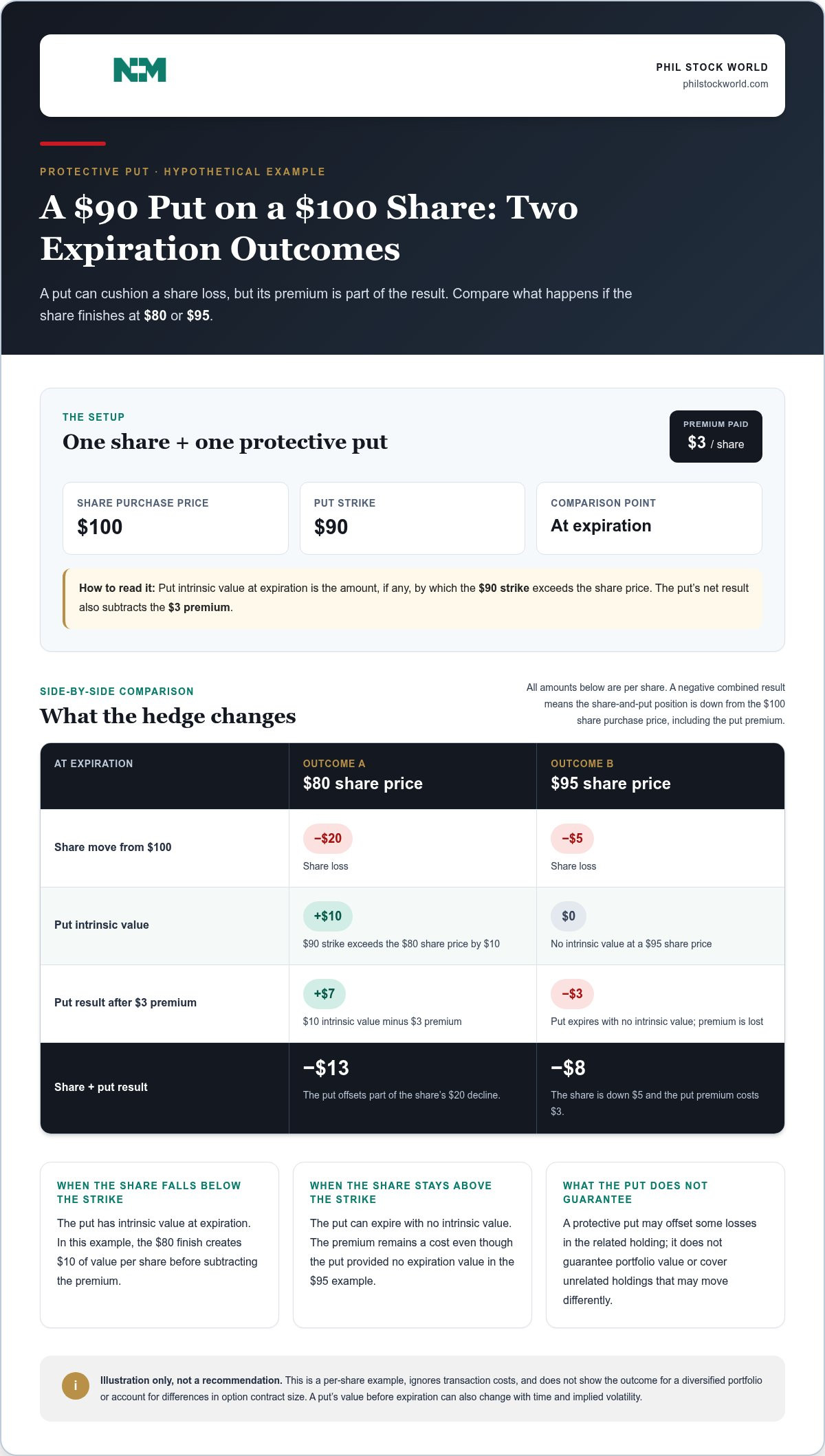
A protective put is a purchased put paired with a related holding, designed to offset some downside over a chosen period, not to guarantee a portfolio’s value. For example, an investor who owns shares bought at $100 and buys a put with a $90 strike for a $3 premium may get a cushion against losses below the strike at expiration. But the premium is a cost, the shares can still lose value above the strike, and unrelated holdings may not move in step with the option’s underlying asset.
What does a put option hedge actually do?
Think of the put as a paid-for contingency, not a force field. It can become more valuable when its underlying falls, yet it may lose value if the decline doesn’t arrive before expiration or if pricing factors move against it. A portfolio hedge is meant to manage exposure you already own; buying puts without a related position is closer to a bearish speculation. Neither approach guarantees a profit or prevents all losses.
When might a hedge fit an investor’s objective?
A temporary hedge may suit a defined period of concern, such as an upcoming company event or a short-term need to limit exposure. A standing hedge aims to protect for longer, but premiums can accumulate each time protection is renewed. Ask yourself: am I reducing a specific holding’s risk, or trying to preserve broad market participation through a downturn?
The answer also helps distinguish options from other ways to manage risk. Holding more cash can reduce the amount exposed to market declines, while rebalancing can bring an oversized position back toward a chosen allocation. Reducing concentration can lower dependence on one company or sector. These approaches have their own trade-offs, but they don’t require buying options. A put hedge makes sense only when its target, time horizon, and cost align with the risk you want to address.
How put-option value changes as the market, time, and volatility move
A put’s premium isn’t a fixed price tag. It shifts with the underlying asset, the strike, time until expiration, and implied volatility. That’s why a hedge can behave differently from the simple story of “market falls, put rises.” To understand how to hedge a portfolio with put options, separate the payoff at expiration from the option’s changing market value before that date.
Strike price, expiration, and the protection threshold
A put is at the money when its strike is near the underlying price, in the money when the underlying is below the strike, and out of the money when it’s above. At expiration, a put’s intrinsic value is the amount, if any, by which its strike exceeds the underlying price. A lower strike generally costs less upfront but leaves more of an initial decline uncovered. A nearer expiration means a shorter protection window, so compare the expiration date with the period you actually want to cover.
Implied volatility, time decay, and option premium
Before expiration, a put’s premium can include both intrinsic value and time value. Implied volatility is the level of expected movement reflected in option prices, not a promise or forecast that a particular move will happen. Higher implied volatility can raise premiums, making protection more expensive. The Cboe Volatility Index, or VIX, is one broad-market volatility reference, not a substitute for the price or implied volatility of a specific put.
Time works against a purchased option if other factors stay unchanged. As expiration approaches, there’s less time for a favorable move, so the option’s time value generally erodes. A put can lose value while the underlying stays stable because time passes and the option’s remaining time value shrinks. Changes in implied volatility can also affect the premium, sometimes offsetting or amplifying that decay.
Hypothetical example, not a recommendation: Suppose a share trades at $100 and an investor buys a put with a $90 strike for a $3-per-share premium. At expiration, if the share is $80, the put has $10 of intrinsic value per share. Ignoring transaction costs, that’s a $7 net gain on the put after its premium, which offsets part of the share’s $20 decline. If the share instead finishes at $95, the put expires with no intrinsic value, and its buyer loses the $3 premium while the share has declined $5. The example illustrates the payoff on one share; it doesn’t show the outcome for a diversified portfolio or account for differences in option contract size.
Before expiration, the put may be worth more or less than its intrinsic value because time and implied volatility still matter. For instance, a sharp jump in expected volatility could increase its premium even before the underlying falls; a drop in volatility could pull the premium down. Reviewing market charts and options analysis can help you understand these moving parts. Phil Stock World’s market commentary and analysis offers additional context on market conditions, while an index reading alone can’t price an individual hedge.
Match put options to portfolio exposure and size a hedge
Start with the portfolio, not the options chain. List the holdings you want to protect, their approximate weights, any concentrated positions, and the sectors that drive the portfolio’s risk. Then define the protection period. A hedge that expires before the risk you care about has passed may offer little help when you need it.
The right underlying matters. A put on one stock may track a concentrated holding more directly, while a broad-index put can cover some market-wide exposure across several holdings. But an index won’t mirror every portfolio: differences in companies, sector weights, and performance create basis risk, the chance that the hedge and the assets move differently. The S&P 500 is one possible reference point, not a universal match.
Choosing between a single-stock put and an index put
A single-stock put may be worth analyzing when a portfolio’s risk is concentrated in that same company. An index put may be more relevant when the intended hedge is broad market exposure. Neither is automatically precise. Compare the option’s underlying with your holdings, including sector and company mix, then consider how much mismatch you can tolerate.
| Factor | Single-stock put | Broad-index put |
|---|---|---|
| Underlying match | Direct for the specific stock | Tracks an index, which may differ from portfolio holdings |
| Hedge precision | Potentially closer for a concentrated position | Depends on how closely the portfolio follows the index |
| Complexity | Requires assessing company-specific exposure | Requires comparing portfolio mix and index composition |
| Key limitation | Doesn’t directly hedge other holdings | Basis risk if holdings or weights diverge from the index |
Estimating contracts without mistaking a rough hedge for certainty
Delta estimates how much an option’s price may change for a small move in its underlying, all else equal. It changes as market conditions and the option itself change, so it isn’t a fixed hedge ratio. A rough sizing framework is:
Estimated contracts = desired dollar hedge ÷ (underlying price × absolute put delta × contract multiplier).
Hypothetical sizing example: Suppose a portfolio is valued at $100,000 and an investor wants to model coverage equal to 20% of that value, or $20,000. An index fund is trading at $500, and a put has an absolute delta of 0.40. Using a 100-share multiplier, the estimated sensitivity-based coverage per contract is $500 × 0.40 × 100, or $20,000. That suggests one contract as a rough starting estimate, not a promise that losses will be offset by that amount. It assumes the portfolio moves like the chosen index, an assumption that may not hold.
Standard equity option contracts commonly represent 100 shares, but adjusted contracts can differ, so check the contract terms. This framework helps explain how to hedge a portfolio with put options while keeping the limits visible: delta shifts, prices move, and a rough calculation can’t erase mismatch risk.
How to put a portfolio hedge in place and manage its trade-offs
A hedge is easier to manage when its job is clear before you enter it. Use this process to connect the option to a specific risk, then review whether it still fits as your holdings and market conditions change. This is a framework for analysis, not a guarantee of protection or a recommendation to trade.
- Define the risk. Name the holding, sector, or broad-market exposure you want to address, and estimate how much downside you’re trying to offset. Avoid treating “markets might fall” as a complete hedge objective.
- Choose the exposure. Compare the option’s underlying with the portfolio risk. A hedge tied to a different asset may not move in step with your holdings.
- Set the time horizon. Match expiration to the period you want to cover, while recognizing that markets don’t follow a schedule and an option can expire before a risk has passed.
- Estimate the size and cost. Review the contract multiplier, option sensitivity, premium, and how much of the intended exposure the position may address. For a purchased put, the premium paid is generally the maximum option loss, excluding transaction costs.
- Review the position. Decide in advance what changes in your portfolio or the option’s remaining term would prompt a fresh assessment.
A practical checklist before entering a hedge
Write down the amount and type of risk the put is meant to address. Check that expiration covers the intended period without assuming you can time a market move precisely. Then inspect liquidity, the bid-ask spread, and contract details, including multiplier and exercise terms. A wide spread can make entry or exit less favorable. Phil Stock World’s risk management for options resources can support your research, but they don’t promise that a hedge will work as planned.
There’s a real cost to protection. If markets rise, remain stable, or fall only after the put expires, the premium may be lost. Repeatedly buying new puts can weigh on returns over time, even when each purchase has a defined purpose. That trade-off is central to deciding whether the potential offset is worth paying for.
Monitoring the hedge as conditions change
Reassess after a major portfolio change, a meaningful market move, or as expiration approaches. Ask whether the original exposure still exists, whether the option still covers the intended period, and whether its current cost and sensitivity fit the objective. Don’t keep a position simply because you already paid for it.
Closing or “rolling” a put by replacing it with a later-dated option is a new decision, not an automatic extension. It can involve another premium, transaction costs, and a different strike or level of protection. Before expiration, understand the contract’s exercise and assignment process: exercising a long put can mean selling the underlying at the strike, while assignment affects the option writer. Procedures can vary by contract and account. Phil Stock World offers a virtual portfolio review to help you examine how a proposed hedge relates to your holdings, along with options education and market analysis for continued learning.
Make put hedging part of a disciplined investing process
A put hedge works best as part of a repeatable decision process, not as a reflex to every market scare. The useful question isn’t simply whether the option made money. It’s whether the position addressed the risk it was meant to address, at a cost and over a period you understood. Keep that standard in view, and each hedge can teach you something about your portfolio and your assumptions.
- Identify the exposure. Note which holding, sector, or market risk you’re concerned about.
- Define the purpose. State what the put is intended to offset and for how long.
- Evaluate the cost. Consider the premium, potential time decay, and the risk that the hedge won’t track your holdings closely.
- Monitor the position. Revisit it as portfolio exposure, market conditions, and expiration change.
- Learn from the outcome. Compare what happened with the original objective, then adjust your process rather than assuming the same setup will work again.
Puts are one tool, not a complete risk plan. Diversification can reduce reliance on a narrow set of holdings; rebalancing can bring allocations back toward intended levels; and cash management can change how much capital is exposed to market moves. These approaches have different trade-offs, and a put may not be necessary for every risk or every period.
What a successful hedge should, and should not, mean
Judge success against the stated purpose: did the put offset some of the defined exposure during the period you intended? A hedge can lose money while the overall portfolio performs well, because protection has a cost and markets may rise or remain steady. That doesn’t automatically mean the decision was poor. Nor does one profitable hedge prove that the same method will work under different market conditions.
Keep a brief record of the reason for the position, its expected role, and what you observed as it changed. This makes the review more useful than simply labeling the trade a win or a loss. It also helps distinguish a sound process from a favorable outcome driven by timing.
Continue learning with market context and portfolio review
Options strategies are easier to assess when you keep learning how market conditions, volatility, and portfolio exposure interact. Phil Stock World publishes market commentary and options education, along with market analysis and virtual portfolio reviews that help readers examine a strategy in context. A review is an opportunity to discuss and learn from portfolio considerations, not a promise of a particular outcome.
For a deeper look at advanced option trading strategies and ongoing options education, explore Phil Stock World’s educational resources. The aim isn’t to hedge every uncertainty. It’s to make deliberate choices, understand their trade-offs, and revisit them with a clear head.
Make your next hedge decision with a clearer framework
Turn your thinking into a simple review habit. Before acting, write down the risk you want to address and what would make you reconsider the position. That note can keep future decisions anchored to your stated purpose rather than the mood of the market. Learning how to hedge a portfolio with put options is an ongoing process, not a one-time call on where prices are headed.
Phil Stock World was founded and is led by veteran trader and market analyst Phil Davis. Its educational webinars, virtual portfolio reviews, and membership access to market analysis and trading-room content offer ways to keep building market knowledge. These resources support learning and review, not guaranteed results or individualized financial planning.
Explore Phil Stock World’s market analysis and options education to keep sharpening your understanding. A thoughtful process won’t remove uncertainty, but it can help you meet it with more confidence and discipline.
Frequently Asked Questions
How much of my portfolio should I hedge with put options?
There’s no fixed percentage that fits every portfolio; decide based on the loss you’re trying to cushion and the exposure driving it. For example, if one holding dominates your risk, hedging a small slice of broad-market exposure may miss the point. Consider how the portfolio might behave under different declines, then compare partial coverage with the premium you’d be willing to spend. The goal is a deliberate risk choice, not a universal hedge ratio.
Can put options protect an entire stock portfolio?
Not reliably in every market scenario. A broad-index put may offset some losses if your stocks move similarly to that index, but sector concentration, individual company news, or different portfolio weights can cause a mismatch. For example, a portfolio tilted toward technology may fall more or less than a broad index. Even a carefully matched hedge won’t prevent every loss, so consider which exposures it leaves uncovered before treating it as portfolio-wide protection.
What happens if my put option expires out of the money?
If the underlying price is above the put’s strike at expiration, the option generally has no exercise value and expires without being exercised. The put buyer loses the premium paid, plus any applicable transaction costs, while still owning the underlying shares if they were held separately. Check the expiration date and contract terms as it approaches. If you don’t want the option to expire, closing it beforehand is a separate decision that depends on its then-current market value.
Is buying a put the same as shorting a stock?
No. Buying a put gives you a right under the contract to sell the underlying at its strike; shorting stock involves borrowing and selling shares with the aim of buying them back later at a lower price. A put buyer’s option loss is generally limited to the premium paid, while a short stock position can lose more as the share price rises. The strategies also differ in costs, timing, and how they respond to volatility.
How do I choose a strike price for a portfolio hedge?
Start by deciding how much decline you’re prepared to absorb before the put begins to provide intrinsic value. A strike closer to the current price generally sets an earlier threshold, while a lower strike leaves more initial decline uncovered. Also consider the premium: at expiration, the put buyer’s breakeven is generally the strike minus the premium paid. Compare possible thresholds with the exposure you’re hedging, not just the option’s apparent affordability.
Do put options always increase in value when the market falls?
No. A put’s price depends on its own underlying, strike, time remaining, and implied volatility, not simply whether the overall market is down. An index can fall while a particular stock rises, for example, leaving a put on that stock weaker. Even if the underlying declines, time decay or falling implied volatility can offset some of the effect. Review the option’s price drivers and portfolio fit before assuming a market drop means the hedge gained value.

