


Gold might be sitting at $4,522 an ounce, but that hasn’t stopped your purchasing power from taking a massive hit this year. It’s a bitter pill to swallow when the traditional hedges fail to move the needle while the 3.4% CPI eats your lunch. You’ve likely noticed that simply buying and holding isn’t enough when the Fed is signaling more rate hikes and energy costs are climbing. To truly protect your wealth, you need sophisticated trading strategies for high inflation that go beyond the generic advice found in mainstream headlines.
This isn’t about panic; it’s about pivoting to a “house” mindset where you sell the premium that others are desperate to buy. We’re moving past the confusion of Fed policy to focus on actionable plays that turn inflationary pressure into a portfolio-building opportunity. We’ll break down exactly how to identify sectors with real pricing power and use active options to turn market volatility into a reliable income stream that offsets your rising living costs. It’s time to stop playing the game and start running the floor.
Key Takeaways
- Learn why the 60/40 portfolio is a sitting duck in the current macro climate and why government-reported inflation metrics often miss the mark for active traders.
- Master specific trading strategies for high inflation by moving beyond gold and targeting the “Essential Three” commodities that drive the 2026 supercycle.
- Discover how to trade like the house by selling premium and using vertical spreads to generate income while capping your downside risk.
- Identify the pricing power stocks that can raise prices without losing customers, focusing on the gross margin tests that separate winners from losers.
- Understand the importance of real-time market commentary and live trading rooms to adjust your hedges as fast as the economy moves.
The Inflation Trap: Why Mainstream Portfolio Advice Fails in 2026
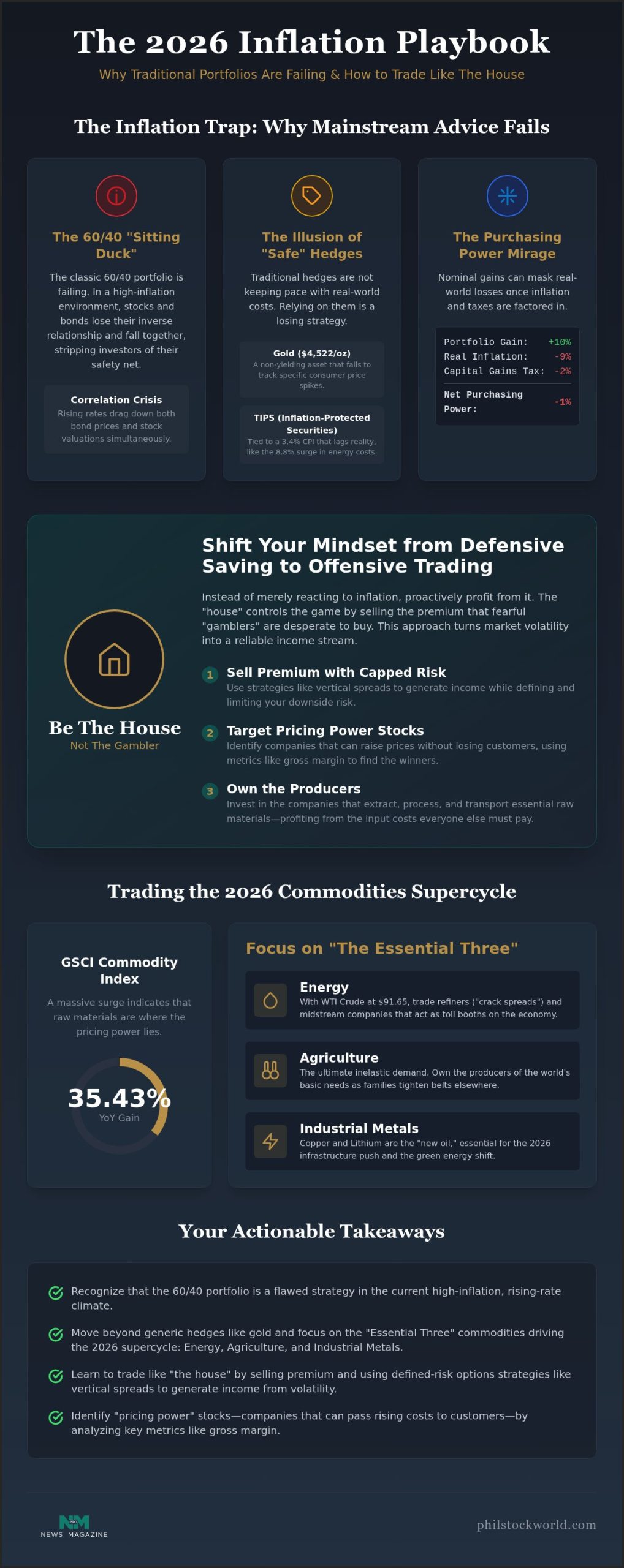
The 60/40 portfolio used to be the gold standard for “set it and forget it” investing. In 2026, it’s a sitting duck. When inflation drives the market narrative, the old rules of diversification crumble because the inverse relationship between stocks and bonds disappears. If you’re following the herd, you’re likely watching your “safe” bond allocation lose value right alongside your equities as the Federal Reserve keeps the effective funds rate at 3.63% to battle a 3.4% CPI that feels much higher at the grocery store.
Mainstream advisors often point toward Treasury Inflation-Protected Securities (TIPS) as the solution. However, TIPS are tethered to government-reported metrics that frequently lag behind the real-world costs of energy and agriculture. With energy prices rising 8.8% in August alone, a government index simply doesn’t capture the heat. Relying on these tools is like bringing a knife to a gunfight. You need more aggressive trading strategies for high inflation to stay ahead of the curve.
Then there’s the “Purchasing Power Mirage.” If your portfolio nets a 10% gain while real-world inflation sits at 9%, you might feel like a winner. But once you factor in capital gains taxes on those nominal profits, your actual purchasing power has shriveled. Shifting from a defensive “saver” mindset to an offensive “trader” strategy isn’t just a choice anymore; it’s a requirement for survival. You can’t just hope to keep up; you have to outpace the burn. Resources like Geldhelden can provide the practical wealth protection strategies needed to navigate these systemic risks.
The Correlation Crisis in Modern Markets
Bonds stop acting as a shock absorber the moment inflation becomes the primary risk. When the Fed signals that rates must stay high, the discount rate applied to future cash flows rises, dragging down the valuations of even the sturdiest “safe” stocks. You can’t hide in tech or utilities when the entire board is bleeding red. Inflationary correlation is the phenomenon where rising interest rates and price pressures force stocks and bonds to move downward in lockstep, stripping investors of their traditional safety nets.
Debunking the Gold Myth
While gold has hit $4,522, it remains a non-yielding asset that often fails to track the specific price spikes hitting your wallet. Understanding what an inflation hedge is requires looking beyond shiny metals toward productive assets. A bar of gold doesn’t have a CEO, a sales team, or the ability to raise prices on its customers. Companies with massive pricing power offer a superior alternative. They can pass costs along and grow their dividends, whereas gold just sits in a vault, costing you the opportunity to earn a real yield elsewhere. Success requires active trading strategies for high inflation that prioritize cash flow over stagnant stores of value.
Trading the Commodities Supercycle: Beyond Generic Hedges
The GSCI Commodity Index has surged 35.43% compared to last year, yet most retail traders are still trying to hedge with broad ETFs that get eaten alive by contango and poor roll yields. If you want to move beyond generic advice, you have to focus on the “Essential Three”: Energy, Agriculture, and Industrial Metals. In 2026, raw materials are the place to be because they represent the input costs that everyone else is forced to pay. While consumer discretionary stocks suffer as families tighten their belts, the producers of the world’s basic needs are sitting in the catbird seat.
Trading like “the house” means you don’t just bet on the spot price of oil or corn. Instead, you own the companies that extract, process, and transport these goods. This approach allows you to capture dividends and earnings growth while the rest of the market panics over the next CPI print. It’s one of the most effective trading strategies for high inflation because it puts you on the side of the people raising the prices, rather than those paying them. Timing these entries requires a keen eye on sector-specific sentiment, looking for the moment when the herd’s fear turns into institutional accumulation.
Energy Trading in a Supply-Constrained World
With WTI Crude hovering around $91.65, the real money isn’t in the futures market; it’s in the “crack spreads.” By trading the equities of refiners, you’re betting on the margin between raw crude and finished products like gasoline. Midstream companies are another powerhouse, offering “inflation-plus” dividends that act as a toll booth on the global economy. Don’t ignore the green shift either. Industrial metals like Copper and Lithium are the new oil, and they’re essential for the 2026 infrastructure push, making them a vital component of any modern portfolio.
Agriculture: The Ultimate Inelastic Demand
People can skip a new car, but they can’t skip dinner. This makes agriculture the ultimate play for inelastic demand. When food prices rise, the companies providing fertilizer and high-tech machinery see their margins expand. To time these entries, you need to understand how to read market charts to spot where institutional money is quietly accumulating these profitable stocks. Watching these footprints allows you to enter before the mainstream media starts screaming about a food crisis. If you’re feeling overwhelmed by these macro shifts, a Virtual Portfolio Review can help you identify which of your current holdings are vulnerable to rising input costs.
Options Strategies for Inflationary Volatility
Mainstream advice usually suggests bonds for income. But in 2026, with the Fed funds rate at 3.63% and CPI at 3.4%, your real return is barely breathing. You need to manufacture your own yield. This is where professional trading strategies for high inflation separate the pros from the victims. By selling premium, you stop being the person buying hope and start being the “house” that sells insurance to the panicking herd. With the VIX sitting at 14.32, premiums might look lean to the untrained eye, but the smart money knows this is the time to set up structures before the next volatility spike hits.
Theta decay is your secret weapon. While the market treads water or reacts to the latest energy price spikes, like the 8.8% jump we saw in August, time value bleeds out of the options you’ve sold. It’s a methodical way to build a portfolio when traditional assets are stagnant. Vertical spreads are particularly effective here, allowing you to cap your risk while still participating in sector rotations. If you’re worried about sudden drops in your core holdings, hedging with put options allows you to lock in gains on those commodity producers we discussed earlier without actually liquidating your position.
The Covered Call: Generating Your Own “Inflation Dividend”
Selling covered calls on your high-pricing-power stocks is like creating a custom dividend. Start by selecting a strike price that is 5 to 10 percent out of the money. This gives you room for the stock to run during an inflationary “melt-up” while still collecting a fat premium. If the stock stays flat, you keep the cash and the shares. If it rises, you’ve capped your gain at a level you were happy with anyway. Selling these calls consistently lowers your cost basis over time, making your portfolio increasingly resilient to price shocks.
Bull Put Spreads: Betting on the Floor, Not the Ceiling
In a volatile interest rate environment, retail traders are often terrified of the next leg down. You can profit from this fear by selling bull put spreads. Instead of guessing how high a stock will go, you’re simply betting it won’t fall below a certain floor. By selling a put and buying a cheaper one further out, you cap your risk while collecting premium from those running for the exits. This strategy offers a massive margin of safety, especially in sectors like energy where demand is inelastic even as costs rise. It’s about being the one who provides liquidity when others are desperate for an exit.
The Pricing Power Play: Identifying Inflation-Resistant Stocks
Pricing power isn’t just a buzzword. It’s the difference between a business that survives and one that gets hollowed out by rising input costs. In 2026, the margin test is the only metric that truly speaks the truth. Look at the gross margins over the last four quarters. If they’re expanding while the CPI is rising, you’ve found a winner. It means the company has a moat so deep that customers will pay whatever is asked. High-inflation regimes reward companies that can tell their customers “the price is going up” and hear “okay” in response.
This is why asset-light businesses are the darlings of sophisticated trading strategies for high inflation. Heavy industry is currently getting crushed by the double whammy of rising CAPEX costs and higher interest rates on their debt. When it costs significantly more to replace a fleet of trucks or upgrade a factory, those profits evaporate. Conversely, a software company with a fixed cost of code doesn’t care if the price of steel doubles. Don’t fall into the value trap of buying low P/E stocks that are actually margin-thin laggards. Many traders see a low P/E ratio and think they’ve found a bargain, but if that company’s debt needs to be refinanced at 2026 rates, that “cheap” stock is actually a liability.
Luxury and Inelastic Moats
The top 1% of consumers are essentially inflation-immune. When a luxury item costs $10,000, a $500 price hike doesn’t change the buyer’s behavior. Trading luxury brands allows you to capture that immunity. Similarly, software-as-a-service (SaaS) firms with multi-year enterprise contracts have a locked-in revenue stream that creates a massive moat. If you aren’t sure if your current holdings have this kind of protection, a virtual portfolio review is a critical step in auditing your exposure to margin-thin laggards.
Financials and the Interest Rate Spread
Banks are the natural beneficiaries of the Fed’s fight against price hikes. As interest rates rise to 3.63%, the spread between what banks pay depositors and what they charge for loans widens. This net interest margin is pure profit. However, you must be selective. Spotting the difference between healthy regional banks and over-leveraged zombies is the key to trading this sector successfully. You can use financial sector options to play the yield curve without the risk of owning the underlying shares. To see how we’re positioning our own capital in these sectors, check out our Premium Membership for real-time trade alerts.
Mastering the Macro: The Phil Stock World Advantage
In a fast-moving economy, yesterday’s news is a liability. While mainstream outlets are busy dissecting last month’s CPI data, the 2026 market has already moved on to the next energy shock or interest rate whisper. You can’t win by following the “Seeking Alpha” echoes or tracking the same generic advice everyone else is reading. To truly succeed, you need a perspective that’s skeptical of the herd and focused on the granular shifts in policy and price action. This is where professional trading strategies for high inflation become more than just a plan; they become a daily practice of risk management and opportunity hunting.
The real secret to “trading like the house” is the ability to adjust your hedges on the fly. Static portfolios get shredded when the Fed funds rate sits at 3.63% and volatility starts to creep up from its 14.32 floor. Our Live Trading Room provides the real-time commentary you need to make those adjustments before the window of opportunity slams shut. By securing a Phil Stock World membership, you’re gaining access to street-smart research that prioritizes clarity over pretense. It’s about having the discipline to ignore the noise and focus on the data that actually moves the needle.
The Power of Community Intelligence
There’s a massive advantage in having hundreds of savvy traders looking for “alpha” in the corners of the market that big banks often overlook. Whether it’s a niche industrial metal or a specific agricultural play, our community identifies value where the herd is panicking. Having a mentor like Phil Davis, who has traded through multiple cycles, provides the institutional knowledge you won’t find in a textbook. For those who wish to apply this level of professional guidance to the property market, you can explore Mentorship Program at Multifamily Schooled to master apartment investing. Trading with a disciplined group provides the psychological edge needed to stay calm when the rest of the market is running for the exits.
Success in this environment requires immediate action. Start by setting up your “Inflation Watchlist” today, focusing on the pricing power stocks and commodity producers we’ve discussed. You should also audit your current portfolio for “hidden” inflation risks, such as companies with high debt-refinancing needs or thin margins. We invite you to join our next interactive educational webinar for a deep dive into these tactics. It’s time to stop being a victim of the macro environment and start being the one who profits from it.
Taking Control of the 2026 Macro Narrative
The days of passive indexing and hoping for the best are over. To thrive in a market defined by a 3.63% Fed rate and persistent 3.4% CPI, you must trade with intention. We’ve explored how moving beyond generic hedges and into the “Essential Three” commodities protects your purchasing power. We’ve also seen how identifying companies with true pricing power ensures your equity plays aren’t hollowed out by rising costs. These trading strategies for high inflation are about more than just staying afloat; they’re about capturing the wealth transfer that inflation inevitably triggers.
It’s time to stop reacting to the headlines and start anticipating them. By leveraging the tools at Phil Stock World, you gain an insider’s edge. Stop following the herd and start trading like “the house”—join Phil Stock World today for real-time alerts and expert market commentary. You’ll get immediate access to our Live Options Trading Room, daily market charts, and professional-grade analysis. Plus, our Virtual Portfolio Reviews will help you audit your current strategy to ensure you’re inflation-ready. The market doesn’t wait for the indecisive. Take the lead and turn this macro pressure into your greatest opportunity.
Frequently Asked Questions
What are the best stocks to buy when inflation is high?
The best stocks are those with massive pricing power and asset-light models. Think luxury brands or enterprise software where input costs stay flat while prices rise. You also want exposure to the “Essential Three” commodities: Energy, Agriculture, and Industrial Metals. These companies act as the “house” by passing costs to consumers, making them core components of effective trading strategies for high inflation in the 2026 market.
How do options help protect a portfolio from inflation?
Options allow you to manufacture your own yield and hedge against downside volatility without selling your core positions. By selling covered calls or bull put spreads, you collect premium from traders who are panicking over the latest CPI print. This “house” approach turns market uncertainty into a consistent income stream. It’s a proactive way to offset rising living costs while keeping your portfolio protected from sudden interest rate shocks.
Is gold still a good hedge against inflation in 2026?
Gold has reached $4,522, but it remains a non-yielding asset that carries a high opportunity cost. Unlike a company with pricing power, gold doesn’t have a sales team or a CEO working to grow its value. While it can act as a store of value, it often fails to track specific price spikes in energy or food. Productive assets that generate cash flow are usually a more efficient way to outpace inflation.
What is the difference between real and nominal returns for traders?
Nominal returns are the raw profits you see on your screen, while real returns are what’s left after subtracting inflation and taxes. If you earn 10% when inflation is 9%, your nominal gain looks great, but your actual purchasing power has barely moved. Once you pay capital gains taxes on that 10%, you’ve actually lost money. Smart traders focus on real returns to avoid the common “Purchasing Power Mirage.”
How does rising interest rates affect my trading strategy?
Rising interest rates increase the discount rate applied to future cash flows, which often compresses valuations for high-growth tech stocks. However, higher rates also widen the “spread” for banks, increasing their profit margins. Your strategy should shift toward financials and companies with low debt-refinancing needs. Understanding how the 3.63% Fed funds rate impacts different sectors is essential for refining your trading strategies for high inflation and avoiding valuation traps.
Can I use a virtual portfolio to test inflation-hedging strategies?
You can certainly use a virtual setup to stress-test your positions before committing real capital. At Phil Stock World, we offer a Virtual Portfolio Review to help you audit your current holdings for hidden inflation risks. This process allows you to see how your portfolio reacts to shifts in energy prices or interest rate hikes. It’s an essential step for any trader wanting to ensure their strategy is actually inflation-ready.
Why do retail traders usually lose money during inflationary periods?
Retail traders often lose because they chase yesterday’s news and rely on outdated hedges like TIPS or broad commodity ETFs. They tend to follow the herd into popular “safe” stocks that become valuation traps when interest rates rise. Without a community or real-time commentary, they fail to adjust their hedges as fast as the economy moves. They get stuck paying the higher prices that the “house” is busy collecting.
Which sectors should I avoid when the CPI is rising?
Avoid consumer discretionary sectors where families are likely to cut spending as their budgets tighten. You should also stay away from capital-intensive heavy industries that face massive CAPEX costs and high debt-refinancing risks. Margin-thin retailers are another danger zone; if they can’t pass on a 3.4% CPI increase to their customers, their profits will vanish. Stick to sectors with inelastic demand and the power to set their own prices.

