

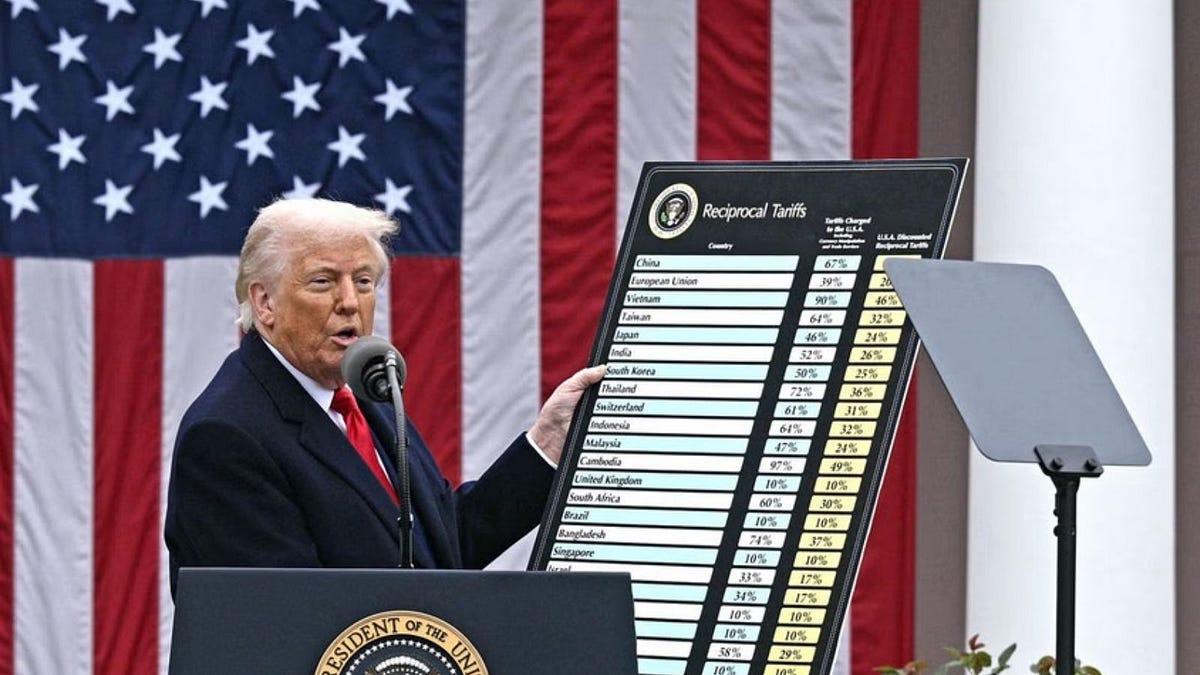
On April 2, 2025 — “Liberation Day” — Donald Trump imposed high tariffs – ranging from 10 to 48 percent — on imports from virtually every one of our trading partners. With that announcement the United States abruptly turned its back on generations’ worth of solemn international agreements, effectively voiding a rules-based international trading system the U.S. itself had largely constructed.
Although the Supreme Court eventually ruled that most of the tariffs were illegal, the Trump administration reinstated many of them using other dubious legal strategies. Businesses are, to say the least, unhappy about the uncertainty created by these unilateral, unstable actions. However, the consequences of Trump’s liberation tariffs have been very different from what both supporters and opponents originally expected.
Contrary to Trump administration expectations and predictions, there has been no revival of U.S. manufacturing employment, and investment in manufacturing — at least as measured by construction spending — has fallen off a cliff. And import prices, even excluding petroleum, have gone up, not down, belying claims that foreigners would pay the tariffs.
What Krugman Is Likely Saying About Why Tariffs Have No Fans
Paul Krugman’s latest Substack piece, “Why Does Everyone Hate Trump’s Tariffs?“, asks an interesting question. The free portion lays out the facts: Trump’s “Liberation Day” tariffs haven’t revived manufacturing jobs, factory construction spending has fallen sharply, and import prices have risen, which undercuts the claim that foreigners would pay. On the other hand, there’s been no recession and no global trade war. Other countries have mostly responded by signing trade deals with each other rather than copying the U.S.
What surprises Krugman most is that almost nobody outside Trump’s core base supports the tariffs. The rest of the piece is behind a paywall, but he listed his six main points, and they line up with arguments he’s made for years. What follows is our interpretation of where he’s likely going, not his actual text.
1. What conventional economics says about tariffs
The textbook view, which Krugman helped shape, holds that free trade makes a country richer overall but doesn’t make everyone richer. Some workers and industries lose when cheaper imports arrive, and tariffs can genuinely help those groups even while the country as a whole pays more.
Politics usually favors those winners. The benefits of a steel tariff go to a few thousand steelworkers and a handful of companies who know exactly what’s at stake and will lobby hard. The costs are spread across 330 million consumers who each pay a little more and barely notice. That imbalance is why protectionism has historically been hard to kill, and it’s one reason countries signed trade agreements in the first place: to tie their own hands against domestic lobbies. By that logic, Trump’s tariffs should have created a loyal group of beneficiaries.
2. Polling on the Trump tariffs
That group never showed up. Polls have consistently found that most Americans disapprove of the tariffs and believe they raise prices. Support tracks closely with overall Trump loyalty, which suggests people back the tariffs because Trump wants them, not because they see a personal benefit. The fight with Canada is especially unpopular, since Americans generally like Canada and don’t see it as a threat.
3. Why support is low, part one: How things actually get made
This is likely Krugman’s central economic point. The old model assumed imports compete with finished American products, so blocking them helps the American maker. But a large share of what the U.S. imports is parts and materials that American factories use to build things. A car may cross the Canadian and Mexican borders several times before it’s finished.
So a tariff that protects one industry raises costs for every industry that buys from it. A steel tariff helps steelmakers but hurts automakers, appliance makers, and equipment manufacturers, who together employ far more people. Studies of Trump’s first-term steel tariffs found that job losses in steel-using industries outweighed the gains in steel itself. Even manufacturers, the group that was supposed to cheer, end up squeezed, which helps explain why factory construction dropped instead of booming.
4. Why support is low, part two: A service economy that cares about prices
Manufacturing now employs well under a tenth of American workers. Most people work in healthcare, retail, restaurants, offices, and other services, so they experience tariffs only as shoppers. The group that could benefit is small, and the group that pays is nearly everyone.
Krugman will likely add that the old idea that costs are “too spread out to notice” broke down because of timing. After the inflation of 2021 to 2023, voters became intensely focused on prices. Tariffs are a visible, easy-to-blame cause of higher prices, and they landed on the most sensitive political nerve of the moment. Farmers, hurt by foreign retaliation and dependent on government bailouts, added another unhappy group.
5. Why support is low, part three: Trump himself
Even an industry that might benefit from protection can’t count on keeping it. Rates change by announcement, exemptions go to companies that win favor, and tariffs get used as threats in disputes that have nothing to do with trade. No business will build a factory on protection that could disappear next month or be struck down in court. Without investment there are no new jobs, and without new jobs, nobody has a real stake in keeping the tariffs.
Krugman will probably also argue that tying tariffs so closely to Trump turned them into a loyalty test. Once a policy becomes “Trump’s thing,” opinion splits along party lines, and people outside his base stop listening to any economic case for it.
6. A policy without a constituency
His likely conclusion is that protectionism in a modern, service-heavy, globally connected economy has no natural defenders. Past tariffs lasted for decades because a lobby protected them. These may be easy to reverse once Trump leaves office, because almost no one outside his base will fight to keep them.
He may also add a sobering note. Removing the tariffs won’t undo the damage quickly. The rest of the world has already started reorganizing trade around the U.S., as the EU-India deal and Canada’s turn toward Europe show, and America’s reputation as a reliable partner will take much longer to rebuild than the tariffs took to impose.
What this means for investors
If Krugman is right that the tariffs have no real defenders, the long-term question is when they come off, not whether. But “when” has gotten harder to answer. After the Supreme Court struck down the emergency tariffs in February, the administration rebuilt much of the structure on sturdier legal ground. The ruling left intact tariffs based on specific trade laws passed by Congress, including those on steel, aluminum, and autos. When the temporary 10% surcharge ran out in July, new Section 301 tariffs replaced it the same moment, covering roughly 60 economies at 10% or 12.5%. The average effective tariff rate stood at 6.7% as of July, compared with 2.3% in January 2025. Courts are unlikely to rescue anyone this time. Real relief probably requires a new administration or a Congress willing to act. Trump Threatens 50% Canada Auto Tariff: Stock Reactions – General Motors (NYSE:GM), Stellantis (NYSE:STLA – Benzinga
Meanwhile, the Canada fight keeps escalating. After trade talks collapsed in August, the U.S. put 50% tariffs on about $20 billion of Canadian goods, covering electronics, industrial machinery, dairy, paper goods, appliances, and agricultural equipment, and announced a 50% duty on Canadian vehicles and parts starting January 1, 2027. Starting September 29, certain Canadian products will be banned from entering the U.S. altogether. Yahoo Finance, Dimerco
Steel is the clearest example of the one group that does benefit, and the market is treating that protection as a valuable asset. Nucor is up about 51% this year and Steel Dynamics about 38%, while Cleveland-Cliffs is still down about 5%. These stocks trade directly on tariff headlines. They fell sharply when a U.S.-Canada deal that could have cut tariffs on Canadian steel and aluminum looked close, then Nucor and Steel Dynamics each gained about 4%, Cleveland-Cliffs about 7%, and Century Aluminum about 5% once talks collapsed. That’s a useful warning. If Krugman is right that tariffs eventually fade, part of these gains could fade with them. AOL, Invezz
Automakers show Krugman’s value-chain argument in action. General Motors faces an estimated $2.5 billion to $3.5 billion in gross tariff costs this year, which could eat more than 20% of its operating profit. The strangest part is who pays the most. U.S. automakers face roughly 25% duties on vehicles imported from their own Canadian and Mexican plants, while Japanese, Korean, and European competitors pay a flat 15%. A policy meant to protect American carmakers is taxing them more heavily than their foreign rivals. When Trump announced the 50% Canadian auto tariff, GM, Ford, and Stellantis all fell while U.S. steelmakers rallied, which shows exactly who the market sees as winners and losers. Auto tariff impact on GM, Ford, and Stellantis as Canada retaliates By Investing.com
Retailers and consumer brands have less to gain from a rollback than they did a year ago. The broad tariffs they faced are lower than at the peak, and refunds of the illegal tariffs are going to the companies that paid them, which puts cash back on their books. Their biggest remaining exposure is China, which faces the highest effective tariff rate among major trading partners at 22.8%. That makes this week’s Trump-Xi summit worth watching. The two sides have discussed cutting tariffs on some goods, including American energy and farm exports, and the U.S. is expected to hold off on new tariffs against China until after the summit, keeping the threat as leverage. IEEPA tariff refunds are moving forward | NRF
For options traders, the key feature of these stocks is how much they move on a single headline. News out of Washington and Ottawa can move the auto names several percent in one session. There’s also a crowded calendar ahead: the Canadian import ban on September 29, the Trump-Xi summit, the November midterms, and the January 1 auto tariff. Option premiums tend to swell before known events like these and shrink afterward. That favors defined-risk spreads over outright calls or puts, and it argues for caution about selling premium right before a big event, since that’s exactly when a surprise can gap a stock past your strike. 24/7 Wall St.

