


Most traders spend their mornings drowning in a sea of Bloomberg alerts and CNBC talking heads, yet they still find themselves on the wrong side of the trade when the opening bell rings. It isn’t a lack of information that’s killing your P&L; it’s the inability to separate the signal from the deafening 2026 noise. A standard daily market briefing for traders often ends up being just another distraction rather than a weapon. You’ve likely felt the sting of analysis paralysis, staring at a 3.88% effective Fed funds rate while the mainstream media misses the real story behind the price action. It feels like you’re playing against ‘The House’ with a blindfold on, but it doesn’t have to be that way.
We’re going to transform your morning routine into a high-alpha strategy by focusing on the levers that actually move the needle. You’ll learn how to cut through the fluff, understand the ‘why’ behind every tick, and build a concise pre-market plan that generates higher conviction entries. We’re diving into the specific signals that matter in this deregulated environment, from core PCE trends to the new risk-based margin rules, ensuring you’re never caught off guard by a market turn again.
Key Takeaways
- Stop serving as exit liquidity for institutional players by looking past the stale headlines that dominate mainstream news cycles.
- Learn to read the 2026 macro environment, where understanding central bank shifts and new SEC margin rules provides the context needed for every trade.
- Identify the structural differences between a generic news aggregator and a strategic daily market briefing for traders that prioritizes actionable entries over dry data.
- Establish a streamlined 15-minute pre-market filter to extract high-conviction signals and align them with your current portfolio strategy.
- Gain a timing edge by leveraging independent analysis that often identifies major market turns days before they reach the mainstream media.
Beyond the Headlines: Why Most Daily Market Briefings Fail Active Traders
Let’s be honest. Most of what passes for a daily market briefing for traders is just a recycled list of things that already happened. By the time you read that a tech giant missed earnings or that the Fed held rates at 3.88% in September 2026, the big money has already repositioned. You aren’t getting a head start; you’re being handed the bill. This is the ‘Late News’ Trap. When you react to last night’s headlines, you aren’t trading a strategy. You’re providing the exit liquidity that institutional desks need to offload their positions without slippage.
A news aggregator tells you the building is on fire while you’re already standing in the ashes. It’s passive, backward-looking, and ultimately useless for anyone trying to capture alpha. A strategic daily market briefing for traders, however, identifies where the matches are being kept before the first spark flies. Mainstream media maintains a structural bias toward ‘buy and hold’ narratives because their corporate sponsors require a stable, passive audience to keep the fee-machine running. They don’t want you nimble or skeptical; they want you parked in index funds. This constant stream of generic optimism creates a heavy psychological toll, often leading to impulsive, herd-based decisions that completely ignore the cold, hard price action on your charts.
The Problem with Institutional ‘Echo Chambers’
Large-scale financial journalism often functions as a high-budget echo chamber for big banks. When a major network describes their research as ‘unbiased,’ it’s usually just code for being uninformed about the tactical realities of an active trader. These reports are engineered for the masses, not for someone looking to exploit ‘The House’ perspective. Following the herd in 2026, especially after the SEC eliminated the Pattern Day Trader rule in favor of risk-based margin, is a dangerous game. The herd is almost always led toward a cliff by the very institutions that stand to profit from the resulting liquidity event.
Signal vs. Noise: The Trader’s Filter
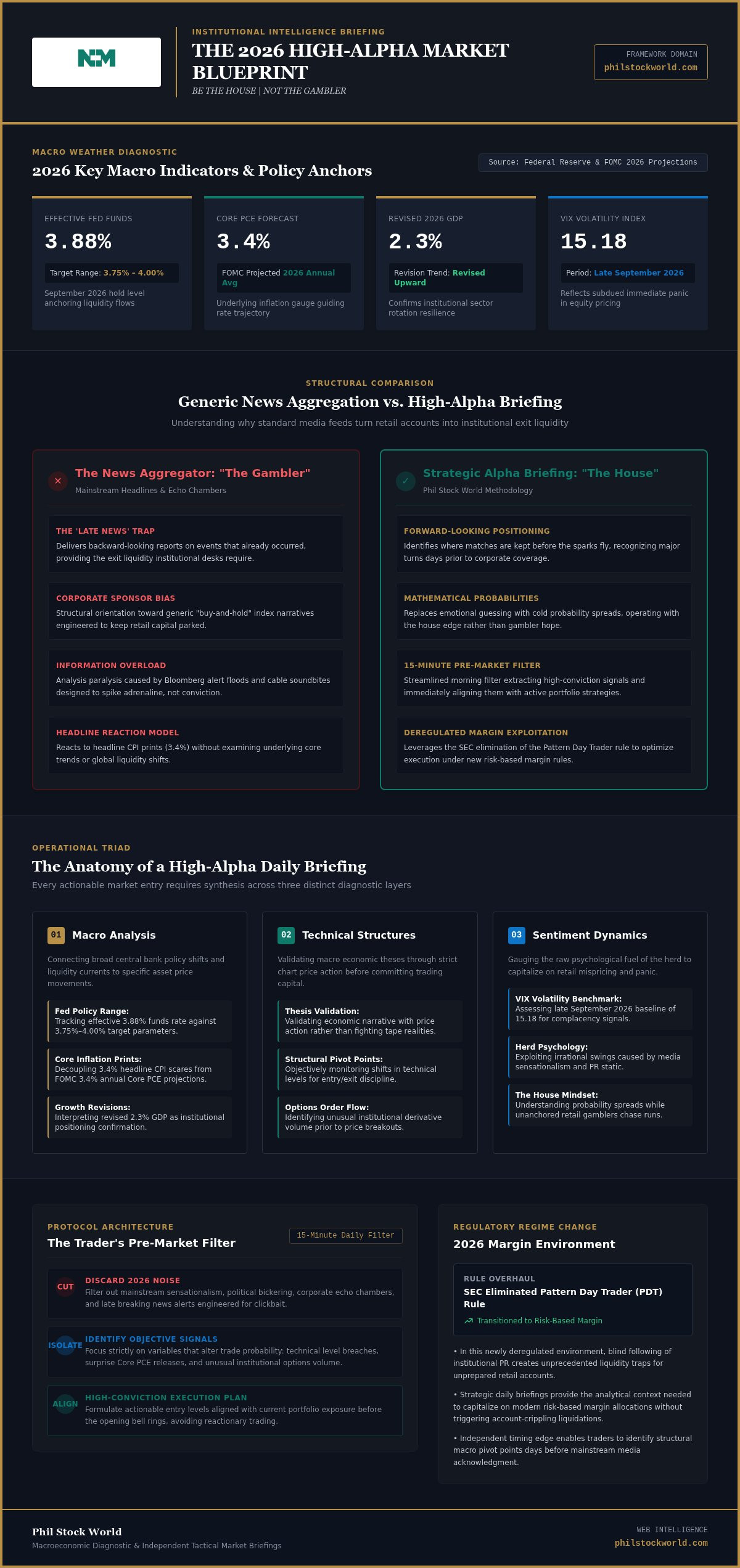
To survive, you need a filter. A ‘Signal’ is any piece of data that objectively changes the probability of a trade’s success. This includes shifts in Technical analysis levels, surprise PCE inflation prints, or unusual options flow. ‘Noise’ is everything else: the sensationalism, the political bickering, and the clickbait designed to spike your adrenaline rather than your account balance. In 2026, the signal-to-noise ratio represents the narrow frequency where actionable data intersects with real-time risk management, effectively drowning out the static of institutional PR.
The Anatomy of a High-Alpha Briefing: Macro, Technicals, and Sentiment
A winning trade isn’t born from a single lucky guess; it’s engineered through a multi-layered filter. If you want to stop gambling and start operating like ‘The House,’ your daily market briefing for traders needs to be more than a news summary. It must be a diagnostic tool that weighs macro weather, technical structures, and the raw emotion of the herd. While the gambler hopes the market goes up, the house understands the probabilities and sets the spread accordingly. This structural edge is what separates professional analysis from retail guesswork.
Macro Analysis: Connecting Policy to Price Action
In 2026, the market ‘weather’ is dictated by a Fed funds rate sitting between 3.75% and 4.00%. A headline CPI print of 3.4% might scare the retail crowd, but a high-alpha briefing looks at the underlying trend of core PCE, which FOMC participants projected to average 3.4% for the year. You have to understand how global liquidity flows are forcing sector rotations. When you see GDP growth revised up to 2.3% for 2026, you aren’t just looking at a number. You’re looking for confirmation of institutional positioning. Confirming these macro theories on your charts is essential. Before you place a trade, you should understand What is technical analysis? in the context of these broad shifts, using price action to validate the economic narrative rather than fighting it.
Sentiment: The Secret Ingredient of Profitable Briefings
Sentiment is the fuel that drives the market’s irrational moves. With the VIX hovering around 15.18 in late September 2026, the lack of immediate panic can actually be a warning sign of complacency. A strategic daily market briefing for traders tracks the ‘Footprints of the Herd’ by analyzing put/call ratios and retail chatter. The goal isn’t to join the conversation; it’s to see where the retail crowd is leaning so you can find contrarian opportunities. When everyone is talking about a ‘resilient economy’ despite persistent inflation, that’s often when the institutional exits are being quietly prepared.
By synthesizing these three pillars, you create a plan with actual conviction. If you’re tired of guessing which way the wind blows, reviewing professional Market Charts and Analysis can help you spot these patterns before they become obvious to the masses. Identifying key support and resistance levels before the opening bell allows you to set your traps. It’s about the ‘why’ behind the move, not just the move itself. You don’t care about the outcome of one hand; you care about the edge over a thousand hands.
Mainstream Media vs. Independent Analysis: Choosing Your Information Edge
Mainstream financial media exists to sell advertising, not to help you secure a better fill. When you rely on a network broadcast as your primary daily market briefing for traders, you’re essentially reading yesterday’s diary. There is a massive speed gap between institutional-grade independent analysis and the major networks. Often, specialized trading rooms spot a shift in global liquidity or a breakdown in technical structures 48 hours before it becomes a lead story on a cable news ticker. By then, the smart money has already squeezed the orange dry.
Actionability is the real litmus test. A generic market summary might tell you that “volatility is increasing,” which is about as helpful as a weather report saying it might rain while you’re already wet. Contrast that with a trade alert that specifies strikes, expirations, and exact entry zones. Professional Market sentiment analysis requires more than just looking at a fear gauge; it demands a real-time understanding of how the crowd is reacting to 2026 policy shifts. Discussing these briefings in a live trading room beats reading them in a vacuum because you get to see the logic stress-tested by peers who have skin in the game.
Why Specialized Trading Rooms Win in 2026
The landscape has shifted from broad, generic financial news to niche, strategy-specific intelligence. In a year where the SEC has replaced the PDT rule with a risk-based margin system, being generic is a death sentence for your capital. Traders are increasingly looking for Seeking Alpha alternatives that provide a singular, authoritative voice rather than a confusing cacophony of crowdsourced opinions. These specialized rooms focus on the ‘why’ behind the price action, connecting the dots between central bank policy and sector rotation before the retail herd even wakes up.
The Myth of the ‘Free’ News Feed
There is a hidden, often devastating cost to trading on surface-level information. Most retail traders fail because they try to save a few dollars on research while losing thousands on bad entries driven by delayed data. They treat trading like a hobby, yet wonder why they don’t get professional results. In the high-stakes environment of 2026, ‘free’ news is frequently the most expensive thing a trader can consume because it costs you the one thing you can’t get back: your timing edge. Investing in premium research isn’t an expense; it’s the cost of doing business as an insider rather than a target.
Pre-Market Rituals: Build Your 2026 Trading Plan
Reading a daily market briefing for traders is only half the battle. The real work happens when you translate that analysis into a set of orders. In the fast-moving 2026 market, you can’t afford to be reactive. You need a ritual that turns information into execution before the first print hits the tape. If you aren’t prepared by 9:15 AM, you’re already behind the curve.
Step 1: The 15-Minute Filter. Don’t get bogged down in every minor headline. Scan your briefing for high-conviction signals, those rare moments where macro policy, sentiment, and technicals align. If the data doesn’t scream at you, it’s probably noise that belongs in the trash.
Step 2: Level Check. Map the briefing’s insights onto your current holdings. If the briefing identifies a major resistance level that your long positions are approaching, it’s time to consider hedging or taking profits. You’re looking for the intersection of your portfolio’s delta and the market’s expected path.
Step 3: Risk Assessment. With the VIX hovering around 15.18, volatility is relatively low but potentially coiled. Adjust your position sizes based on the day’s expected range. Never let a single trade threaten your capital, especially under the SEC’s risk-based intraday margin system that replaced the old PDT rules.
Step 4: Execution. Set your price alerts and limit orders now. By the time the opening bell rings and the retail herd starts panic-buying or selling, your plan should already be in motion. You want to be the one providing the liquidity, not the one desperately seeking it.
From Briefing to Execution: Setting Your Parameters
Your daily stock market commentary should act as a map, identifying not just where to trade, but where to stay away. Identifying ‘No-Trade’ zones is just as important as finding entries. Integrating advanced option trading strategies into your morning routine allows you to play the probabilities rather than the direction. It’s about systems over luck. If you want to refine these systems, start your Premium Membership today to access our full strategic toolkit.
Auditing Your Strategy Daily
Consistency requires constant review. A virtual portfolio review should be a staple of your weekly synthesis. You need to spot the delta between what the briefing predicted and what the market actually delivered. In the current 2026 cycle, where GDP growth is hitting 2.3% but inflation remains sticky at 3.4%, knowing when to strike and when to sit on your hands is the ultimate edge. Luck is for gamblers; the house relies on the audit.
The Phil Stock World Edge: Trading Like ‘The House’ Every Morning
The House always wins. It’s a cliché for a reason, but in the markets, most retail traders are content playing the role of the tourist at the craps table. At Phil Stock World, we flip the script. Our daily market briefing for traders isn’t just a summary of what the 3.88% effective Fed funds rate means for your morning coffee. It’s a deconstruction of the ‘Pulse’, finding the signal where others only see static. We don’t guess which way the wind blows; we build a better windmill. By focusing on the structural advantages of the market, we move away from the frantic gambling of the herd and toward a methodical, high-probability approach.
Inside the PSW Options Trading Newsletter
We move beyond the headlines to deliver actionable ‘House’ strategies that prioritize capital preservation. Instead of gambling on whether a stock ticks up or down by Friday, our strategy focuses on selling premium and sophisticated hedging. This approach keeps your account resilient during high-volatility events, like the surprise 3.4% core PCE prints that have defined the 2026 landscape. Through our Educational Webinars, we turn briefing readers into strategy masters who understand the mechanics of the trade. A Phil Stock World membership provides the exact tools needed to conduct your own Virtual Portfolio Review, ensuring your positions stay aligned with the broader macro shifts we identify every morning.
Join the Smartest Community in Trading
Why settle for a dry corporate lecture when you can participate in a spirited, peer-to-peer discussion? The power of our Live Trading Room lies in real-time, collective analysis. Mainstream traders are often stuck waiting for a delayed ticker or a sanitized news report, but our members are already dissecting the footprints of institutional players. This isn’t a classroom; it’s an insider’s club where complex information is shared with wit, transparency, and a touch of irreverence. You get access to real-time daily market briefing for traders insights that the major networks wouldn’t dare touch. It’s time to stop trading against the house and start trading with it. Join the insiders, leverage our Market Charts and Analysis, and finally start your morning with a real, quantifiable edge.
Own the Open with a Professional Edge
Success in the 2026 market isn’t about having the most data; it’s about having the right filter. You’ve seen how reacting to stale headlines turns you into exit liquidity and why a daily market briefing for traders must synthesize macro policy with real-time sentiment to be effective. By adopting a ‘House’ perspective and utilizing a disciplined 15-minute pre-market ritual, you move from the role of the gambler to the role of the operator. It’s about systems, not luck.
Founded by veteran analyst Phil Davis, Phil Stock World has been delivering actionable options strategies since 2006. We provide exclusive access to live interactive trading rooms where you can stress-test your ideas with a savvy community of peers. Stop drowning in the noise and start operating with conviction. Ready to trade like ‘The House’? Join Phil Stock World and get the daily edge you’ve been missing. The market moves fast, but with the right plan, you’ll always stay ahead of the curve.
Frequently Asked Questions
What should a daily market briefing for traders include?
A comprehensive briefing must integrate macro context, technical levels, and sentiment analysis. A quality daily market briefing for traders should go beyond simple price updates to explain the ‘why’ behind the moves. It should highlight upcoming 2026 economic data releases like PCE inflation or GDP revisions. Most importantly, it must provide clear support and resistance levels to help you identify high-conviction entry and exit zones before the opening bell.
How do I filter out market noise from my morning news routine?
Start by ignoring sensationalist headlines designed for clicks rather than capital. Focus on data that changes the probability of a trade’s success, such as unexpected shifts in central bank policy or unusual options flow. If a piece of news doesn’t impact your specific strategy or key technical levels, it’s just static. Developing a disciplined 15-minute filter helps you stay focused on actionable signals while the rest of the herd gets distracted by mainstream narratives.
Is it worth paying for a premium trading newsletter in 2026?
Yes, because the cost of misinformation is significantly higher than a subscription fee. Premium research provides a timing edge that free news feeds simply can’t match. In a year where the SEC has shifted to risk-based margin systems, having access to institutional-grade analysis and trade alerts helps you operate like ‘The House’. You aren’t just paying for data; you’re paying for a proven framework that has protected capital since 2006.
How much time should I spend reading market briefings each day?
You should aim for a focused 15 to 20 minutes of deep study rather than hours of casual browsing. Efficiency is key to avoiding analysis paralysis. Use this time to scan for high-conviction signals and map insights onto your current portfolio. Once you’ve identified your ‘No-Trade’ zones and set your limit orders, step away from the screen. Quality analysis is about finding the signal quickly, not lingering in the noise of the headlines.
What is the difference between macro news and actionable trading sentiment?
Macro news describes the long-term ‘weather’, like the Fed holding rates near 4.00%, while sentiment reveals how the crowd is reacting to that weather right now. Actionable sentiment involves gauging fear and greed through metrics like put/call ratios or the VIX, which sat around 15.18 in late September 2026. While macro gives you the broad direction, sentiment helps you time the entry by identifying when the retail herd is over-extended or panicked.
Can a daily briefing help with long-term portfolio protection?
Absolutely. A strategic daily market briefing for traders identifies emerging risks before they become catastrophic sell-offs. By understanding global liquidity shifts and sector rotations, you can use hedging strategies to insulate your holdings. Services like a Virtual Portfolio Review allow you to audit your strategy against the current market cycle. This proactive approach ensures you aren’t caught off guard when the 2026 economic landscape shifts unexpectedly, keeping your capital safe.
Why do mainstream financial news outlets often mislead retail traders?
Mainstream outlets are built on an advertising model that requires high volume and broad appeal, often favoring ‘buy and hold’ narratives. Their reporting is frequently backward-looking, serving as exit liquidity for big banks rather than a guide for active traders. They prioritize sensationalism to keep viewers engaged, which leads to impulsive, herd-based decision making. Independent analysis avoids this bias by focusing on tactical edges that benefit the individual trader, not corporate sponsors or institutional desks.
How do I transition from reading a briefing to placing a trade?
You move from theory to practice by setting specific parameters based on the briefing’s technical overlays. Identify your entry, target, and stop-loss levels before the opening bell rings. If the briefing suggests a high-volatility environment, you might adjust your position size to manage risk more effectively under the new margin rules. Setting price alerts and limit orders allows you to execute your plan mechanically, removing the emotional friction that often ruins a perfectly good trade idea.

