


What if maximizing portfolio efficiency meant making fewer moves, not more? If your holdings overlap, costs are difficult to compare, and every market headline seems to call for an adjustment, the confusion is understandable. More activity does not automatically make an investment portfolio work better.
A useful review starts with what each holding is meant to do, how much risk it adds, and whether its costs make sense for that role. This guide offers a repeatable way to assess those trade-offs, spot concentration that may be hidden in a long holdings list, and keep potential returns in perspective without chasing guarantees.
We’ll look at portfolio purpose, diversification, fees, tax considerations, and risk, then bring them together in a practical monitoring routine. The goal is not to react to every signal or rebuild your portfolio on a whim. It is to identify what deserves attention, what can stay the course, and when a change may support your investing objectives.
Key Takeaways
- Maximizing portfolio efficiency means aligning holdings with your goals, risk tolerance, and costs, not trading more or chasing the highest possible return.
- Map stocks, funds, cash, and options to uncover overlapping exposures that can be easy to miss when reviewing holdings one by one.
- Compare diversified investing, active selection, cash, and hedging by their potential benefits, trade-offs, and monitoring demands.
- Use a written allocation and review rules to distinguish intentional rebalancing from reactionary moves driven by market noise.
- A recurring check of objectives, exposure, costs, and risk can help keep your portfolio review focused and consistent.
What Maximizing Portfolio Efficiency Means for an Investor
Portfolio efficiency describes how well a portfolio’s holdings support an investor’s objectives while keeping risk, diversification, and avoidable costs in view. It cannot guarantee investment results. In practice, maximizing portfolio efficiency means making the pieces work together, not simply adding investments or chasing the strongest recent performer.
The idea draws on Modern Portfolio Theory (MPT), which examines the relationship between diversification, risk, and expected return. For an investor, the practical questions are whether each holding has a clear role, whether combined exposures fit their comfort with volatility, and whether expenses or unnecessary complexity are getting in the way. This is different from business efficiency, where a company might compare output with resources. Here, the focus is the fit between a portfolio and its purpose.
Efficiency does not mean maximizing returns at any cost or trading more often. More activity can bring additional research, transaction, or tax considerations without improving a portfolio’s fit. And even a well-organized portfolio can lose value when markets fall. Efficiency is about the quality and coherence of the process, not a promise about the outcome.
How Is Portfolio Efficiency Different from Portfolio Performance?
Performance describes what a portfolio has done over a period. Efficiency looks at how its holdings, risks, and costs align with the investor’s aims. A portfolio might rise in value while relying heavily on one company or sector, leaving the investor with more concentration risk than intended.
For example, an investor’s stocks may have recently gained, while several depend on similar market conditions. That result does not prove the portfolio is well structured, just as a later decline would not automatically prove every decision was flawed. A review can assess whether the process still makes sense, but market outcomes remain uncertain.
Which Investor Goals Should Shape an Efficiency Review?
Start with your timeline and financial needs, not a list of tempting new holdings. Ask when you may need to use the money, how much liquidity you want available, and how you might respond to a sharp drop in value. Those answers help define the portfolio’s purpose and the volatility you can tolerate.
There is no universal allocation that suits every investor. Clear objectives give you a basis for judging whether an investment belongs in the portfolio and what role it should play. Without that foundation, a new holding can add complexity without addressing a real need.
How to Audit Holdings, Costs, Diversification, and Risk
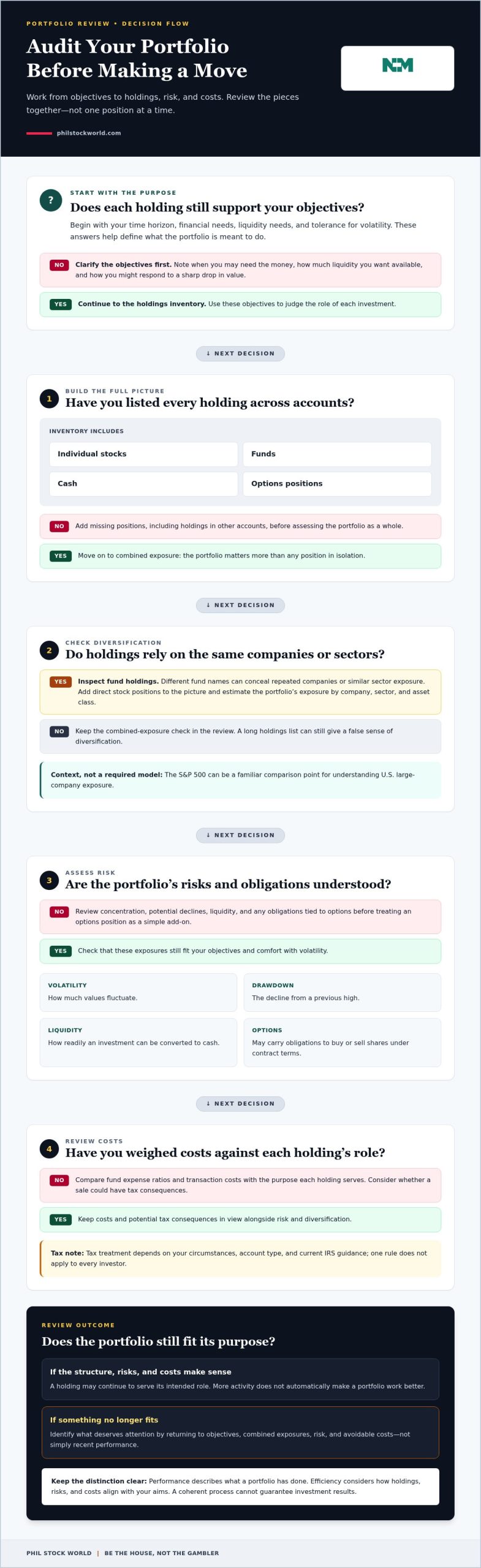
A useful audit moves from purpose to details, rather than starting with a tempting trade. Maximizing portfolio efficiency begins with a clear picture of what you own and how the pieces behave together. Review in this order:
- Define objectives: Note your time horizon, liquidity needs, and tolerance for volatility.
- List every holding: Include individual stocks, funds, cash, and options positions across accounts.
- Inspect overlap: Look through funds to identify repeated companies, sectors, or asset classes.
- Assess risk: Consider concentration, potential declines, liquidity, and any obligations tied to options.
- Review costs: Check fund expense ratios, transaction costs, and possible tax consequences.
Review holdings as one portfolio, because combined exposure matters more than any position viewed in isolation. A long holdings list can create a false sense of diversification if several investments depend on the same companies or sectors.
How Can Investors Spot Overlap and Concentration?
Look beneath fund names at their underlying holdings. Two funds with different labels may own many of the same large companies or lean heavily toward the same sector. Add direct stock positions to the picture, then estimate how much of the overall portfolio depends on each company, sector, and asset class. The S&P 500 can be a familiar comparison point for understanding U.S. large-company exposure, but it is not a required portfolio model.
For performance context, FINRA’s guide to evaluating your portfolio’s performance can help frame what to review. Keep the question broader than returns: does the portfolio’s structure still match its intended purpose?
Which Costs and Risks Belong in the Review?
Compare fund expense ratios and transaction costs with the role each holding plays. Consider whether a sale could have tax consequences, too. Tax treatment depends on your circumstances, account type, and current IRS guidance, so do not assume one rule applies to every investor.
Risk has several dimensions. Volatility describes how much values fluctuate; drawdown is the decline from a previous high. Liquidity is how readily an investment can be converted to cash. Options can add obligations, such as the possibility of buying or selling shares under a contract’s terms. Understand those exposures before treating an options position as a simple portfolio add-on.
If a second set of eyes would help you organize these questions, a virtual portfolio review offers a structured way to examine portfolio structure and decision-making.
Comparing Portfolio Efficiency Strategies and Their Trade-Offs
There is no single strategy that makes every portfolio more efficient. The useful question is whether an approach fits your objectives without adding costs, risk, or upkeep that outweigh its purpose. Fees, taxes, liquidity needs, and your capacity to monitor positions can all change the practical trade-off.
| Approach | Purpose | Potential benefit | Trade-off | Monitoring burden |
|---|---|---|---|---|
| Low-cost diversification | Spread exposure across investments | Can reduce reliance on any one company | Doesn’t eliminate market risk; fund expenses still matter | Generally focused on allocation, overlap, and costs |
| Active selection | Choose individual investments based on research | Allows targeted views and more control over holdings | Requires research and discipline; results may lag broad markets | Ongoing review of company assumptions and position sizes |
| Cash allocation | Keep funds available for liquidity needs or planned uses | Offers flexibility and avoids having to sell other holdings for cash | May weigh on growth if cash exceeds the investor’s needs | Review whether the amount still suits liquidity goals |
| Selective hedging | Offset a defined risk in some holdings | May soften a particular loss scenario | Can involve costs and limit gains; options add complexity | Requires attention to terms, exposure, and changing conditions |
Passive Diversification or Active Stock Selection?
Broad diversification can help manage company-specific exposure, but it cannot prevent losses when markets or asset classes decline together. Active stock selection offers more control, along with more work: research, clear decision rules, and the ability to tolerate periods of underperformance without abandoning the process. For more context on combining holdings, explore building a portfolio with stocks and options.
When Might Hedging or Options Reduce Efficiency?
A hedge is designed around a risk, not as a promise to prevent losses. It may cost money, and a position that offsets downside can also cap some potential gains. Keep protection distinct from income-seeking or speculation, because each has a different purpose and risk profile. Before using options, understand the obligations and outcomes the strategy could create. Advanced option trading strategies can help build familiarity with those mechanics.
Maximizing portfolio efficiency means choosing trade-offs deliberately. A strategy that looks elegant on paper may be a poor fit if its tax implications, liquidity limits, or monitoring demands do not match your circumstances.
How to Improve Portfolio Efficiency Without Overtrading
A written process gives every portfolio change a reason to exist. Instead of treating each headline as a cue to act, use a repeatable sequence:
- Document your current allocation. Record holdings and their approximate share of the portfolio, including cash and options positions.
- Set review rules. Decide whether you’ll check on a calendar schedule, after a meaningful change in your circumstances, or when an allocation moves outside a range you’ve chosen.
- Compare for drift. Check today’s allocation against your intended ranges, not against a market forecast.
- Decide deliberately. If something has changed, write down why an adjustment may be appropriate and what trade-offs it could bring. If the original rationale still holds, inaction can be a decision too.
Rebalancing means restoring intended risk exposure when the portfolio has drifted. It is not a bet on where the market goes next. Calendar-based reviews create a predictable routine; threshold-based reviews focus attention on changes large enough to matter to your plan. Neither requires a universal interval or trigger. Choose rules you can follow consistently while accounting for possible transaction costs and tax consequences.
How Should Investors Set Rebalancing Rules?
For each holding, note its target range and the role it plays. Then decide how you’ll review: at set points on your calendar, or when an allocation moves beyond a limit you’ve defined. A scheduled check can prevent constant tinkering; a drift trigger can flag changes between reviews. Choose a rule grounded in your objectives, not a reaction to market noise. For a practical checklist, see these portfolio rebalancing tips.
How Can Market Research Support Better Decisions?
Useful research helps you test whether new information changes an investment’s underlying rationale or the portfolio’s overall exposure. A headline may be dramatic without being relevant to your holdings. Charts and market commentary can sharpen your questions, but they are not automatic trade signals. A price move, for example, might prompt you to revisit your assumptions, not to buy or sell on reflex. This guide to how to read market charts offers context for interpreting market activity.
A written review process turns maximizing portfolio efficiency into a habit, helping you act on your rules rather than every market jolt. To examine your portfolio structure and decision-making with added context, explore a virtual portfolio review.
How to Keep Portfolio Efficiency on Track with a Consistent Review
A portfolio review works best as a repeatable check, not a referendum on every market move. Choose a cadence that fits your circumstances, then use the same questions to see whether the portfolio still reflects its purpose. A brief written record makes it easier to separate a genuine change from the noise of the moment.
What Should a Regular Portfolio Review Cover?
Revisit your objectives, time horizon, and liquidity needs. Then check diversification, costs, risk exposures, and the rationale you recorded for each holding. Note what has changed since the last review, including shifts in your circumstances or the portfolio itself. Record what you considered but did not act on, and why. That creates a decision trail instead of relying on memory. For a deeper framework, see this virtual portfolio review guide.
- Objectives: Do your goals, timeline, or need for accessible cash look different?
- Exposure: Do holdings still provide the intended diversification, or has concentration crept in?
- Costs: Are expenses and transaction activity still reasonable for each holding’s role?
- Risk: Do volatility, liquidity, and potential downside remain within your comfort level?
- Rationale: Are the reasons for holding each investment still valid to you?
A self-review may be enough when your holdings are understandable, your objectives remain clear, and you can assess changes against a written process. If you are unsure how positions fit together or which questions deserve attention, structured education can help you examine the choices more methodically.
How Can Investors Use Research Without Outsourcing Their Decisions?
Market commentary, charts, and educational webinars can provide context and useful questions for independent study. Treat them as inputs, not instructions: test an idea against your own goals, constraints, and tolerance for risk before deciding whether it matters to your portfolio. Maximizing portfolio efficiency still depends on understanding your holdings and making deliberate choices.
Phil Stock World’s commentary and webinars offer educational perspectives, while a virtual portfolio review can help you examine portfolio structure and decision-making. These resources can support your own review, but they cannot guarantee investment results.
For ongoing market education and analysis, explore Phil Stock World membership as a resource for your independent research.
Make Your Next Portfolio Review Count
Maximizing portfolio efficiency is not about making constant moves or finding a guaranteed path to better returns. It is about checking that each holding has a purpose, the portfolio’s combined risks still fit your objectives, and costs and complexity remain worth carrying.
Keep the process simple: revisit your goals, review exposure and overlap, and follow written rules before rebalancing. A consistent review can help you focus on meaningful changes instead of reacting to every headline. No process can control market outcomes, but a deliberate one can make your decisions easier to explain and assess.
For additional context, Phil Stock World offers daily market commentary, analysis, charts, community discussion, educational webinars, and virtual portfolio reviews. Founded and led by trader and market analyst Phil Davis, its resources can support your own research and decision-making. Explore Phil Stock World membership and educational resources as you build a review routine that works for you.
Start with one clear question about your portfolio, then take the next step with confidence and patience.
Frequently Asked Questions
What does maximizing portfolio efficiency mean?
Maximizing portfolio efficiency means aligning your investments with your objectives while considering risk, diversification, and costs. It is about whether holdings work together for a clear purpose, not about trading constantly or chasing the highest recent return. A sensible review can help uncover overlapping exposures or avoidable complexity, but efficiency cannot guarantee a profit or prevent losses. Market outcomes remain uncertain, even when your decision-making process is disciplined.
How can I make my portfolio more efficient without taking more risk?
Start by reviewing what you already own before adding anything. List stocks, funds, cash, and options positions, then check for overlapping company, sector, or asset-class exposure. Compare costs and consider whether each holding still serves a purpose. You can improve clarity and reduce unnecessary complexity without increasing risk, though any portfolio change can have trade-offs. Efficiency does not require taking on more volatility or making more trades.
Does portfolio rebalancing improve returns?
Rebalancing does not guarantee higher returns. Its main purpose is to bring your portfolio back toward intended risk exposure when allocations drift, rather than to predict the market’s next move. Depending on what you sell or buy, rebalancing may involve transaction costs or tax consequences. Set a deliberate review rule based on your objectives, and assess whether the benefits of restoring your chosen allocation justify the potential costs and effort.
How often should I review my investment portfolio?
There is no single review schedule that suits every investor. You might choose calendar-based check-ins, reviews triggered by meaningful allocation drift, or a combination that fits your circumstances. The key is consistency: revisit your objectives, liquidity needs, holdings, costs, and risk using the same framework. A written record of what changed, and what did not call for action, can help keep reviews focused rather than turning daily market moves into a reason to trade.
Can options make a portfolio more efficient?
Options can serve a defined portfolio purpose, such as hedging a particular exposure, but they also add complexity and potential obligations. A hedge may involve costs and can limit gains as well as soften losses. Options are not automatically protective or efficient, and their usefulness depends on the strategy, terms, and risks you understand. Distinguish a protection goal from income-seeking or speculation, and assess how the position affects the portfolio as a whole.
How do fees and taxes affect portfolio efficiency?
Fees and taxes can reduce the value of an investment outcome, so review fund expense ratios and transaction costs alongside each holding’s purpose. A change that looks useful before costs may be less attractive after them. Tax consequences depend on your circumstances and account type, so do not assume a sale or distribution will have the same effect for every investor. Consult current IRS guidance when evaluating tax questions relevant to your situation.
Is a diversified portfolio always an efficient portfolio?
No. Diversification can spread company-specific exposure, but it does not automatically make a portfolio efficient or eliminate market risk. Several funds may hold many of the same companies or sectors, creating overlap beneath a long holdings list. Efficiency also depends on whether investments match your objectives, risk tolerance, liquidity needs, and cost considerations. Review combined exposures and each holding’s role instead of judging diversification by the number of investments alone.

