


A strong portfolio review goes beyond headline returns. Professional portfolio feedback for retail investors should distinguish performance measurement, which shows how a portfolio performed, from attribution, which explains what drove the result, and appraisal, which considers what the result says about the investment process. A sound assessment compares returns with a suitable benchmark and considers risk, allocation, and decisions over time.
It’s natural to judge a portfolio by whether it’s up or down. That number matters, but it can hide whether gains came from deliberate choices, broad market exposure, or risks that may not suit your goals. This guide shows how to read performance and attribution, choose useful appraisal measures, and distinguish constructive feedback from advice that doesn’t fit your approach. You’ll get a practical way to turn review comments into questions for your next investment decision, rather than treating every critique as a signal to trade. We’ll move from the scorecard to the drivers behind it, then consider what the feedback means for your portfolio.
Key Takeaways
- Separate portfolio returns from the decisions behind them, then judge both against a relevant benchmark and the risks taken.
- Treat feedback as a prompt to investigate: identify its reasoning, ask clarifying questions, and decide whether it fits your goals and process.
- Compare review options by the kind of help you need, from educational resources to a focused portfolio discussion.
- Look for a reviewer who can explain their methods, assumptions, and limitations clearly, not just deliver a confident verdict.
1. Performance measurement, attribution, and appraisal
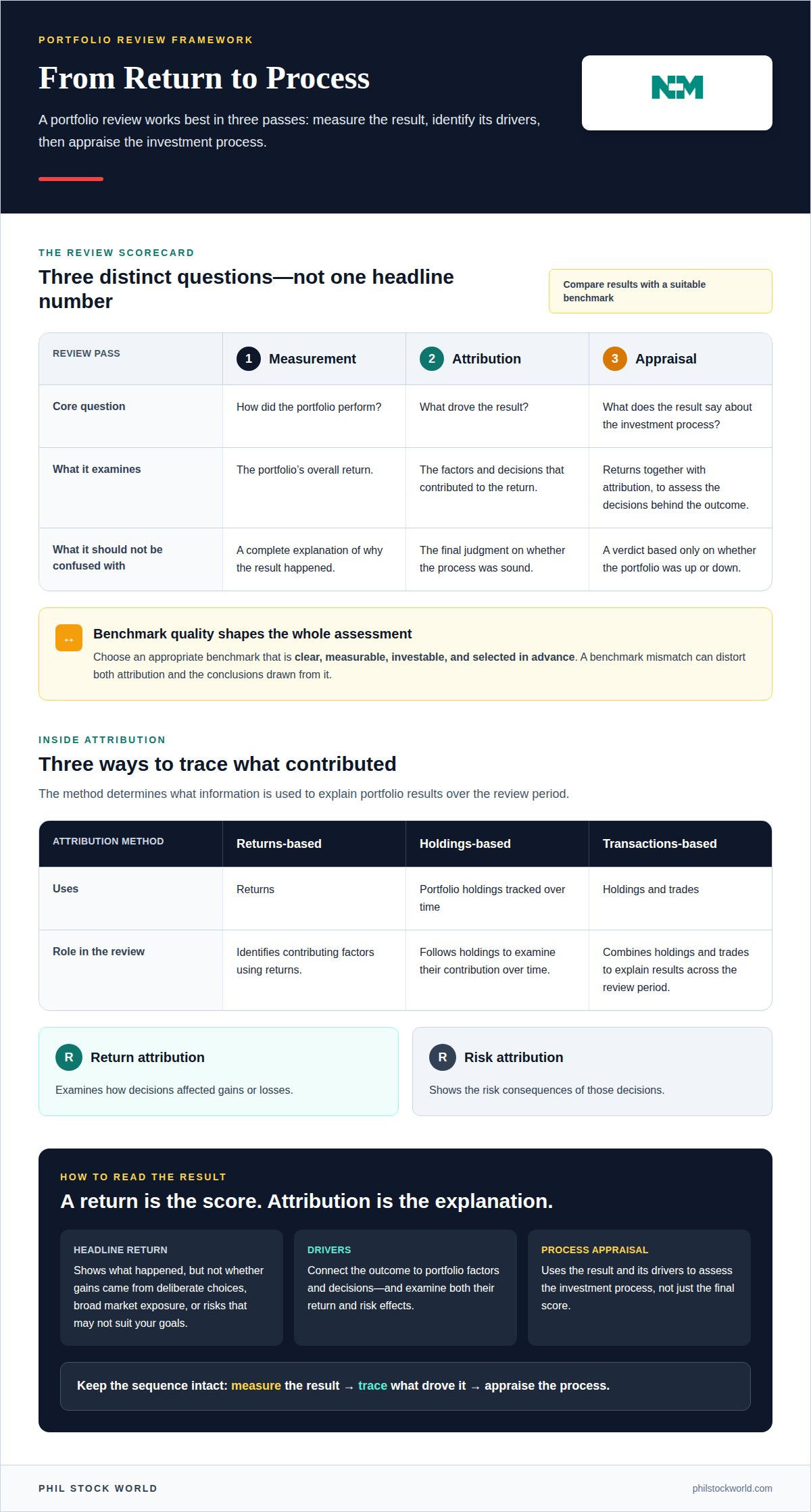
Assess a portfolio in three passes: measurement, attribution, and appraisal. Measurement gives the overall return; attribution explains which decisions produced it. Appraisal uses returns and attribution to assess the investment process, not just the final score. Compare results with an appropriate benchmark that is clear, measurable, investable, and selected in advance.
Then examine the drivers. Returns-based attribution uses returns to identify contributing factors; holdings-based attribution tracks portfolio holdings over time. Transactions-based attribution combines holdings and trades to explain results across the review period. Return attribution examines the effects on gains or losses, while risk attribution shows the risk consequences of those decisions. A benchmark mismatch can distort both.
What fiduciary rules apply when financial advisors review retail investor portfolios? There isn’t one answer for every review; obligations depend on the advisor’s role and service arrangement. Before discussing recommendations, ask the reviewer to explain their capacity, applicable standard, and conflicts in writing.
What information and documents should I prepare for a portfolio review? Gather recent account statements, holdings, transaction history, benchmark, and investment goals. Include relevant account types, cost basis, and tax details, along with any constraints such as planned withdrawals. These records help connect portfolio decisions with actual outcomes.
How do taxes, fees, and account types affect portfolio recommendations? They affect after-cost, after-tax results and which investments may suit each account. For example, realized gains in a taxable account can make a proposed rebalance different from a change inside a tax-advantaged account. Include fee and tax information in the review.
What are the risks of sharing portfolio and personal financial information with review services? Statements can reveal account numbers, balances, transactions, and personal details, creating exposure if they’re mishandled. Share only relevant records, redact credentials and full account numbers, and use a secure submission method. Never send passwords or one-time access codes.
How can I verify a financial advisor’s registration and disciplinary history in the United States? Search the SEC’s Investment Adviser Public Disclosure database and FINRA BrokerCheck using the advisor’s name. Match the identity and firm, then review registration details and reported disciplinary history rather than relying on a title alone.
Reflecting on and analyzing feedback
Treat feedback as a hypothesis to examine, not an instruction to trade. Write down the reviewer’s central claim, the evidence behind it, and the portfolio decision it concerns. For example, “reduce technology exposure” is incomplete without a reason, such as concentration risk, benchmark mismatch, or a changed investment thesis. Ask what evidence would change that conclusion.
Separate observations from recommendations. “This holding has lagged its benchmark” describes a result; “sell it” proposes an action. Check whether the reviewer considered your time horizon, risk tolerance, investment goals, and reasons for owning the asset. If reviewers disagree, compare their assumptions before choosing between their conclusions.
How do portfolio review services compare with robo-advisors and online portfolio analyzers? A review service typically focuses on human interpretation and discussion, while robo-advisors use automated processes to manage portfolios and analyzers provide software-generated metrics. Compare the scope: an allocation chart can flag concentration, but it won’t necessarily explain your investment rationale.
How can retail investors get unbiased feedback on their investment portfolio? Share the same goals, holdings, and questions with each reviewer, and ask them to explain their assumptions, conflicts, and evidence. Seek specific reasoning rather than a product pitch, then compare recommendations with your written investment policy. A clear explanation should connect proposed changes to risks and objectives.
Turn comments into a decision log. Record the feedback, your response, and the evidence you’ll monitor, such as company earnings, portfolio concentration, or benchmark performance. Set a review date based on the decision’s time horizon rather than reacting to every market move. Revisit the log to see whether the original reasoning still holds.
If you want a structured conversation to test your interpretation, a portfolio review perspective can help you examine the reasoning behind feedback before deciding what belongs in your process.
3. What professional portfolio review services are available for retail investors in the United States?
Retail investors in the United States can choose a one-time portfolio review, an ongoing advisory relationship, or a digital analysis tool. Each serves a different purpose. A one-time review examines existing holdings; ongoing advice may include recurring investment discussions. Digital tools can organize account data and highlight patterns, such as heavy exposure to one sector.
An independent portfolio review can focus on allocation, diversification, individual holdings, and investment assumptions. For example, a reviewer might examine whether several funds hold the same large companies, creating overlapping exposure. Ask what the review covers, what information it uses, and whether the output is education, analysis, or a recommendation.
Some financial professionals discuss a portfolio as part of a broader advisory or planning relationship. That can connect investments with goals such as retirement income, a home purchase, or cash reserves. Before engaging, clarify the scope, compensation structure, and any conflicts of interest. A written explanation helps distinguish portfolio analysis from ongoing management.
Automated portfolio services generally use software to analyze information or create and manage investment portfolios. An online analyzer may show allocation or compare holdings with a selected benchmark, while a robo-advisor typically applies automated portfolio processes. Neither format necessarily explains the reasoning behind every result. A human review can address your assumptions directly, though its depth depends on the scope.
Match the service to the question you need answered. If you’re unsure why results differ from a benchmark, request attribution analysis. If overlapping funds concern you, ask for a holdings review. If your investment goals have changed, consider a broader discussion connecting portfolio choices with those goals.
Before sharing account information, identify the review’s deliverable and how the professional will use your documents. A focused review should leave you with clear observations, supporting reasoning, and useful questions for your next decision, not simply a list of transactions to copy.
4. What qualifications should a portfolio reviewer or financial advisor have?
Start with relevant expertise, not an impressive title. A reviewer should explain how their training relates to your portfolio question. For example, assessing fund overlap requires familiarity with holdings and asset allocation. Reviewing tax-sensitive decisions calls for understanding how account type and realized gains affect the analysis.
Credentials can help indicate a professional’s focus. A CFA charterholder has completed investment-focused study; a CFP professional focuses on financial planning; and a CPA specializes in accounting. These designations represent different skill sets, not interchangeable guarantees. Ask which parts of your review draw on the reviewer’s expertise and where another specialty may be relevant.
Experience matters most when it matches the task. Someone reviewing a portfolio of individual stocks should explain how they assess company-specific risks. A review centered on mutual funds should address fund holdings, costs, and overlapping exposure. Ask for a sample explanation, with private client information removed, to see whether the reviewer communicates clearly.
Also examine how the reviewer works. They should distinguish data from opinion, explain assumptions, and show how conclusions relate to your stated goals. Ask what information supports each recommendation and what could change the analysis. A reviewer who welcomes precise follow-up questions makes it easier to evaluate the reasoning rather than simply accept a verdict.
Check the professional’s registration and disciplinary record using the United States resources discussed earlier. Match the results to the person and firm, then compare their listed role with the work they propose. Ask directly about compensation, conflicts, and whether they receive incentives tied to particular investments. Clear answers help you understand the relationship before sharing documents.
A strong reviewer doesn’t need to predict markets. They should be able to explain their method, acknowledge analytical limits, and make findings understandable. Before a meeting, write down the decision you’re weighing, such as whether to rebalance or keep a holding. Use that question to assess whether their expertise fits your needs. Explore a portfolio review conversation when you want structured feedback on your holdings.
Phil Stock World: Premium Membership
Phil Stock World’s Premium Membership gives investors access to market commentary and analysis to support ongoing research. If you want feedback on how your holdings fit together, its Virtual Portfolio Review offers a focused way to examine your portfolio and think through the reasoning behind your investment decisions.
Educational Webinars and Market Charts and Analysis can help you build context around market moves and compare your interpretation with broader trends. These resources can be useful when weighing feedback, tracking a thesis, or looking for a clearer framework for your next decision. They provide information and analysis, leaving investment choices in your hands.
If these resources fit the support you’re looking for, visit Phil Stock World to explore the next step.
Make Your Next Review a Better Decision Point
Use your next review as a checkpoint for the quality of your decision process, not a verdict on one market move. Professional portfolio feedback for retail investors is most valuable when it helps you define what evidence could change your mind, and what wouldn’t. That distinction can keep a temporary swing from rewriting a long-term thesis while leaving room to respond when the facts shift.
Before making a change, write a decision rule in plain language: which signal matters, what action it could justify, and what would invalidate the idea. Revisit the rule as new information arrives. Over time, this practice can turn review conversations into a learning loop, sharpening your judgment without outsourcing it. The aim isn’t to eliminate uncertainty; it’s to make your reasoning more deliberate when uncertainty appears.
Ready to continue the conversation? Contact Phil Stock World and take your next step with greater clarity.
Frequently Asked Questions
What is an investment portfolio review?
An investment portfolio review is a structured examination of your investments, their purpose, and how they work together. For example, you might consider whether a stock holding still supports your original thesis or whether several funds create unintended overlap. The result should clarify what deserves closer attention, which assumptions remain relevant, and what questions to investigate before making a change.
Why Does Investor Feedback Matter?
Investor feedback matters because an outside perspective can reveal assumptions you’ve stopped questioning. A reviewer might point out that you’re judging a holding by its purchase price rather than its current prospects. Use that observation to revisit your reasons for owning it, not as an automatic sell signal. Professional portfolio feedback for retail investors works best as input to your own disciplined decision process.
What benchmarks and metrics are used to assess an investment portfolio?
Reviewers may compare a portfolio with a benchmark that reflects its investment approach, then examine measures beyond total return. The Sortino ratio focuses on downside volatility, while upside and downside capture ratios show how a portfolio moved during market rises and falls. Maximum drawdown measures the deepest decline from a peak; drawdown duration tracks how long recovery takes.
What steps should I take after receiving professional feedback on my portfolio?
First, separate factual observations from suggested actions. Next, write down the evidence supporting each suggestion and note any assumptions you disagree with. Then identify a practical next step, such as monitoring a holding’s thesis or reviewing an allocation at your next scheduled check-in. Keep a brief decision record so you can later compare what you expected with what actually happened.