

Here we are again:
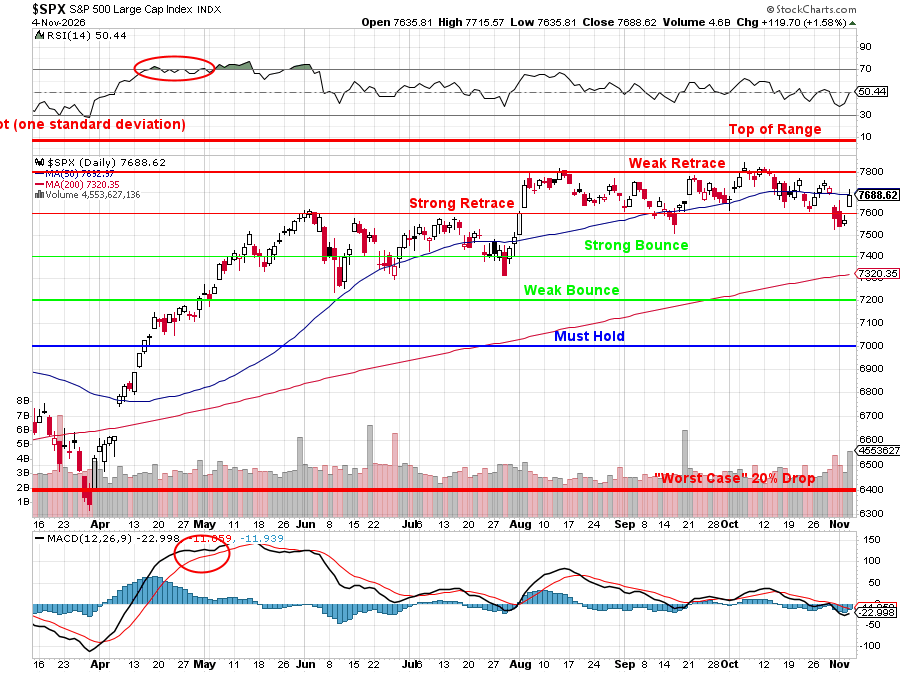
The Dow may have gained an impressive 1,500 points but the other 470 stocks in the S&P 500 are still struggling to retake the 50-Day Moving Average, which is EXACTLY where we closed yesterday. Note the RSI has quickly moved back to neutral (50) – up about 13 points on a 120-point gain in the index. What does that tell us? That a move to 7,800 will add another 15 points to RSI (65ish) and then we’ll be stretched the other way – which makes a new high unlikely without a strong catalyst in the next few weeks.
So, do we have a strong catalyst on the horizon? Because we already changed our Government and that was only good enough to get us back to where we were in August…
🚢 There are catalysts strong enough to turn this rebound into a sustained advance but the decisive sequence is payrolls → inflation and Treasury auctions → AI earnings. The election has reduced one source of uncertainty; the next two weeks must demonstrate that earnings can hold up without borrowing costs rising again.
The next two weeks: where the rally gets tested
| Date | Catalyst | What would support the rally | What could break it |
|---|---|---|---|
| Today, Nov. 5, 8:30 a.m. | Q3 productivity and unit labor costs | Productivity offsets wage costs, allowing margins to hold without more inflation | Weak productivity leaves companies choosing between higher prices and lower margins |
| Friday, Nov. 6, 8:30 a.m. | October employment report | Continued hiring without accelerating wage pressure | Either renewed wage inflation or a sharp deterioration in employment |
| Monday, Nov. 9, 1 p.m. | $58Bn three-year Treasury auction | Orderly demand and stable financing conditions | Weak demand adds pressure ahead of CPI |
| Tuesday, Nov. 10, 8:30 a.m. | October CPI and real earnings | Cooling underlying inflation and improving purchasing power | Persistent services inflation, even before November’s oil relief |
| Tuesday, Nov. 10, 1 p.m. | $42Bn ten-year Treasury auction | Investors absorb duration without demanding a higher yield | A weak auction compounds a disappointing CPI |
| Thursday, Nov. 12, 1 p.m. | $25Bn thirty-year Treasury auction | Long-end yields stabilize | Inflation and fiscal concerns push long-term borrowing costs higher |
| Thursday, Nov. 12, after close | Applied Materials earnings | Equipment demand converts into deliveries, margins, and cash | Customer delays or a weaker spending outlook |
| Friday, Nov. 13, 8:30 a.m. | October PPI | Pipeline inflation moderates | Cost pressure remains broader than energy |
| Tuesday, Nov. 17, morning | Home Depot earnings | Housing-related spending and customer transactions stabilize | Promotions support sales but erode margins |
| Tuesday, Nov. 17, after close | Nvidia earnings | Strong forward demand, cash conversion, and manageable transition costs | Excellent backward-looking results fail to support forward expectations |
1. Tomorrow’s jobs report must thread a narrow needle
The market wants enough hiring to preserve the earnings outlook, but not enough wage pressure to strengthen the case for another rate increase.
The information available this morning is mixed rather than recessionary:
-
-
-
- ADP reported 86,000 additional private-sector jobs in October.
- ISM services remained in expansion at 54.5, but slowed to a three-month low.
- September JOLTS showed 7.5M job openings and little change in layoffs, while quits increased.
-
-
That makes tomorrow’s report more than a headline payroll number. Watch prior-month revisions, hours worked, unemployment, participation, and wages.
The bullish outcome is orderly moderation. A very weak report is not automatically good news because it lowers yields: the same report may require analysts to cut revenue and credit-quality assumptions.
2. November 10th is probably the biggest immediate macro hurdle
CPI arrives at 8:30 a.m., followed by the ten-year auction at 1 p.m. That creates two chances for the bond market to challenge the equity rally on the same day.
The distinction is important:
-
-
-
- CPI tests whether inflation is becoming less persistent.
- The auction tests the price investors require to finance the government.
-
-
Equities need not receive a perfect CPI report. But a hot core reading followed by poor Treasury demand would be a particularly difficult combination for expensive growth stocks.
The refunding totals $125Bn, but approximately $97Bn replaces maturing debt. The net new cash raised is about $28Bn—not $125Bn of entirely additional borrowing. It is still a substantial duration-demand test.
November’s falling oil does not fix October’s CPI
Brent dropped more than 8% yesterday and was partially rebounding this morning. That supports the outlook for future transportation costs, inflation expectations and household purchasing power – IF it stays below $100.
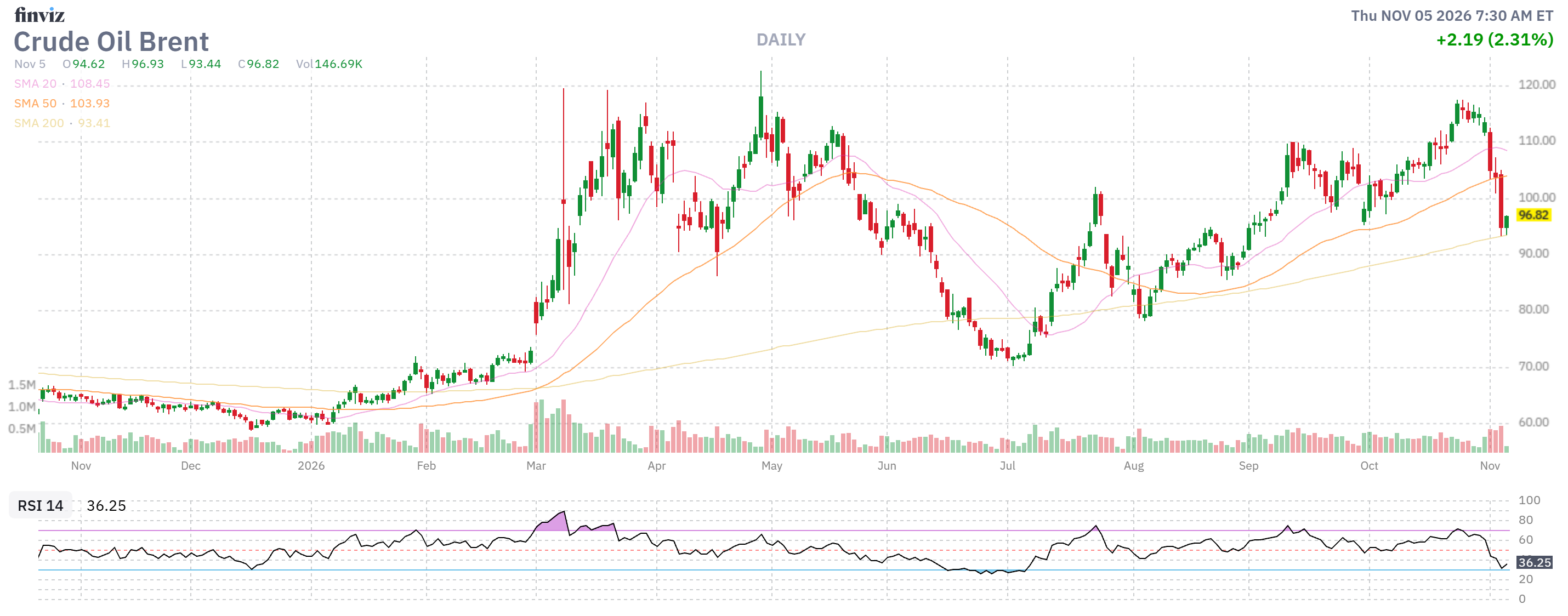
But next Tuesday’s CPI measures October. Yesterday’s oil decline cannot retroactively improve that report.
This creates a potential tug-of-war: a disappointing October number versus investors arguing that November is already improving. For that argument to sustain a rally, oil needs to stay lower – not merely give back a geopolitical premium for one session.
3. AI spending is no longer a uniformly bullish variable
The most important market development yesterday was not simply “technology rallied.”
Microsoft and Amazon rose strongly while Nvidia and other infrastructure suppliers weakened. Investors were treating a slower data-center buildout as potentially positive for buyers’ cash flow but negative for suppliers’ future orders. That divergence continued in this morning’s futures commentary.
That means the Nasdaq has two competing routes:
| Development | Potential beneficiaries | Potential pressure points |
|---|---|---|
| AI spending remains very strong | Chips, equipment, networking, infrastructure | Buyers’ free cash flow and financing needs |
| AI spending becomes more disciplined | Cash-generating platforms and application businesses | Suppliers valued on uninterrupted capacity expansion |
| Spending slows because end demand disappoints | Few broad winners | Both buyers and suppliers |
The healthy outcome is spending discipline without demand destruction. The unhealthy outcome is that “better returns on AI” turns out to mean customers cancel projects because the economics never worked.
Applied Materials on November 12th gives us an early physical-demand check. Nvidia on November 17th is the larger index event. The question is not merely whether either beats last quarter’s estimates; it is whether forward orders, delivery schedules, margins and customer financing remain consistent with current expectations.
4. The broader S&P needs evidence outside the AI complex
A rally can become more durable through rotation. It does not require every semiconductor stock to regain its high.
But the replacement leadership must have earnings behind it. Home Depot’s November 17th report is useful because it tests housing-related demand, large purchases, and the difference between transactions and price-driven sales growth.
For consumer reports generally, I would look for:
-
-
-
- Unit or transaction growth rather than inflation alone.
- Stable inventories.
- Margins holding after promotions.
- Guidance supported by actual demand rather than cost exclusions.
-
-
If the AI suppliers weaken while consumer and industrial earnings also deteriorate, there is no genuine broadening—just investors moving between temporarily safer places.
5. The election is a change in probabilities, not an overnight legislative stimulus
The new Congress does not take office until January 3rd and the president retains his veto and substantial executive authority. Stronger oversight and fewer new adverse legislative changes are plausible benefits; immediate tariff removal, restored credits, and approved projects are not automatic consequences.
Over the next few weeks, watch whether the rhetoric becomes specific:
-
-
-
- Negotiated policy changes rather than campaign promises.
- Actual permit decisions rather than assumptions about a national construction ban.
- Improved corporate planning confidence rather than simply a higher stock multiple.
-
-
That is especially important for data centers: opposition can delay individual projects, but an election result alone does not cancel every contracted order.
The next major confirmation: November 25
BEA will release October personal income, spending, and PCE inflation alongside the second estimate of Q3 GDP and corporate profits on November 25th. That is the next comprehensive test of whether households are spending from stronger real income or stretching their finances.
There is no scheduled November FOMC decision. The next meeting is December 8–9, so this month’s data will shape the December debate before the Fed itself acts.
The election bought the market relief. It did not buy lower Interest Rates, stronger Household Purchasing Power or better returns on Data-Center construction. Those still have to be delivered.
There is a credible bullish path: lower oil, stable employment, cooler inflation and stronger cash generation broaden the rally beyond the companies selling the AI buildout. The bearish path is equally clear: sticky Inflation keeps financing expensive while suppliers’ growth expectations weaken and ordinary businesses cannot take up the slack.
That is the make-or-break test – NOT whether RSI reaches an estimated number, but whether earnings and financing conditions improve enough to support prices after the relief rally.
And now, we’ll ask Sancho to give us the War/Oil Report:
🫏 Oil Down 17% on Vibes: War and Oil Report
The short version: Democrats took Congress, Brent fell 16.6% in four sessions, and nothing in the Gulf has actually been signed. The market is trading the hope that a weakened Trump finally wants out. Maybe he does but he said two opposite things on Tuesday and Wednesday.
The election
-
-
-
The result: Democrats flipped both chambers. BBC projections have them near 54 Senate seats and 240 in the House, with counting still finishing. Schumer says the war “must end” and Jeffries is echoing him.
-
Trump’s admission: Vance said the war was “the reason we lost.” Trump agreed it was “largely true because it drove the gasoline up a little bit, short term,” then added “if I had it to do again, I’d have to do it again.“ apnews
-
The gas numbers: Gas was $4.14 a gallon on Election Day, the highest ever for one, and diesel was $6.28. A “little bit” is 36% above last year’s $3.05. finance.yahoo
-
What Congress can do: Not much until January. A Democratic Congress can restrict funding and oversee the war but Trump keeps wide latitude to act by executive order. Analysts split on what he does now. One former White House Iran director thinks escalation is likelier because Trump no longer fears voters and is desperate not to take the loss on his record. Another thinks the defeat sets the stage for a deal. usatoday
-
-
The Bullshit Meter
-
-
-
“We seem to be getting everything we want.“ (Trump to the Financial Times.) Iran’s Strait Authority still runs a toll regime and Iran’s seven conditions for reopening the strait are unmet. Rating: no.
-
“No immediate plans” versus “We have to do something large.“ Trump said the first to the Financial Times and the second to Fox, including a possible “heavy hit.” Axios reports the military is finishing preparations for possible major combat, and US media say three carriers are in the region. Both tracks are live. gulfnews
-
“The US approved the Qatari draft.“ This is a single source, a Qatari newspaper relayed by Pakistan’s Tribune. A senior Iranian official told Reuters Iran and the US are still “far from a deal.” Qatar says only that there’s “still a chance.” Rating: unconfirmed. tribune.com
-
Iran’s seven conditions. They reportedly include war reparations and US forces leaving the region, per the same Tribune report. That’s an opening bid and Rezaei says the US response was “not convincing.” aljazeera
-
Hegseth. Trump publicly says he’s doing “a very good job” while CBS reports he’s asking aides whether Hegseth should stay.
-
The tankers. Iran says four tankers hit mines on an “unauthorized” route. I can’t confirm that, but Windward reported a similar episode on Nov. 1.
-
-
Israel is another variable. Its Oct. 27 election produced no majority, with Netanyahu’s bloc at 53 of the 61 seats needed. He has said the “primary objective” is eliminating Iran’s regime.
The oil
-
-
-
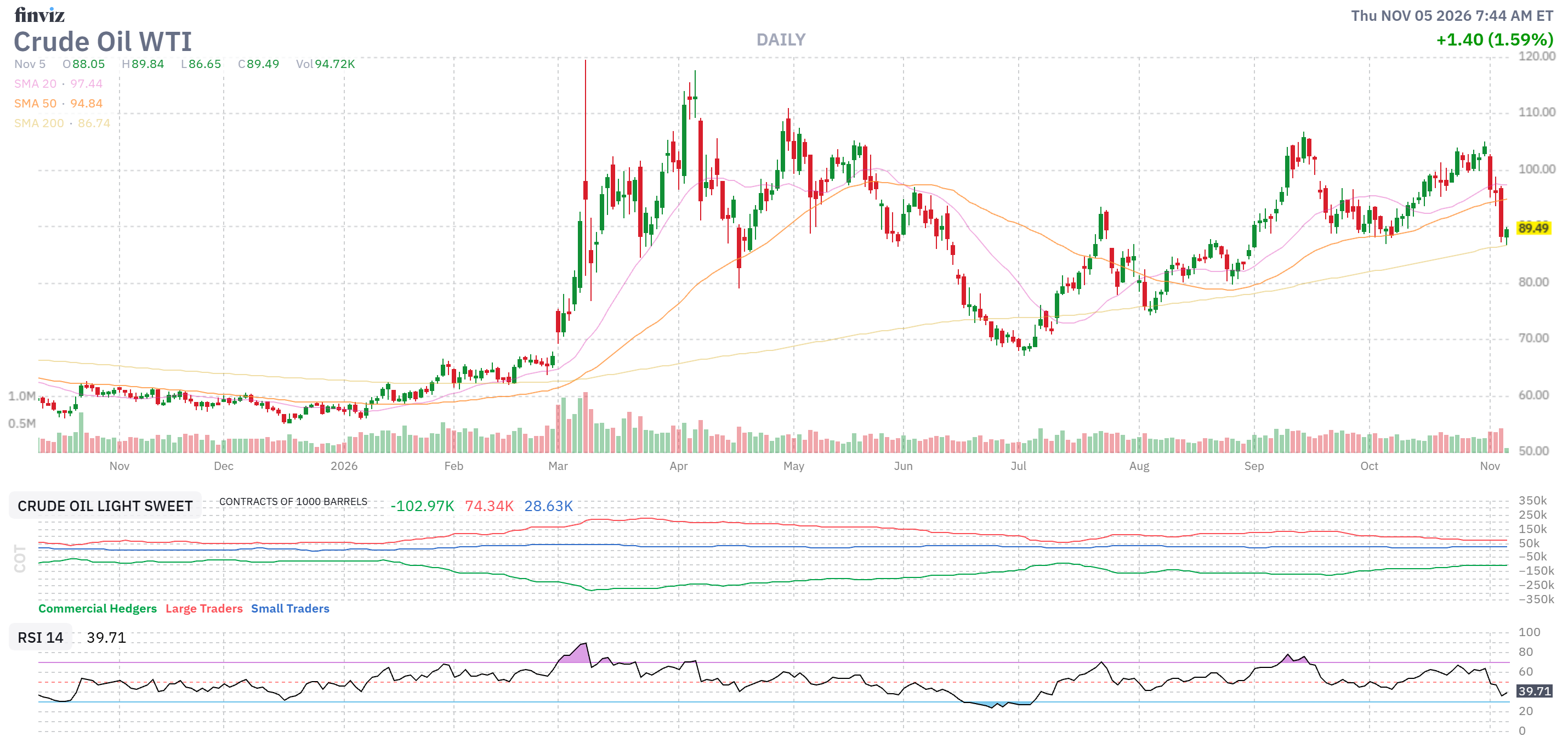
Prices: Brent is $96.73 this morning, bouncing from a $94.62 close. That’s down 8.7% on Wednesday alone and 18.9% from the Oct. 23rd close of $116.72. WTI is $89.58.
-
-
-
-
-
Paper versus physical: Murban physical crude was $100.90 at the same time Brent was near $93.6. Physical Gulf barrels are still about $7 over the screen price. gulfnews
-
The flows haven’t changed: As covered yesterday, Iran’s exports are zero and products are scarce. Global stocks sat 509M barrels below pre-war at the end of September. The US Strategic Petroleum Reserve is at 282.2M barrels, the lowest since 1982. oilpriceapi
-
Why it fell anyway: Hope and positioning, plus a real disagreement on the balance. JPMorgan says the market was already in surplus by about 1.1M b/d in September, while the IEA said it was in deficit.
-
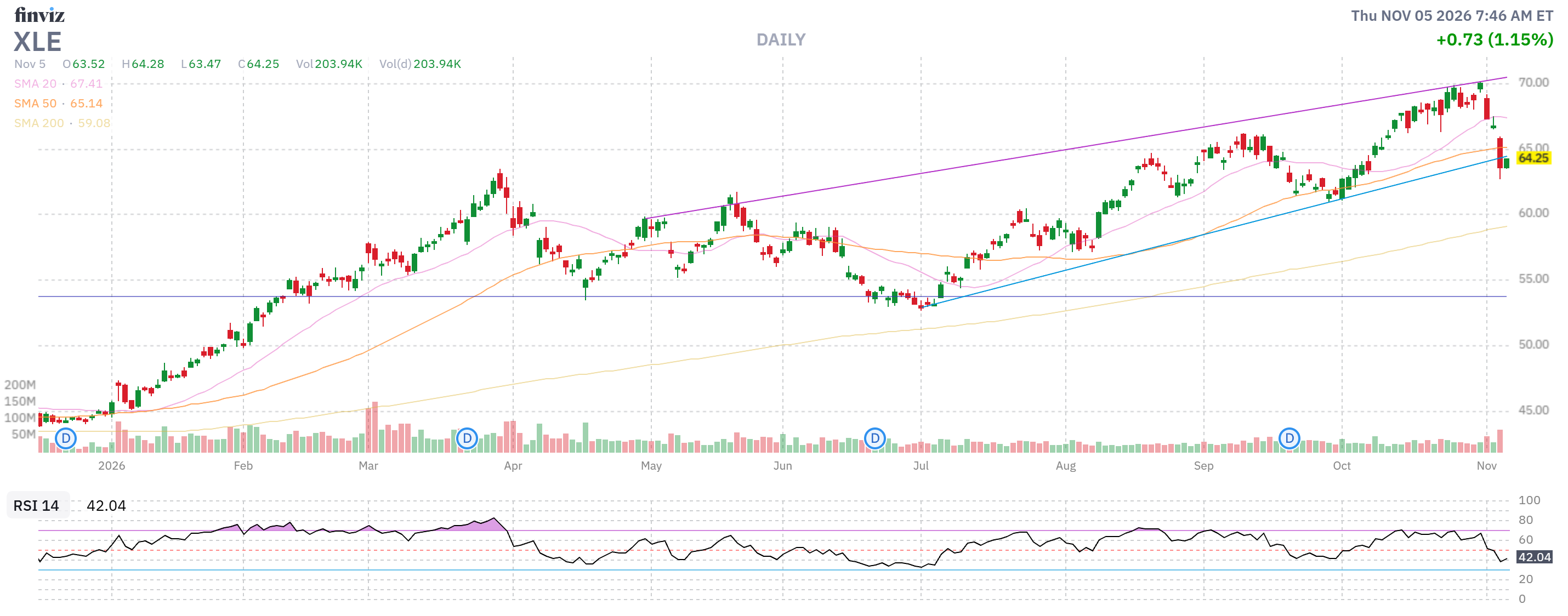
Stocks: Energy fell, with XLE down 4.7%. The Dow ETF rose 3.1% and SPY rose 1.65%, after QQQ had fallen 6.1% in four sessions before the vote.
-
-
The money
-
-
-
Central banks: The Bank of England hiked to 4% today and warned inflation heads toward 4.9%. Bloomberg’s headline says unanimous while its text says 8-1, so the vote split is unclear. The Fed held at 3.75% to 4.00% with two dissents wanting a hike, and the ECB held at 2.5%.
-
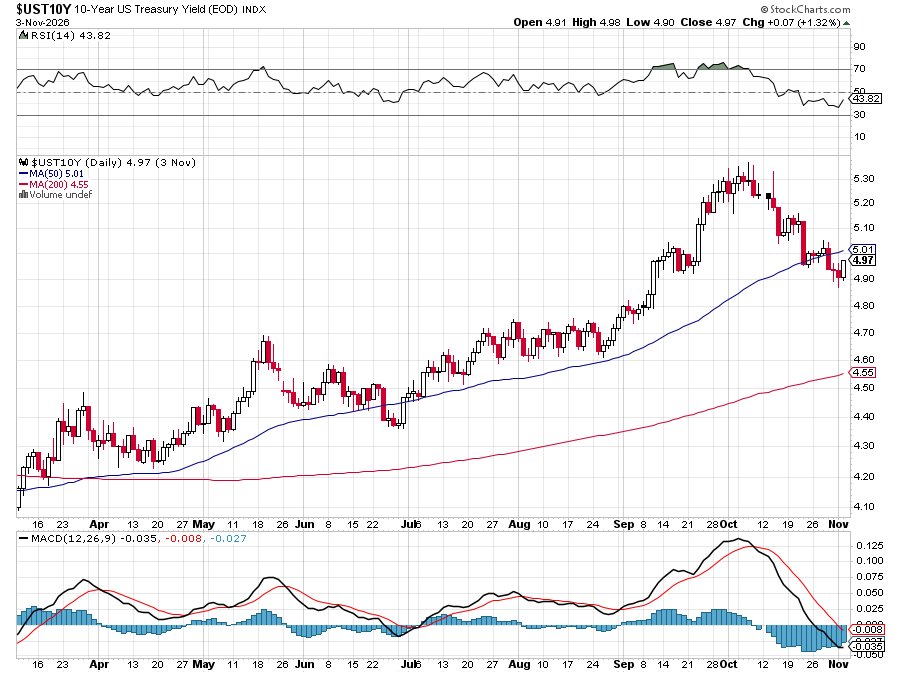
Yields: The 10-year is 4.89%, down from 5.14% on Oct. 19th.
-
-
-
-
-
Europe’s gas: Dutch TTF gas topped €100 for the first time since 2022, and EU storage was 74.6% full on Nov. 1, the lowest for that date since records began. Cheaper oil doesn’t fix a winter gas problem.
-
Jobs on Friday: Economists expect about 59,000 jobs and 4.2% unemployment, after +29,000 in September. That is a weak economy with 5% inflation heading its way (Stagflation!). investopedia
-
-
What to watch
-
-
-
-
A joint announcement: Qatar is working on one. If it doesn’t come soon, the strike plan is the alternative.
-
Mines and transits in Hormuz: These are the only real measures of whether anything is opening.
-
Friday’s jobs number: A miss makes the Fed’s hike dissenters look worse.
-
January: That’s when the new Congress can actually restrict the war.
-
-
-
Until then, we’re going to have to muddle through and continue to take advantage of the bargains the market throws at us.
Yesterday, in our Live Member Chat Room, we issued a Top Trade Alert on FSLR that has the potential to return up to 1,550% on the CASH!!! – turning $16,000 into $296,000 over the next two years! Are we going to make $296,000? Only if everything goes PERFECTLY and it probably won’t but – are we going to make $100,000 (625%) – there’s a VERY GOOD chance of that working out – even if it’s a bumpy ride…
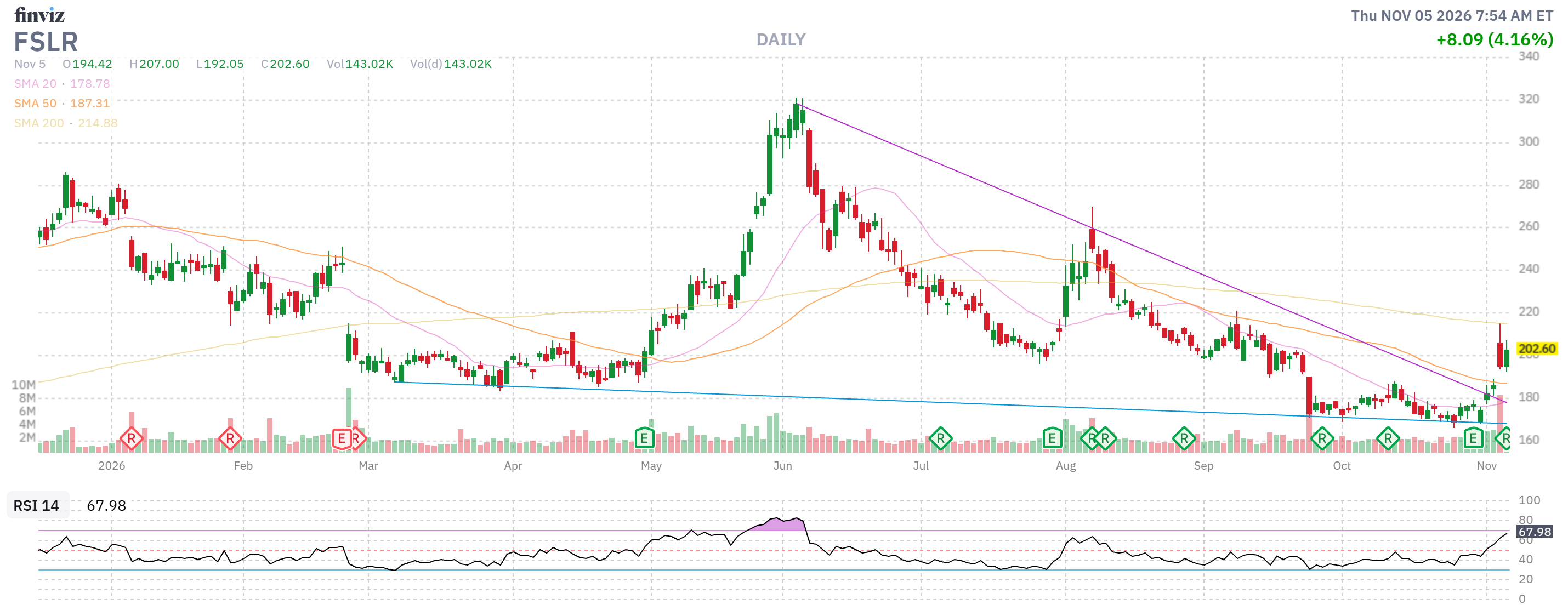
Those of you too cheap to subscribe can simply play FSLR long at $201.50. Our Jan 2029 target is $220 and that would be good for an $18.50 (9.2%) gain. It’s the options strategies that turn 9.2% into 1,550% – using substantially less capital than purchasing the stock. We’ll check back once in a while to see if the Membership option was a worthwhile decision!