


Most retail traders treat the 2026 market like a slot machine when they should be acting like the casino owner. It’s an expensive mistake. If you’ve felt the sting of getting chopped up in recent sideways action or watched a bull strategy wither as the Fear & Greed Index dipped to 33, you aren’t alone. It’s exhausting to use high-risk setups at exactly the wrong moment, but that’s what happens when you’re following the herd instead of the cycle.
We agree that the old buy-and-hold mantra feels hollow with the 10-Year Treasury Note yield sitting at 4.756 percent. To thrive now, you must master market cycle trading strategies for options that turn volatility into a predictable paycheck. This guide shows you how to align your portfolio with the four distinct market phases to maximize gains and hedge against sudden shifts. We’ll break down specific setups for each stage, explain how the June 2026 FINRA Rule 4210 overhaul changes your intraday margin approach, and show you why the house always wins by selling the premium that others are desperately buying.
Key Takeaways
- Stop confusing expiration dates with market momentum by learning how to distinguish calendar cycles from the actual profit-driving phases of the market.
- Identify the specific “House” setups required for Accumulation and Markup phases so you can stop using static strategies that only work in a bull market.
- Master market cycle trading strategies for options to align your portfolio with current volatility levels and avoid the high-risk mistakes that trap the retail herd.
- Learn to spot technical exhaustion signals like RSI and volume divergence to identify cycle turns before they become expensive “Bull Traps.”
- Discover how real-time analysis and “The House” methodology can help you generate consistent income by selling fear rather than buying speculative hope.
Decoding the Cycle: Market Phases vs. Expiration Cycles
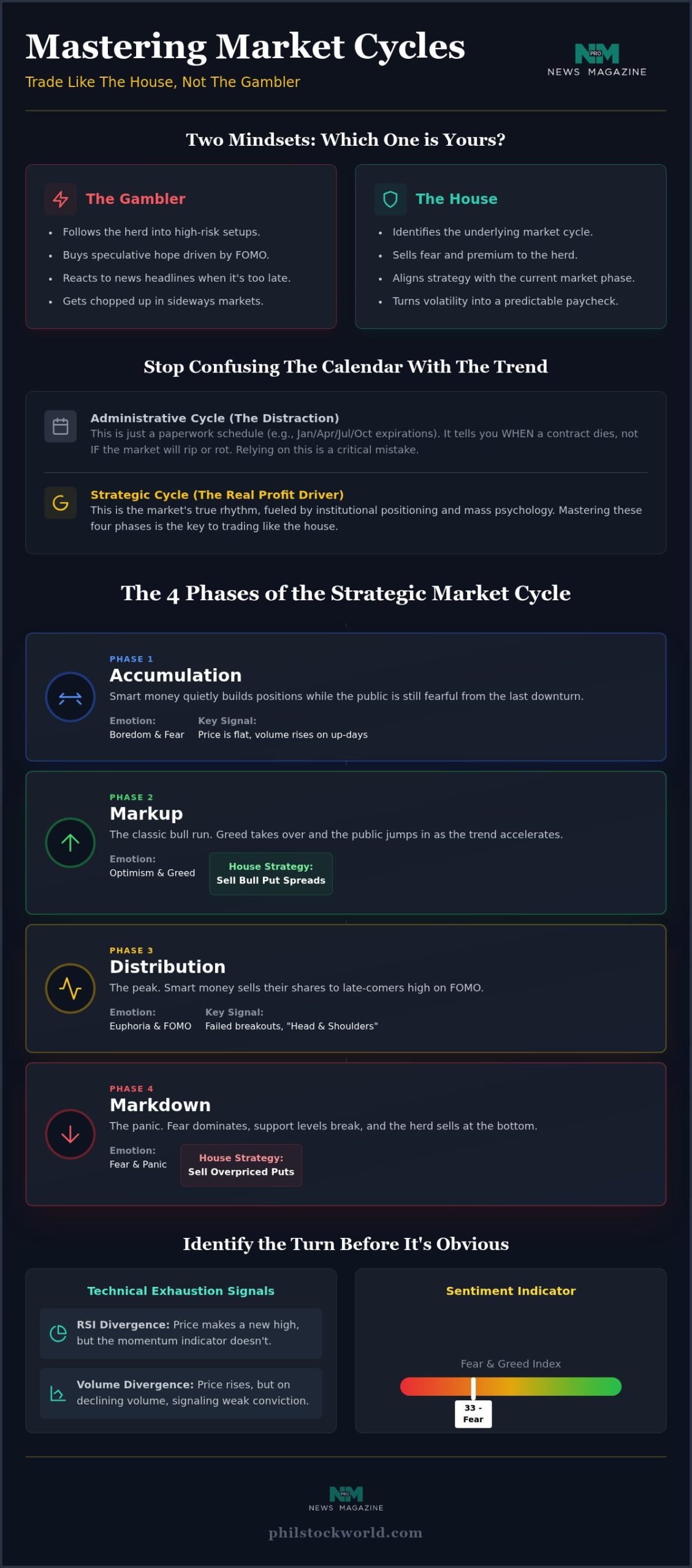
Most retail traders get lost in the calendar. They see “Cycle 1” or “Cycle 2” on an options chain and think they’re looking at a roadmap. They aren’t. Those are just administrative schedules that tell you when a contract expires. If you want to trade like the house, you have to look past the dates and see the underlying rhythm of the price action. Relying on a static strategy, like always selling iron condors regardless of the market environment, is a fast track to getting run over when the trend shifts.
The Administrative Cycle: What the Textbooks Tell You
The options market traditionally operates on three cycles: January, February, and March. This structure dictates that a stock will have expirations in specific months, like the Jan/Apr/Jul/Oct sequence. It’s useful for tracking liquidity and open interest, especially when major players are looking to hedge large positions. Institutional rebalancing often aligns with these quarterly expiration months, creating predictable pockets of volume that the savvy trader can exploit. But don’t confuse this paperwork with a strategy. Knowing when a contract dies won’t tell you if the market is about to rip or rot.
The Strategic Cycle: What Professional Traders Actually Watch
Real profit comes from understanding Stock market cycles, which move through four distinct stages fueled by human emotion and institutional positioning:
- Accumulation: Smart money quietly buys while the public is still fearful and the news is bleak.
- Markup: Momentum takes over, greed starts to drive the bus, and the bull run accelerates.
- Distribution: Institutional players quietly sell their shares to late-comers who are high on FOMO.
- Markdown: Fear dominates as the market searches for a floor and the herd panics.
This is where market cycle trading strategies for options become your edge. The house doesn’t just gamble; it adjusts the odds based on the environment. During the Distribution phase, implied volatility (IV) often creeps up as big players pay for insurance. When the Markdown hits, the house is busy selling overpriced puts to panicked retail traders who are desperate for protection. Sentiment is your leading indicator. If you can identify the shift from greed to fear before the herd does, you stop being the gambler and start being the casino. Mastering market cycle trading strategies for options means knowing exactly when to be the buyer of volatility and when to be the one collecting the rent.
The Four Phases of the Market Cycle for Options Traders
Accumulation is the “boring” phase. It is where the smart money quietly builds positions while the public is still licking its wounds from the previous crash. You will often see a divergence between price and volume; the price might be flat, but volume is rising on green days. This is the foundation. When the market finally breaks through key resistance levels on high conviction, we enter the Markup phase. This is the classic bull run. The house loves this stage for selling bull put spreads. Volatility is usually low, and the trend is your friend. You can see how institutional players navigate these shifts in Fidelity’s thinking on the business cycle, where they align sector rotation with economic momentum to capture the meat of the move.
Spotting the Distribution and Markdown Danger Zones
When your neighbor starts giving you aggressive stock tips, you are likely in Distribution. This is the peak of euphoria. The smart money is busy offloading shares to late arriving retail traders who are high on FOMO. Look for “Head and Shoulders” patterns or failed breakouts that suggest the buyers are exhausted. Once the support levels snap, we hit the Markdown. This is where the real damage happens. Fear takes over, and the CNN Business Fear & Greed Index, which currently sits at a shaky 33, starts to plummet. Implied volatility (IV) goes through the roof as everyone scrambles for insurance. This is why long term portfolio protection is non negotiable. If you aren’t prepared, the house will harvest your premium while you are frozen in panic.
If you are unsure where your current holdings sit in this cycle, a Virtual Portfolio Review can help you audit your risk before the next leg down. Understanding these phases is the difference between being the one paying the rent and the one collecting it.
Mapping Option Strategies to the Market Cycle
Successful trading isn’t about finding the “best” strategy. It’s about finding the right strategy for the current environment. Most retail traders lose because they treat every market like a bull run, buying “lotto ticket” calls that decay to zero 90 percent of the time. To trade like the house, you must flip the script. You sell what the herd is desperate to buy and buy what they are too afraid to touch. Mastering market cycle trading strategies for options involves more than just picking a direction; it’s about matching your trade structure to the market’s volatility and momentum.
| Market Phase | Primary Strategy | Volatility (IV) Outlook |
|---|---|---|
| Accumulation | Cash-Secured Puts | Low / Bottoming |
| Markup | Bull Call Spreads / LEAPS | Stable / Rising |
| Distribution | Iron Condors / Covered Calls | High / Peaking |
| Markdown | Bear Put Spreads / Tail Hedges | Spiking / Extreme |
Strategies for Accumulation and Markup
During Accumulation, the smart money is quietly building positions. This is the perfect time to use Cash-Secured Puts. You essentially get paid to wait for the bottom. If the stock stays flat, you pocket the premium; if it drops, you buy the shares at a discount you already liked. As the cycle shifts into Markup, momentum becomes the engine. With the Federal Reserve’s target range at 3.50 to 3.75 percent as of September 2026, call options and LEAPS become more attractive as interest rates influence pricing models. You can use Bull Call Spreads to capture the upside while keeping your risk defined. For a deeper look at these setups, check our guide on advanced option trading strategies to see how the house structures these wins.
Strategies for Distribution and Markdown
When the market hits Distribution, volatility starts to churn. This is the time for neutral strategies like Iron Condors. You are harvesting high IV from a crowd that can’t decide if the party is over. Once the support breaks and the Markdown begins, the house shifts into defense. Bear Put Spreads allow you to profit from the slide without the uncapped risk of shorting stock. This is where “The House” methodology truly shines. While the panicked herd is overpaying for protection, you are the one selling them those overpriced puts. You aren’t gambling on the crash; you are providing the insurance and collecting the premium. By adjusting your Delta and Theta as the cycle matures, you ensure that time decay works for you, not against you.
Risk Management: Identifying the ‘Turn’ Before the Herd
The most dangerous part of any cycle isn’t the middle; it’s the turn. This is where retail traders get lured into “Bull Traps” or “Bear Traps” that wipe out months of gains in days. You might see a small rally during a Markdown phase and think the bottom is in, only to get slammed by the next leg down. Or you see a dip in a Markup phase and panic sell right before the real run begins. Identifying these pivots is the core of effective market cycle trading strategies for options. Without a plan for the turn, you’re just another piece of liquidity for the house.
Technical Indicators for Cycle Shifts
Spotting institutional selling requires looking at the footprints left behind on the tape. Learning how to read market charts allows you to see when the big money is quietly exiting while the price is still holding steady. We look for volume exhaustion; if the market is making new highs but volume is drying up, the fuel is gone. The 200-day moving average serves as our ultimate cycle line in the sand. If the price is below it, we aren’t looking for aggressive bull plays. Divergence between price and momentum indicators like RSI or MACD is the single most important warning sign that a cycle turn is imminent. When the price hits a new high but the RSI makes a lower high, the house starts tightening the hedges.
Sentiment Analysis: The Ultimate Cycle Tool
The psychological pivot is often more telling than the charts. It’s that moment when the “Fear of Missing Out” (FOMO) suddenly transforms into the “Fear of Losing Everything.” We monitor the Put/Call ratio to see when the herd is leaning too far in one direction. If everyone is buying calls, the market is likely over-leveraged and due for a Distribution phase. At Phil Stock World, we treat mainstream media headlines as contrarian signals. When the news is screaming about a “new era” of endless growth, we’re usually looking for the exit.
Building a disciplined trading approach means ignoring the noise and sticking to the data. You should never be “all in” on a single cycle phase. The 2026 regulatory landscape adds another layer of complexity; with the new intraday margin standard under FINRA Rule 4210 now in effect, firms are monitoring deficits more aggressively. A poorly timed bet at a cycle pivot could trigger immediate trading restrictions. Proper position sizing ensures that even if you’re wrong about the timing of the turn, you have the capital to adjust and survive.
Don’t wait for the headlines to tell you the cycle has shifted. Join our Premium Membership for real-time analysis of these turns and learn to position your portfolio before the herd panics.
Navigating 2026 Cycles with Phil Stock World
Waiting for the weekend financial news to tell you where the market is going is a recipe for disaster. By the time the talking heads on television agree that we’ve entered a Distribution phase, the smart money has already moved to the sidelines. In a 2026 environment where crude oil has surged over $92 a barrel and the Federal Reserve is keeping traders guessing with a 3.50 to 3.75 percent target range, you need insights that move at the speed of the tape. A Phil Stock World membership provides the kind of granular, real-time research that big banks usually keep behind closed doors.
The market cycle isn’t a static map; it’s a living, breathing wave. You can either learn to surf it with precision or get crushed by the weight of the herd’s panic. Mastering market cycle trading strategies for options requires a shift in perspective from being a gambler to being the house. We don’t just react to price action. We anticipate the structural shifts that drive it.
Inside the Live Trading Room
Watching the house adjust strategies in real-time is the best way to flatten your learning curve. Our Live Trading Room isn’t a lecture hall; it’s a high-level discussion among peers who are actively navigating the same volatility you are. You get real-time alerts for cycle-specific trades, whether we are selling premium in a boring Accumulation phase or deploying tail hedges as the Markdown begins. Having direct access to Phil Davis and the PSW team allows you to validate your strategies before you put capital at risk. You aren’t going solo against the machines; you’re trading with a pack of savvy veterans who know how to spot a “Bull Trap” before it snaps shut.
The Virtual Portfolio Review: Your Cycle Audit
The number one mistake retail traders make is overstaying their welcome in a dying trend. They hold onto Markup strategies long after the Distribution phase has begun. A virtual portfolio review acts as a critical cycle audit to see if your current trades are out of sync with the macro environment. We help you identify the “dead wood” in your portfolio and show you how to rotate into setups that actually benefit from current volatility levels. This isn’t about generic advice; it’s about aligning your specific Greeks with the reality of the 2026 market. Stop guessing where the turn is and start using a disciplined, data-driven approach to protect your gains. Join Phil Stock World today and start trading like ‘The House’.
Mastering the Rhythm of the 2026 Market
The market is a series of predictable shifts in sentiment and liquidity. By now, you understand that acting like “The House” isn’t about guessing the future; it’s about reacting to the present with the right tools. We’ve decoded how market cycle trading strategies for options allow you to harvest premium during Distribution and build long-term wealth during Accumulation. You don’t have to get caught in the next “Bull Trap” if you’re watching the volume and momentum signals we’ve discussed. The key is to stop being the liquidity for institutional players and start being the one collecting the rent.
Stop trading against the machines alone. Phil Davis has been providing expert analysis since 2006, helping traders navigate every crisis and boom with a “House” mentality. When you Start Your Phil Stock World Membership Today, you gain access to real-time trade alerts based on proprietary cycle analysis and our vibrant Live Trading Room community. It’s an exclusive insider’s club where complex data is transformed into actionable profit. The next cycle turn is already forming. Make sure you’re on the right side of it and ready to surf the next wave with confidence.
Frequently Asked Questions
What is the best option strategy for a bearish market cycle?
Bear Put Spreads and Tail Hedges are the top choices for a Markdown phase. These strategies allow you to profit from downward momentum while keeping your risk defined. Unlike shorting stock, which carries uncapped risk, these setups let you capitalize on rising implied volatility. You are essentially buying protection when it is relatively cheap or selling call spreads to collect premium from those betting on a dead-cat bounce.
How do I know when the market cycle is shifting from Markup to Distribution?
Look for technical divergence and a peak in retail euphoria to spot the turn. When the price hits new highs but momentum indicators like RSI or MACD start trending lower, the fuel for the rally is drying up. Volume often becomes exhausted at the top as institutional players quietly offload shares to late arriving retail traders. This is the moment when the house stops selling put spreads and starts looking for neutral setups.
Is it better to buy or sell options during the Markdown phase?
You should focus on selling overpriced premium to the panicked herd while holding strategic long hedges. During a Markdown, implied volatility often spikes, which inflates the price of puts. By acting like the house, you can sell these expensive contracts to retail traders who are desperate for insurance. However, you must pair this with disciplined position sizing to ensure you aren’t wiped out by a sudden, unexpected volatility expansion.
How long does a typical market cycle last in 2026?
Market cycles in 2026 have become more compressed due to the rapid transmission of global news and the June 2026 FINRA Rule 4210 overhaul. While a full cycle once took years, we now see phases play out over months or even weeks. The current interest rate environment of 3.50 to 3.75 percent also accelerates shifts in capital. Monitoring real-time data is more important than following historical calendar averages for your trades.
Can I use market cycle strategies for short-term day trading?
Yes, you can apply these principles to intraday moves, especially under the new margin standards that replaced the pattern day trader rule. Understanding the macro cycle helps you determine your bias for the day. If the broader market is in a Markdown phase, your short-term market cycle trading strategies for options should lean toward bearish setups. This prevents you from fighting the primary trend during your smaller intraday trades.
What is the difference between an option expiration cycle and a market cycle?
An option expiration cycle is a purely administrative calendar date, whereas a market cycle represents the actual economic and psychological phase of the market. Expiration cycles tell you when a contract dies, but they provide zero insight into price direction. Market cycles are the profit drivers. Professional traders ignore the calendar cycle and focus on where the smart money is moving within the economic phases of Accumulation, Markup, Distribution, and Markdown.
How does volatility (VIX) affect market cycle trading?
Volatility is the heartbeat of the cycle and dictates which option strategies are viable. In the Markup phase, the VIX is usually low and stable, making it a great time to buy calls or LEAPS. When the cycle shifts to Markdown, the VIX spikes, which dramatically increases the cost of options. This is when the house methodology excels by selling that expensive volatility back to a fearful market for a predictable paycheck.
Why do institutional traders always seem to be on the right side of the cycle?
Institutional players win because they trade based on liquidity and sentiment rather than headlines. They are the ones buying during the boring Accumulation phase while the public is still fearful. By the time the news is bullish, they are already in the Distribution phase, selling their positions to the retail herd. They act as the house by providing liquidity and collecting premium rather than chasing speculative gains with high-risk bets.

