


Most investors treat portfolio insurance like a mandatory tax on their success, but the reality is that the most successful traders don’t buy protection; they sell it to the uninformed. You’ve likely felt that familiar gut-punch when a flash crash wipes out months of gains in a single afternoon. It’s frustrating to watch your hard-earned profits evaporate while you’re stuck paying exorbitant premiums for protection that feels more like a burden than a safety net. Implementing sophisticated portfolio hedging strategies with options shouldn’t feel like a drain on your annual returns.
We’re going to show you how to flip the script and adopt the “House” mentality, protecting your capital from 2026 market volatility without the high cost of traditional insurance. You’ll learn how to structure positions that offset their own costs, creating a “sleep at night” portfolio that remains resilient even as the 10-year Treasury yield stays elevated near 4.78 percent. This guide provides a clear framework for timing your hedges and using the current VIX environment to your advantage before the next wave of volatility hits.
Key Takeaways
- Stop relying on the “relic” 60/40 portfolio and understand why modern markets require active, uncorrelated protection.
- Master sophisticated portfolio hedging strategies with options that act as a strategic layer rather than a drain on your capital.
- Learn to “be the house” by using Bear Put Spreads to offset hedging costs, essentially getting paid to protect your downside.
- Discover how LEAPS can provide a multi-year safety net, allowing you to ignore the daily noise and focus on long-term growth.
- Gain a clear framework for sizing your protection so you’re never over-leveraged or under-insured when the macro environment shifts.
Why Traditional Diversification Fails in 2026
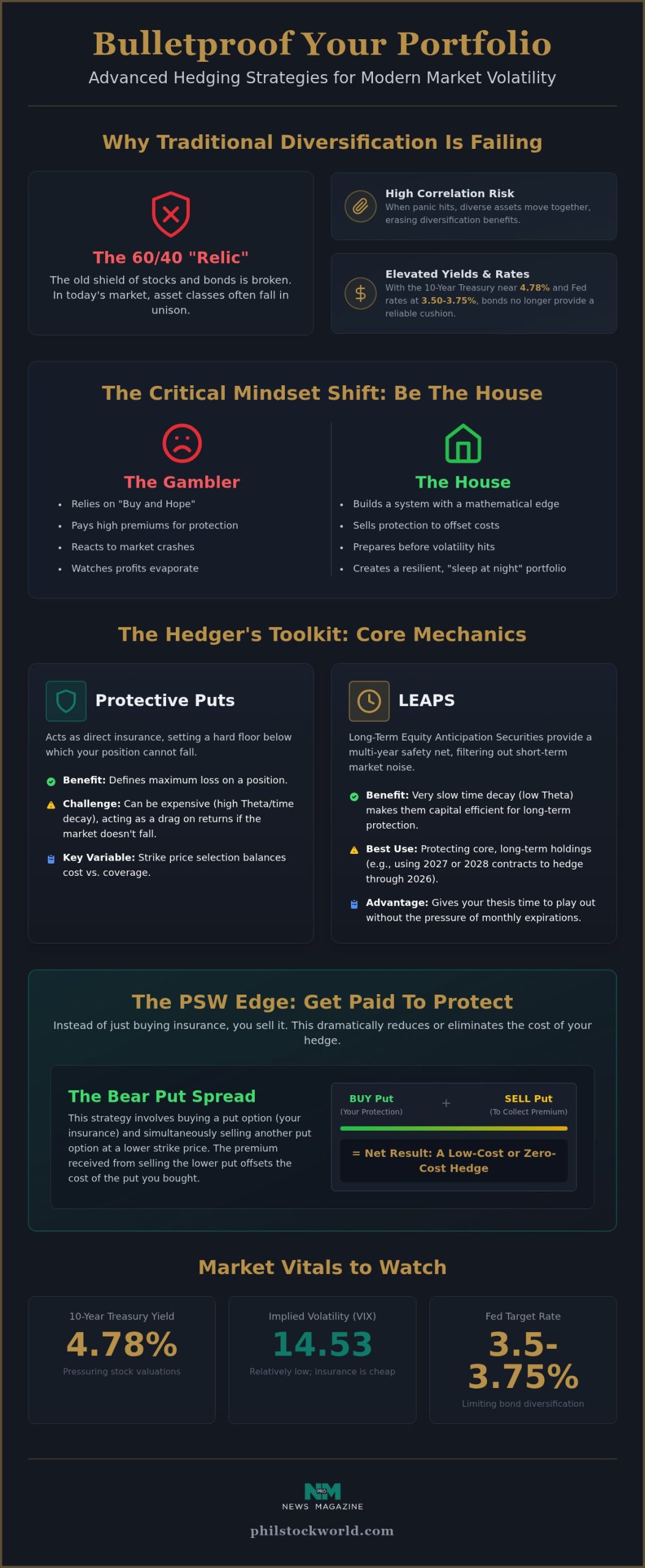
The 60/40 portfolio isn’t just resting; it’s a relic of a market that no longer exists. For decades, the mainstream narrative told you that holding a mix of stocks and bonds would shield you from the worst of the storms. In 2026, that shield has more holes than a screen door. With the 10-year Treasury yield hovering around 4.78 percent and the Fed keeping rates in the 3.50 to 3.75 percent range, the inverse relationship between equities and fixed income has largely dissolved. When the market drops now, it drops in unison.
This is the reality of correlation risk. In the context of a 2026 market crash, correlation is the phenomenon where disparate asset classes lose their unique identities and move toward a single, downward trajectory as liquidity vanishes and panic takes over. Relying on “buy and hope” is a psychological trap that leaves you at the mercy of the crowd. To survive, you need to transition to “The House” mentality. Casinos don’t pray for a specific outcome; they build a system where the math is tilted in their favor, regardless of which card is flipped. Professional portfolio hedging strategies with options are the tools that allow you to build that system.
The Myth of the Safe Haven
Gold, bonds, and cash used to be the bunker you’d run to when things turned sour. That’s no longer the case. Market sentiment in 2026 moves at the speed of an algorithm, and traditional safe havens often get liquidated alongside risky assets to cover margin calls. We’ve seen it happen repeatedly this year. If you aren’t active, you’re a target. You can’t just hide in cash and hope inflation doesn’t eat your purchasing power while you wait for the dust to settle.
Hedging as Portfolio Insurance
Think of hedging as the cost of doing business, not a wasted expense. You don’t buy fire insurance while your curtains are already ablaze; you buy it when the sun is shining. A common starting point is the Protective Put, which sets a hard floor under your positions. However, simply buying puts is often too expensive for the average trader. If you’re feeling exposed and aren’t sure where the leaks are, a Virtual Portfolio Review can help you audit your current setup. Effective portfolio hedging strategies with options require a disciplined approach to risk, ensuring you’re protected before the next volatility spike sends the VIX screaming past its current 14.53 level.
Core Mechanics: Hedging with Put Options and LEAPS
The foundation of any robust defense is the Protective Put. It acts as a hard floor for your stock positions, ensuring that no matter how far the market slides, your exit price is locked in. While the concept is simple, the execution separates the professionals from the prey. Mastering portfolio hedging strategies with options means you aren’t just buying a contract; you’re managing Greeks. Delta tells you how much protection you’ve actually purchased, while Theta represents the daily “rent” you pay to stay in the trade. For those just starting to explore hedging strategies from the CBOE, understanding that time decay is the primary enemy of the uneducated hedger is a vital first step.
Choosing Your Strike Price
Strike selection is a balancing act between cost and coverage. Out-of-the-money (OTM) puts are cheaper but require a larger market drop before they provide real protection. In-the-money (ITM) puts offer immediate downside coverage but demand a higher upfront premium. A put option with a Delta of 0.50 will increase in value by approximately $0.50 for every $1.00 move lower in the underlying stock. Finding the sweet spot involves calculating exactly how much “deductible” you’re willing to pay before your insurance kicks in. If you choose a strike too far below the current price, you might save on premium, but you’ll still feel the sting of a 10 percent correction before the hedge starts doing the heavy lifting.
Long-Term Protection with LEAPS
If you want to stop staring at every 1 percent wiggle in the S&P 500, LEAPS (Long-Term Equity Anticipation Securities) are your best friend. By using 2027 or 2028 contracts, you can effectively sleep through 2026 volatility. These long-dated options are incredibly capital efficient because they suffer from much slower time decay compared to monthly contracts. At Phil Stock World, we prefer LEAPS for building “The House” positions because they give your thesis time to breathe. It’s about moving away from the frantic pace of day trading and toward a structured, multi-year defensive posture. You can see these strategies in action and learn to manage them yourself by joining our Premium Membership community.
Effective portfolio hedging strategies with options aren’t about guessing the bottom or predicting exactly when the Fed will pivot. They’re about preparing for the inevitable shifts in a resilient but high-yield economy. By locking in protection that lasts for years rather than weeks, you remove the emotional burden of market timing and replace it with mathematical certainty. This proactive approach ensures that when the herd panics, you’re already positioned to profit from the chaos.
The PSW Edge: Cost-Effective Hedging with Spreads
Buying naked puts is often a sucker’s game, especially when volatility begins to trend upward. While the VIX sits at 14.53 as of early September 2026, we know how quickly that can jump toward its historical median of 17.58 or higher. When premiums bloat, the retail crowd overpays for “insurance” that requires a total market meltdown just to break even. This is where most traders bleed out. They buy protection at the top of the price curve and watch as Theta eats their lunch. To truly master portfolio hedging strategies with options, you have to stop being the gambler and start acting as the casino. This means selling volatility to the panicked masses while structuring your own protection at a fraction of the retail cost.
The Bear Put Spread is a fundamental tool for this “House” mentality. Instead of just buying a put, you simultaneously sell a lower-strike put, effectively selling the “trash” to someone else to lower your own entry cost. You’re still protected, but your break-even point is much more favorable. By layering these spreads, you create a dynamic defense that responds to market shifts without draining your account every month. It’s about being surgical with your capital rather than just throwing money at a vague fear of a crash.
The Mechanics of the Put Ratio Backspread
If you’re looking for a street-smart favorite, the Put Ratio Backspread is hard to beat. By selling one put closer to the money and buying two puts further out, you create a position that can profit immensely from a massive downward move while costing very little. In some cases, you can even set this up for a small credit. It’s a volatility play that rewards you for being right about a crash without punishing you if the market simply drifts sideways. This is the definition of efficiency in a 2026 market where sudden, algorithmic-driven drops are the new normal.
Financing the Hedge: The ‘Calamity’ Spread
The ultimate goal is a net-zero cost basis for your protection. At Phil Stock World, we frequently utilize “Calamity Spreads” which combine short calls with long puts. You’re essentially using the premium from selling upside potential to pay for your downside floor. While there is a “called away” risk if the market moonshots, this is managed through a disciplined trading approach. It’s a conscious choice: you trade a portion of your upside for a bulletproof floor. This strategy is the backbone of our philosophy because it turns hedging from a nagging expense into a strategic advantage that allows you to stay in the game when everyone else is being forced out.
Implementation: Timing and Sizing Your Protection
The biggest mistake retail traders make is waiting for the storm to break before checking the roof. By the time the VIX starts climbing toward its historical median of 17.58, the cost of protection has already skyrocketed. Successful portfolio hedging strategies with options require you to be proactive when the “Fear Gauge” is low, like the current 14.53 level we’re seeing in September 2026. You want to buy your umbrella while the sun is still out and premiums are cheap. Waiting for the panic means you’re paying for everyone else’s fear, which is the exact opposite of acting like “The House.”
Sizing is just as critical as timing. You don’t need to hedge every penny of your portfolio; doing so is a guaranteed way to ensure zero long-term growth. We utilize the “Rule of Threes” to manage this. Scale into your protective positions in three distinct tranches. This allows you to adjust your cost basis if the market continues to climb, ensuring you aren’t “all in” on a hedge that isn’t yet necessary. It keeps your capital fluid and your stress levels low, allowing the math to work in your favor over time.
Macro Indicators for 2026
The shift from “Risk On” to “Risk Off” rarely happens in a vacuum. You have to watch the data, like the August 2026 nonfarm payrolls increase of 162,000, which signaled a resilient but cooling labor market. When the probability of a Fed rate hike jumps, the “Footprints of the Herd” become visible on the charts as institutional players begin to rotate. Using daily stock market commentary helps you filter the noise and identify these structural shifts before the mainstream media even catches a whiff of trouble. It’s about reading the tape, not the headlines.
Dynamic Adjustments
A hedge isn’t a “set it and forget it” tool. You need to be ready to “roll” your positions as market conditions evolve. If the market dips and your puts gain significant value, take those profits and reset the hedge at a lower strike price. This process locks in gains while maintaining your downside floor. However, be wary of the “over-hedging” trap. If you spend too much of your annual return on protection, you’ll end up underperforming even a basic index. If you’re unsure if your current setup is balanced for the current 4.78 percent yield environment, a Virtual Portfolio Review can help you audit your hedge effectiveness and find the leaks.
To see how we adjust these hedges in real-time as global events unfold, explore our Premium Membership options and join our live trading community.
Conclusion: Building Your ‘Bulletproof’ Portfolio
Building a bulletproof portfolio doesn’t require a crystal ball; it requires the right math. By now, you should see that the most effective portfolio hedging strategies with options aren’t about fearing market drops. They’re about profiting from the volatility that sends the average investor into a tailspin. Transitioning from a reactive investor who buys protection at the peak of a panic to a proactive trader who sells volatility when the VIX is at 14.53 is the first step toward long-term survival in this 2026 environment. You’re no longer just a participant in the market; you’re the one setting the terms.
Mainstream financial news is designed for clicks, not capital preservation. While the headlines obsess over the Fed’s target range of 3.50 to 3.75 percent, professional traders are looking at the tape and the Greeks. Specialized research allows you to ignore the noise and focus on the technical setups that actually matter. When you stop trading like a victim of market circumstances and start managing your risk with the precision of a casino, the entire game changes. You gain the “sleep at night” confidence that comes from knowing your downside is capped while your upside remains strategically open.
The Phil Stock World Community Advantage
The Phil Stock World community provides the real-time edge you need to stay ahead of the herd. In our interactive trading rooms, we don’t just talk about theory; we adjust hedges as the market moves. When a global event triggers a sudden spike in the 10-year Treasury yield toward that 4.78 percent mark, our members receive instant alerts to protect their gains and adjust their spreads. You don’t have to navigate these choppy waters alone or guess which strike price is the “sweet spot” for the current macro climate. Join Phil Stock World today and stop trading like a victim.
Your 2026 Action Plan
Implementation is where the rubber meets the road. Follow this 2026 action plan to secure your wealth and stabilize your returns:
- Step 1: Audit your current correlations. Ensure your “diversified” assets aren’t all moving in the same downward direction during a liquidity crunch.
- Step 2: Identify your “must-protect” core holdings. Focus your hedging budget on the positions that form the backbone of your long-term wealth.
- Step 3: Select the appropriate spread strategy. Use the Bear Put Spread or Put Ratio Backspread to keep costs low while maximizing your coverage in a high-yield environment.
The 2026 market rewards the disciplined. By integrating sophisticated portfolio hedging strategies with options into your daily routine, you move far beyond the “buy and hope” crowd. You’re building a system that works whether the market is climbing or crashing. That’s how you trade like the house, and that’s how you win.
Take Command of Your Market Defense
The transition from a nervous investor to a confident trader depends on your ability to stop viewing protection as an expense and start seeing it as a strategic edge. You’ve seen why traditional diversification fails and how cost-effective spreads can turn a “tax” on your profits into a resilient safety net. By mastering portfolio hedging strategies with options, you ensure that market volatility becomes a source of opportunity rather than a source of stress. It’s about moving away from the “buy and hope” crowd and adopting a systematic approach that protects your capital in any economic climate.
Success in 2026 requires more than just a set of tools; it requires a community and expert guidance. You can gain access to real-time interactive trading sessions and daily expert market commentary from Phil Davis to refine your approach. Our proven “House” methodology for risk management is designed to keep you on the right side of the tape, no matter how the macro data shifts. Start Your Phil Stock World Membership and Trade Like ‘The House’ today to begin building your bulletproof portfolio. The market doesn’t wait for the unprepared, so take the first step toward professional-grade protection now.
Frequently Asked Questions
Is hedging with options worth it for smaller portfolios?
Yes, hedging is absolutely worth it for smaller portfolios because protecting your seed capital is the only way to ensure long term growth. While larger accounts have more flexibility, smaller traders can use credit spreads or micro-options to manage risk without breaking the bank. The goal is to survive the 2026 volatility so you have the capital to play the next hand. It’s about building the “House” mentality from day one, regardless of your account size.
How much does it typically cost to hedge a portfolio?
The cost typically ranges from 2 percent to 5 percent of your portfolio value if you’re just buying “naked” insurance. However, sophisticated portfolio hedging strategies with options utilize spreads to lower that entry cost significantly. With the VIX at 14.53 in September 2026, premiums are relatively affordable, but they won’t stay that way. By selling further out-of-the-money options to finance your floor, you can often reduce your net cost to nearly zero.
Can I hedge against a specific stock or just the whole market?
You can absolutely hedge both individual stocks and the broad market depending on where your risk lies. If you have a massive gain in a high-beta tech stock, buying individual puts locks in that specific profit. For general “sleep at night” protection, index options provide a broader safety net. Most successful traders use a combination of both to ensure that a single bad earnings report or a macro shift doesn’t sink their entire ship.
What happens to my hedge if the market stays flat?
If the market stays flat, time decay becomes your biggest enemy because long options lose value every day. This is why buying naked puts is often a losing game for retail investors. By using “The House” methodology and selling premium through spreads, you offset that decay. In a sideways 2026 market, a well-structured spread can actually remain profitable or at least neutral, whereas simple insurance would eventually expire worthless.
Do I need a special brokerage account to trade hedging spreads?
Most brokerages require you to have “Level 3” options approval to trade spreads and more complex hedging structures. You’ll need to demonstrate a certain level of experience and capital to get the green light. It’s also important to remember that the Pattern Day Trader rule was officially eliminated in June 2026. While the $25,000 threshold is gone, you still need to check your specific broker’s intraday margin requirements before scaling your strategy.
How often should I rebalance or check my portfolio hedge?
You should review your hedge at least once a week or whenever a major macro event occurs. Market conditions in 2026 move fast, and a hedge that worked when the 10-year Treasury was lower might need adjustment as yields hit 4.78 percent. If you aren’t sure how to audit your current positions, a Virtual Portfolio Review is a great way to ensure your protection still matches your risk profile. Don’t wait for a crash to find out you’re under-insured.
What is the difference between a protective put and a collar?
A protective put is simple insurance where you pay a premium to set a hard floor. A collar is a more advanced move where you buy that put but also sell an out-of-the-money call to pay for it. You’re essentially trading your extreme upside potential for a free or low-cost downside floor. It’s a classic way to implement portfolio hedging strategies with options when you want to protect gains without a constant drain on your cash.
Can I use index options like SPY or QQQ for broad portfolio protection?
Absolutely. Using SPY or QQQ options is one of the most efficient ways to get broad market coverage. These instruments are incredibly liquid, meaning you can enter and exit positions with minimal slippage even during high volatility. They allow you to hedge your entire equity exposure with a single trade rather than managing dozens of individual puts. This broad-brush approach is ideal for protecting against systemic shocks that drag the entire market down regardless of performance. For those managing positions across different instruments, check out SPX to SPY Converter to simplify your strike price mapping.

