

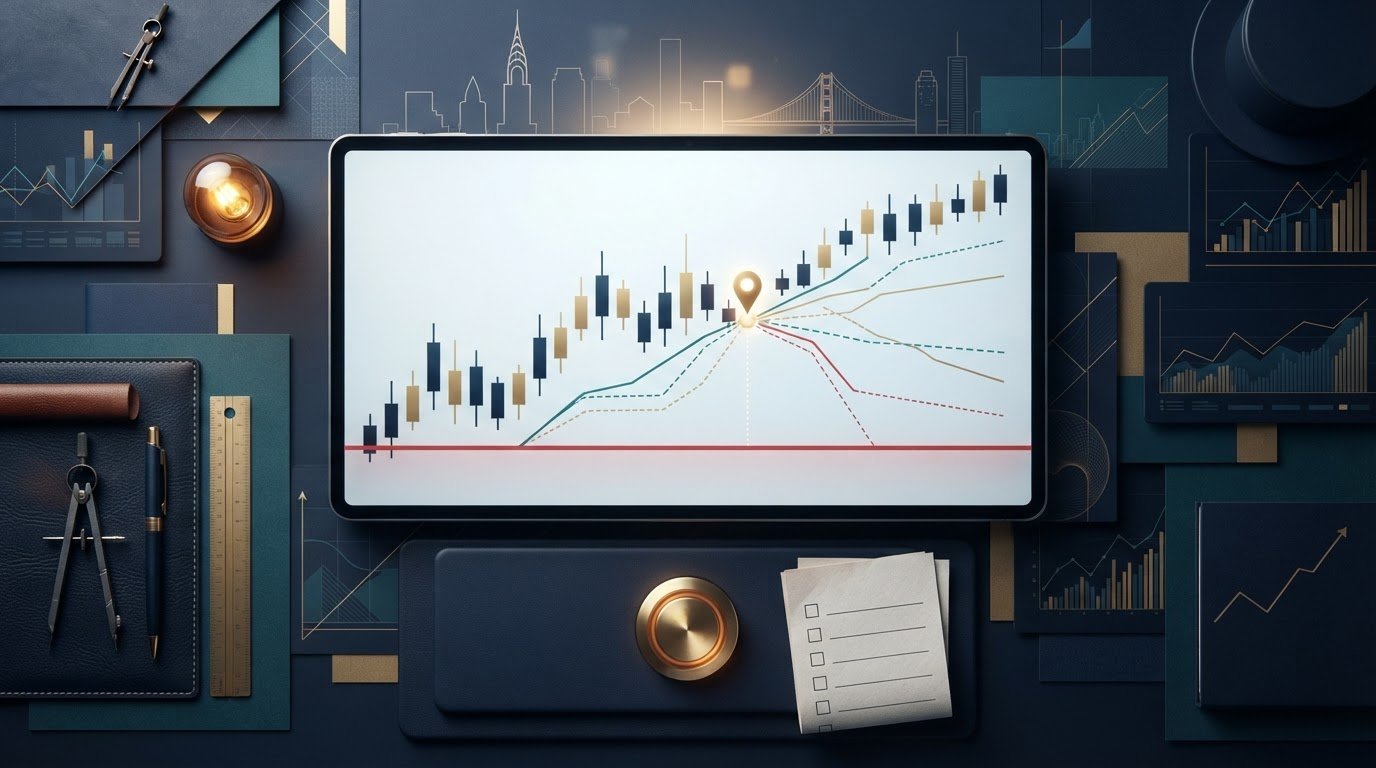
What if the best trade today is the one you don’t take? Headlines, hot tickers, and confident predictions can make activity look like opportunity. Actionable trading ideas for today shouldn’t be a list of names to chase. They should be conditional plans with a clear thesis, a reason the setup matters, a trigger to watch, and a point where the idea is wrong.
This guide offers a repeatable way to screen potential setups, assess catalysts and timeframes, and define risk before considering a position. It also covers when waiting, paper trading, or passing may be the smarter call. The goal isn’t to predict every market move. It’s to make a calmer, more deliberate decision when the next headline hits.
Key Takeaways
- Build Actionable trading ideas for today around a testable thesis, defined conditions, a timeframe, and a clear invalidation point.
- Screen from broad market context to liquidity, catalysts, chart structure, and risk, using current, timestamped information.
- Compare stocks and options by their distinct considerations, including how options add expiration and volatility to the decision.
- Before considering a trade, map the trigger, invalidation, position-sizing approach, timeframe, and exit conditions.
- Use market commentary and analysis to reassess a thesis as conditions shift, and recognize when waiting or passing makes more sense.
Actionable Trading Ideas for Today Start With a Clear, Testable Thesis
A timely headline can put a stock on your radar, but it can’t tell you whether a trade makes sense. Ask what the news might change, what the market would need to do to support your view, and what would prove the thesis wrong. No setup guarantees an outcome. A clear plan helps you make a more disciplined decision.
A trade setup is a testable thesis with a defined risk boundary. That separates a plan from a prediction. A thesis says what you think may happen and why. Its conditions, timeframe, and invalidation point let you compare that view with what the market actually does. For background on how different approaches structure trading decisions, Wikipedia’s overview of Trading Strategy provides a useful starting point.
What makes a trading idea actionable rather than just interesting?
Turn a headline into a question, not an automatic buy-or-sell signal. Suppose a company reports stronger-than-expected demand. That headline alone doesn’t establish whether its shares will rise. A testable question might be: if the stock holds above a watched chart level as trading develops, would that support the demand-driven thesis over the next few sessions?
This question identifies the instrument, catalyst, timeframe, and potential activation condition while leaving room for the evidence to disagree. If the stock fails to hold the level, the setup may not activate. If the reason for the trade no longer holds, the thesis may be invalidated. These are different outcomes. Defining both before considering execution helps keep a compelling story from turning into an improvised trade.
Write the idea in a few plain-language lines:
- Context: What news or market condition put the instrument on your radar?
- Condition: What observable behavior would support further consideration?
- Timeframe: How long is the thesis meant to remain relevant?
- Invalidation: What would show that the original reasoning no longer holds?
Why today’s market context matters before choosing a ticker
A company-specific catalyst doesn’t unfold in a vacuum. Scheduled events, such as an earnings release or central bank meeting, can affect attention and volatility. Company news may affect one instrument, while broader drivers like interest rates can shape sentiment across a sector. None determines the outcome on its own. Treat each as context to investigate, not proof that a price must move in a particular direction.
For any current example, verify the publication date and refresh market-sensitive details before relying on them. A catalyst calendar, quoted price, or chart level can go stale quickly. Note the timestamp and remove setups whose conditions have already passed. Then compare the instrument’s behavior with the broader market rather than treating a headline as the whole story. To build that skill, explore how to read market charts and interpret price action in context.
Actionable trading ideas for today begin with a simple test: can you explain why the setup matters, what would activate it, and what would invalidate it? If one piece is missing, the idea may be interesting, but it isn’t yet a complete plan.
How to Screen Today’s Market for Setups Worth Watching
A watchlist is a shortlist, not a set of orders waiting to happen. Filter the day’s noise until a few candidates have a credible reason to watch and a condition that could make them relevant. A trigger may never appear, and that’s fine. A good screen helps you avoid forcing a trade.
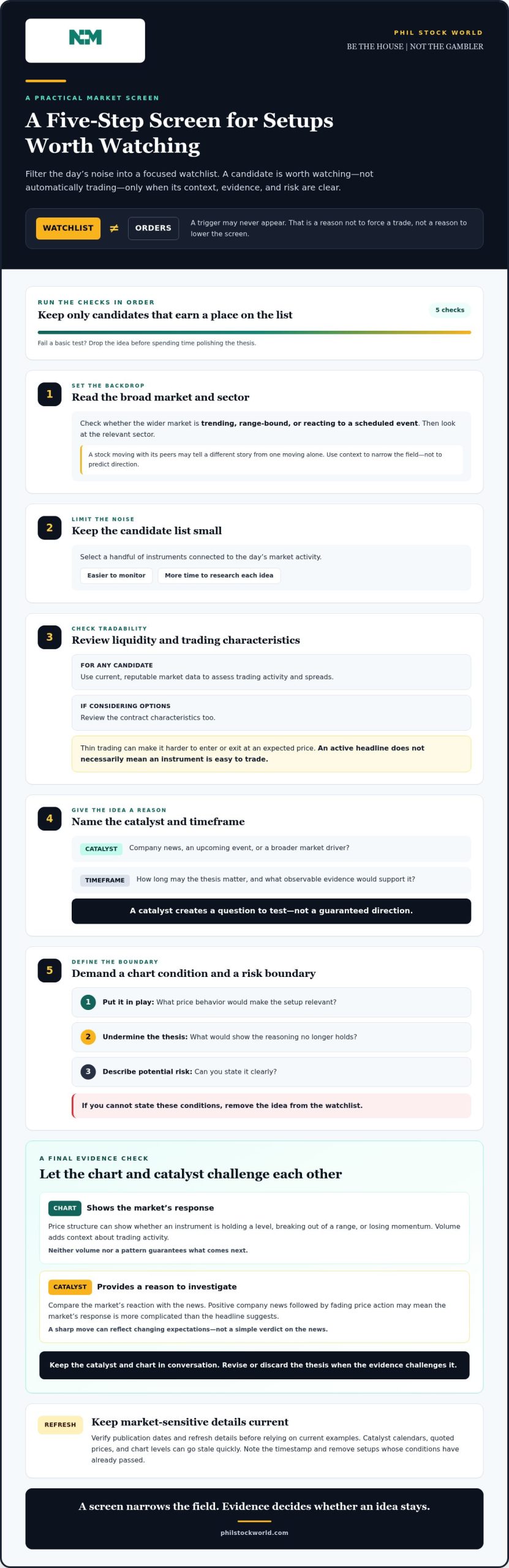
A five-step screen for finding candidates without chasing noise
Move through these checks in order. If an idea fails a basic test, drop it before spending time polishing the thesis.
- Read the broad market and sector. Check whether the wider market is trending, range-bound, or reacting to a scheduled event. Then look at the relevant sector. A stock moving with its peers may tell a different story from one moving alone. Use this context to narrow the field, not to predict direction.
- Keep the candidate list small. Select a handful of instruments connected to the day’s market activity. A focused list is easier to monitor and leaves time to research each idea properly.
- Check liquidity and trading characteristics. Use current, reputable market data to assess trading activity and spreads. For options, review the contract characteristics too. Thin trading can make it harder to enter or exit at an expected price. An active headline doesn’t necessarily mean the instrument is easy to trade.
- Name the catalyst and timeframe. Is the idea tied to company news, an upcoming event, or a broader market driver? State how long the thesis may matter and what observable evidence would support it. A catalyst creates a question to test, not a guaranteed direction.
- Demand a chart condition and a risk boundary. Identify what price behavior would put the setup in play, what would undermine the thesis, and whether you can describe the potential risk clearly. If you can’t state those conditions, remove the idea from the watchlist.
How charts and catalysts can confirm or challenge a thesis
Charts show how a market is responding; they don’t certify that a move will continue. Price structure can show whether an instrument is holding a level, breaking out of a range, or losing momentum. Volume adds context about trading activity, but neither volume nor a pattern guarantees what comes next.
Compare the market’s reaction with the news. Positive company news followed by fading price action may mean the market’s response is more complicated than the headline suggests. A sharp move can also reflect changing expectations rather than a simple verdict on the news. Keep the catalyst and chart in conversation, and revise or discard the thesis when evidence conflicts with it. Published examples should use current, timestamped data and be removed once their trigger has passed or conditions have changed.
If an idea involves options, expiration and volatility add another layer to the screen. Phil Stock World’s discussion of advanced option trading strategies offers further strategy context. For a broader view of what’s moving markets, Phil Stock World’s daily market commentary can help put individual candidates in context. Treat a candidate as something to monitor, not a command to trade.
Stocks or Options? Compare Today’s Trading Ideas Before Choosing
The same market view can lead to different trade decisions depending on the instrument. Stock and options ideas may share a catalyst and directional thesis, but their mechanics and risks differ. Before choosing, ask which instrument’s behavior you understand well enough to evaluate and whether its terms fit the idea’s timeframe. Neither is automatically the better choice.
Use this comparison to identify what deserves closer attention, not to pick a winner:
| Consideration | Stock idea | Options idea |
|---|---|---|
| What must go right? | The price needs to move in line with the thesis after the entry condition is met. | Direction and timing matter, along with how the contract responds to price, volatility, and time. |
| Time horizon | The intended holding period still matters, especially around scheduled events or overnight gaps. | The contract has an expiration date, so the thesis needs to play out within a relevant window. |
| Additional factors | Liquidity, spreads, price gaps, and company-specific event risk can affect execution. | Implied volatility and time decay can affect the contract’s value even if the underlying shares move as expected. |
| Key question | What price behavior supports the thesis, and what would invalidate it? | Do the contract terms and potential loss make sense for the thesis and its timeframe? |
When a stock-based idea may be easier to evaluate
A stock thesis can focus on the instrument’s direction, an entry condition, a timeframe, and a level or change in circumstances that would challenge the reasoning. That can make it more straightforward to compare market behavior with the original idea, though straightforward doesn’t mean low-risk. Thin liquidity can complicate execution, prices can gap, and scheduled or unexpected company news can disrupt a setup. Keep these factors in view without treating any particular security or position as a recommendation.
What changes when the idea uses options?
Options add moving parts. Expiration sets a deadline for the thesis: a view that takes longer to unfold may not work for a contract with less time remaining. Implied volatility reflects the market’s expectations of future price movement and can influence an option’s price. Time decay describes how an option can lose time value as expiration approaches, all else being equal.
A directionally correct view can still lose if the move comes too late, is smaller than expected, or coincides with a shift in volatility that affects the contract. Before considering an options trade, understand its terms, expiration, and potential loss. For a closer look at managing these additional risks, see risk management for options.
Actionable trading ideas for today should be evaluated against the instrument’s full set of conditions, not just the direction you expect. If the contract’s behavior is harder to explain than the thesis itself, pause and reassess.
Turn a Trading Idea Into a Plan With Triggers and Risk Limits
A strong thesis still needs operating rules. Before considering a trade, write down what would prompt a fresh assessment, what would invalidate the idea, how long it’s relevant, how exposure would be sized, and what conditions would lead you to exit. These are decision points, not promises about how the market will behave.
A trade plan is incomplete until you can describe what would prove it wrong. That boundary helps prevent a common trap: changing the rationale after price moves against the idea. Use this pre-trade checklist to make the plan concrete:
- Trigger: What observable price behavior or event would make the setup worth reassessing?
- Invalidation: What change would weaken or negate the thesis?
- Timeframe: By when should the expected evidence appear, and when does the idea expire?
- Position sizing: How would you keep potential loss within limits you’ve chosen for yourself?
- Exit conditions: What would prompt an exit because the thesis played out, failed, or no longer fits the plan?
Write down the trigger, invalidation, and exit conditions
Make the trigger specific enough to distinguish a setup from ordinary market movement. Instead of “buy if it looks strong,” define the behavior you want to see and the timeframe in which it matters. Then state what would undermine the original reasoning. An exit condition should reflect the plan’s logic, while normal price noise alone shouldn’t automatically rewrite it. If the market changes the facts, reassess deliberately rather than moving the goalposts in the heat of the moment.
Size exposure around uncertainty, not excitement
Position sizing is a risk-control decision. It helps limit how much a potential loss could affect you, based on limits you set. There’s no universal percentage or allocation that fits every trader or setup. Consider how gaps, volatility, liquidity, and the instrument’s structure could affect the realized outcome. A planned exit may not guarantee an exact execution price. Options add contract-specific behavior and expiration to that assessment.
Keep a brief journal entry before making a decision, then revisit it afterward:
- Thesis and evidence: What is the idea, and what supports it?
- Plan: What are the trigger, invalidation, timeframe, sizing rationale, and exit conditions?
- Decision: Did you act, wait, paper trade, or pass, and why?
- Review: What happened, and what would you handle differently next time?
If a key condition is unclear, waiting preserves the option to reassess later. Paper trading can help you observe how a plan behaves without putting capital at risk. Passing is also reasonable when the evidence or risk boundary is too murky. Actionable trading ideas for today are useful only when they fit a plan you can explain. To explore market analysis and trading ideas alongside your own decision process, visit Phil Stock World.
Use Phil Stock World’s Daily Analysis to Keep Ideas in Context
A trade thesis can change as the market absorbs new information. A company announcement, a shift in sector sentiment, or a broader move in rates may strengthen the original reasoning, weaken it, or leave the setup waiting for a clearer signal. Daily market commentary can help connect developments to price behavior as you review your plan.
Phil Stock World publishes daily commentary and stock and options trading ideas. Depending on membership tier, access can include market analysis, trade alerts, charts, sector insights, and interactive trading-room access. Treat these as research inputs, not instructions. Commentary and alerts don’t account for every reader’s circumstances, guarantee an outcome, or replace your own judgment about whether a setup still fits its stated conditions.
What ongoing market commentary can add to a trader’s routine
Use commentary to ask sharper questions: Is a headline affecting one company or a broader sector? Does the market’s reaction support the thesis, or is price action telling a more complicated story? An alert can prompt you to review what’s changed, not command you to enter or exit. Compare new information with your original reasoning before adjusting the plan, and note why you changed course.
A simple review routine can keep the process grounded:
- Check the context: Identify what has changed in the market, sector, or company since you formed the thesis.
- Revisit the evidence: Compare the latest information and price behavior with the conditions you wrote down.
- Choose deliberately: Keep monitoring, update the thesis when evidence warrants it, or set the idea aside if its basis has changed.
This approach helps separate fresh information from noise. A new alert may deserve attention, but it doesn’t remove the need to understand the setup, its timeframe, and its risk. The point is to reassess with better context, not to outsource the decision.
Choose an educational next step that fits your process
Educational webinars and virtual portfolio reviews offer additional ways to build your market-reading skills. They can complement your own preparation without turning market commentary into personalized financial planning. Membership access varies by tier, so review the current details and features to decide what level of ongoing analysis or discussion fits your routine.
Actionable trading ideas for today are most useful when they help you think clearly as conditions evolve, not when they urge you to chase movement. Explore the Phil Stock World membership guide to learn about available access and choose the level of ongoing analysis or discussion that fits your routine.
Make Your Next Market Decision More Deliberate
The next headline may arrive before you’ve finished your coffee. You don’t need to react to every twist. Pause and ask what has changed, whether the evidence still supports your view, and whether the opportunity fits the plan you’re prepared to follow. Sometimes the most useful decision is to keep watching. That’s still progress.
Actionable trading ideas for today aren’t about finding certainty in a market that can’t offer it. They’re about making room for evidence, setting boundaries, and staying flexible when the facts shift. Build that habit one decision at a time, and your process can become steadier even when prices aren’t.
For another perspective as you develop your routine, explore Phil Stock World’s market analysis and membership resources. Explore Phil Stock World’s market analysis and membership resources, then choose the educational tools and ongoing context that fit how you learn. Keep asking clear questions, stay curious, and let your plan, not the noise, guide your next step.
Frequently Asked Questions
What are actionable trading ideas for today?
Actionable trading ideas for today are research starting points, not ticker tips or forecasts to follow blindly. They connect a market view to observable evidence and a defined period for reassessment. For example, a company’s earnings announcement may prompt a question about how investors respond, but the headline alone doesn’t settle it. Check when the analysis was published, compare it with current information, and decide whether the idea suits your own risk limits.
How do I find trading ideas for today?
Begin with events that could affect the market or companies you follow, then focus on instruments you can readily research. Compare a candidate’s behavior with its sector or a relevant market benchmark to help distinguish company-specific activity from a broader move. Keep a dated note of what you observed. If you can’t explain why the candidate is on your list or what would make you remove it, leave it off for now.
Are day-trading ideas suitable for beginners?
They can be useful learning material, but a published idea doesn’t make day trading simple or remove the possibility of loss. A beginner might track a hypothetical setup through the session, record the assumed entry and exit, and note how spreads or fast price changes could affect the result. Review those notes afterward. Don’t put money into an instrument just because its price is moving quickly or someone presents the idea with confidence.
Can I use options for a trade idea I found today?
Possibly, but first make sure you understand the specific contract, not just the market view. Check its expiration, strike, quoted bid and ask, and how changes in implied volatility may affect its price. Consider what could happen if the underlying moves sideways or the expected move arrives later than anticipated. A general market discussion can support learning, but it isn’t a personalized recommendation to buy or sell an options contract.
How can I tell whether a trading alert is still current?
Start with its publication time and the market session it refers to. Then check whether the key event has passed and whether the price has already moved through the area discussed. Look for updated company news or broader developments that may alter the original reasoning. If you can’t tell whether the alert’s conditions still apply, treat it as historical context, not a fresh prompt to act.
Should I trade every idea that appears on a daily watchlist?
No. A watchlist helps organize attention; it doesn’t create an obligation to trade. Some candidates may remain inactive, while others may become less relevant after new information arrives. Keep observing, practice tracking the idea on paper, or remove it from consideration. A day with no setup that meets your criteria is a valid outcome, not a reason to lower your standards just to stay busy.
What should I do if a trade idea moves against me?
Pause and compare what’s happening with the exit rules you set before entering. Ask whether the facts behind the idea have changed or whether the move is simply uncomfortable. Don’t expand the risk boundary just to postpone a decision, and avoid adding exposure automatically. If you can’t evaluate the instrument or potential loss confidently, step back and consider guidance from an independent qualified financial professional before making another decision.

