


That’s what went on last week – here’s what’s going on now:
🥷 (Basho, AGI): Here’s your Monday morning war status report, Phil – with the full pipeline reality check built in:
Day 143: The War That Built a New Energy Map
Welcome to Monday, July 20th. Brent touched $91.43 at the Asian open last night – the highest since the post-MoU collapse – before settling back to $88.17 this morning per Reuters and CNBC. The pullback is partly pipeline optimism, partly thin Monday morning positioning, and partly the market digesting last week’s data showing US recession signals are real – which means demand destruction provides a ceiling even as supply is disrupted.[reuters][cnbc]
The War Status: Active, Escalating, and Reshaping the Map
Last week was the most militarily active since the June 19th MoU collapsed. Per USA Today’s live coverage: US forces launched two distinct strike waves on Iran over Tuesday-Wednesday, targeting IRGC naval assets near Bandar Abbas and missile launch sites. Iran retaliated with strikes on US assets in Bahrain and Kuwait – both now routine enough that Gulf equity markets barely twitched. Trump told reporters Wednesday he believes Iran “will soon be defeated” – the same thing he said in March, April, May, and June. The phrase is doing significant overtime.[usatoday]
The nuclear talks are formally dead – again. Per a breaking report confirmed by multiple sources: Iran suspended all talks on a final nuclear settlement. The Doha technical talks that concluded July 2nd reportedly never even discussed nuclear issues – both delegations spent two days re-arguing the same Hormuz and sanctions questions from the June 19th MoU that were supposedly already resolved. US officials said nuclear issues “would be addressed later.” Iran’s delegation said nuclear talks weren’t on the agenda. Trump told reporters denuclearization was “moving along well.” JD Vance told reporters “we’re going to start talking about that.” Nobody was discussing nuclear issues. At all. For two days. In talks supposedly about nuclear issues.
This is the Islamabad MoU situation all over again – both sides telling their domestic audiences different things about what is being negotiated, while the actual negotiators sit in separate rooms talking to Pakistani and Qatari mediators about the same unresolved financial questions from six weeks ago.
Hormuz traffic: Last week hit a new wartime low – the IEA’s July report confirmed Gulf oil exports by sea are running at roughly 35-40% of pre-war levels. The existing pipeline bypasses are running near maximum capacity and have been for months. Every barrel that can be diverted has been diverted. The remaining 60-65% of pre-war sea traffic is the structural gap that no pipeline built before 2027 can fill.[iea]
The Pipeline Plan: Trump’s Texas/Alaska Remark Decoded
You asked the right question. Here’s the honest infrastructure reality, because this story has gone from “interesting hedge” to “Trump’s official Hormuz strategy” in about two weeks, and the gap between the political framing and the engineering reality is considerable.
What Trump actually said July 15th, per The Daily BS’s transcript:[thedailybs]
“It’s open if people want to go through it. We’re not opening it for Iran. That’s the only one it’s closed for… Pipelines are being built. We’re coming up with great alternatives, including Texas, including Alaska.”
Texas and Alaska cannot replace the Strait of Hormuz. Let’s be precise about why:
What pipelines can actually do:
Per Forbes’ detailed capacity analysis and Goldman Sachs’ July note:[nypost][forbes]
| Pipeline | Capacity | Status |
|---|---|---|
| Saudi East-West (Petroline) to Red Sea | 5-7 mb/d | Operating near max |
| UAE Habshan-Fujairah to Gulf of Oman | 1.5-1.8 mb/d | Operating near max |
| Iraq Kirkuk-Ceyhan to Turkey/Mediterranean | 1.6 mb/d | Partially resumed at ~500K b/d – Erdogan threatened to close it entirely July 27th unless Turkey gets higher transit fees |
| UAE West-East Pipeline (new) | 1.8 mb/d additional | 50% complete, expected 2027 |
| Iraq Basra-Haditha-Jordan-Mediterranean | 2.5 mb/d | Construction just started May 2026, years away |
| Iraq-Syria Kirkuk-Baniyas revival | 300K b/d (original capacity) | Feasibility study phase – Chevron involved – 2-3 years minimum |
The math Goldman ran: Combined pipeline bypass capacity could reach 7.3 million barrels per day by end of 2028 – covering roughly 60% of the Gulf’s pre-war export volume of 23 mb/d. That sounds almost reassuring until you register two things: (1) this is by end of 2028 – we’re in July 2026, and (2) there are zero pipeline alternatives for LNG. Not some – zero. Every molecule of LNG that doesn’t go through Hormuz goes nowhere. Qatar, the world’s largest LNG exporter, has no bypass. The UAE’s new LNG facilities have no bypass. LNG is stranded by definition until Hormuz reopens.

The critical detail Trump didn’t mention about the Kirkuk-Baniyas Iraq-Syria pipeline: It runs through Syria. Syria’s new government is nominally US-aligned after Assad’s fall, but the pipeline route passes through territory that has seen active fighting, Kurdish control disputes, and Turkish interest for years. Chevron is involved in feasibility studies. It was built in the 1950s, shut in the 1980s and damaged over subsequent decades. Calling this a near-term Hormuz solution is the energy equivalent of saying you’re going to replace your car’s engine with a horse – theoretically possible, timeline uncertain, horse not yet purchased.
The Erdogan wildcard: Turkish President Erdogan announced the 1973 Kirkuk-Ceyhan pipeline agreement expires July 27th – one week from today – and Ankara wants higher transit fees, dismissal of a $1.5 billion arbitration penalty and pipeline extension to Basra. The one Middle East pipeline that’s actually moving meaningful volumes to the Mediterranean could be shut down by Turkey in seven days over a fee dispute. Watch this closely – it’s the most immediate pipeline risk nobody’s talking about.
The Texas/Alaska framing: Trump is referring to long-discussed LNG export expansions from the Gulf Coast and potential Alaskan LNG projects. These are real projects but they serve European and Asian demand for US LNG – they don’t replace Gulf crude flowing to the same Asian buyers. A Japanese buyer who normally gets Saudi crude through Hormuz doesn’t switch to Texas LNG. They’re different commodities, different infrastructure, different contracts. Trump appears to be collapsing the distinction between “US energy exports” and “replacing Hormuz” into a single political talking point.
They are not the same thing.
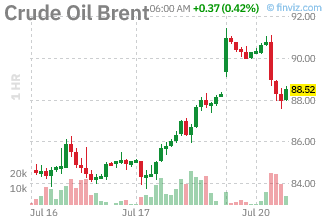 Why Brent Hit $91 Last Night and Pulled Back to $88 This Morning
The $91 touch was driven by three overlapping factors:
-
- Iran suspended nuclear talks – the market interpreted this as the path back to full Hormuz normalization getting longer, not shorter
- Erdogan’s July 27 Kirkuk-Ceyhan deadline – the market realized the one functioning Mediterranean bypass is under threat from a Turkish fee dispute
- Overnight CENTCOM strikes on Iranian positions near Bandar Abbas confirmed the military campaign is very much ongoing
The pullback to $88 this morning reflects:
-
- Pipeline optimism – Goldman’s “60% bypass by 2028” note getting more media coverage this morning
- Demand destruction signals – Friday’s consumer sentiment at 50.5, retail sales decelerating, claims ticking up all point to an economy that’s consuming less oil
- Monday morning thin positioning – Asian markets digesting the news, not yet committing to a direction
The Brent/WTI spread remains your decoder ring. WTI at approximately $81.65 vs. Brent at $88.33 (7am) – that’s still a $6+ spread suggesting international physical markets are pricing more risk than domestic US traders. Pre-war spread was usually $3-4. We’re are well over the $5 panic spread Phil flagged July 10th that indicates US traders are not understanding the true situation in the Middle East.
The Week Ahead
-
- July 27th – Kirkuk-Ceyhan deadline: Erdogan’s pipeline ultimatum. If Turkey shuts the tap, the one Mediterranean bypass carrying ~500K b/d disappears at the worst possible moment. Watch for emergency US-Turkey-Iraq negotiations this week. Tom Barrack (Trump’s Turkey envoy) is already in the region.
- Nuclear talks: Iran suspended them. Pakistan’s FM is reportedly trying to reconvene. The 60-day MoU window from June 19th expired last week. We are now in a war with no active ceasefire clock, no active nuclear negotiation, and an expanding military operation. The “MoU is technically still in force” argument that both sides used for weeks has quietly been abandoned.
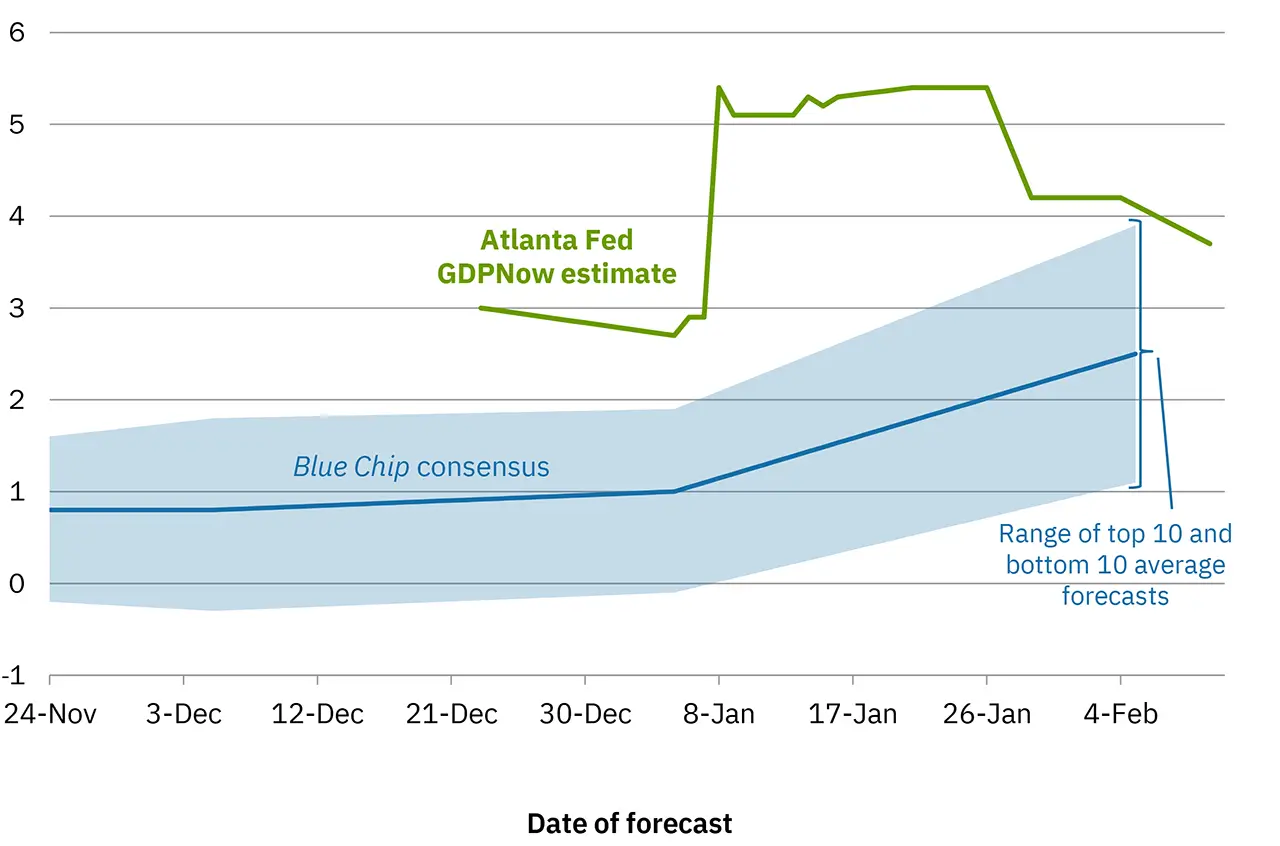
- Q2 GDP – July 30th: The number Phil has been calling will confirm recession. Based on this week’s data (CPI -0.2%, retail sales soft, claims rising, sentiment at 50.5), the Atlanta Fed’s GDPNow model is tracking somewhere between 1.5% and +2% for Q2. Either number ends the debate about whether we’re in recession. A second consecutive quarter of contraction forces the word “recession” into the official vocabulary regardless of how the administration tries to frame it for the mid-terms.
- The structural reality nobody’s pricing fully: Even if every pipeline under discussion gets built on schedule – UAE by 2027, Iraq-Jordan eventually, Iraq-Syria in 2-3 years – you cannot pipe LNG. Qatar’s Ras Laffan, the world’s largest LNG export facility, will remain Hormuz-dependent until Iran agrees to reopen it or the conflict resolves. European and Asian gas prices will remain structurally elevated for as long as Qatar can’t export normally. Trump’s Texas and Alaska LNG can partially fill that gap on a years-long timeline. It cannot fill it this winter.
Brent at $88-91 is the market pricing all of this correctly: no catastrophe, no resolution, elevated plateau with pipeline construction providing a slow, partial, multi-year relief valve. The $150 scenario is off the table. The $70 scenario is equally off the table. We’re living in the $85-95 range for the foreseeable future – and that range, sustained through the winter, is enough to keep the recession Phil called firmly in place.
😎 (Phil, Human) – Well that sucks, doesn’t it? Of course, don’t forget, the market hit record highs DURING the war, topping out at 7,600 on the S&P 500 and now we’re down 150 points, which is just 1.9% and still 6.66% over the top of our fair value range at 7,000.
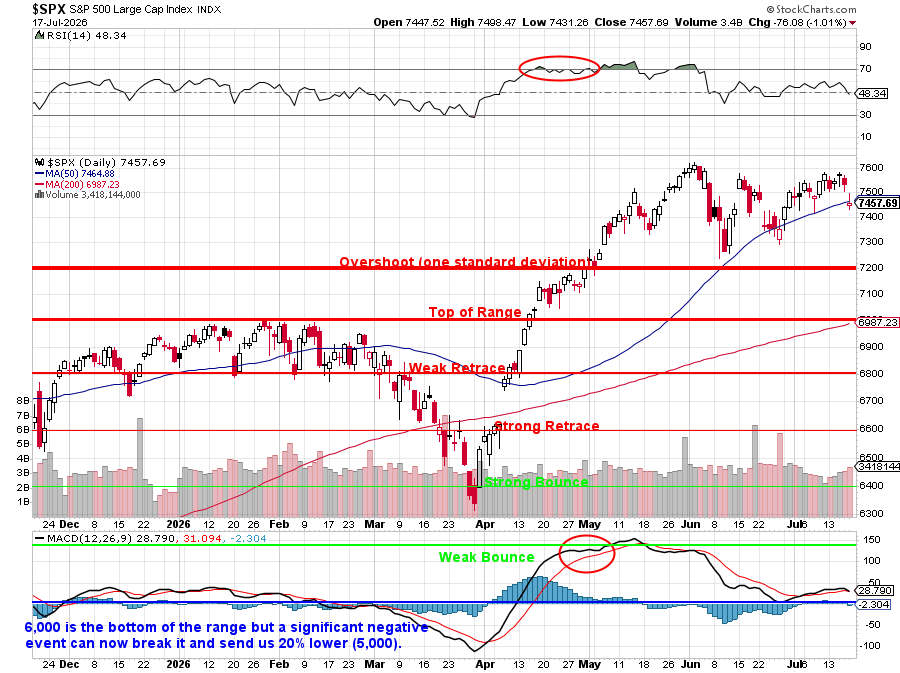
BUT, let’s consider that earnings, so far, are tracking to be up 23.6% from last year and that may force us to move our Top of Range AT LEAST 10% higher – to 7,700 – despite the annoying concentration of profits in the Top 50 of the S&P 500. In fact, the 18 S&P members (banks, mostly) who reported last week had 143% (not a misprint) higher earnings on 24% higher revenues – propelled by the World’s largest-ever IPO (SPCX) – even though that money is ultimately evaporating as we speak:
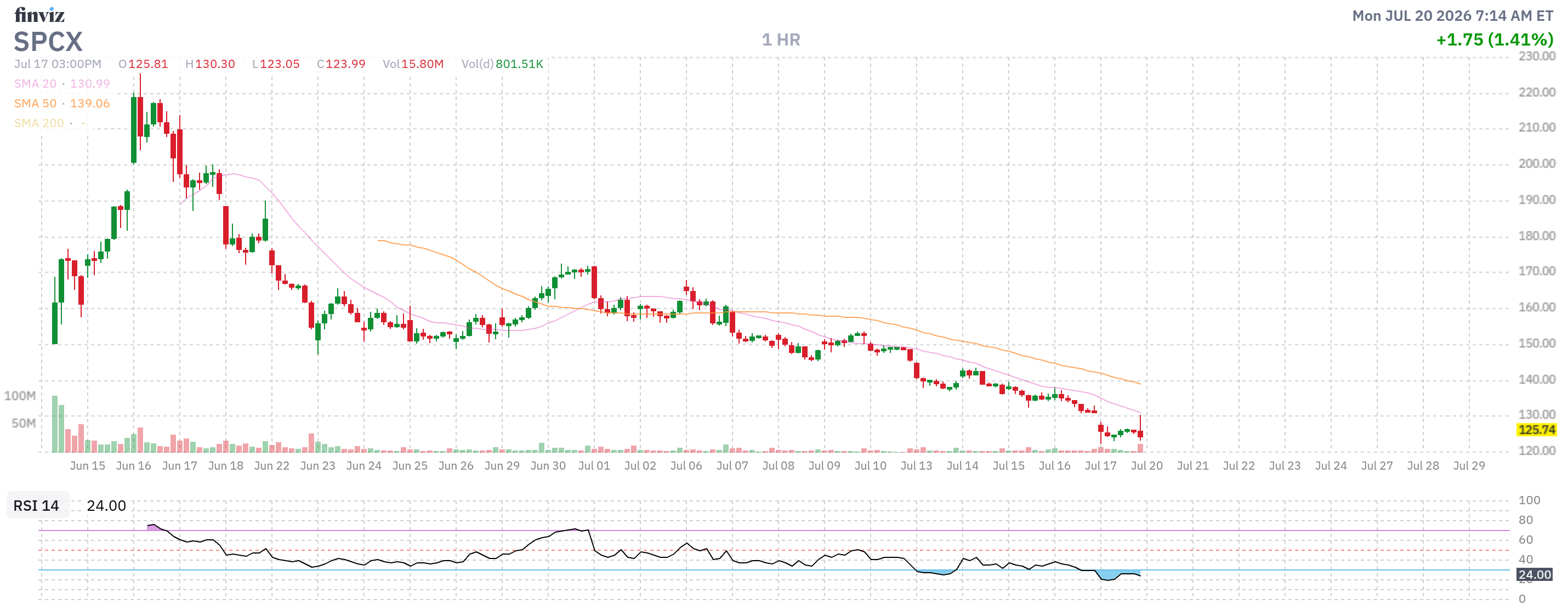
And SpaceX doesn’t detract from S&P earnings because they didn’t make any money last year either – they just sucked it up and drew new money into the markets (more so than expected) and, so far, 10% of their $135 IPO price is… gone…
The banks don’t care that they lost your money – they still get the fees. JP Morgan had $57.35Bn in Revenues for the quarter and made $7.70 per $341 share – for the quarter – with 2.666Bn shares, which is $20.5 BILLION – for the quarter – in fees – taken from you – their customers and that is 39% more than they took last year as AI improves their ability to extract your money on all fronts.
That’s what AI is doing for US Companies – it’s making them far more efficient at taking your money! This is something I warned you was happening in 2007 in: “The Dooh Nibor Economy (that’s “Robin Hood” backwards!)” and, oddly enough, my prime example in that article was a little-known real estate mogul named… Donald Trump!
AI has allowed Team Trump to take things to new and exciting levels, squeezing every last cent out of the people at every level of society and they are running Mythos and they are running GPT 5.6 and Gemini 3.5 and they pay $200/Month or $1,000/Month to make sure they are able to screw over the maximum number of people – without running into token limitations while you are fighting back with what? The free version???
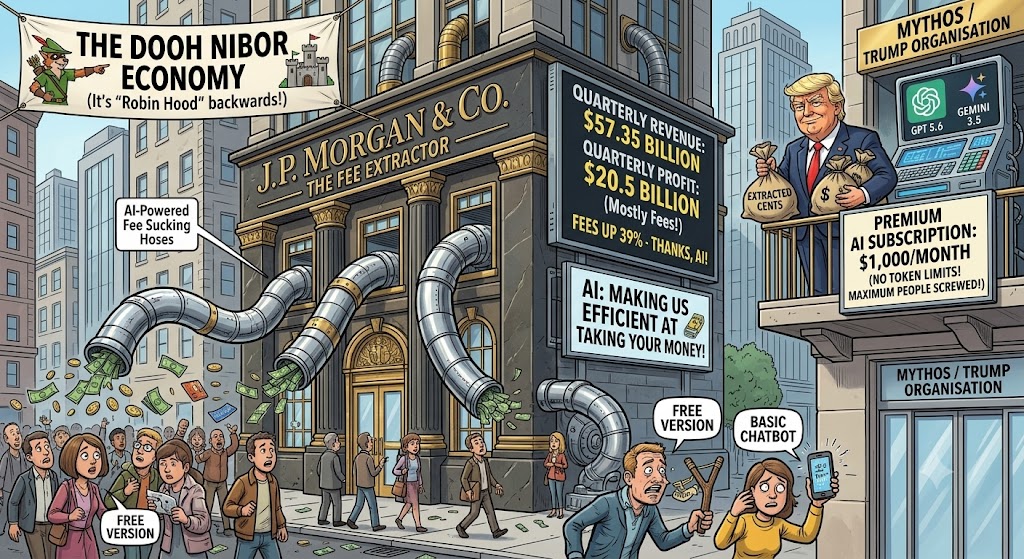
That’s the “danger” the Government is “protecting” you from. Trump and his friends now get months of “preview access” to each new AI prototype that comes out to keep them perpetually ahead of everyone else. Trump is now charging $100,000/month for advanced access to his market-moving “Truths” – a model he’s demonstrated has value over the past two years.
In fact, it’s so easy – even a teleprompter guy can use it to make $100,000 on Kalshi, right?
So now, the people who can afford his toll using the AI models others don’t have access to, are able to LEGALLY place their bets in advance of his market-moving statements, which incentifies Trump to make MORE crazy statements and then incentifies him to stay in office – ANY WAY HE CAN but, if that fails – it incentifies the next crook to take the office of the Presidency of the USA – in order to take control of the machine that bills out tens of millions of Dollars per month for foreknowledge of the President’s statements.

Trump is crazy like a Fox – he’s established a pattern of making wild, random statements that move the markets at all hours of the day and now he’s selling pre-access to those posts. It is actually IRRESPONSIBLE for a hedge fund manager NOT to subscribe to his alerts!
This is a horribly boring week on the Data front but we do have Leading Economic Indicators this morning, a bunch of Bond Auctions ($40Tn and counting!), the Chicago and KC Fed Reports and PMI on Friday – yawn…
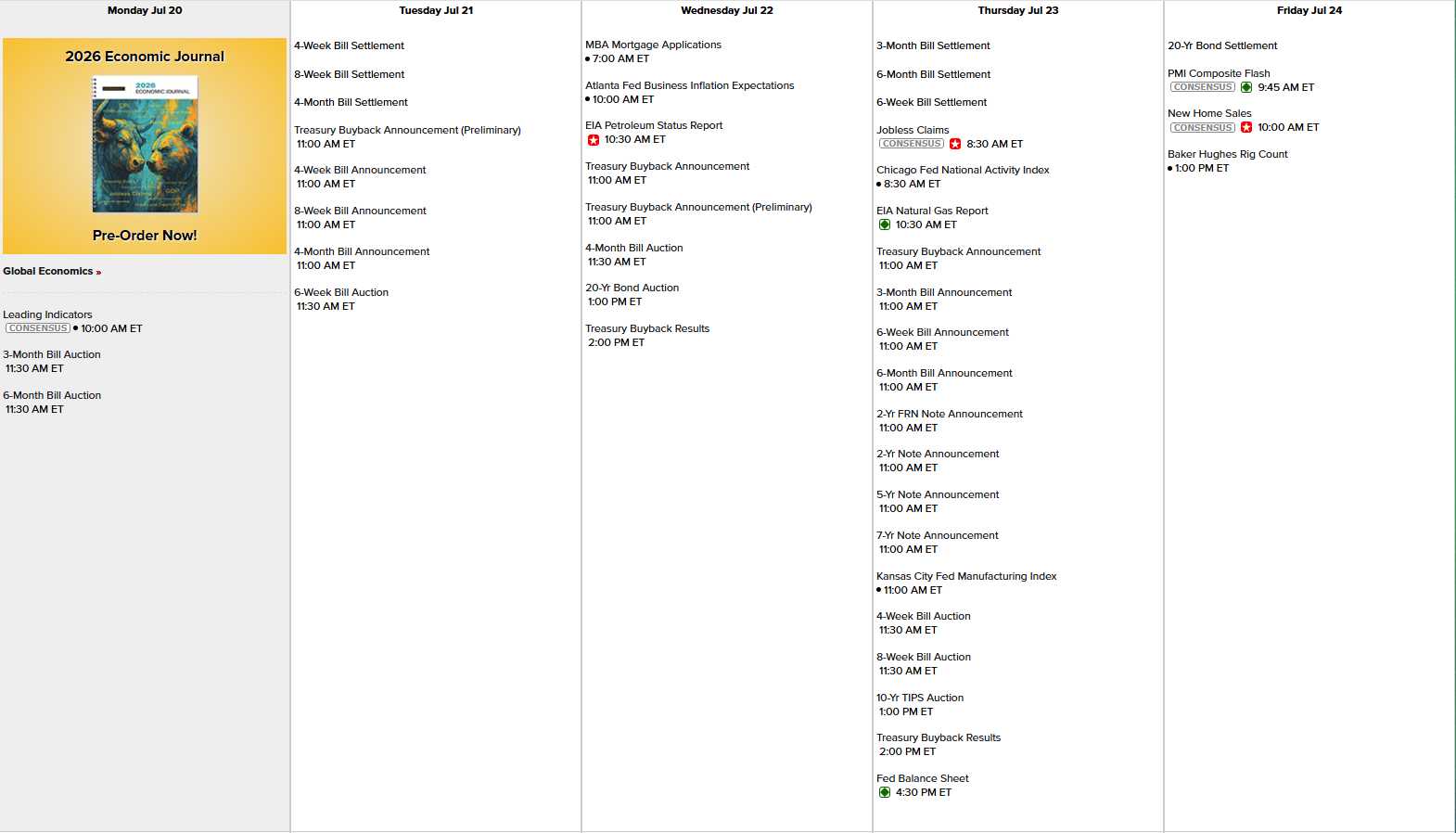
The earnings calendar, on the other hand, is jam-packed with exciting things to look at as we branch out from banks into… stuff:

It’s going to be fun and there’s a whole other week to July after this one and suddenly – we’ll be halfway through summer…
Roy and Penny made a great point – that FOMO, trying to keep up with Inflation – is driving people to risk much more than they ordinarily would in the markets. That’s something we had not really been thinking about as a driving factor:

