


The house always wins because it isn’t betting on the cards; it’s betting on the math of the players. While most retail traders are currently sweating over the VIX sitting at 15.81 or the latest supply chain headlines from the Strait of Hormuz, the pros are busy collecting the premium you’re paying to “protect” your portfolio. If you’ve ever felt the sting of getting stopped out by a random price swing only to watch the market recover without you, you’re playing the wrong side of the game. Mastering a few key market volatility trading tips can be the difference between emotional exhaustion and the calm confidence of a seasoned floor trader.
It’s frustrating to watch your screen turn red while implied volatility makes every “safe” hedge feel overpriced. You’re right to be skeptical of the mainstream narrative, especially with the Fed’s recent shift toward less forward guidance under Chairman Warsh. This guide will show you how to flip the script and transform market chaos into a calculated advantage. We’ll break down a repeatable system for trading these swings, including exactly when to buy versus sell volatility. You’ll finish this with the tools to maintain peace of mind during the next correction.
Key Takeaways
- Stop viewing volatility as a threat; treat it as the statistical dispersion of price that provides the fuel for professional-grade profits.
- Learn to “Be the House” by identifying when Implied Volatility is inflating option premiums, allowing you to sell insurance instead of buying it.
- Master the mechanics of Strangles and Iron Condors to profit whether the market makes a massive move or stays stuck in a range.
- Follow our core market volatility trading tips, starting with strict position sizing rules that keep you in the game when the VIX starts to climb.
- Move beyond trading in a vacuum by using real-time insights to distinguish between meaningful market shifts and temporary algorithmic noise.
Embracing the Chaos: What is Market Volatility in 2026?
Most people hear the word “volatility” and immediately check their blood pressure. They see red on the screen and assume the world is ending. But if you want to trade like the house, you have to realize that financial volatility isn’t a synonym for “crashing.” It’s simply a statistical measure of price dispersion. Think of it as the speed of the tape or the range of the swing. In 2026, this speed has reached a fever pitch. With the Federal Reserve holding rates at a target range of 3.50% to 3.75% through July and Chairman Kevin Warsh ditching traditional forward guidance, the market is effectively flying blind. Add in high-frequency algorithms that react to headlines about the Strait of Hormuz in milliseconds, and you have a recipe for wild, intraday swings. Savvy traders don’t fear this; they crave it. While the crowd is looking at realized volatility, which is just a history lesson of where prices have been, we are focused on implied volatility. This is the market’s forecast of future movement, and it’s where the real money is made.
The Retail Trap: Why Most Traders Panic
Retail traders often fall into a predictable, painful cycle. When the VIX spikes, they get hit with emotional fatigue. They watch their stops get triggered by a “wick” on a candle, only to see the price bounce back minutes later. This leads to the ultimate sin: buying options when they are most expensive. They are essentially buying hurricane insurance while the roof is already flying off. Waiting for things to “settle down” is another common mistake. By the time the screen is green again, the best market volatility trading tips have already been played out by those who kept their cool. The herd buys high and sells low because they react to the noise rather than the numbers.
Volatility as an Asset Class
Think of price swings as a quantifiable resource, like oil or gold. When the VIX, often called the Fear Gauge, climbs above its August 2026 level of 15.81, it’s not a signal to run. It’s a signal that the “insurance” you’re selling is getting more valuable. This is one of the most effective market volatility trading tips: treat the VIX as a timing tool for your entries rather than a reason to hide. If you can quantify the fear, you can price it. By viewing these swings as a resource, you stop being a victim of the market and start becoming a provider of liquidity. Volatility is the lifeblood of the options seller.
Thinking Like the House: The Mechanics of Implied Volatility
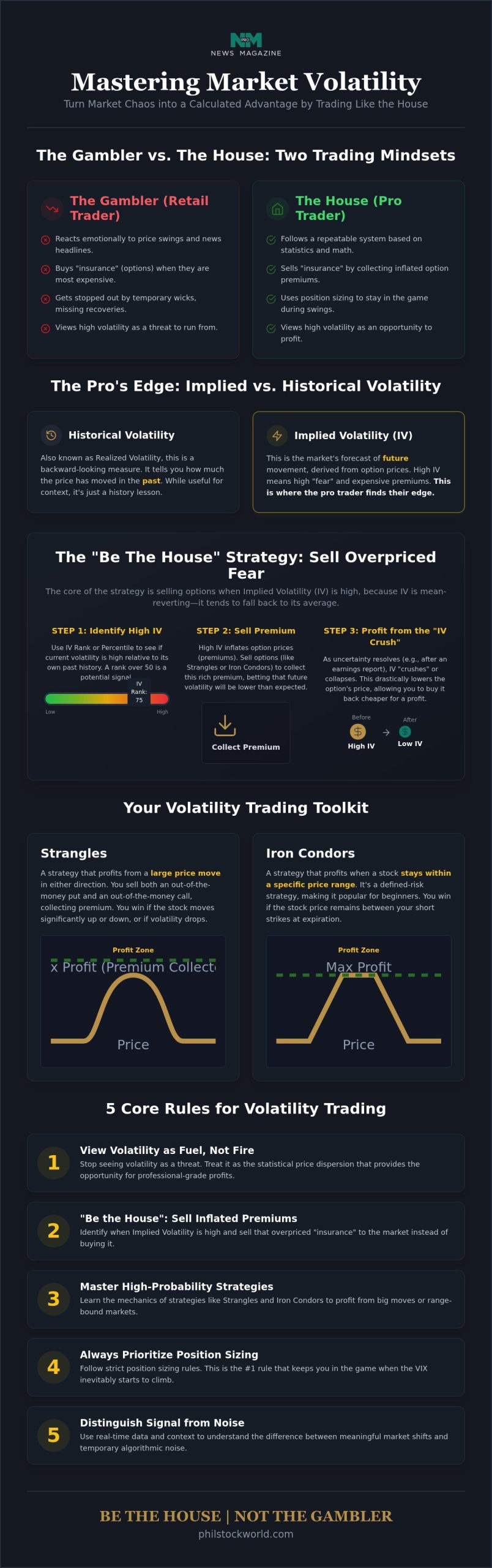
Casinos don’t build billion-dollar monuments by gambling; they build them by owning the math. In the markets, “The House” is the trader who sells overpriced insurance to the panicked masses. This insurance takes the form of option premiums, and the primary driver of those premiums is Implied Volatility (IV). When uncertainty spikes, whether it’s due to the Fed’s 3.50% to 3.75% rate hold or geopolitical tension, IV inflates. It’s essentially a “fear tax” added to the price of an option. One of the most critical market volatility trading tips is to recognize that IV is mean-reverting. Unlike stock prices, which can trend higher forever, volatility eventually settles. By selling when IV is high, you’re betting that the market’s expectation of future chaos is higher than what will actually happen. To do this effectively, you shouldn’t just look at the raw IV number. Use IV Rank or IV Percentile to see where current volatility sits relative to the past year. If a stock has an IV of 50%, but its IV Rank is 90%, you know you’re looking at an expensive premium that’s ripe for selling.
Vega: Your Secret Lever in Volatile Markets
Vega is the Greek that measures how much an option’s price changes for every 1% move in IV. It’s the secret lever that can make or break your trade. If you’re long an option, you want Vega to rise because it pads your position. However, if you buy right before a major event, you risk the “IV Crush.” This happens when the event passes, uncertainty vanishes, and IV collapses, dragging the option’s price down even if the stock moves in your direction. Short positions, conversely, love falling IV. The ‘House’ wins by being the net seller of Vega. If you want to see how we apply this math daily, checking out our Premium Membership alerts can provide a front-row seat to these strategic entries.
Comparing Historical vs. Implied Volatility
The “Volatility Gap” is the space where professional traders find their edge. Historical volatility tells you what actually happened, while implied volatility tells you what the market is currently pricing in for the future. Markets are notorious for overestimating risk. By studying an academic overview of options trading strategies, you’ll see that selling the spread between IV and historical volatility is a cornerstone of professional risk management. When IV is significantly higher than historical realized moves, the market is overpaying for protection. These are the moments when we stop being the gambler and start being the house. Following these market volatility trading tips helps you stay objective when everyone else is trading on pure adrenaline.
Battle-Tested Strategies: Straddles, Strangles, and Spreads
If you’ve mastered the “House” mindset, you know that the actual tools you use are just ways to express a mathematical edge. The most common market volatility trading tips usually revolve around the “I Don’t Care” trade, also known as the Long Strangle. By buying both an out-of-the-money call and put, you’re betting on a massive move in either direction. It’s a favorite for earnings or major Fed announcements, but there’s a catch. If you buy a strangle when the VIX is already screaming, you’re paying a massive premium. The move has to be historic just for you to break even. This is where the Iron Condor comes in. It’s the ultimate “House” play because you’re selling spreads on both sides of the price, essentially betting that the market will stay within a specific range. You collect the “rent” while everyone else gambles on the direction. It’s the difference between being the guy at the slot machine and the guy who owns the casino floor.
The Long Strangle vs. The Straddle
Choosing between these two comes down to a cost-benefit analysis of Gamma versus capital. A Straddle uses at-the-money strikes, meaning it’s more expensive but reacts instantly to price changes. A Strangle is cheaper because it uses out-of-the-money strikes, making it more capital efficient for those expecting a true breakout. You can find a deeper dive into these nuances in our guide on Advanced Option Trading Strategies. The key is to avoid buying these when IV is at its peak. If you ignore this, the “IV Crush” will eat your lunch even if the stock moves your way. We prefer buying when the market is quiet and selling when it’s screaming.
Selling Premium: The Bread and Butter of Income Trading
When volatility is high, the premiums on credit spreads become irresistible. Instead of betting on where the market is going, you’re betting on where it won’t go. By selling a call or put spread, you define your risk upfront, which solves the “unlimited risk” problem of naked selling. This is how you collect “rent” on your positions. Incorporating these market volatility trading tips into your routine turns a red screen from a disaster into a shopping list. For those with long-term portfolios, simply buying protective puts acts as a hedge. It’s the equivalent of buying insurance when you see clouds on the horizon, allowing you to stay in your favorite stocks without liquidating everything during a temporary spike. It’s about staying in the game, not just surviving it.
5 Essential Market Volatility Trading Tips for 2026
Surviving a high-velocity market requires more than just a sharp eye for charts; it requires a structural defense that most retail traders ignore. If you want to stop the “death by a thousand cuts” during price swings, these market volatility trading tips will help you build a professional-grade fortress around your capital.
- Tip 1: The 1-2% Rule. Position sizing is your only real protection. Never risk more than 1% to 2% of your total account equity on a single trade. In a world where the VIX can jump 20% in an afternoon, being “all in” is just a slow form of financial suicide.
- Tip 2: Trade the VIX Correlation. Don’t just watch your ticker. With the VIX sitting near 15.81 in August 2026, keep a close eye on how your assets move relative to the fear gauge. If the VIX is climbing while your stock is flat, the market is telling you a storm is coming.
- Tip 3: Shorten Your Timeframes. Overnight gaps are the primary killers of retail accounts. With Cboe’s extended trading hours now running from 7:30 a.m. to 4:15 p.m. ET, the window for “surprise” news is wider than ever. Closing positions before the bell or tightening stops can save you from a morning disaster.
- Tip 4: The ‘Pre-Flight’ Plan. Every entry must have a pre-defined exit for both profit and loss. Since Chairman Warsh has reduced forward guidance, the market reacts violently to every data point. Don’t try to think when the screen is red; let your plan do the thinking for you.
- Tip 5: Maintain a Cash Buffer. Cash is a position. Keeping 20% to 30% of your portfolio in “dry powder” allows you to strike when blood is in the streets and premiums are at their highest.
Mastering the Stop-Loss in a Whip-Saw Market
Standard stop-losses are often “hunted” during high volatility because they are placed at obvious support levels. Instead of using a static dollar amount, use the Average True Range (ATR) to set stops that actually breathe with the market’s current rhythm. A hard stop protects you from a total catastrophe, but a mental stop allows you to stay in a trade if the move is just algorithmic noise. To see how we manage these exits in real-time, join our Live Trading Room for an antidote to market panic.
Mindset: The Disciplined Trader’s Edge
The hardest part of implementing market volatility trading tips is separating your price action from your personal net worth. When a trade goes against you, it’s not a reflection of your intelligence; it’s just a data point in a probability game. The best trades often feel the most uncomfortable at the moment of entry because they go against the prevailing fear. In 2026, a cold spreadsheet of rules beats a warm gut feeling every single time.
Navigating Turbulence with the Phil Stock World Community
Trading in a vacuum is a recipe for disaster, especially when the market decides to take the elevator down while the stairs are broken. When the headlines are screaming about the Strait of Hormuz or the latest Fed pivot, it’s easy to let your lizard brain take the wheel. This is where most retail traders fail. They isolate themselves, stare at a blinking red screen, and let panic dictate their exits. Cutting through the noise requires a signal that doesn’t come from a frantic news cycle. By surrounding yourself with a community of peers who’ve seen these cycles before, you gain the perspective needed to execute market volatility trading tips with clinical precision. It’s about moving from a state of reaction to a state of execution.
A Phil Stock World membership offers more than just trade alerts; it provides an insider’s perspective that rejects mainstream hysteria. When everyone else is selling their favorite positions at the bottom, our members are often looking at the math of the “House” to see where the real opportunity lies. This collective intelligence keeps you objective when the market feels personal. It transforms the solitary stress of trading into a collaborative strategic exercise.
Inside the Live Trading Room
There is no substitute for seeing “The House” strategy in action during live sessions. In our Live Trading Room, you aren’t just getting a list of tickers; you’re watching real-time analysis as global events unfold. It serves as the ultimate antidote to market panic. You can participate in interactive Q&A sessions to get professional feedback on your specific ideas before you pull the trigger. There is a massive psychological benefit to being part of a group that stays calm while the rest of the world is losing its mind. It turns a stressful event into a high-level discussion among peers. Watching these market volatility trading tips play out in real time builds a level of confidence that a textbook simply can’t provide.
Stress-Testing with Virtual Portfolio Reviews
Even the best-laid plans need a reality check. Our Virtual Portfolio Review process allows you to see if your hedges actually hold up when the VIX starts to climb. We help you identify hidden risks in your current holdings that might not be obvious during a bull run. Are you over-leveraged in a sector sensitive to the 3.50% to 3.75% rate environment? Are your “hedges” actually correlated with the downside? We help you answer these questions before the next spike hits. It’s time to stop gambling and start operating. Join the club and start trading like the house today.
Stop Gambling and Start Operating
The market doesn’t care about your feelings, but it certainly rewards your discipline. By shifting from a reactive retail mindset to a “House” philosophy, you’ve already taken the first step toward long-term profitability. You now understand that implied volatility isn’t a monster; it’s a measurable resource you can price and sell. Whether you are deploying Iron Condors to collect rent or using strangles to profit from macro shifts, these market volatility trading tips provide the framework for a repeatable, professional system.
Success in 2026 requires more than just a set of rules. It requires a community that stays grounded when the headlines turn frantic. You don’t have to navigate these whip-saw moves alone. With access to the Live Trading Room, real-time trade alerts from Phil Davis, and exclusive Virtual Portfolio Reviews, you can finally trade with the confidence of an insider. It’s time to stop being the gambler and start being the one who owns the math.
Start Trading Like ‘The House’-Join Phil Stock World Today!
Keep your head clear and remember that every spike is just another opportunity in disguise.
Frequently Asked Questions
Is it safe to trade during high market volatility?
It’s as safe as your risk management allows. High volatility isn’t inherently dangerous; it’s simply a high-speed environment where small mistakes are amplified. If you follow disciplined market volatility trading tips like sticking to the 1-2% position sizing rule, you can operate safely while others panic. It’s about having a plan before the storm hits. When you know your max loss upfront, the speed of the tape becomes an opportunity rather than a threat.
What is the best indicator for measuring market volatility?
The VIX, or CBOE Volatility Index, remains the gold standard for measuring broad market fear. As of August 2026, the VIX sits at 15.81, providing a solid baseline for current expectations. For individual stocks, Implied Volatility (IV) Rank is a superior tool. It tells you whether current volatility is high or low relative to the stock’s own history, helping you decide if options are overpriced or a bargain for your specific strategy.
How much capital do I need to start trading volatility strategies?
You can start with as little as $2,000 thanks to the SEC’s 2026 elimination of the old $25,000 Pattern Day Trader (PDT) rule. While you don’t need a massive bankroll, you do need enough to diversify your trades. Having a few thousand dollars allows you to utilize defined-risk spreads. These are capital-efficient ways to implement professional-grade strategies without exposing your entire account to a single move or a sudden margin call.
Can I use market volatility trading tips for long-term investing?
Absolutely, because volatility is a primary tool for hedging. Long-term investors use these insights to buy protective puts when the VIX is low or to sell covered calls when IV is high to generate extra income. Instead of liquidating your portfolio during a macro shift, you can use these market volatility trading tips to stay in the game. This approach reduces your overall downside exposure while your core holdings continue to grow.
What happens to my options if volatility suddenly drops (IV Crush)?
An IV Crush causes the extrinsic value of your options to evaporate, dragging down the price even if the stock doesn’t move. This usually happens immediately after binary events like earnings or Fed meetings. If you’re a buyer, this is a total nightmare. If you’re “The House” selling premium, this crush is exactly how you get paid. The overpriced insurance you sold suddenly becomes much cheaper to buy back for a quick profit.
Should I use market orders or limit orders during a volatile session?
Always use limit orders. In a whip-saw market, the bid-ask spread can widen significantly; a market order might fill at a price that puts you in the red instantly. Limit orders give you total control over your entry and exit prices. Don’t let the speed of the tape bait you into a bad fill. Wait for the market to come to your price, ensuring you maintain your mathematical edge over the gamblers.
How often does the VIX need to be checked for day trading?
You should keep an eye on the VIX throughout the session, especially during the new extended hours from 7:30 a.m. to 4:15 p.m. ET. It isn’t something you need to watch every second, but checking it at the open, mid-day, and before the close helps you gauge the market’s temperature. Significant intraday spikes in the VIX often precede sharp reversals in equity prices, giving you a vital heads-up before the move happens.
What is the difference between a straddle and a strangle?
A straddle involves buying or selling a call and a put at the exact same strike price, usually at-the-money. A strangle uses different strikes that are out-of-the-money, making it a cheaper but lower-probability play. Straddles are more sensitive to small price changes, while strangles require a much larger move to become profitable. Choosing between them depends on your specific budget and how much immediate price sensitivity, or gamma, you want to capture.

