

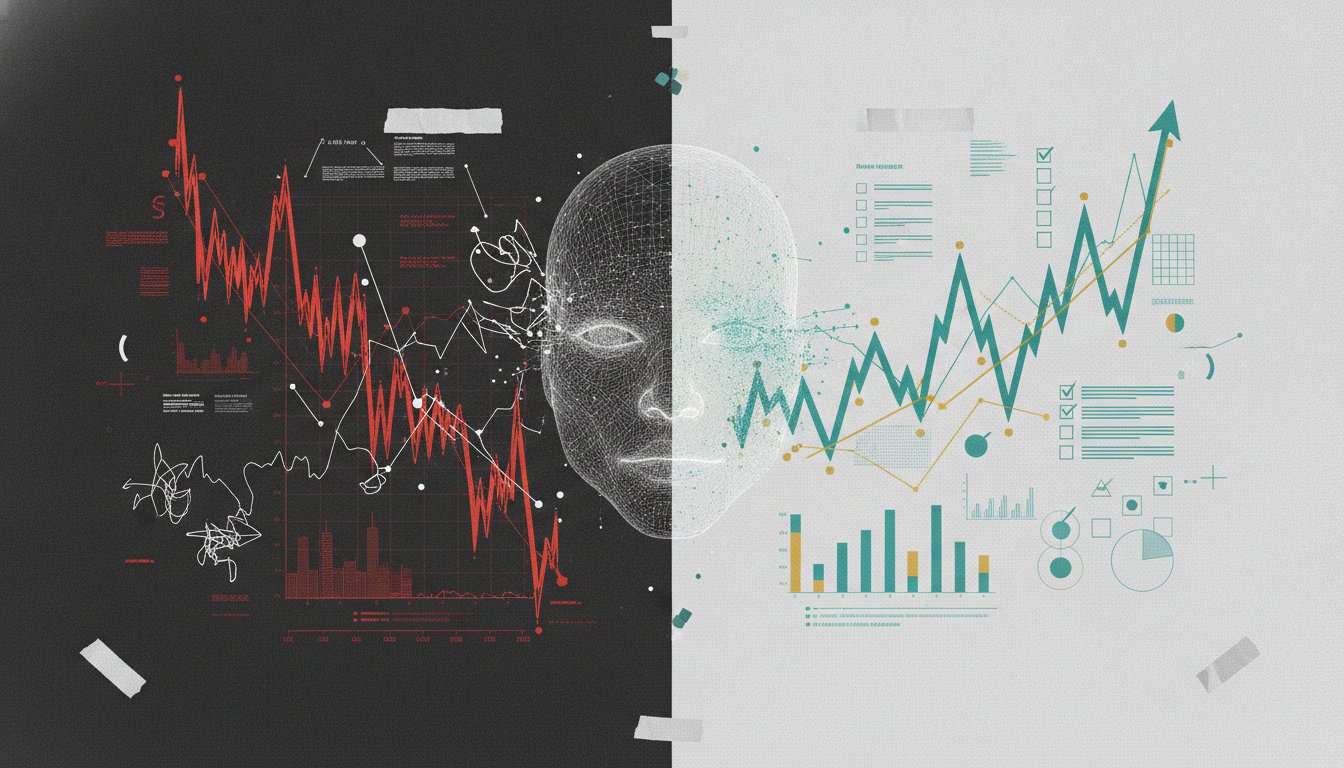
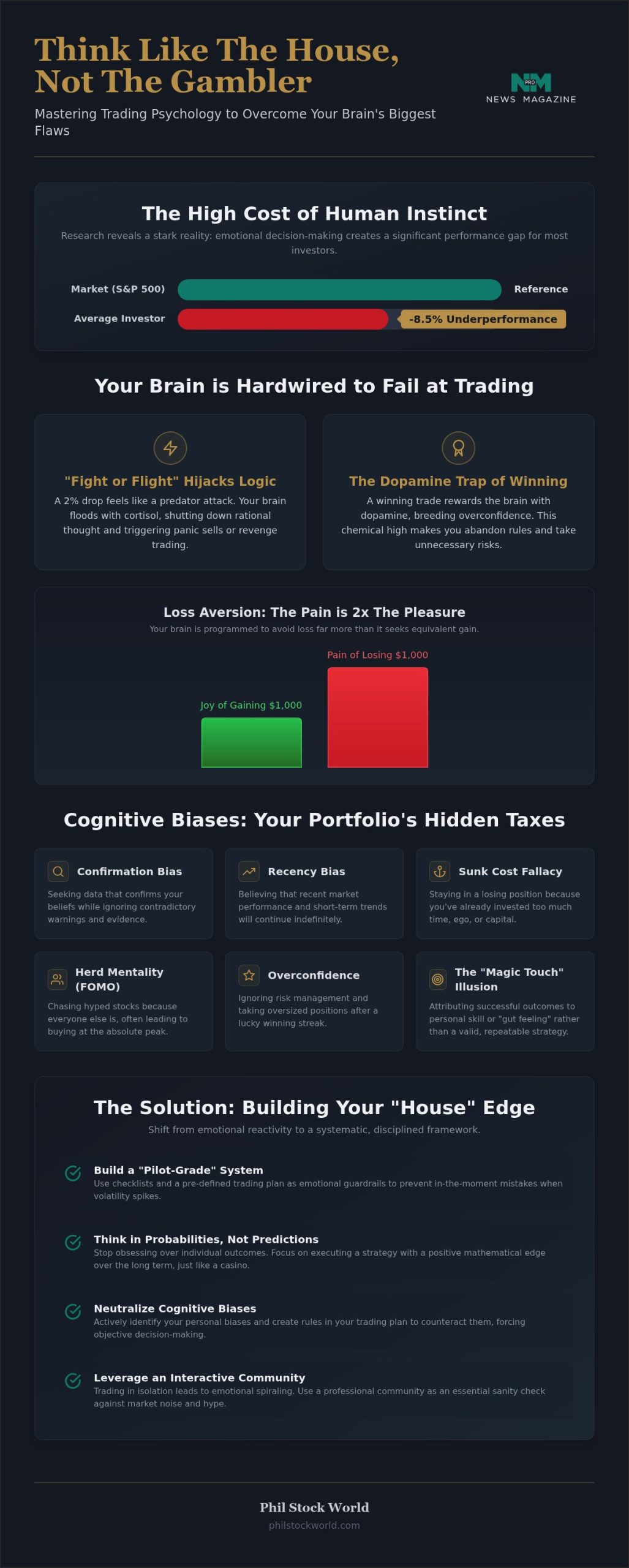
In a market where retail trading demand has surged 25 percent past its old 2021 peak, the most dangerous volatility isn’t on your screen; it’s between your ears. It is a bitter pill to swallow, but research consistently shows that the average equity investor underperforms the broader market by nearly 8.5 percentage points. This is not because you lack the right charts or the latest SEC fee updates. It is because your hardwired survival instincts are actively sabotaging your trading psychology and mindset.
You have likely felt the sting of cutting a winner too early out of fear, or holding a loser far too long because you were conditioned to buy the dip and hoped for a miracle. It is exhausting, and frankly, it is a recipe for the high failure rates seen in retail circles. We are here to change that narrative. You will learn how to stop trading like a gambler and start thinking like “The House.” This article explores how to build a repeatable system that replaces emotional reactivity with calm, institutional discipline, ensuring that your brain finally becomes your greatest asset rather than your biggest portfolio risk in 2026.
Key Takeaways
- Decode the biological “fight or flight” triggers that cause you to treat a minor market dip like a life-threatening predator.
- Identify and neutralize the cognitive biases that trick you into ignoring critical data while chasing phantom patterns in the charts.
- Master the shift in your trading psychology and mindset required to stop obsessing over individual outcomes and start operating with the mathematical edge of “The House.”
- Build a “pilot-grade” system of checklists and trading plans that act as emotional guardrails when market volatility spikes.
- Discover why trading in isolation leads to emotional spiraling and how an interactive community provides the necessary sanity check for long-term consistency.
The Biological Mismatch: Why Your Brain is Hardwired to Fail at Trading
Your brain is a legacy system. It hasn’t had a firmware update in 50,000 years. When a stock ticker flashes red and your P&L drops 2 percent, your amygdala doesn’t see a market fluctuation. It sees a predator. This “Fight or Flight” response is why your trading psychology and mindset often feels like a liability. Your body floods with cortisol, your heart rate spikes, and the logical prefrontal cortex goes offline. You aren’t analyzing a chart anymore. You’re just trying to survive. This biological mismatch makes you prone to panic selling when you should be holding, or worse, aggressive “revenge trading” to win back what was lost.
Trading psychology is the study of how mental states dictate market execution.
Winning trades are equally hazardous. A successful exit triggers a massive dopamine hit. It feels incredible. However, it’s a chemical trap that breeds overconfidence. You start believing you have a “magic touch” instead of acknowledging a high-probability setup. Most “gut feelings” are simply sophisticated forms of bias masquerading as intuition. They’re the brain’s way of finding patterns where none exist just to satisfy its reward centers.
The Evolution of Loss Aversion
Evolution didn’t care about your Sharpe ratio. It cared about calories and survival. This is why the pain of losing $1,000 feels twice as intense as the joy of gaining $1,000. Within the field of Behavioural finance, this is called loss aversion. It’s the biological quirk that forces retail traders to hold losing positions while praying for a bounce. You enter the “Hope Phase.” You stop being a trader and become a spectator of your own ruin. You’re waiting for the market to “be fair,” but the market doesn’t have a conscience.
The Herd Mentality and Social Proof in 2026
In 2026, the herd is louder than ever. AI-driven sentiment engines and social media hype cycles exploit our primal need for belonging. These echo chambers make it feel “safe” to buy a stock that has already peaked. Our brains crave social proof. If everyone on your feed is bullish, your brain tells you it’s safe to jump in. It isn’t. Following the herd is the safest way to ensure mediocre results. By the time the crowd is excited, the smart money has already left the building. This is why having an insider perspective is vital; it acts as a sanity check against the digital noise.
The Cognitive Biases That Erode Your Edge (And How to Spot Them)
If your brain’s hardware is outdated, its software is riddled with bugs. These cognitive biases act as hidden taxes on your portfolio, quietly draining your capital before you even realize a trade has gone south. Even with a solid trading psychology and mindset, these mental shortcuts can bypass your logic. Confirmation bias is the most seductive of these glitches. It’s the reason you only click on articles that agree with your bullish thesis while ignoring the mounting evidence of a sectoral downturn. You’re not looking for the truth. You’re looking for permission to stay in a trade that is already failing.
Recency bias is another portfolio killer. It convinces you that because the market went up for three days, it must go up on the fourth. This leads to a dangerous “buy the dip” conditioning that works until it suddenly, catastrophically, doesn’t. When the trend finally breaks, many traders fall into the sunk cost fallacy. They “average down” on a losing position, throwing good money after bad simply because they’ve already invested time and capital. Instead of admitting a mistake, they double their risk. Learning the art of recovering from big losses starts with realizing that the market does not care what you paid for a stock. Understanding the retail trading mistakes to avoid that turn you into exit liquidity for institutional players is equally essential to breaking these destructive patterns.
The Overconfidence Trap
A lucky streak is the most dangerous thing that can happen to a novice. After three or four winning trades, you start to believe you’ve mastered the market. Your confidence soars, but your risk management craters. You start taking larger positions and ignoring stop-losses because you “feel” the next move. Professional traders are the most skeptical people in the room. They know that every win contains a seed of arrogance that must be weeded out. To keep your ego in check, a Virtual Portfolio Review can offer an objective look at whether your returns are due to skill or just a temporary tailwind.
FOMO and the “Late to the Party” Syndrome
Fear of Missing Out (FOMO) is the psychological mechanic of chasing a stock that has already moved. By the time you see everyone on social media bragging about 20 percent gains, you’re likely looking at an “exhaustion gap.” This is where the last of the retail herd piles in, providing the liquidity for institutional players to exit. Staying on the sidelines when others are celebrating requires immense discipline. It means understanding that there will always be another trade, but you only have one pot of capital to protect.
Thinking in Probabilities: Adopting the “House” Mindset
Walk into any major casino and you will notice the floor managers aren’t sweating when a high-roller hits a lucky streak at the roulette table. They don’t change the rules, move the table, or fire the dealer because of one “losing” spin. They know the math is on their side over the long haul. This is the ultimate goal of a professional trading psychology and mindset. You must move from the desperation of the gambler to the cold, calculated confidence of the House. When you stop obsessing over the result of a single trade, you finally gain the freedom to execute your strategy without fear.
Most retail traders ask, “What will happen next?” This is a gambler’s question. The professional asks, “What is the likelihood of X happening, and what is my risk if it doesn’t?” When you stop trying to be right and start trying to be profitable, the emotional weight of a single trade vanishes. According to experts in Mastering Your Trading Psychology, the shift from prediction to probability is what separates the consistent winners from those who churn their accounts. You need a sample size of at least 100 trades to judge a system, not five. If your strategy has a 60 percent win rate, a string of four losses is statistically normal, not a crisis.
Prediction vs. Preparation
Trying to predict the market is a fool’s errand. In the volatile landscape of 2026, the “black swan” is the new normal. Instead of guessing direction, you must develop “If-Then” scenarios for every entry. If the price hits X, I do Y. If it breaks Z, I exit. This removes the need for mid-trade decision-making when your brain is high on cortisol. One of the best ways to apply this is by mastering advanced option trading strategies, which allow you to profit from time decay and volatility rather than just directional guesses.
The Role of Edge in Trading Psychology
You cannot have a disciplined mindset if you don’t have a proven edge. An “edge” is simply a statistical advantage that plays out over time. It’s the reason the House always wins. When the market feels chaotic, your only anchor is the math. Trusting your system means knowing that while any single trade is a coin flip, the series is a sure thing. This level of calm confidence comes from backtesting and real-world execution, allowing you to stay sane while the herd panics over a minor intraday move.
Systems Over Luck: Building a Disciplined Trading Framework
Psychology is often dismissed as a “soft skill,” something you deal with only after you have mastered the charts. That is a fatal mistake in the 2026 market. Your trading psychology and mindset act as the operating system for your technical strategy. Without a rigid framework, you are just a gambler with a better vocabulary. A trading plan serves as a contract with your rational self. It is written when the markets are closed and your mind is calm, specifically so it can guide you when the screen is red and your pulse is racing. Successful traders use checklists for the same reason commercial pilots do. They don’t want to rely on memory or “gut feelings” when the stakes are high. If the checklist isn’t cleared, the trade simply does not fly.
Discipline also requires knowing when to step away. The “Walk Away” rule is your primary defense against emotional spiraling. If you have hit a daily loss limit or feel the urge to “revenge trade” after a stop-out, your edge has been compromised. In those moments, your brain is no longer capable of objective analysis. Recognizing this biological state is the difference between a professional and an amateur who burns their account in a single afternoon. Adopting a disciplined trading approach is what ultimately separates those who survive volatile markets from those who become the exit liquidity for institutional players.
Position Sizing as Emotional Management
Position sizing is the ultimate psychological guardrail. We often suggest the “Sleep Test” for retail traders. If you find yourself checking ticker symbols at 3:00 AM or feeling a knot in your stomach during a 1 percent move, your position is too large for your current risk tolerance. Smaller trades allow for objective decision-making. They give you the breathing room to let a trade play out according to the plan. The math of ruin is unforgiving; a single “all-in” move is not a strategy, it is a psychological failure that ignores the statistical reality of the market.
The Virtual Portfolio Review
To truly break the cycle of hope and fear, you must audit your emotional leaks with cold data. A virtual portfolio review helps you distinguish between a good trade with a bad outcome and a bad trade with a lucky outcome. Most amateurs repeat bad trades because they got lucky once, eventually leading to a catastrophic correction. Objective data kills the “Hope” phase of a trade by showing you exactly where your process is breaking down. If you want to stop guessing and start executing with precision, you can book a Virtual Portfolio Review to get an insider’s audit of your strategy and discipline.
The Power of Environment: Why Who You Trade With Matters
Trading can be a lonely business. For many retail investors, the entire experience happens in a vacuum, staring at flickering numbers in a quiet room. This isolation is a primary driver of emotional spiraling. When you trade alone, your internal monologue becomes the only voice in your head, and that voice is often biased, fearful, or overconfident. In the high-speed environment of 2026, having a community acts as a vital sanity check. It provides a collective trading psychology and mindset that can absorb individual panic. Seeing a peer or a mentor remain calm during a sudden 3 percent market drop prevents you from hitting the “sell everything” button in a cortisol-fueled haze.
Generic financial news outlets are designed to generate clicks through sensationalism. They want you looking at the screen every five minutes because urgency sells ad space. Specialized trading rooms operate on the opposite principle. They prioritize clarity over the digital noise. Maintaining a professional trading psychology and mindset is much easier when you are surrounded by people who treat a losing trade with the same indifference as a rainy day. It’s just part of the business. Professionalism is contagious. If the people around you aren’t panicking, you’re far less likely to lose your cool when a position moves against you.
The “Insiders Club” Advantage
Phil Stock World is built on the premise of creating a culture of disciplined, “House-style” trading. Instead of the frantic energy found on social media platforms, the focus here is on real-time market commentary that defuses emotional triggers before they lead to expensive mistakes. This is why many are moving toward specialized trading rooms that offer a professional alternative to mainstream financial sites. These environments provide a structured space where the goal isn’t just to find the next “hot tip,” but to refine the mental execution required to stay profitable in volatile cycles. It’s about being in a room where the math matters more than the hype.
Learning Through Observation
There is a massive difference between recreational trading and professional income generation. One is about the “fun” of the gamble; the other is about the grind of the edge. By watching experienced mentors navigate volatility without flinching, you begin to internalize their lack of emotional reactivity. You learn to leverage community wisdom to avoid the classic retail mistakes we discussed earlier, such as chasing exhaustion gaps or holding losers out of hope. In 2026, your network isn’t just for networking. It is your emotional guardrail, helping you maintain the discipline that a solo environment often erodes. To discover more about how executive coaching can strengthen these professional skills, read more about specialized development programs.
Turning Your Mind into Your Greatest Asset
The markets of 2026 are faster and more psychological than ever, but you don’t have to be a victim of the volatility. You now understand that your own biology is often the biggest hurdle to consistent returns. By identifying cognitive biases and replacing “gut feelings” with a rigorous, probability-based framework, you move from the stress of a gambler to the calm of the House. Success is found in the systems you build and the community you keep, rather than any single lucky trade. It is time to stop fighting your instincts and start leveraging a professional trading psychology and mindset that treats market swings as opportunity rather than a threat.
You don’t have to navigate these cycles alone. With access to real-time interactive trading rooms and direct insights from Phil Davis, who has over 35 years of market experience, you can build the emotional guardrails necessary for long-term survival. If you are ready to audit your strategy for leaks, a Virtual Portfolio Review offers the objective data you need to kill the cycle of hope and fear. Join Phil Stock World and start trading with “The House” today. The market is always moving. With the right mindset, you will finally be moving with it.
Frequently Asked Questions
What is the most important trait of a successful trading mindset?
Discipline and emotional neutrality are the most vital traits. A successful trader views a loss as a simple business expense rather than a personal failure. It’s about maintaining a neutral state regardless of market volatility. By detaching your self-worth from your daily P&L, you can execute your strategy with the same indifference as a machine. This level of detachment allows you to stay focused on the process rather than the outcome.
How can I stop my emotions from affecting my trades?
You cannot eliminate emotions, but you can build systems that make them irrelevant. Start by reducing your position size until the movement of a stock no longer triggers a physical stress response. Use automated stop-losses and pre-written checklists to handle the heavy lifting. When you remove the need for mid-trade decision-making, you effectively sideline your amygdala. It’s about building a framework that protects you from your own primitive biology.
Is trading psychology more important than technical analysis?
Technical analysis provides the “what” and “where,” but your trading psychology and mindset determine if you actually follow through. You can have the most accurate chart in the world, but if you freeze during a minor intraday drop, the analysis is worthless. Most profitable traders spend more time auditing their mental state than their indicators. Analysis is just a tool. Your mindset is the hand that wields it.
What are the most common psychological mistakes traders make in 2026?
In 2026, the most common error is chasing AI-driven hype cycles out of FOMO. Traders often enter positions after an exhaustion gap has already formed and the smart money has left. Another major mistake is revenge trading after a stop-out, where the ego tries to win back capital by taking excessive risk. These errors are fueled by the high-speed information environment, which exploits our natural desire for social proof and rapid rewards.
How do I develop a “House” mindset in my own trading?
Developing a House mindset requires you to stop obsessing over any single trade. Casinos don’t panic when a player wins a hand; they trust their statistical edge over thousands of rounds. You must view your strategy as a series of events rather than a one-off gamble. When you trust the math of your system, you can accept losses with the same calm confidence as a casino manager watching the roulette wheel.
What should I do after a major trading loss to reset my mindset?
Immediately step away from the screens for at least 24 hours. A major loss triggers a physiological response that compromises your logic for hours. Once you are calm, conduct an objective review to see if the loss was a result of bad luck or a broken process. If you followed your plan, accept it as a cost of doing business. If you broke your rules, identify the emotional trigger that caused the lapse.
Can a trading plan really help with fear and greed?
A trading plan is your contract with your rational self. It defines exactly when to enter and exit before the market opens and the adrenaline starts pumping. By pre-determining your risk, you remove the greed that makes you hold too long and the fear that makes you sell too early. It’s an emotional guardrail that keeps you grounded when the market is trying to push you into a state of panic.
Why do I keep breaking my own trading rules?
You likely break your rules because you don’t fully trust your edge or your position size is too large. When the financial stakes are too high, your survival instincts override your logic. This leads to impulse trades that bypass your pre-written plan. To fix this, reduce your risk per trade and focus on the consistency of your execution. Improving your trading psychology and mindset starts with trading at a size you can actually handle.

