


In 2026, the market isn’t just trying to take your money; it’s designed to use your panic as the very fuel that powers the next institutional rally. If you have ever felt like the “invisible hand” is specifically targeting your stop-losses, you’re not paranoid. You are likely just playing the game without the house’s edge. Adopting a disciplined trading approach is the only way to stop being the exit liquidity for the big players who treat the market like a casino they own. It is time to stop guessing and start operating.
We all understand the frustration of getting shaken out of a winning position because of a momentary spike in volatility. It’s exhausting to watch your portfolio swing wildly while you struggle to maintain a consistent routine. This guide promises to show you how to transition from a retail gambler to a systematic ‘House’ trader by using a proven, disciplined framework. We will explore the specific daily systems and emotional detachment strategies needed to turn market chaos into repeatable, professional profits.
Key Takeaways
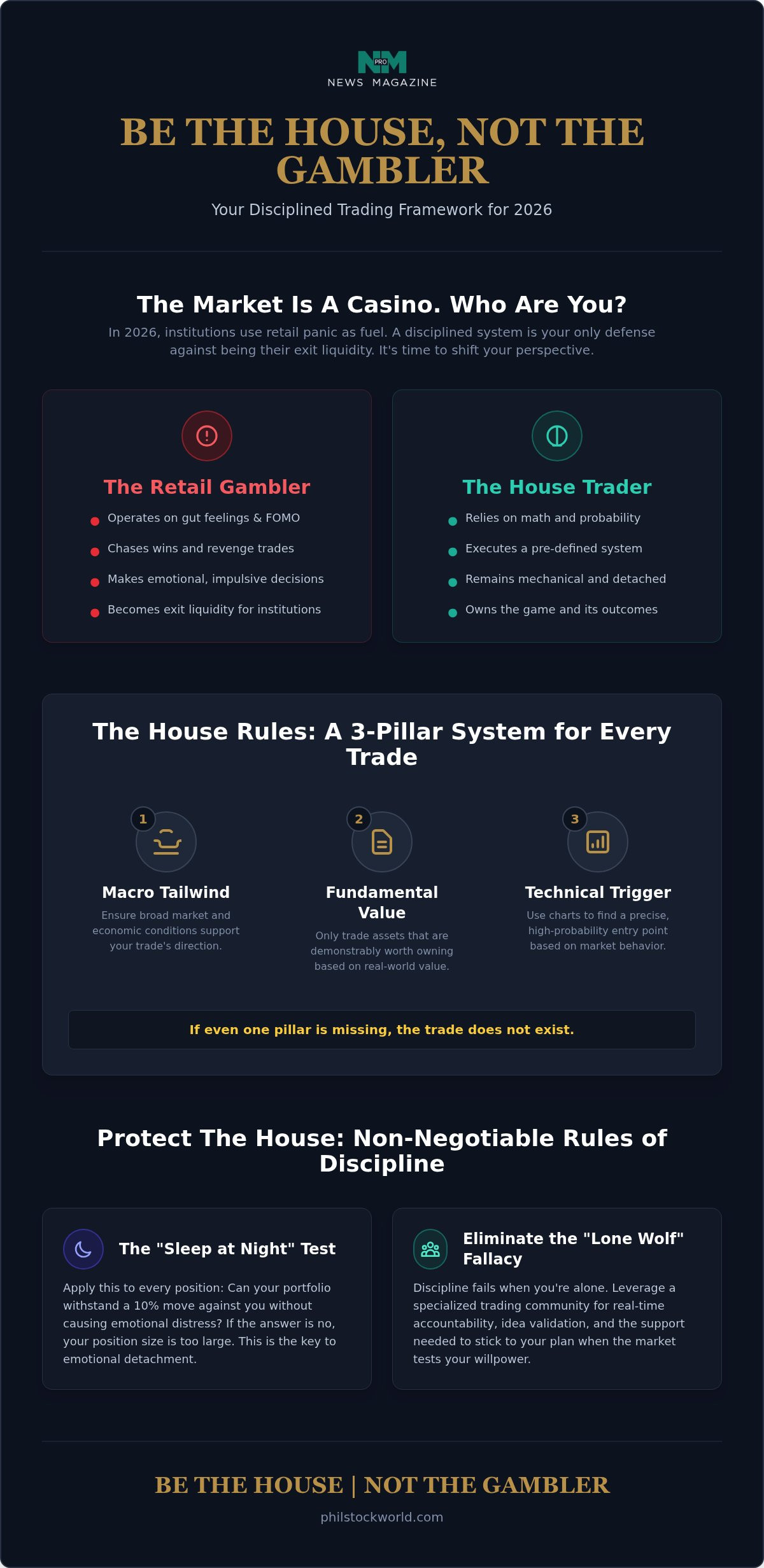
- Stop serving as exit liquidity for institutions by shifting your perspective from a retail gambler to the owner of the house.
- Build a disciplined trading approach that relies on a mechanical system of math and probability rather than gut feelings or intuition.
- Apply the “Sleep at Night” test to your position sizing to ensure that even a 10% market move doesn’t disrupt your emotional detachment.
- Establish a high-performance daily routine for 2026 that integrates pre-market macro analysis with deep fundamental research.
- Eliminate the “Lone Wolf” fallacy by leveraging a specialized trading community to provide the real-time accountability needed to stick to your plan.
The Psychology of the Herd: Why a Disciplined Trading Approach is Your Only Defense
In the high-velocity market of 2026, you are either the predator or the prey. Most retail traders fall into the latter category, serving as exit liquidity for institutional giants. This happens because professionals need a massive volume of buyers to sell into when they want to exit a large position. They find that volume by triggering your emotions. By the time you feel safe enough to buy, the smart money is already handing you the bag. A disciplined trading approach isn’t just a luxury; it’s your only shield against a system designed to exploit your biological impulses.
The noise-to-signal ratio has reached a breaking point this year. Between AI-generated sentiment cycles and 24/7 financial doom-scrolling, your brain is under constant assault. This environment breeds the Gambler’s Mindset, where you chase the rush of a win rather than the consistency of a process. In contrast, “The House” doesn’t care about a single hand. They care about the math. Understanding your trading psychology and mindset is the first step toward moving from the betting table to the dealer’s seat.
Recognizing the Retail Trading Mistakes to Avoid
In 2026, FOMO has evolved. It’s no longer just about missing a rally; it’s about being algorithmically lured into liquidity pockets at the absolute peak of a move. When the herd rushes in, the professionals rush out. Revenge trading is another trap. After a loss, the urge to get it back leads to over-leveraged positions that ignore every rule in your playbook. These common retail trading mistakes to avoid are what turn a minor setback into a portfolio-killing event. If you are buying because everyone else is talking about it, you are likely the one paying for their vacation.
The Cost of Indiscipline: A Portfolio Audit
Think about your last month of trading. How many of your losses came from setups that weren’t actually in your plan? These off-plan trades carry hidden costs that go beyond the dollar amount lost. They erode your confidence and break the mechanical flow of your system. A single afternoon of impulsive clicking can erase three months of systematic gains. This is why a disciplined trading approach focuses on the cumulative result rather than the individual trade. By focusing on high-probability setups and rigid risk management, you neutralize the emotional spikes that lead to disaster. Discipline is the price of admission for long-term survival.
The Mechanics of ‘The House’: Building Your Strategy Template
Building a disciplined trading approach isn’t about having an iron will to resist clicking a button. It’s about building a machine that makes the decision for you before the market even opens. Most traders fail because they rely on intuition. In reality, intuition is often just a fancy word for unprocessed trauma and greed. To “Be The House,” you must stop predicting and start calculating. The House approach is the systematic sale of premium to gamblers who seek overnight riches.
In 2026, the casino doesn’t care if a specific player hits a lucky jackpot. They care that the underlying math ensures they win over ten thousand hands. Your strategy template must be documented to the point where a stranger could execute it without asking you a single question. If your system isn’t back-testable in your own mind, you’re just playing a hobby. Professionals don’t have hobbies; they have systems.
The Core Pillars of a Disciplined System
You can’t trade what you don’t understand. Fundamental analysis acts as your primary filter. It tells you what is worth owning based on real-world value. Once you have a high-quality target, use market charts to find your entry. We don’t use charts to guess the future. We use them to decode the footprints of the herd. We follow the Rule of Three. Every trade requires a Macro tailwind, a Fundamental value proposition, and a Technical trigger. If one of those three is missing, the trade simply doesn’t exist. This level of rigor is what separates the winners from the liquidity. A proactive sector rotation strategy is one of the most powerful macro tailwinds you can add to this framework, helping you identify which areas of the market the smart money is moving into before the crowd catches on.
Integrating Advanced Option Trading Strategies
Directional bets are for the crowds. To truly operate with a disciplined trading approach, you need to use advanced option trading strategies. This means shifting from buying lottery ticket calls to selling spreads. When you sell premium, you are selling time and volatility to the gamblers who are desperate for a quick score. This increases your win probability significantly. The stock can go up, stay flat, or even go down slightly, and you still collect your profit. It’s a transition from speculation to insurance. If you want to see how these mechanics play out in real-time, our educational webinars break down the specific math behind “The House” philosophy.
Position Sizing and Hedging: The Non-Negotiable Rules of Discipline
Most traders spend 90% of their time hunting for the perfect entry price. They treat the market like a sniper mission where one shot makes or breaks the month. In reality, your entry price is almost irrelevant compared to your position size. If your sizing is wrong, your disciplined trading approach will evaporate the moment the first red candle appears on the screen. Discipline isn’t a personality trait; it’s a function of risk management.
The ‘Sleep at Night’ test is the ultimate benchmark for 2026. If a 10% move against your position causes your heart rate to spike or makes you reach for the ‘sell’ button in a panic, your position is too large. You’ve gambled more than your emotional capital can handle. Professionals know that once panic sets in, rational thought exits the room. A virtual portfolio review often reveals that retail traders aren’t bad at picking stocks. They are simply over-leveraged in the wrong places.
The Math of Position Sizing
In the volatile 2026 environment, calculating ‘Total Portfolio Heat’ is vital. This is the sum of all your open risk across every active trade. While the herd might follow a generic 2% rule, a disciplined trading approach adjusts for the Average True Range (ATR) of each asset. A high-volatility tech stock requires a smaller footprint than a stable dividend payer to maintain the same risk profile. The House never bets the entire bankroll on one hand because they know the math always wins over time, provided they stay in the game.
Hedging: The Disciplined Trader’s Secret Weapon
Hedging is your insurance policy against your own human nature. When you have systematic hedges in place, you stop fearing market dips. In fact, you start to love them. While the undisciplined crowd is busy panic-selling at the bottom, the hedged trader is calmly looking for value. This emotional resilience comes from knowing your downside is capped. By using ‘The House’ philosophy to sell premium and buy protection, you create a buffer that keeps your head clear. If you aren’t protected, you aren’t trading; you’re just hoping. And hope is a terrible strategy for 2026.
A disciplined trading approach isn’t a zen-like state you reach after years of meditation. It is a repetitive, almost mechanical loop of actions that protects you from your own worst impulses. In the 2026 market, where information moves at the speed of a neural link, having a rigid checklist is your only hope of staying objective. You don’t wake up and “feel” the market. You follow the system. This loop ensures that by the time the opening bell rings, you are an observer of the chaos, not a participant in it.
- Step 1: Pre-market macro review. Check the futures, global headlines, and economic data. You need to know if the macro wind is at your back or in your face.
- Step 2: Watch List Review. Look for fundamental shifts. If a company’s earnings profile changed overnight, the price action is secondary.
- Step 3: ‘If/Then’ Scenarios. Pre-define your exits. If the stock hits $150, I sell half. If it breaks $140, I’m out. Decide this before the ticker starts moving.
- Step 4: Mid-day Audit. Check for style drift. Are you trading because there’s a setup, or because you’re bored?
- Step 5: Post-market Journaling. Document why you took the trade. If you followed your process, the trade was a success regardless of the P&L.
Pre-Market Preparation: Setting the Tone
Filtering market noise from news is a survival skill. News is a change in fundamentals. Noise is just the 24/7 chatter of the herd. Before the bell rings, identify your key support and resistance levels. This gives you a map. Establish a daily bias, but stay flexible. If the data changes, your bias must change too. Maintaining a disciplined trading approach means being right is less important than being prepared. To see how we map out these levels daily, check our Market Charts and Analysis for real-time insights.
The Mid-Day Discipline Check
The hours between 11:00 AM and 2:00 PM are the most dangerous for the undisciplined. When the market goes flat, the urge to “make something happen” leads to low-quality entries. This is boredom trading. Often, the most profitable action you can take is to close your laptop and walk away. Managing the afternoon fade and avoiding late-day FOMO prevents you from becoming the liquidity that institutions use to close their books. Real discipline is often defined by the trades you choose not to take.
Beyond Willpower: Why Specialized Trading Communities Enforce Discipline
The “Lone Wolf” trader is a romanticized myth that usually ends in a blown-out account. Trading in isolation is the fastest way to succumb to cognitive bias. When you’re the only one looking at your charts, you’ll eventually start seeing patterns that aren’t there just to justify a trade you’re dying to take. A specialized trading room acts as a mirror. It reflects the reality of the market back to you before you make an expensive mistake. Discipline is much easier to maintain when you know someone is watching your homework.
Crowd-sourced fundamental analysis is the real edge in 2026. While one person can miss a crucial detail in a 10-K filing, a community of savvy peers will catch it in seconds. This is why many are moving toward community-driven research platforms that prioritize real-time interaction over static, one-way articles. A disciplined trading approach thrives when it is tested against the collective intelligence of an insider’s club. You don’t just get data; you get context and a sanity check.
Accountability in Real-Time Trading Rooms
Watching a mentor with decades of experience pass on a “tempting” setup is a masterclass in restraint. It teaches you that the best trades are often the ones you don’t take. In our interactive rooms, the “Peer Review” effect is powerful. If you have to explain the logic of your entry to a room full of professionals, you’ll quickly realize if you’re gambling or following a system. This layer of social accountability is a core benefit of the Phil Stock World membership. It forces you to maintain your disciplined trading approach even when the market is trying to lure you into a liquidity trap.
Building a Multi-Year Disciplined Legacy
The goal isn’t just to survive the week. It’s to build a multi-generational legacy. Most people treat trading like a high-stakes video game, but the real winners treat it like a boring, highly profitable utility business. Moving from the frantic energy of day trading to the methodical pace of wealth building requires a shift in perspective. Discipline compounds. A small edge, applied consistently over years, creates a gap between you and the herd that no amount of “luck” can bridge. Eventually, you stop looking for the next big thing. You become “The House” yourself, providing the stability and wisdom that the next generation of traders needs to survive.
Owning the Game in 2026
The market doesn’t care about your feelings, but it definitely cares about your capital. By now, you should see that staying profitable in 2026 isn’t about being a genius. It’s about being a professional who follows a system. You’ve learned how to dodge the exit liquidity trap by shifting to a “House” mindset and why position sizing is the real secret to emotional detachment. Implementing a disciplined trading approach is the only way to ensure you aren’t just another statistic in an institutional spreadsheet.
Don’t try to go it alone in this high-frequency environment. You can get access to real-time interactive trading rooms, veteran market analysis by Phil Davis, and proven “Be The House” options strategies that turn probability in your favor. It’s time to stop gambling and start trading like ‘The House’ with a Phil Stock World Membership today. You have the map. Now, you just need the discipline to follow it. The house always wins; it’s time you became part of the house.
Frequently Asked Questions
What is a disciplined trading approach exactly?
A disciplined trading approach is a mechanical system that prioritizes mathematical probability over human intuition. It’s the practice of following a pre-defined set of rules for every trade, regardless of how you feel about the market’s direction. Instead of gambling on gut feelings, you operate like a casino owner who knows the edge is in the process, not the outcome of a single hand. This consistency ensures you stay objective under pressure.
Can I be a disciplined trader without a written plan?
No, you can’t manage what you haven’t documented. Without a written plan, your brain will naturally find excuses to break rules when fear or greed spikes. A written strategy acts as a contract with yourself, removing the burden of decision-making during volatile market hours. If your rules aren’t on paper or a digital screen, they aren’t rules; they’re just suggestions that will inevitably be ignored when the herd starts panicking.
How much time does a disciplined trading routine take each day?
A professional routine typically requires about 30 to 60 minutes of focused pre-market analysis. This includes reviewing global macro data and setting your “if/then” scenarios for existing positions. Throughout the day, you might spend another 15 minutes on a mid-day audit to check for style drift. The goal isn’t to stare at screens for eight hours; it’s to have a system so efficient that the actual execution takes very little time.
Is trading discipline more important than technical analysis?
Absolutely. You can have the most sophisticated technical indicators in the world, but they are useless if you don’t have the discipline to follow their signals. Most traders fail not because their charts are wrong, but because they lack the emotional detachment to exit when the math says to. A disciplined trading approach allows even a simple strategy to become profitable, while an undisciplined trader will lose money even with a perfect setup.
What happens if I break my trading discipline rules?
When you break your rules, you immediately transition from “The House” back to being “The Gambler.” You lose your statistical edge and become the very exit liquidity that institutional traders use to fund their gains. More importantly, breaking discipline erodes your self-trust, making it harder to follow the plan next time. If you slip up, the only professional response is to close the position immediately and conduct a portfolio audit to find the trigger.
How does hedging help with trading discipline?
Hedging acts as an emotional insurance policy that keeps your head clear during market downturns. When you know your downside is capped through systematic protection, you are far less likely to panic-sell at the bottom. This safety net allows you to stick to your long-term plan while the undisciplined crowd is liquidating in fear. It transforms a market crash from a personal crisis into a strategic opportunity to find new value in 2026.
Can a trading community actually help me stay disciplined?
Yes, because humans are social creatures who perform better when they are being observed. A specialized trading room provides real-time accountability that you simply can’t get as a lone wolf. When you have to justify your trade logic to a group of savvy peers, you are much less likely to take a low-quality, impulsive entry. Seeing mentors pass on tempting but undisciplined setups reinforces the “Be The House” mindset in your own practice.
What is the best tool for tracking my trading discipline?
The most effective tool is a detailed trading journal that documents your process rather than just your profit and loss. You should record why you entered, how you felt, and whether you followed your pre-defined checklist. In 2026, digital journals that track discipline scores are popular, but even a simple spreadsheet works if you are honest. The goal is to identify patterns of style drift before they lead to significant portfolio volatility.

