


The big banks aren’t necessarily smarter than you, but they’ve spent decades learning how to turn your predictable reactions into their personal ATM. In this wide-open 2026 market, where the old $25,000 equity rules are dead and margin rates are a total wild west, the traps have only become more subtle. If you’ve ever felt like the tape waits for your entry just to reverse, you’re likely repeating the common retail trading mistakes to avoid that keep most accounts underwater. It’s a cycle that turns you into “exit liquidity” for the pros, but that’s a role you can resign from today.
It’s exhausting to watch a “sure thing” trade evaporate while you’re buried under a mountain of conflicting financial news. You want a way out of the noise and a strategy that actually sticks when the Nasdaq starts swinging. This article will show you how to dismantle the systemic and psychological traps that cause 90% of traders to fail. We’re going to look at how to stop gambling on hope and start hedging like “The House” with a repeatable system for consistent gains. By the end, you’ll have the tools to maintain emotional control and finally trade with the calm confidence of a true market insider.
Key Takeaways
- Stop playing the broker’s game by recognizing how gamified 2026 trading interfaces encourage the high-frequency churn that drains your capital.
- Discover the critical retail trading mistakes to avoid, including the dangerous myth that a high win rate matters more than proper risk-to-reward ratios.
- Shift your focus from micro-patterns to macro-realities to ensure your technical setups aren’t just noise in a larger institutional move.
- Overcome the biological traps of FOMO and loss aversion by implementing a systematic approach that removes emotional friction from your decision-making.
- Learn to operate like “The House” by prioritizing income-generating strategies and volatility management over speculative directional bets.
The 2026 Retail Landscape: Why Traditional Trading Advice is Failing
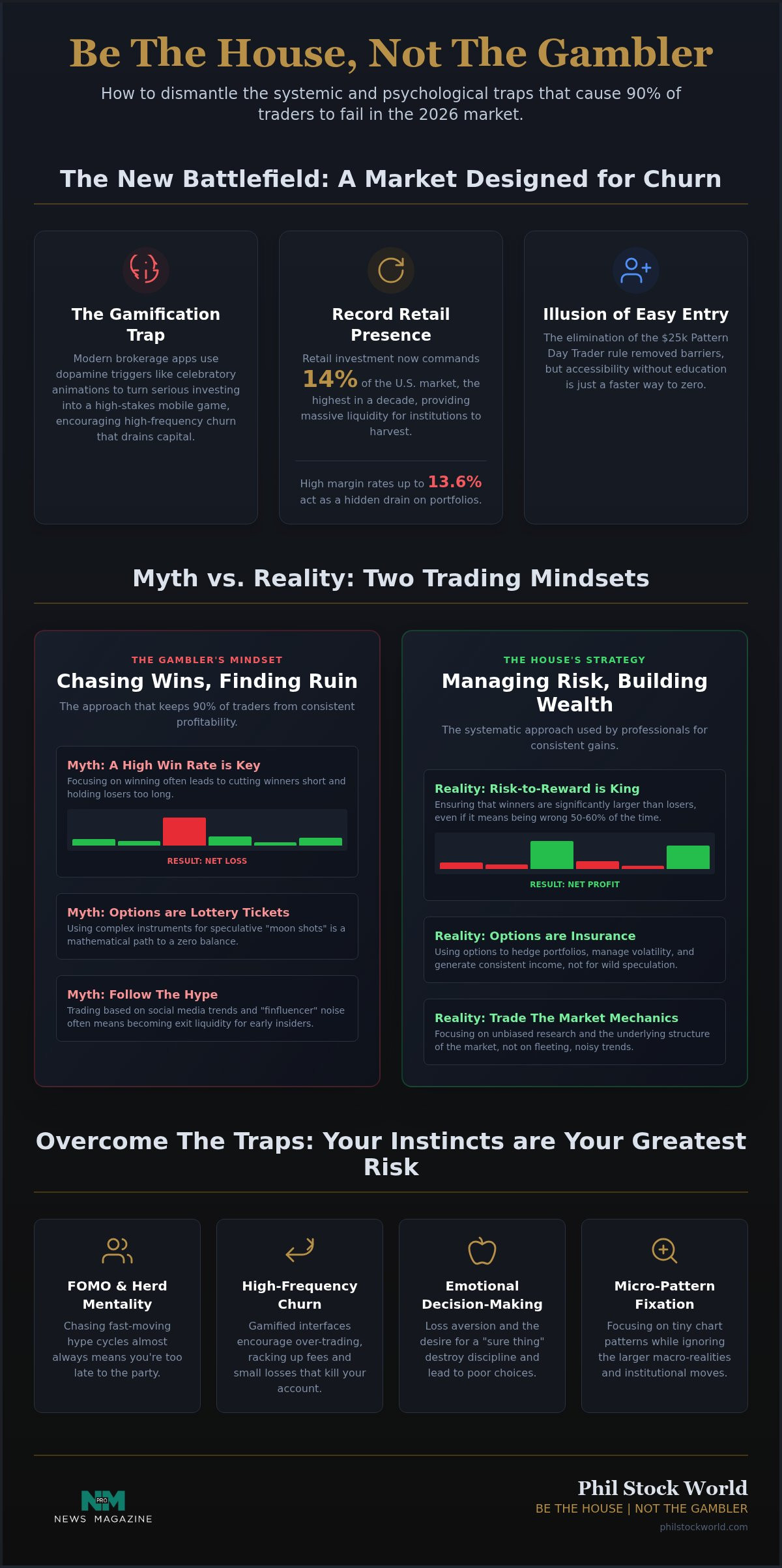
The 2026 market isn’t just volatile; it’s designed to be addictive. When we talk about retail trading mistakes to avoid, we aren’t just talking about picking the wrong stock. We are talking about falling for a systemic architecture that treats your portfolio like a loot box. Modern brokerage apps use haptic feedback and celebratory animations to trigger dopamine, turning a serious financial endeavor into a high-stakes mobile game. This is the “Gamification Trap,” and it’s why the vast majority of retail participants end up as liquidity for the big players. Retail investment now commands 14% of the U.S. sector, which is the highest share in a decade. That’s a lot of fresh capital for institutional grinders to harvest.
Professional institutions operate like “The House” in a casino. They don’t gamble on direction; they manage risk and harvest volatility. Retail traders, conversely, act like the gamblers at the craps table, betting everything on a single roll. If you want to survive this year, you have to stop thinking like a customer and start thinking like the owner of the casino. While 64% of investors plan to increase their acquisitions this year, most will do so without a proper hedge, leaving them vulnerable to the next sudden shift in Federal Reserve policy.
The Illusion of Easy Entry in 2026
Since the FINRA Pattern Day Trader (PDT) rule was eliminated on June 4, 2026, the barrier to frequent trading has vanished. You no longer need a $25,000 equity balance to execute rapid-fire day trading strategies, which sounds like a win for the little guy. In reality, it has led to a record number of liquidations. Zero-commission trades and one-click execution create a false sense of security. It’s too easy to enter a position without understanding the margin interest rates, which can climb as high as 13.6% at some traditional brokerages. Accessibility without education is just a faster way to go broke.
The Information Overload Paradox
Your phone is a firehose of AI-generated hype and “finfluencer” noise. This creates faster, more dangerous hype cycles that trap retail traders at the absolute top. The mistake isn’t a lack of info; it’s the inability to find unbiased financial research amidst the clutter. Most viral trends are just exit strategies for the people who got in early. To win in 2026, you need to stop trading the news and start trading the mechanics of the market itself. If you’re following the herd, you’re already too late to the party.
Myth vs. Reality: Debunking the Most Dangerous Trading Beliefs
Most traders enter the 2026 market with a head full of bad data and “hustle culture” nonsense. If you’re getting your financial education from thirty-second clips on social media, you’re likely absorbing the very retail trading mistakes to avoid that institutions rely on to stay profitable. The most persistent myth is the idea that you need a high win rate to be successful. It’s an ego trap. In reality, professional “House” strategies often involve being wrong 50% or even 60% of the time. The difference is that their winners are significantly larger than their losers. They prioritize position sizing and risk-to-reward ratios over the vanity of a perfect track record. If you’re aiming for a 90% win rate, you’re likely holding losers too long and cutting winners too short just to keep your stats pretty.
Another dangerous belief is that options are purely speculative tools for gamblers. While buying out-of-the-money calls on a whim is a fast track to zero, advanced option trading strategies are actually the most effective way to hedge a portfolio and generate consistent income. Pros use options as insurance, not as lottery tickets. They sell volatility when it’s expensive and buy it when it’s cheap. By shifting your mindset from “betting” on a stock’s direction to “insuring” your capital, you move from being the mark to being the house. If you’re feeling overwhelmed by these concepts, a quick virtual portfolio review can help identify where your current strategy is leaking capital.
The “Get Rich Quick” Fallacy
Chasing 1,000% gains is a mathematical certainty for ruin. When you hunt for “moon shots,” you’re forced to take on massive tail risk that eventually catches up to you. The “House” approach is boring by design. It focuses on consistent, small wins compounded over years. To stay alive in 2026, you must learn to spot “Hype Trades” before they suck you in. If a stock is trending on every platform and the AI-generated news cycle is screaming “buy,” you aren’t early. You’re the exit liquidity for the smart money that entered months ago.
Leverage: The Double-Edged Sword
Leverage is a tool, but for most retail traders, it’s a noose. The mistake isn’t using leverage; it’s using it out of desperation to “catch up” on previous losses. With 2026 margin interest rates hitting as high as 13.6% at some brokerages, the cost of being wrong is higher than ever. Institutions use leverage to enhance low-risk, high-probability spreads. Retail traders use it to double down on a losing hand. Understanding that margin is a high-interest loan, not “free money,” is the first step toward using it strategically rather than as a gambling crutch.
Technical Pitfalls: The Structural Mistakes That Drain Portfolios
Most retail participants treat their brokerage accounts like a high-speed video game, but in the 2026 market, “Action Addiction” is a primary reason for failure. Even with $0 commissions becoming the industry standard, overtrading remains one of the most expensive retail trading mistakes to avoid. Every time you click “buy” or “sell,” you’re paying the invisible tax of the bid-ask spread and slippage. In a high-frequency environment where algorithms execute in microseconds, your frequent churn serves as a steady income stream for market makers. If you’re trading just to feel something, you’ve already lost the plot.
The structural decay of a portfolio often starts with a refusal to look at the big picture. Many traders get hyper-focused on five-minute candles while ignoring the massive macro waves moving the entire ocean. Learning how to read market charts is a vital skill, but it’s fundamentally useless if you don’t understand the underlying economic catalysts. Technical patterns are just the footprints of the herd. If you don’t know where the herd is being driven by interest rate shifts or policy changes, you’re just staring at dirt and calling it a strategy. A proactive sector rotation strategy is one of the most effective ways to stay ahead of these macro-driven moves before they become front-page news.
We also see a recurring tragedy in the “Averaging Down” trap. Retailers love to buy more of a sinking ship because it’s “on sale,” but professionals know that a price drop is often a signal that the fundamental thesis has broken. This leads to poor exit planning where traders “marry” their losers out of ego and “date” their winners out of fear. They cut a 5% gain to feel a win but let a 40% loss run because they can’t admit they were wrong. It’s a recipe for long-term insolvency.
The Failure of Static Stop Losses
In 2026, institutional algorithms are specifically programmed for “Stop Hunting.” Your static stop loss, placed right below a obvious support level, is essentially a “kick me” sign for high-frequency traders. They’ll intentionally drive the price down to trigger those stops, grab your liquidity, and then reverse the trend. Instead of simple stops, savvy traders are increasingly using options for structural protection. This allows you to stay in the trade through the noise without being “wicked out” by a temporary spike in volatility.
Position Sizing: The Silent Portfolio Killer
The math of survival is simple, yet most ignore it. Going “all in” on a single trade idea is the quickest way to end your career. Professionals use tools like the Kelly Criterion to determine exactly how much capital to risk based on their edge. No single trade should ever represent a catastrophic risk to your capital. If one bad headline can wipe out 20% of your total account, you aren’t trading; you’re just a gambler waiting for the house to catch up to you.
The Psychology of the Herd: Why Your Instincts Are Your Greatest Risk
Your brain is a prehistoric survival machine, not a high-frequency trading algorithm. In the 2026 market, where AI-driven hype cycles move at light speed, your natural instincts are often your worst enemies. The most common retail trading mistakes to avoid usually stem from Fear Of Missing Out (FOMO). When you see a stock verticalizing and everyone on social media is posting screenshots of their gains, your biological urge is to join the hunt. This is exactly when institutions are looking for exit liquidity. They need someone to buy their shares at the top, and your FOMO makes you the perfect candidate. By the time you feel “safe” enough to enter, the smart money is already halfway out the door.
Loss aversion is the other side of that psychological coin. Humans are hardwired to feel the pain of a loss twice as intensely as the joy of a gain. This biological quirk is why retail traders hold onto losing positions far too long, hoping for a “bounce” that never comes. It often leads to revenge trading, a dangerous cycle where you try to “win back” money from the market after a bad hit. You start taking larger, riskier positions to break even, which is the fastest way to blow up an account. The market doesn’t owe you anything, and it certainly doesn’t care about your feelings.
Biological Wiring vs. Market Success
Success in trading requires you to act against your evolution. Your amygdala wants to protect you from the “threat” of a red screen, leading to panic selling at the bottom. Meanwhile, confirmation bias makes you filter out any bearish news that contradicts your current long position. To survive, you have to build a “Trading Firewall” between your emotions and your execute button. This means having a pre-defined plan that dictates exactly when you enter and exit, regardless of how your gut feels in the moment. Adopting a disciplined trading approach is what separates pros who trade what they see from retail traders who trade what they feel.
The Importance of a Trading Community
The “lonely trader” syndrome is a major contributor to impulsive, emotion-driven errors. When you’re trading in a vacuum, your own biases become an echo chamber. A professional live trading room provides the necessary accountability to keep you grounded when the market gets wild. Having a mentor who has survived multiple cycles helps you distinguish between a temporary dip and a structural shift. It’s about surrounding yourself with people who will call you out before you make a move you’ll regret. If you’re ready to stop guessing and start following a proven framework, consider joining our Premium Membership to trade alongside a community that prioritizes logic over hype.
Cultivating a “House” Advantage: Systems Over Luck
Success in the 2026 market doesn’t come from a “hot hand” or a lucky streak. It comes from building a system that treats trading as a business rather than a trip to the casino. While most retail participants are busy buying expensive options and hoping for a miracle, the “House” is on the other side of that trade, selling that volatility and collecting the premium. To stop being the mark, you’ve got to start thinking like an operator. This begins with a brutal audit of your current holdings. A virtual portfolio review is the most effective way to identify the specific retail trading mistakes to avoid that are currently draining your capital. If you don’t know where you’re leaking, you can’t fix the ship.
The power of the “House” lies in hedging. Every single trade needs a “Plan B” that doesn’t involve hope. In a world where 56% of retail investors see the market as “mid-cycle,” the danger of complacency is high. If you aren’t protecting your upside with strategic offsets, you aren’t trading; you’re just praying. A commitment to continuous education is the only way to stay ahead of the algorithmic shifts and policy changes that define 2026. You have to move beyond the basics of support and resistance and start understanding how to harvest income from the market’s natural movements. Understanding how to implement a sector rotation strategy that trades market cycles like “The House” is a critical part of that education, ensuring you’re positioned in the right sectors before the crowd catches on. It’s about becoming the one who provides liquidity, not the one who gets consumed by it.
Building Your Rule-Based Framework
A professional framework is built on three pillars: your entry point, your exit target, and your “uncle” point. The “uncle” point is the price at which you admit the trade is dead and walk away without emotion. Most traders fail because they decide these numbers while the trade is live and their adrenaline is spiking. The House never bets more than it can afford to lose on a single hand. By defining these boundaries beforehand, you move from a gambler reacting to price action to a strategic operator executing a plan. It’s about survival first and profit second.
Your Next Steps with Phil Stock World
You don’t have to navigate this volatile environment alone. A Phil Stock World membership serves as the ultimate antidote to the “lonely trader” syndrome. You get access to live alerts and a community that prioritizes risk management over the latest viral hype. Our trading room is an insider’s club where we share complex information with transparency and a touch of irreverence. It’s time to stop being the market’s exit liquidity and start trading with the discipline and wit of someone who actually knows how the game is played.
Mastering the 2026 Market: From Liquidity to Operator
The 2026 landscape is faster and more unforgiving than ever, but it’s also packed with opportunity for those who refuse to follow the herd. By identifying the systemic retail trading mistakes to avoid, you’ve already taken the first step toward reclaiming your capital. Success isn’t about finding a magic indicator; it’s about shifting from the “Gambler” mindset to becoming a “Strategic Operator” who sells volatility and hedges every move. You’ve seen how institutional “Stop Hunting” and biological biases like FOMO are designed to drain you. Now, you have the framework to dismantle those traps and keep your equity where it belongs.
You don’t have to fight the institutional algorithms alone. With over 20 years of institutional market analysis behind us, we’ve built a community designed to help you thrive in any environment. Stop making retail mistakes and start trading like “The House” with a Phil Stock World membership today. You’ll gain access to our interactive Live Trading Rooms and real-time trade alerts that prioritize math over hype. It’s time to stop being the market’s exit liquidity and start operating with the calm confidence of a true insider. We’re ready when you are.
Frequently Asked Questions
What is the most common mistake retail traders make?
The most common error is overtrading, often fueled by the gamified interfaces of modern 2026 brokerage apps. Many participants mistake activity for progress, racking up invisible costs through slippage and the bid-ask spread. This “Action Addiction” is one of the primary retail trading mistakes to avoid if you want to protect your capital. Without a pre-defined strategy, you aren’t trading; you’re just providing a steady stream of liquidity to institutional algorithms waiting on the other side.
How can I avoid emotional trading in a volatile 2026 market?
You avoid emotional trading by building a “Trading Firewall” that removes the need for gut-level decisions when the tape gets wild. This involves setting your entry, exit, and “uncle” points before you ever put a penny at risk. In the volatile 2026 environment, where AI-driven news cycles can trigger massive swings in minutes, relying on your instincts is a recipe for ruin. Stick to a disciplined trading approach that prioritizes logical execution over prehistoric survival urges.
Is it possible to recover from a large trading loss?
Recovery is absolutely possible, but it requires you to abandon the urge to “win it back” through revenge trading. Trying to force a recovery usually leads to even larger, desperate positions that blow up the remaining account. Instead, take a step back and perform a rigorous audit of your strategy. A Virtual Portfolio Review can help you identify exactly where your mechanics failed, allowing you to rebuild with a focus on consistent, small gains rather than risky moonshots.
Why do retail traders often buy at the top and sell at the bottom?
Retailers buy at the top because of FOMO and sell at the bottom because of panic, both of which are hardwired biological responses. When a stock is verticalizing and social media is screaming, your brain perceives a missed opportunity as a threat. Conversely, when the screen turns red, your amygdala triggers a “flight” response. Institutions exploit these cognitive shortcuts by driving prices to trigger your stops and then absorbing your shares right before the actual reversal occurs.
How much capital do I need to avoid common retail trading mistakes?
The specific dollar amount is less important than your risk management strategy, especially since the $25,000 PDT rule was eliminated in June 2026. Whether you have $5,000 or $500,000, you can still fall into the same traps if you don’t understand position sizing. The goal is to ensure that no single trade can cause catastrophic damage to your portfolio. Focus on mastering the mechanics of “The House” rather than worrying about the size of your initial stack.
What is “position sizing” and why is it more important than the trade itself?
Position sizing is the mathematical process of determining how much capital to risk on a single trade to ensure long-term survival. It is more important than the trade itself because even a perfect strategy will fail if you bet too much on a single losing hand. Professional operators use tools like the Kelly Criterion to stay in the game. By limiting your exposure, you ensure that a string of losses is merely a temporary setback rather than a career-ending event.
Can a trading newsletter really help me avoid mistakes?
A high-quality membership can help, but only if it provides the educational tools to fix your underlying retail trading mistakes to avoid. Many services just scream about the latest hype stock, which actually feeds into the FOMO trap. You want a community that offers real-time trade alerts based on institutional analysis and risk management. The goal should be to teach you how to fish in a volatile market, not just hand you a single, risky trade idea.
What is the difference between a gambler and a “House” trader?
A gambler bets on a specific direction and hopes for a big win, while a “House” trader manages probabilities and harvests volatility. Gamblers are often directional, meaning they need the stock to move exactly where they predicted to make a profit. The House uses hedging and income-generating strategies to ensure they can stay profitable even if the market moves sideways or slightly against them. It is the difference between playing the slots and owning the casino.

