


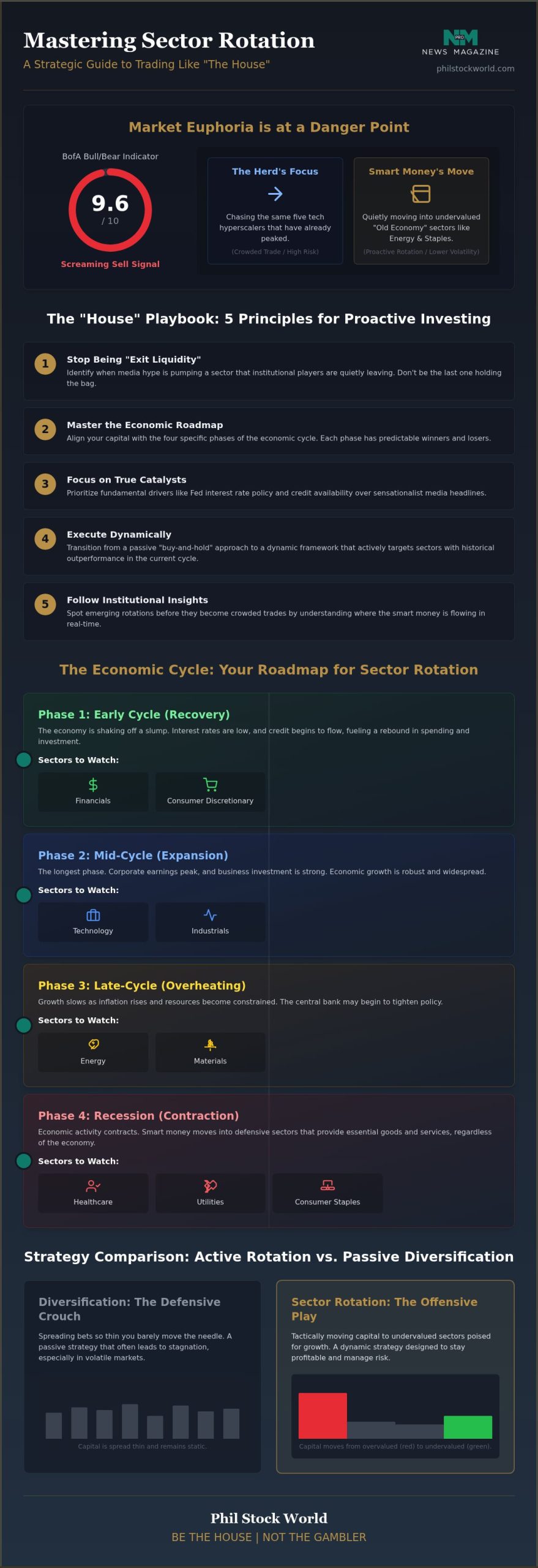
Bank of America’s Bull/Bear Indicator just hit a screaming 9.6 out of 10, a level of market euphoria that historically precedes a massive wake-up call. While the herd is still chasing the same five tech hyperscalers, the real money is already moving into “Old Economy” sectors like energy and consumer staples. It’s frustrating to buy into a peak because you didn’t have a proactive sector rotation strategy in place. You’re likely tired of the conflicting macro data that makes every investment move feel like a high-stakes coin flip.
We’re here to change that dynamic. This guide will show you how to stop reacting to headlines and start playing like “The House.” We’ll provide a clear framework to identify the next winning sector before it’s front-page news, helping you lower volatility and exit crowded trades before the floor drops. You’ll learn how to decode the 2026 economic cycle like an insider, ensuring your capital is always positioned ahead of the curve. It’s time to stop guessing and start following the money where it’s actually going, not where it’s already been.
Key Takeaways
- Stop serving as “exit liquidity” for institutional players by identifying when the media is pumping a sector that has already peaked.
- Master a repeatable sector rotation strategy by aligning your capital with the four specific phases of the 2026 economic roadmap.
- Identify the true catalysts for market movement by prioritizing Fed interest rate policy and credit availability over sensationalist headlines.
- Transition from a passive buy-and-hold approach to a dynamic execution framework that focuses on sectors with historical outperformance in the current cycle.
- Access real-time institutional insights through interactive trading rooms to spot emerging rotations before they become crowded trades.
The Mechanics of Sector Rotation: Why the Herd Always Arrives Late
Think of the market as a massive poker game. If you’re looking around the table and can’t spot the sucker, it’s probably you. In the high-stakes world of institutional finance, the “sucker” is often the retail investor who unknowingly provides what we call exit liquidity. A professional sector rotation strategy isn’t about following the news; it’s about anticipating the next move before the headlines even break. While the herd is busy reacting to yesterday’s winners, the smart money is already quietly building positions in tomorrow’s leaders.
At its core, Sector Rotation is the tactical movement of capital from overvalued industries that have already run their course into undervalued sectors that are just beginning to wake up. Most people think of this as a pure profit-hunting mission. While the gains can be massive, the hidden secret is that rotation is actually one of the most powerful risk management tools in existence. By exiting a sector that has become “crowded,” you protect your capital from the inevitable reversal that follows a peak. Implementing a disciplined sector rotation strategy allows you to sidestep the carnage of a collapsing bubble while your peers are still holding the bag.
The Psychology of the Crowded Trade
Retail traders are hardwired for FOMO. When you see a specific sector dominating the headlines and every analyst on TV is screaming “Buy,” the smart money is likely already looking for the door. This is the “consensus trade.” When everyone agrees a sector is a winner, there’s nobody left to buy and push the price higher. You don’t want to be the one buying at the top just so a hedge fund can cash out. Learning to identify these traps is essential, and you can dive deeper into these retail trading mistakes to avoid to stop being the market’s exit liquidity.
Rotation vs. Diversification: Knowing the Difference
There’s a common misconception that being diversified is enough to keep you safe. Diversification is essentially a defensive crouch; it’s staying safe by spreading your bets so thin that you barely move the needle. Rotation, however, is about staying profitable. In a volatile year like 2026, a static 60/40 portfolio is a recipe for stagnation. While the diversified crowd waits for the tide to lift all boats, active rotators are moving into the specific sectors that the current economic winds are actually blowing toward. The “House” mentality is simply the art of spotting value and positioning yourself before the herd even realizes the game has changed.
The Four Stages of the Economic Cycle: A Roadmap for Smart Money
The economy doesn’t move in a straight line. It breathes. For the savvy trader, these breaths are predictable phases that dictate where the money flows next. A successful sector rotation strategy relies on identifying which of the four stages we’re in: Early, Mid, Late, or Recession. Each phase has its own winners and losers. Knowing the difference is what separates “The House” from the retail crowd that is always a step behind.
Early and Mid-Cycle Dynamics
This is the expansionary part of the cycle where the most aggressive gains are often made. In the Early phase, the market is shaking off a slump. Interest rates are typically at their lowest, acting as rocket fuel for rate-sensitive areas. This environment favors Financials, as lending picks up, and Consumer Discretionary, as shoppers regain confidence. It’s a period of rapid growth that eventually matures into the Mid-cycle.
The Mid-cycle is the longest phase and represents the “sweet spot” of the expansion. Corporate earnings growth is at its peak, and the credit cycle is in full swing. This is where Technology and Industrials typically find their stride. Understanding the key drivers for each sector during this phase is essential. It’s not just about growth; it’s about identifying which industries have the strongest tailwinds from business investment and consumer spending before the economy starts to overheat.
Late-Cycle and Recessionary Defense
Eventually, the party starts to get a bit too loud. In the Late-cycle, inflation begins to bite, and the cost of raw materials climbs. This is the moment when Energy and Materials often outperform the broader market. You’ll start seeing warning signs like inventory build-ups or yield curve inversions. Smart money begins to rotate out of high-flying tech and into the hard assets that benefit from rising prices.
When the music finally stops and we enter a Recession phase, it’s time to get defensive. Sectors like Consumer Staples, Healthcare, and Utilities become your best friends. People still buy toothpaste and pay their electric bills even when the market is wobbling. While Mid-cycle Tech might offer explosive returns, Recessionary Healthcare offers something more valuable during a downturn: stability. If you’re unsure if your current holdings are ready for a shift, a Virtual Portfolio Review can help you spot if you’re over-weighted in yesterday’s winners. Transitioning your sector rotation strategy from offense to defense isn’t about fear; it’s about being the only one in the room with a plan when everyone else is panicking.
Identifying the Pivot: Macro Signals That Trump the Headlines
The headlines are noise. By the time a “major market shift” makes it to the front page of a financial site, the smart money has already moved its capital and is looking for the next exit. To master a professional sector rotation strategy, you have to ignore the talking heads and focus on the plumbing of the global economy. The market doesn’t move because of a catchy news segment; it moves because of liquidity, credit, and the cold reality of supply and demand.
The “House” watches the credit cycle with a hawk’s eye. When banks tighten their lending standards, growth-oriented sectors like Technology often lose their luster because the cheap capital that fueled their expansion starts to dry up. Conversely, we watch the inventory cycle to spot trouble in Industrials. If warehouses are overflowing with unsold goods, it’s a clear signal that the sector is about to hit a wall, regardless of what the earnings reports might say. We also use sentiment analysis as a contrarian tool. When the herd’s greed reaches a fever pitch, we look for the exit; when their fear is paralyzing, we look for the entry.
The Role of Monetary Policy in 2026
In 2026, the Federal Reserve remains the ultimate puppet master of market cycles. While the general public obsesses over every syllable of a press conference, savvy traders are busy dissecting the Fed’s balance sheet. We don’t care what they say; we care what they do with the money supply. A shrinking balance sheet is a headwind for high-multiple growth stocks, while a pause in rate hikes can act as a massive catalyst for value sectors. Understanding these macro market insights is the only way to stay ahead of the curve. If you’re waiting for the official announcement to move your money, you’ve already lost the game.
Technical Indicators for Sector Strength
Macro data tells you the “why,” but technicals tell you the “when.” We track the Relative Strength Index (RSI) across major sector ETFs like XLK for tech, XLV for healthcare, and XLE for energy to see where momentum is actually building. It’s about finding the divergence between price and reality. A sector might be making new highs, but if the RSI is trending lower, the rotation has already begun behind the scenes. We use simple moving average crossovers to confirm these shifts, ensuring we aren’t just jumping at shadows. Learning professional stock market charts allows you to see the footprints of institutional capital as it rotates from one sector to another. It’s the most honest data you’ll ever find in a market full of noise.
Strategic Execution: Beyond Buy-and-Hold in Rotating Sectors
Execution is where most traders fall apart. It’s easy to talk about cycles, but pulling the trigger while the herd is screaming in the opposite direction is a different game entirely. Executing a high-level sector rotation strategy requires a methodical, five-step framework that prioritizes risk management over raw greed. The House doesn’t gamble; it calculates. By following a structured process, you move from being a reactive participant to a proactive architect of your own wealth.
First, identify the current economic phase using the macro indicators we discussed. Second, screen for sectors that historically outperform in that specific environment. Third, use sector ETFs like XLK or XLE to gain broad exposure. This lowers your individual company risk; you don’t want a single CEO’s bad day to ruin your entire trade. Fourth, layer in options to enhance your yield or protect against false breakouts. Finally, rebalance your holdings quarterly. This ensures you aren’t over-allocated to a “cooling” sector just because it was a winner six months ago. If you’re ready to see how these steps look in a live environment, our Premium Membership provides the real-time guidance needed to stay ahead.
Leveraging Rotations with Options
The real secret to trading like the House is using options to squeeze every drop of value out of a rotation. When a sector reaches the late-cycle stage, we often sell covered calls to generate income while the trade slows down. This provides a buffer if the sector begins to move sideways. We also use advanced option trading strategies to hedge downside risk when a sector becomes too popular. The House prefers selling volatility when a sector is “crowded” because the premiums are juiced by retail fear. It’s a way to get paid for waiting while the herd decides where to run next.
The Virtual Portfolio Audit
Before you commit real capital to a massive shift, you need to test your thesis. A virtual portfolio review is the best tool for auditing your current weights and seeing if your strategy holds water in the 2026 market. We advocate for tracking “paper trades” alongside your active ones to refine your timing. This builds the muscle memory required for a disciplined trading approach. When volatility hits, you’ll be the one moving with precision while everyone else is paralyzed by the headlines.
Joining the Inner Circle: Real-Time Rotation Alerts with Phil Stock World
The core advantage of our approach is the speed and depth of collective research. While mainstream outlets are busy chasing clicks, our members are dissecting the macro catalysts that drive the next big rotation. This is why serious traders are moving toward sophisticated research communities that offer more than just surface-level opinion pieces. In our trading rooms, we spot rotations in real-time by tracking capital flows across global markets. You’re not just getting a list of tickers; you’re gaining a front-row seat to the moves that actually move the needle. It’s about seeing the footprints of big money before they become obvious to everyone else.
The Final Step: Taking Action
Knowledge alone won’t grow your portfolio. You need the courage and the community to act on that knowledge before the opportunity vanishes. We invite you to step away from the mainstream narrative and join the PSW community for daily market commentary that isn’t afraid to challenge the consensus. Our Premium Membership is designed for traders who are tired of being the market’s exit liquidity and are ready to play the game on a professional level. Don’t let another economic cycle pass you by while you’re stuck on the sidelines. Take control of your financial future with the right tools and real-time support. Join Phil Stock World and Start Trading Like the House Today!
Mastering the 2026 Market Pulse
Success in the current economy doesn’t reward those who sit still. It demands a move beyond the passive buy-and-hold mindset in favor of a disciplined sector rotation strategy that anticipates where institutional capital is flowing next. You’ve learned how the four economic stages dictate winners and why tracking Fed liquidity and technical RSI levels provides the essential timing for your trades. It’s about staying ahead of the herd and refusing to be someone else’s exit liquidity when the floor drops.
You don’t have to navigate these volatile cycles alone. By joining Phil Stock World, you gain access to daily market commentary from veteran trader Phil Davis and real-time interactive trading rooms where we decode market footprints as they happen. You can also leverage our exclusive virtual portfolio reviews to ensure your current holdings aren’t stuck in yesterday’s peak sectors. Stop reacting to sensationalist headlines and start playing with the confidence of the house. The opportunity to capture massive gains across shifting cycles is yours for the taking.
Join Phil Stock World and Start Trading Like the House Today!
Frequently Asked Questions
What is the best sector rotation strategy for beginners?
The best sector rotation strategy for beginners is to focus on broad exchange-traded funds (ETFs) that track the 11 major GICS sectors. Instead of trying to pick individual winners, beginners should align their capital with the four stages of the economic cycle. By moving into defensive sectors like Healthcare during slowdowns and cyclical sectors like Industrials during recoveries, you reduce individual stock risk while still capturing the primary trend of the market.
How often should I rebalance my portfolio for sector rotation?
Most professional traders find that rebalancing quarterly provides the right balance between capturing trends and avoiding excessive trading costs. In the 2026 market, monthly rebalancing often leads to noise rather than actual economic shifts. A quarterly audit allows you to assess if a sector’s fundamentals have truly changed or if the herd is just having a bad week. Consistency beats frequency every time when you’re tracking major capital flows across the economy.
Which sectors perform best during high inflation in 2026?
In 2026, the Energy and Materials sectors have proven to be the strongest hedges against persistent inflation. As Core PCE inflation remains elevated, hard assets and commodity-linked businesses maintain their pricing power better than high-growth tech firms. The S&P 500 energy sector already gained more than 40% earlier this year, proving that capital gravitates toward tangible value when the purchasing power of the dollar is under pressure from macro headwinds.
Can I use ETFs for a sector rotation strategy?
ETFs are the most efficient tool for executing a sector rotation strategy because they offer instant diversification across an entire industry. Using symbols like XLK for Technology or XLE for Energy allows you to play the macro theme without worrying about a single company’s earnings miss. It’s much easier to be right about the direction of the global energy market than it is to pick one specific driller that might have operational issues.
How do interest rates affect sector rotation?
Interest rates act as the primary gravity for all sector valuations. When rates are low or falling, growth-heavy sectors like Technology thrive because their future earnings are worth more today. When the Fed raises rates to combat inflation, Financials often benefit from wider net interest margins, while capital-intensive sectors like Utilities face headwinds. You have to watch the Fed’s balance sheet and rate projections to know which way the wind is actually blowing.
What is the difference between sector rotation and market timing?
Market timing is an attempt to predict when the entire market will go up or down, while sector rotation is about deciding where to be positioned within the market. You can be fully invested at all times but still use rotation to move from aggressive to defensive postures. It’s the difference between trying to predict the weather and simply changing your clothes to match the season that has already arrived on your doorstep.
Is sector rotation suitable for long-term investors?
Sector rotation is highly suitable for long-term investors because it serves as a sophisticated form of risk management. By periodically shifting away from overvalued, crowded sectors and into undervalued ones, you naturally sell high and buy low over the span of decades. This approach helps lower portfolio volatility and prevents the catastrophic drawdowns that occur when a long-term investor stays married to a single sector that has already peaked and entered a multi-year decline.
How do I know if a sector rotation is a “fake out”?
You can spot a “fake out” by looking for a lack of volume confirmation and divergence in technical indicators. If a sector price is moving higher but the Relative Strength Index (RSI) is trending lower, the move is likely exhausted. Professional traders wait for a confirmed moving average crossover before committing significant capital. If the macro data doesn’t support the price move, it’s usually just the retail herd chasing a false headline or temporary spike.

