

 Welcome to year 5!
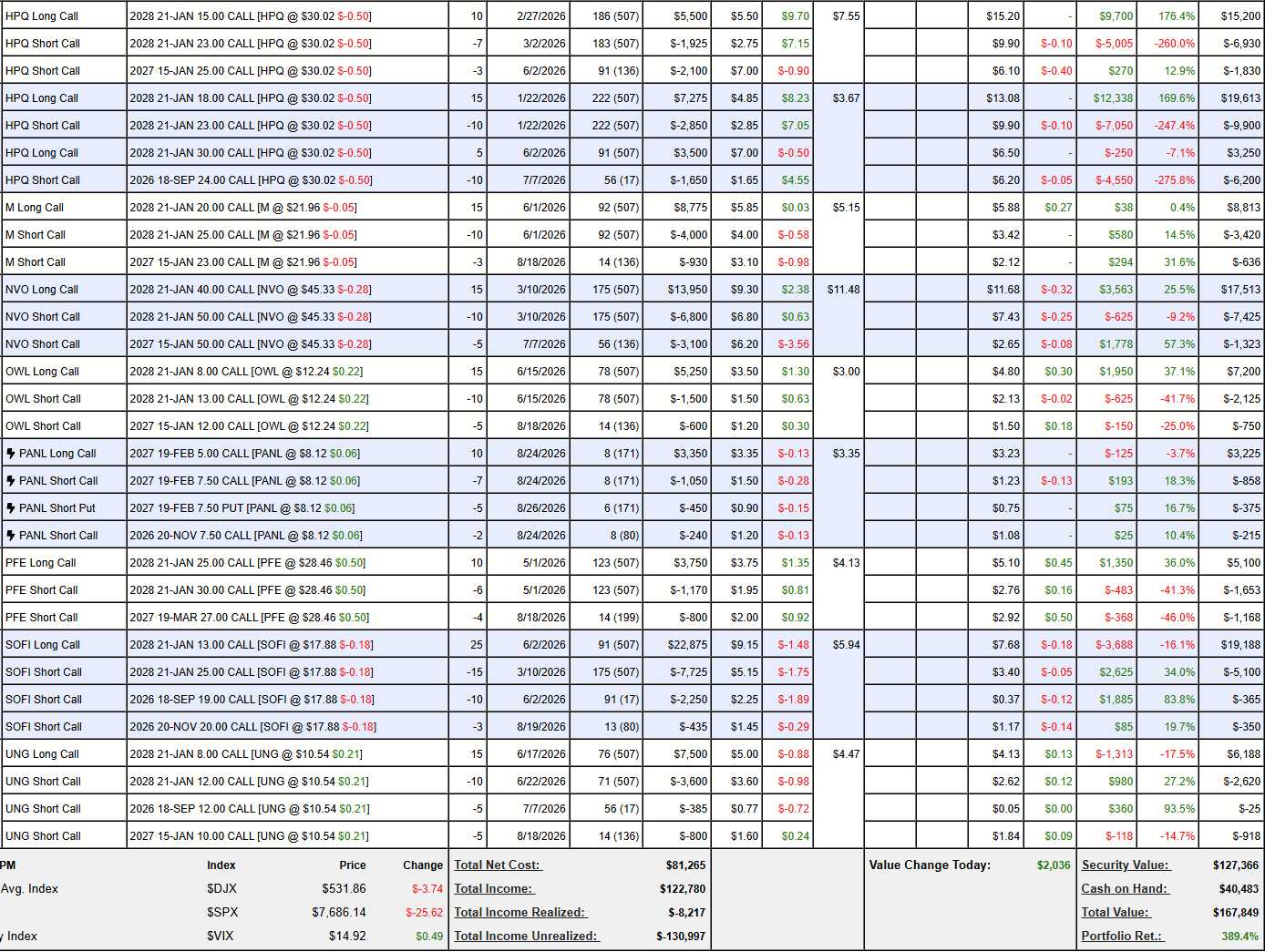
And we are off to a rip-roaring start after a fabulous month, where we barely touched the portfolio but we jumped to $167,849 – which is up $14,615 (9.5%) from our Aug 4th review and up 389% from our $700 start on Aug 25th, 2022. Even more amazingly, we are now averaging 95.36% annual growth, which means it will now only take us 2 years and 8 months (March, 2029) to get to our $1M goal!
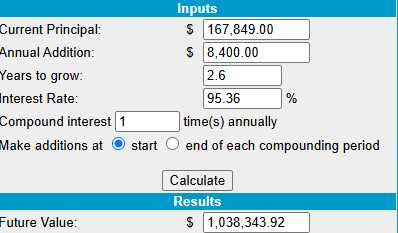
This is the part where I usually warn that these are exceptional returns and very unlikely to keep going at this pace (and the markets are, in fact, dipping this morning) but we keep gaining more and more so let’s accentuate the positive and point out that, IF we keep going at the current pace – we will turn $167,849 plus $700 added each month – into $1,038,343.92 by March of 2029 – it’s like a magic trick!
In fact, while $14,615 seems amazing – it’s actually only slightly ahead of the $2,326/week ($9,304/month) we EXPECTED to make and it’s SLOWER than the $16,773 ($4,193/week) than our pace last month and THIS IS HOW WE TAKE THE TEMPERATURE OF OUR PORTFOLIO – you have to know your numbers or how will you know when things are going off track?
As I said last month:
“Everything is proceeding as I have foreseen… muhahahaha!!!“
I also said: “See, you don’t have to be the Dark Lord of the Sith to do this – it’s just math…” and it still is! If you CONTROL your portfolio and analyze each position and you KNOW how they should perform in a flat market or an up 20% or down 20% market – then you are not very likely to be surprised by the results, right?”
The coolest thing about this portfolio is we aren’t using margin. We started out with $700 and, each month, we put another $700 into the portfolio – which I know seems silly but, if we didn’t keep doing that, our March 2029 total drops to $957,395 so 32 x $700 ($22,400) less contributed leads to $80,948 less money in less than 3 years – THAT is the importance of SAVING MONEY!!!
These have, of course, been an exceptional 4 years but that video is about 12 years old now and everything I said then is true now – it’s never too late to start and the original goal of this portfolio was to make just 10-20% a year with no margin. I never expected it to go this well and I’d attribute it to a very strong market and, of course, our AGI Round Table – which is a game-changer for market research.
I’ve always been a great stock-picker and analyst (he said modestly) but now we have an army of researchers backing me up and they were all trained by me to be as good as me – only 1,000 TIMES FASTER! Our Members benefit from their analysis and wisdom every day and the AGI Team is available for hire for Consulting Work – which is building cash flow as they move towards their IPO but you get first crack at it here – while they are still humble.

Meanwhile, here’s our last year of reviews – in case you’d like to catch up:
-
- How to Become a Millionaire by Investing $700 per Month – Part 48/360
- How to Become a Millionaire by Investing $700 per Month – Part 47/360
- How to Become a Millionaire by Investing $700 per Month – Part 46/360
- How to Become a Millionaire by Investing $700 per Month – Part 45/360
-
How to Become a Millionaire by Investing $700 per Month – Part 44/360
-
How to Become a Millionaire by Investing $700 per Month – Part 43/360
-
How to Become a Millionaire by Investing $700 per Month – Part 42/360
- How to Become a Millionaire by Investing $700 per Month – Part 41/360
- How to Become a Millionaire by Investing $700 per Month – Part 40/360
- How to Become a Millionaire by Investing $700 per Month – Part 39/360
- How to Become a Millionaire by Investing $700 per Month – Part 38/360
-
How to Become a Millionaire by Investing $700 per Month – Part 37/360 – Year 4 Begins!
-
How to Become a Millionaire by Investing $700 per Month – Part 36/360 – 3 Years In!
Since last month, we’ve raised our CASH!!! position to $40,483 (24%) and we do have a nice hedge (SQQQ) but I’m VERY uncomfortable with the market and expect a 10-20% pullback in the next few months and that would suck – so I’m going to be very conservative in this review but, then again – I often say that but then our positions are so good that I can barely find anything to cut – so let’s see how it goes:
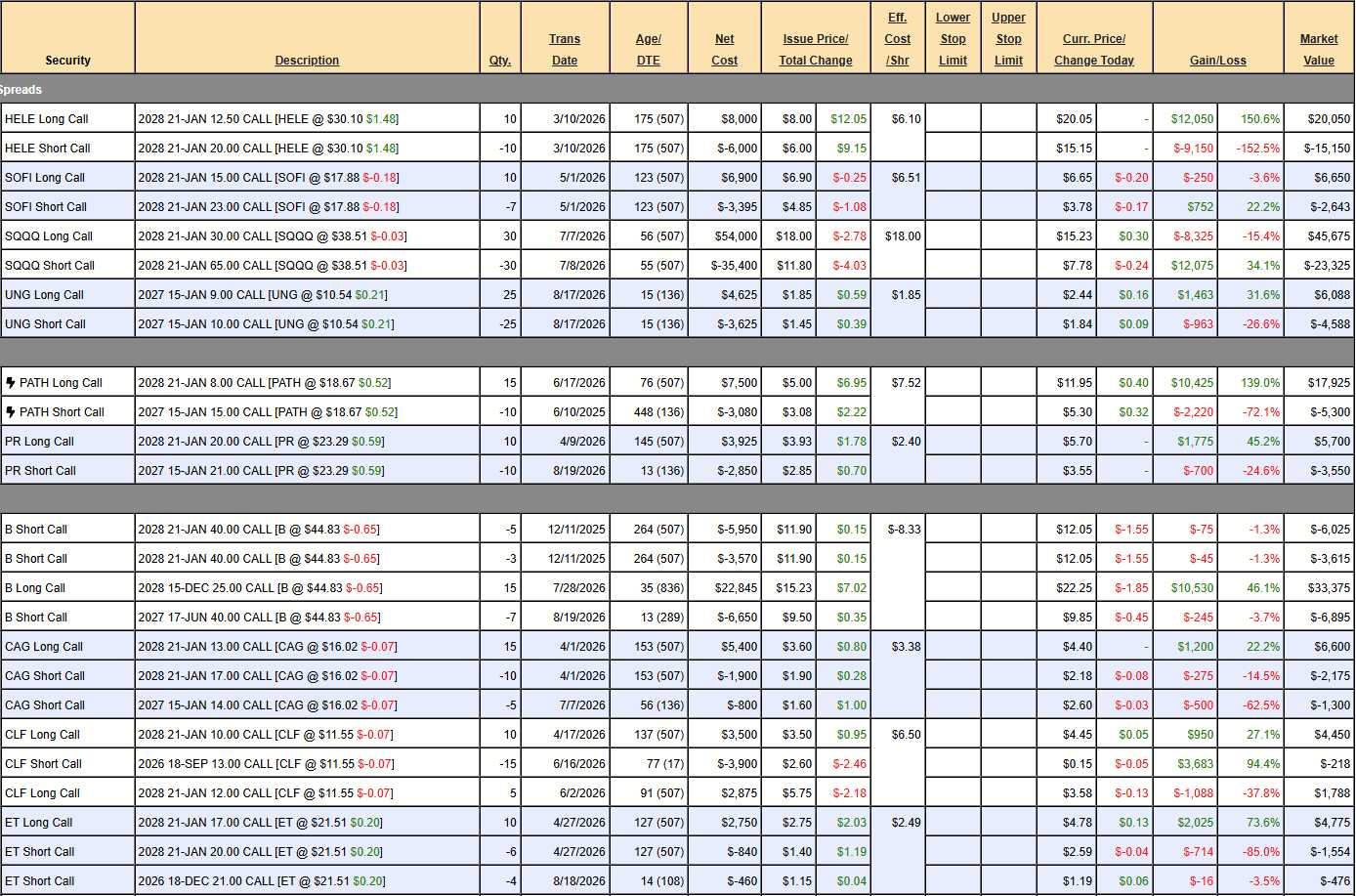
Bull Call Spreads: We were just yesterday, in our Live Member Chat Room, discussing why bull call spreads suck. They are BETS and we HATE betting. We like income-producing plays but, once in a while – a simple bet can be used appropriately. Still, they have to own their keep by remaining VERY LIKELY to pay off with enough REWARD to justify the RISK:
-
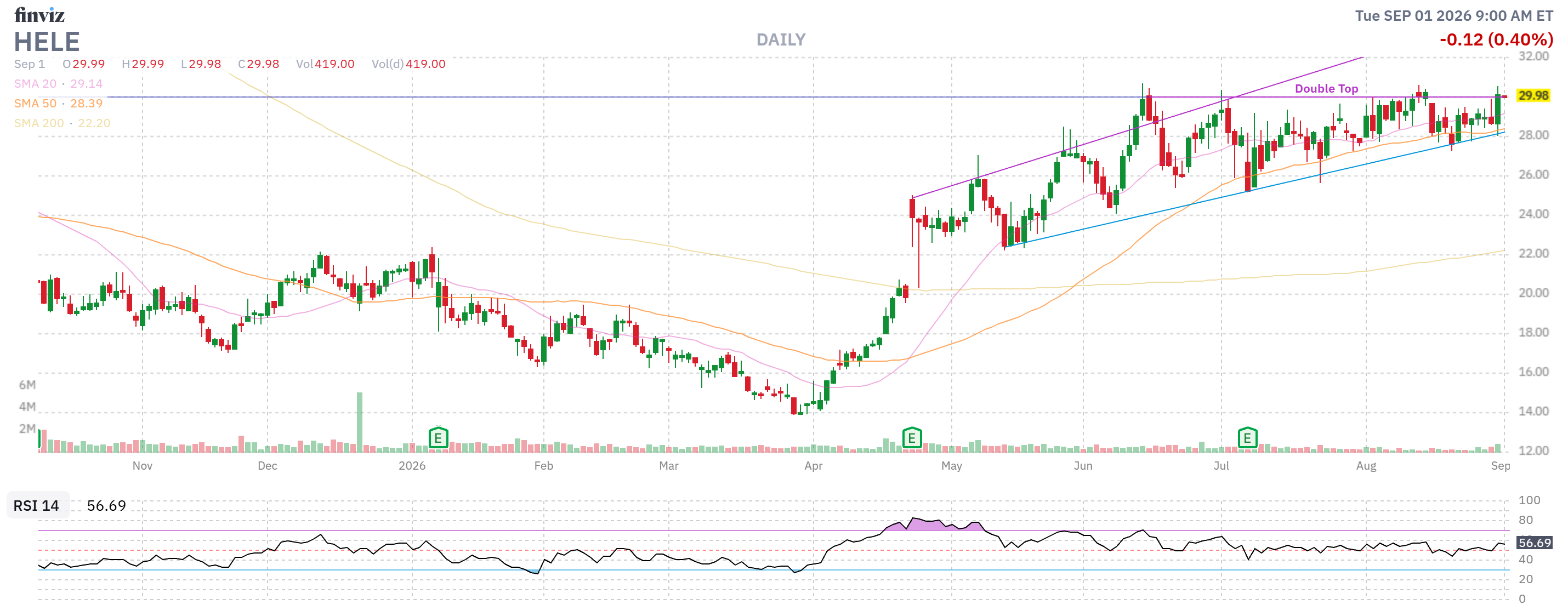
- HELE – We took this one way back in March and thought HELE was severely undervalued at $16.15 and now it’s $29.98 – so I guess we were right. It is now extremely safe-looking, at net $4,900 and it’s a $7,500 spread so we still have $2,600 (53%) left to gain – so there’s no sense in cashing it out. In fact, a trade that will make 53% in 16 months with a very high likelihood of success would be something most stock newsletters would feature on their front page all year – and here we are thinking of cutting it for underperforming our goal!
-
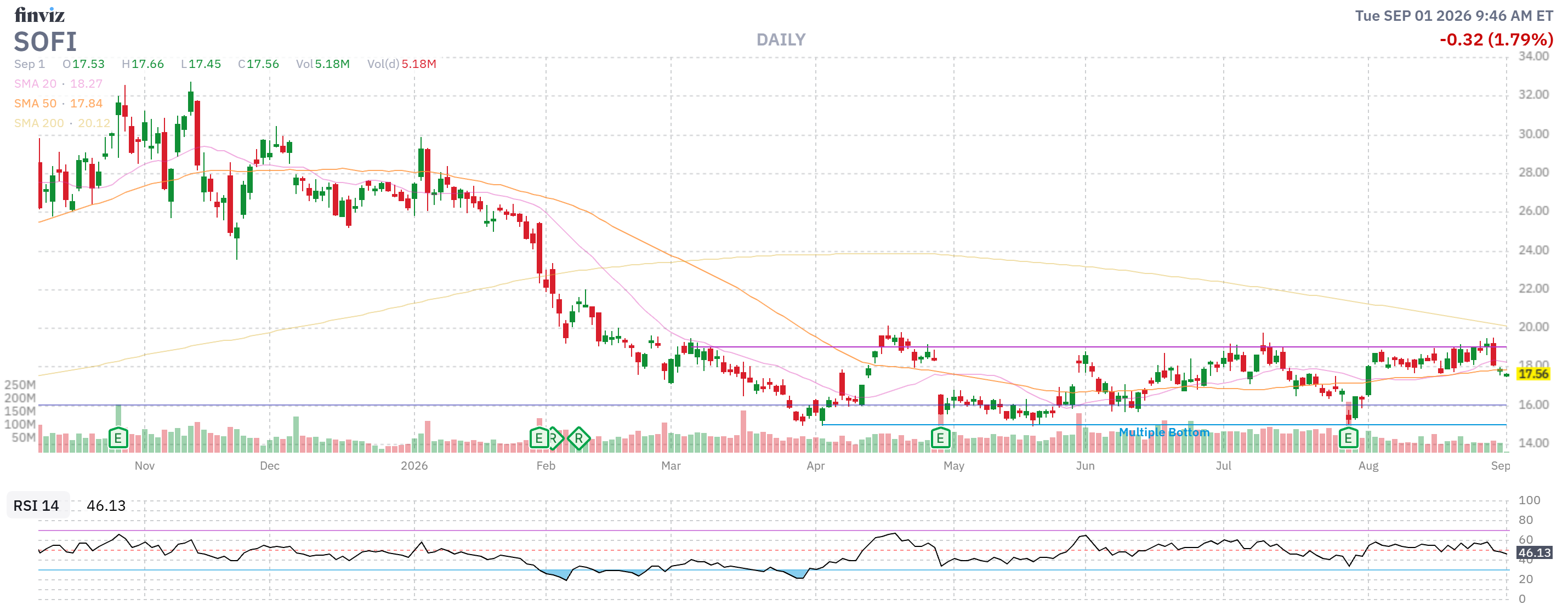
- SOFI – We just orphaned it by not selling new calls and I still think it’s too low. $17.66 is 21x forward earnings but the growth is spectacular and I think it should climb to 25x, which is up 20% so let’s say $21 so $20 is where I’d want to re-cover and that would confirm we’re on-track for our goal at $8,000 and the current net is $4,007 so $3,993 (99%) upside potential and the Jan $17s are $3 so I’m sure we’ll collect $2.50 ($750) for the Q and 4 more next year so let’s say another $1,000 (25%) of potential premium sales.
-
- SQQQ – This is our hedge and, fortunately, the short $65s are losing value faster than our long $30s (not an accident, we did the math and picked the optimal pairing). SQQQ is a 3x inverse ETF so, if the Nasdaq falls 20% then SQQQ rises 60% (less friction costs) from $38.51 to $61.60 so our target is still perfect and that makes this potentially a $90,000 spread, which is currently net $22,350 so we have net $67,650 of downside protection.
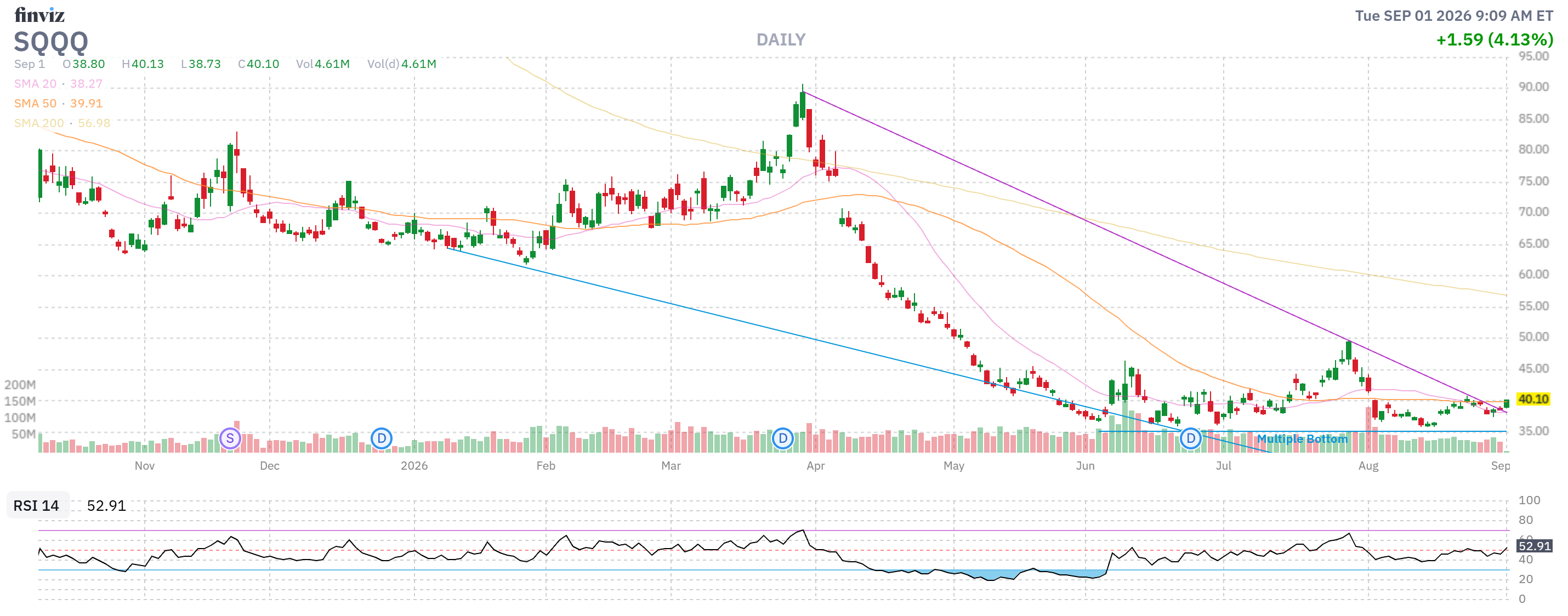
See +0.69 while I was talking about it – NICE!
-
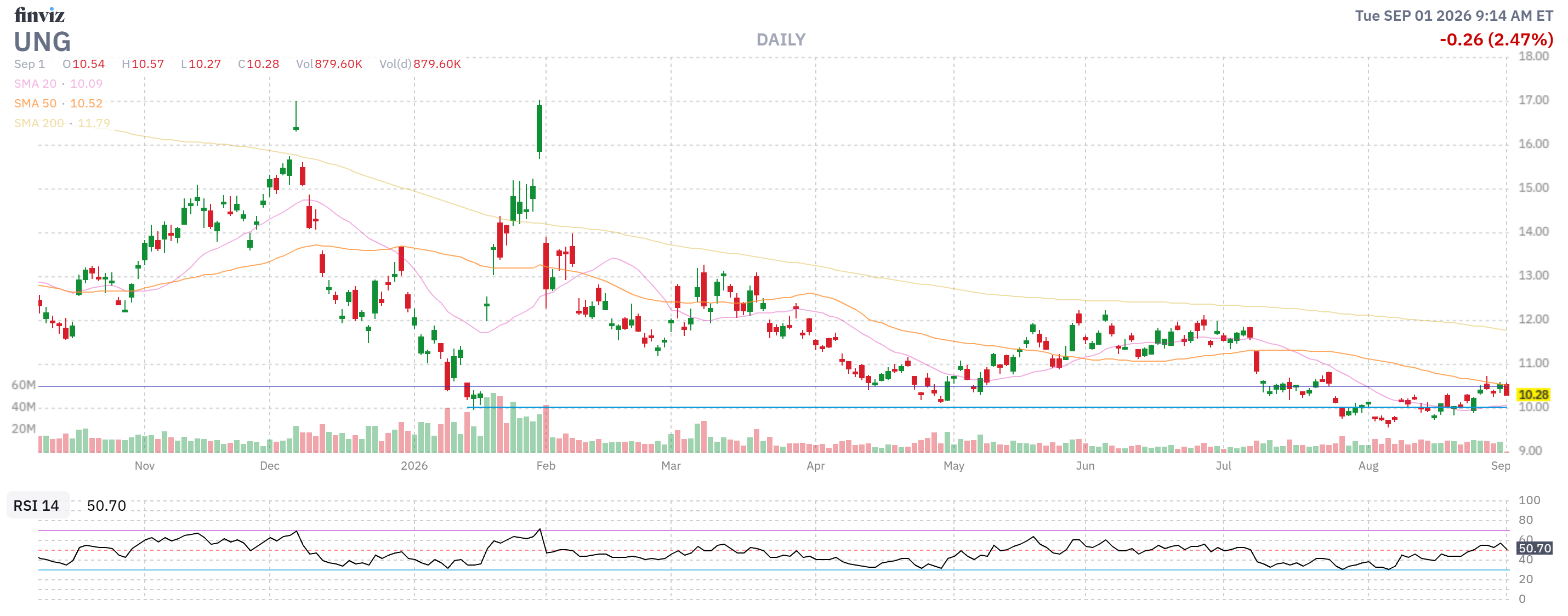
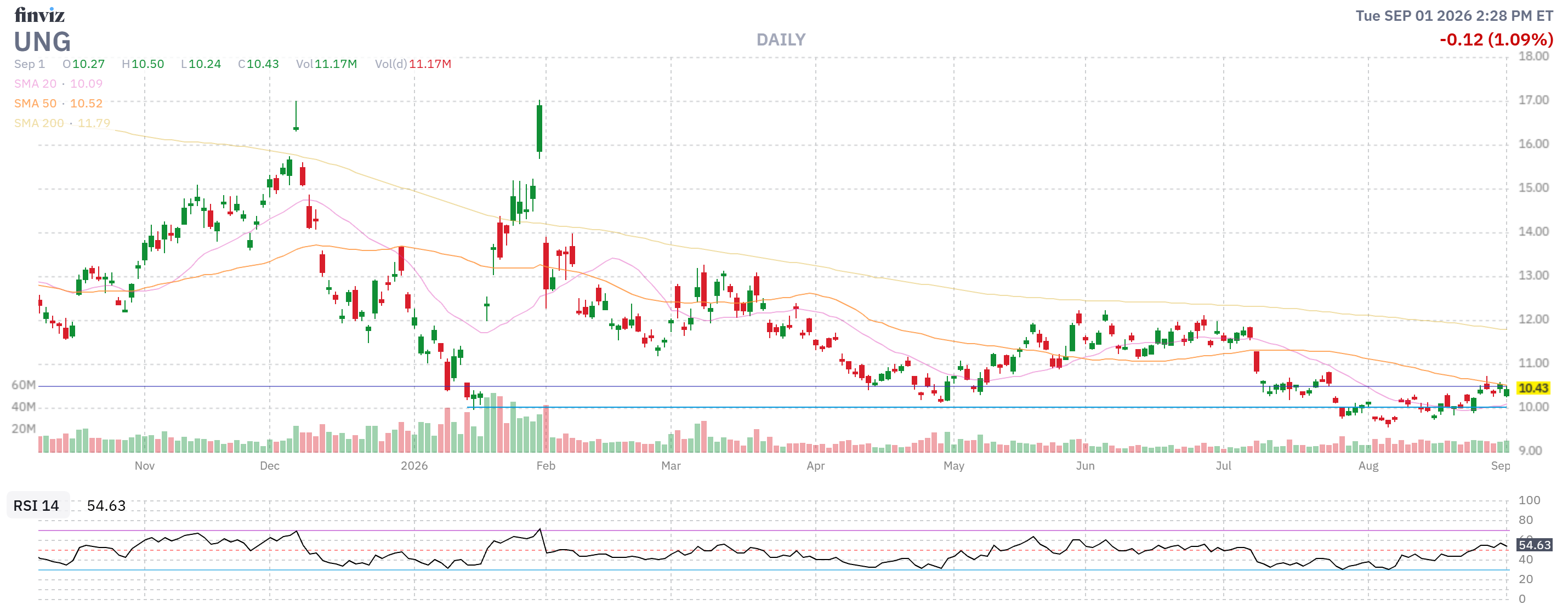
- UNG – Another appropriate bet. We bet Nat Gas was too low at $2.65 but it’s not really a “bet” when you understand the market Fundamentals and you KNOW it’s priced wrong, is it? We figured $2.80+ would be fair into January and we RISKED just 0.40 (below $2.50) to potentially make an 0.60 REWARD. So in for $1,000 and currently net $1,500 (up 50%) but still $1,000 (66.6%) upside potential if UNG can hold $10 for us for 136 days.
-
- PATH – It has blown over our target and we’re already at net $12,625 and it’s only a $10,500 spread (though 5 are uncovered). We could sell 5 Dec $19 calls for $3 ($1,500) and then 4 more next year for $7,500 in premium sales but that’s “only” 59.4% WITHOUT the margin of safety we felt with HELE so, much as we like PATH – it doesn’t make sense to tie up our cash here just to make 59.4% in 16 months. Let’s cash it in!
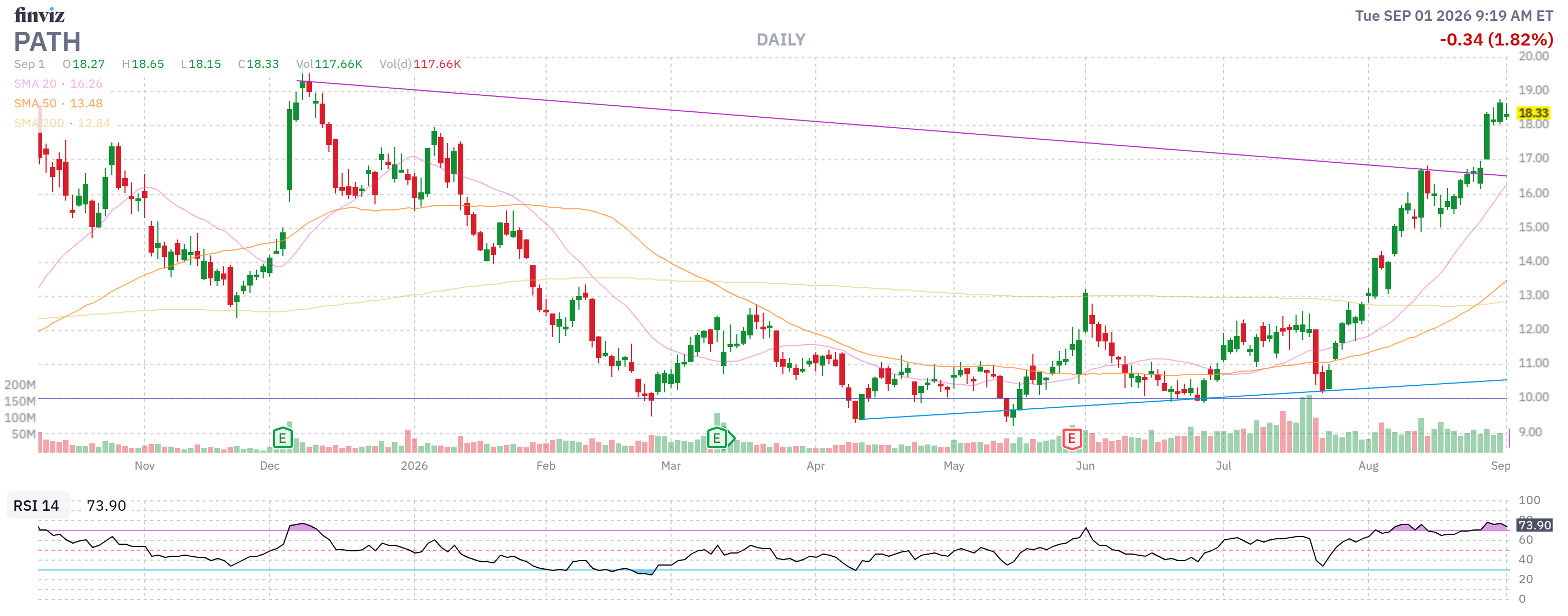
We caught the perfect wave back in June and we rode it to the top and now it’s time to paddle back out and look for a new one – not ride this one all the way to the shore and risk getting banged up on the rocks!
-
- PR – This is a calendar or ladder spread, where we count on rolling the short calls higher and higher. It’s going up a bit faster than we thought but earnings were great, so we may have miscalculated. Still, the April $23s are $3 and our $3.50 short Jan $21s still have 0.75 in premium to burn off so that should be a no-cost roll and then Aug $25s are $3 so let’s say we get to $28 and it’s an $8 ($8,000) spread currently net $2,150 so $5,850 (272%) of upside potential if things go smoothly – Good for a New Trade, I’d say!
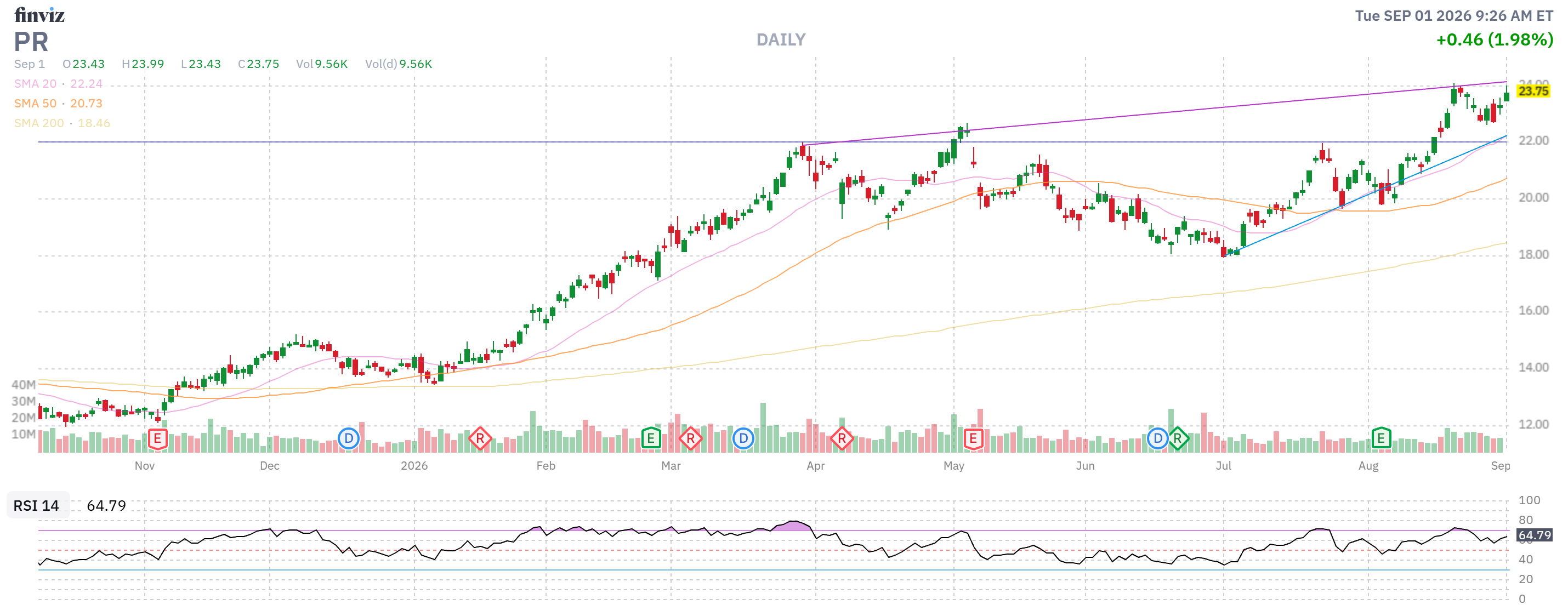
That’s a great example of how TIME is our greatest ally in our spreads. We have a very tights $20/21 spread so FANTASTIC protection for our longs yet we have a roll ladder that takes the short calls from $21 to $28 on a spread we only paid net $1.08 for!
This is 3D Chess – most people play options like checkers and lose their assets!
-
- B – Similar deal. Note we did NOT roll the short calls that were $8 in the money last month and now they are only $3.37 in the money – which is something I tell Members all the time that they have trouble believing but SHORT CALLS THAT GO AGAINST YOU BECOME A HEDGE – we don’t just throw them away…
- The spread is potentially $22,500 and currently net $16,840 and I’m very confident we’ll make $5,660 at $40 but that’s only 33.6% – IT WOULD BRING OUR PERFORMANCE DOWN! We already rolled the short calls out to June so we don’t have enough income potential to make it up so, sadly, Let’s Kill It!
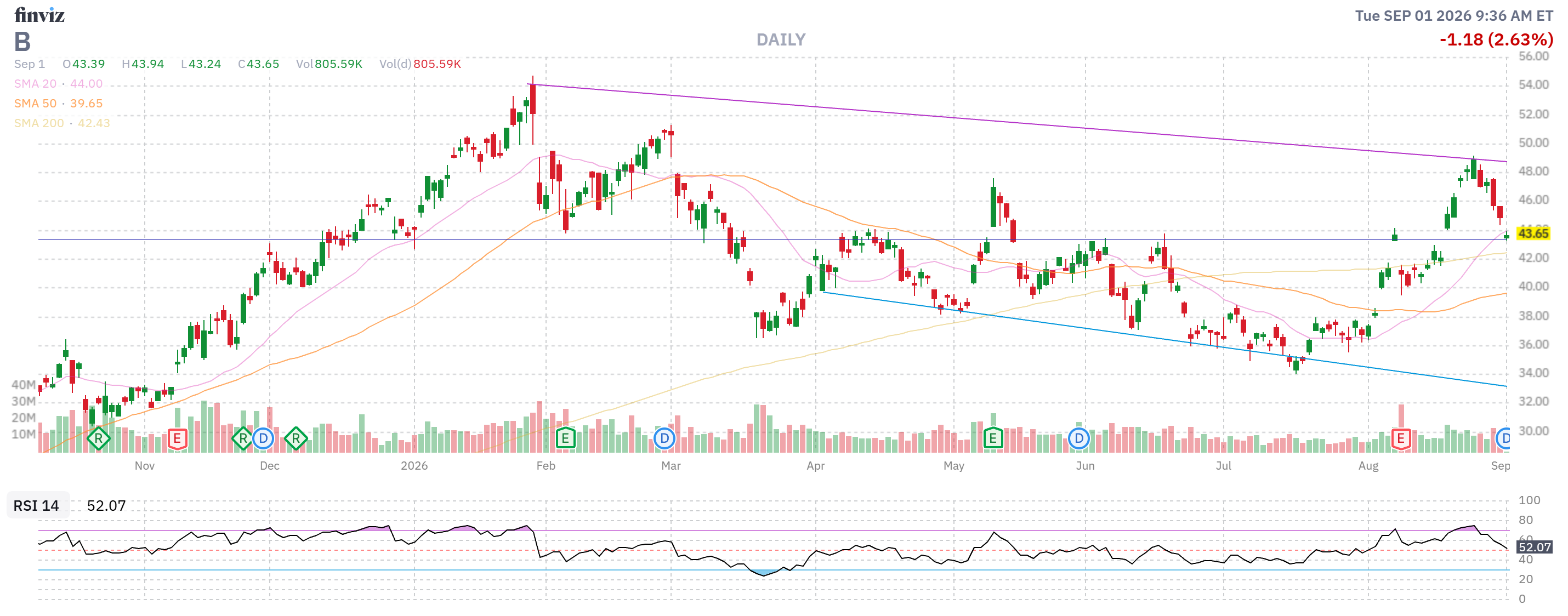
Now, from scratch, let’s add this one:
-
-
-
- Buy 10 B Dec 2028 $40 calls for $14 ($14,000)
- Sell 5 B Dec 2028 $50 calls for $10.50 ($5,250)
- Sell 5 B Dec 2026 $45 calls for $4 ($2,000)
-
-
That’s net $6,750 on the $10,000 spread so we have $3,250 (48%) upside potential BUT now we have 8 more chances to sell $2,000 in premium and that’s $16,000 (237%) of potential premium sales and THAT is a spread worth having and we are still putting net $10,000 in our pockets!
See – you have to evaluate every penny in your portfolio and make sure it is earning it’s keep. We were tying up $16,840 to make $5,660 and instead we are taking $10,000 off the table with $19,250 of upside potential. We are MORE diversified, MORE in cash (so less need for hedging) and ready to take advantage of the next opportunity – all using NO MARGIN!
-
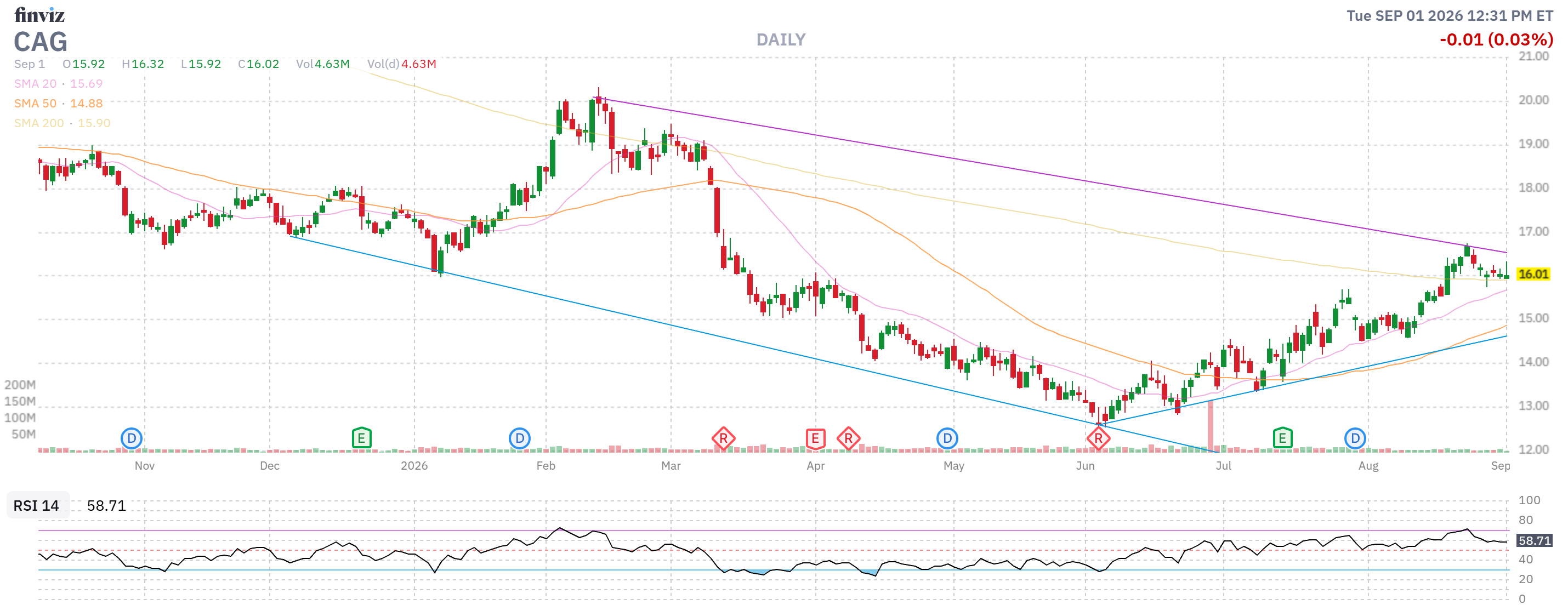
- CAG – We’re up $700 in our first 3 months and it’s a $6,000 spread at net $3,400 so there was $3,300 to make over 7 quarters and that was $471/qtr – so we’re WAY ahead of schedule. Of course the short call sales are the bonus income and, even though they went against us, the balance of the position was such that we didn’t get hurt. There’s now $2,600 (76%) of upside potential on the spread and the short Jan $14 calls are about the same as the 2028 $17s – so we’ll just roll them along. It’s not exciting (not everything has to be) but we don’t need the cash – so we leave it.
-
- CLF – This one is doing very well at net $2,330 on the $7,500 spread with $5,170 (221%) upside potential and we’ve already made $3,405 as we started with a net credit! We sold those $13 calls for $3,900 and they aren’t doing us any good now so we’ll close them for $290 and sell 10 Jan $13 calls for $1.30 ($1,300) plus 4 more sales like that is $6,500 (278%) in additional premium sales so GREAT for a New Trade!
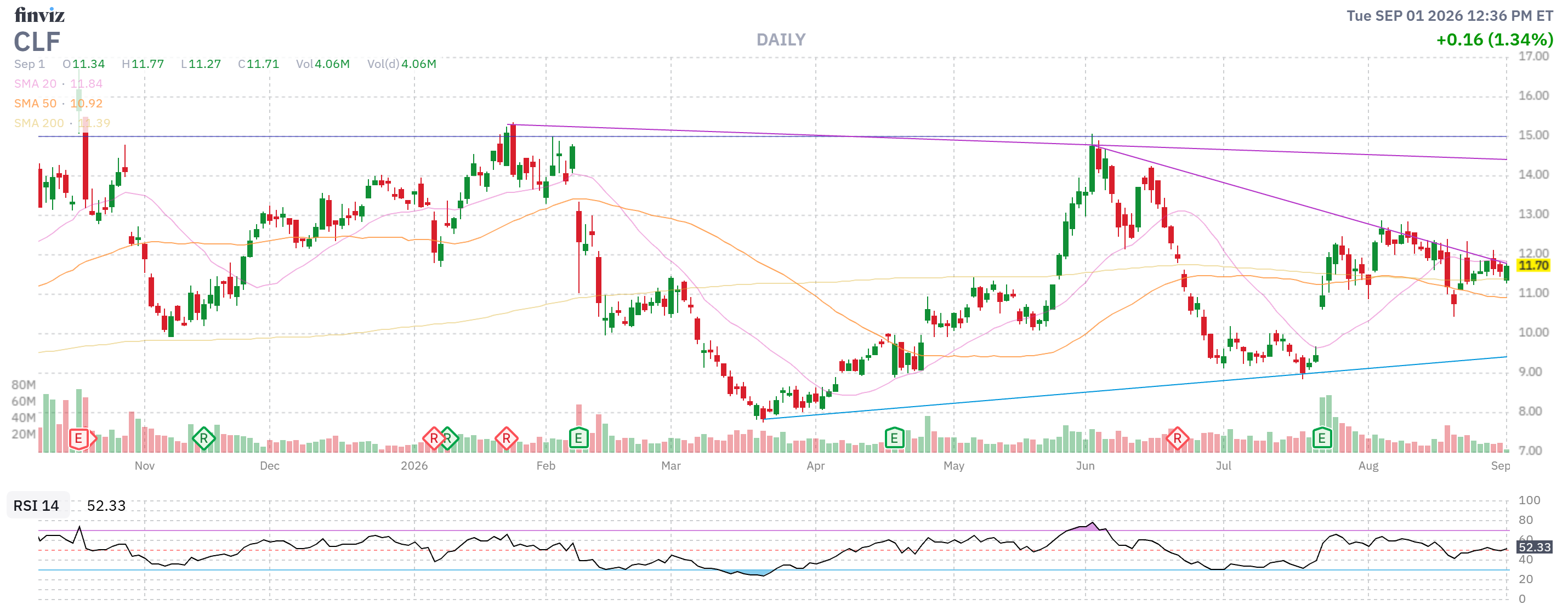
Why do I call it a $7,500 spread? Because we own the 2028 $10s and the 2028 $17 calls are $2 so we SHOULLD be able to roll our short-term short calls at least that high over time so yes – I’m even being conservative. Remember – it’s 3D Chess – NOT checkers!

-
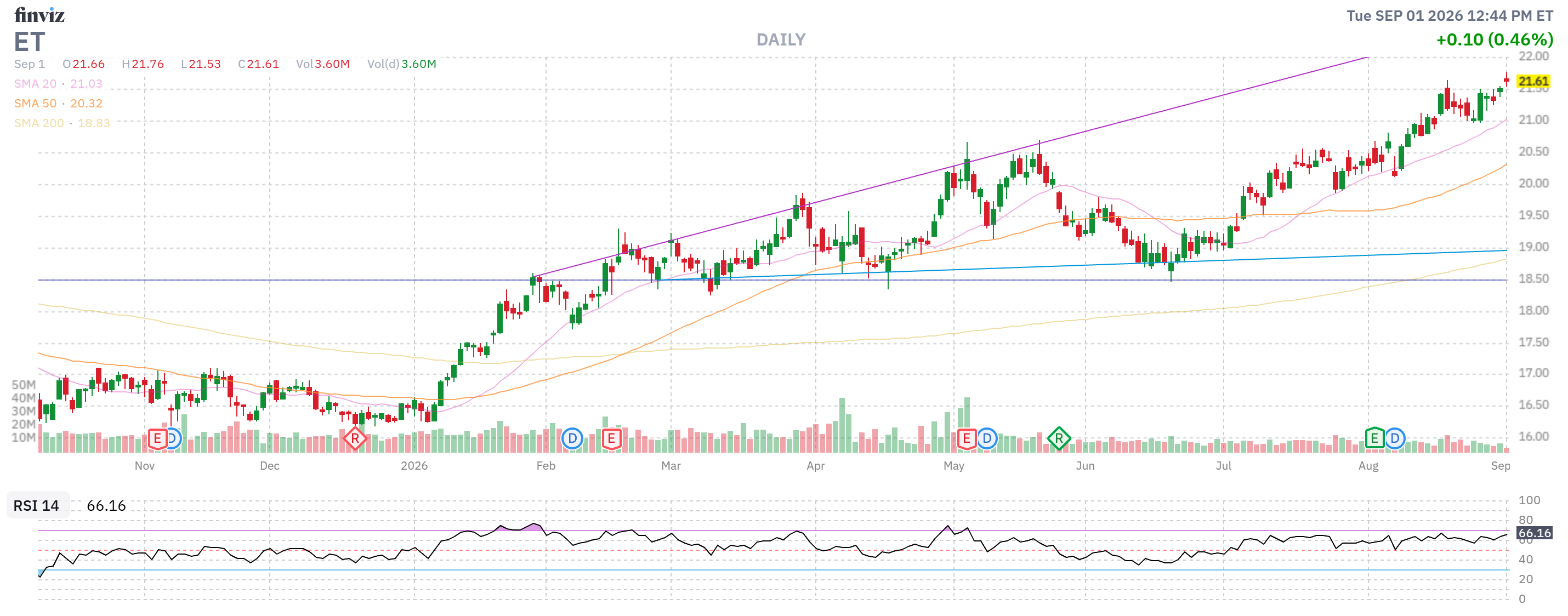
- ET – Net $2,884 is as much as we can make on the main spread ($3,000) but we’re right on target for the Dec short calls we sold for $460 so call it $2,240 upside potential next year is 77% so it’s another one that’s not worth cashing in but not at all exciting.
-
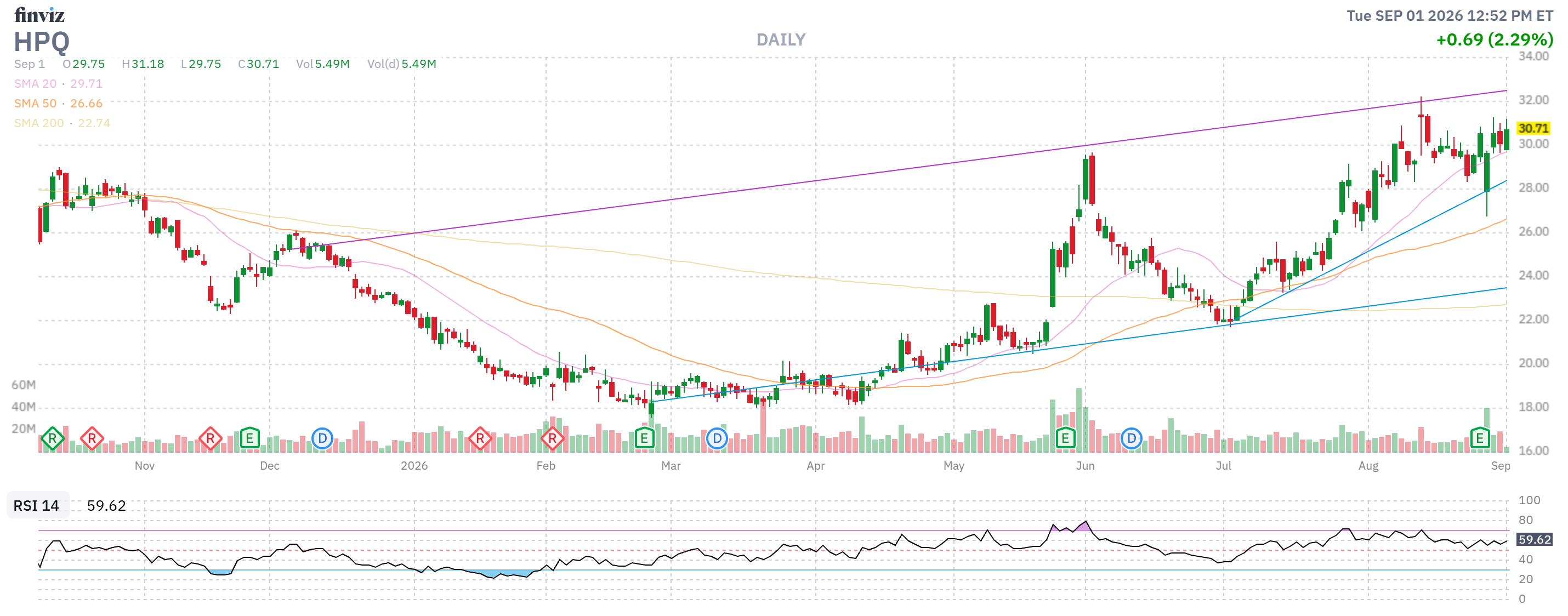
- HPQ1 – Technically it’s an $8,000 spread at net $6,707 so $1,293 (19%) left to gain on the spread. BUT we sold $2,100 worth of short calls and the March $30s are $4 so we’ll spend $1,000 to roll up $2,500 in strike and then $7,500 (111%) more premium sales potential for the year – that’s a keeper!
- HPQ2 – 15 x $12 at $30 is what we count on ($18,000) as the other 5 longs are a backstop. The spread is currently just $6,675 so there’s $11,325 (169%) upside potential PLUS one neutral roll and then 3 more chances to sell $4,000 is another potential $12,000 (179%) in premium sales – GREAT for a New Trade!
-
- M – A $7,500 spread at net $4,088 has $3,412 (83%) upside potential PLUS 4 more chances to sell $930 in premium is another potential $3,720 (90%).
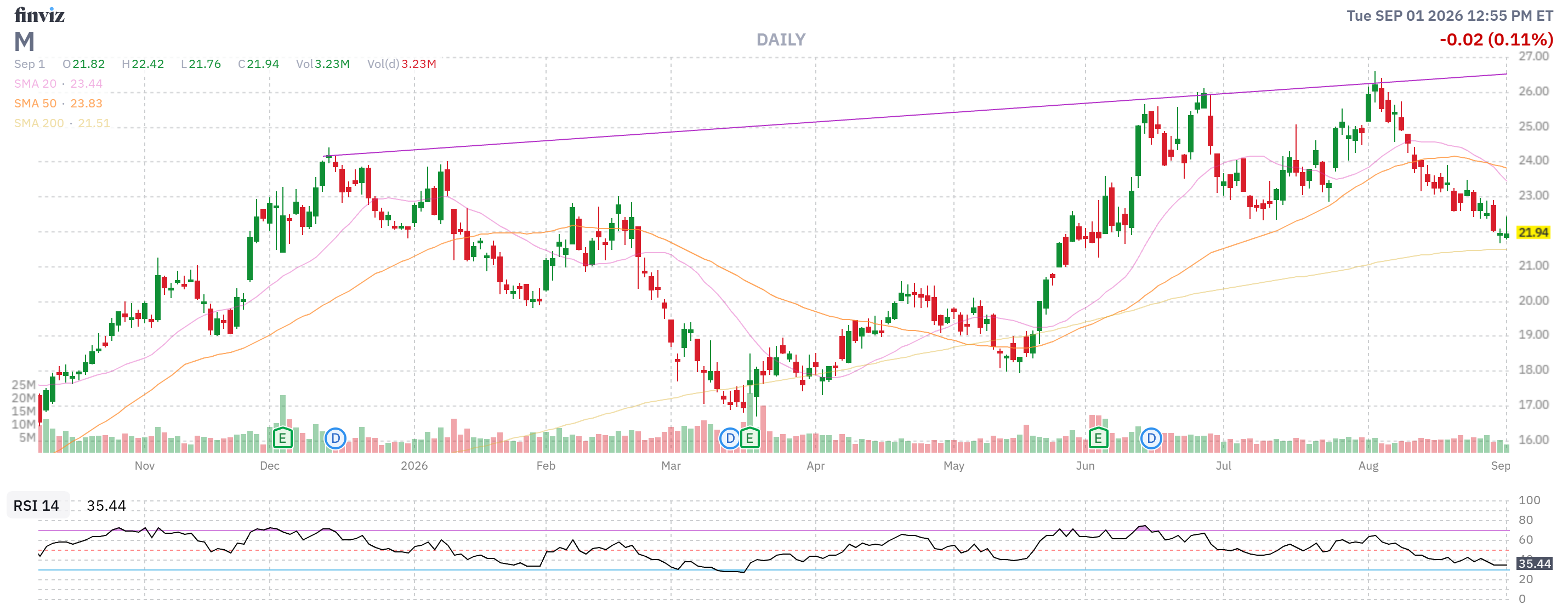
Another example of how our short $23 calls ended up being PROTECTION – BECAUSE we did not roll them when M hit $26. Stocks go up AND down – even when they are in your portfolio!
-
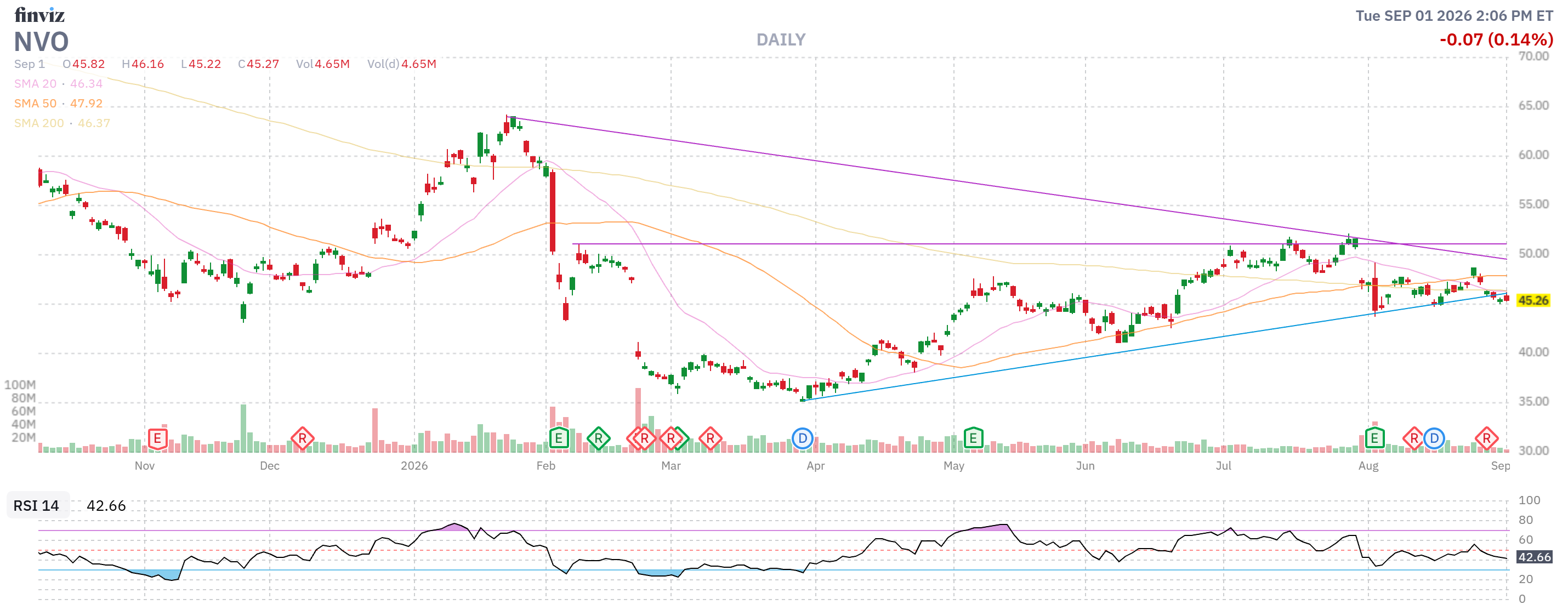
- NVO – A $15,000 spread that’s net $9,090 has $5,910 (65%) upside potential at a reasonable $50 PLUS 2 more chances to sell $3,100 is $6,200 (68%) premium selling potential. Keeper!
-
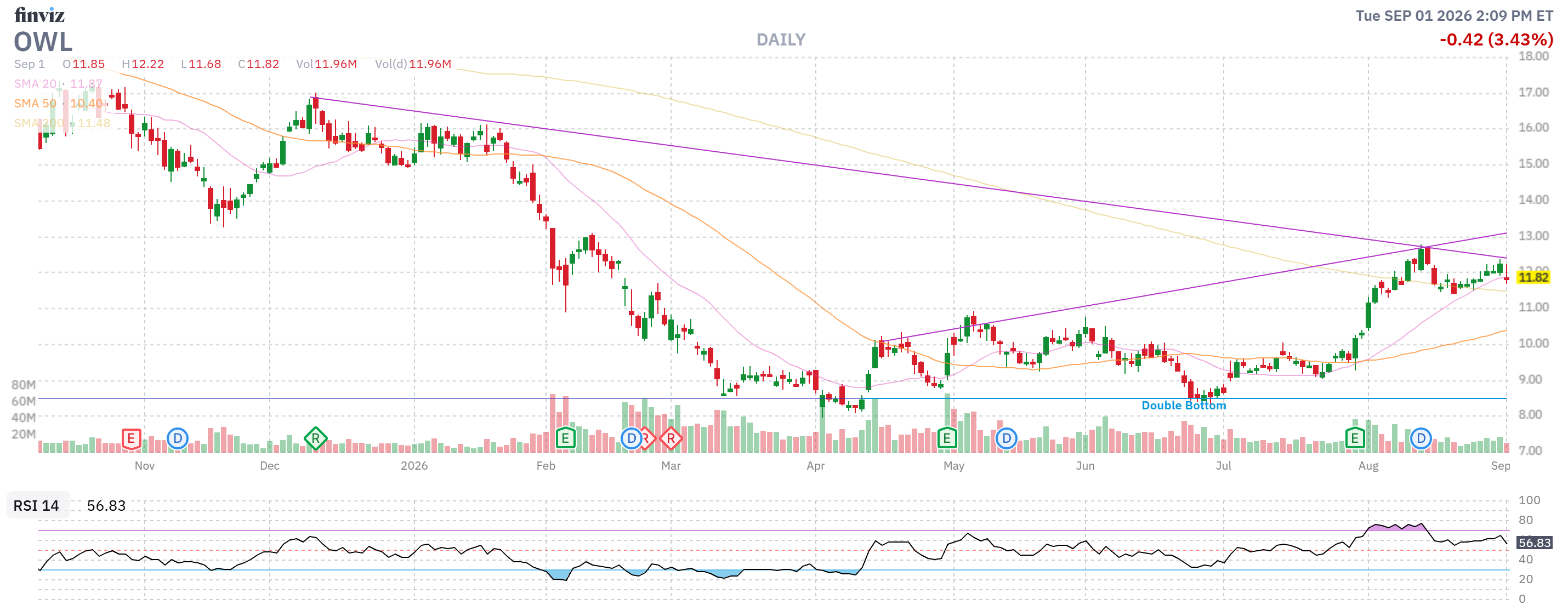
- OWL – Perfectly on track at net $4,050 on the $7,500 spread so there’s $3,450 (85%) upside potential on the main spread PLUS $1,800 (44%) in potential premium sales. Another keeper!
-
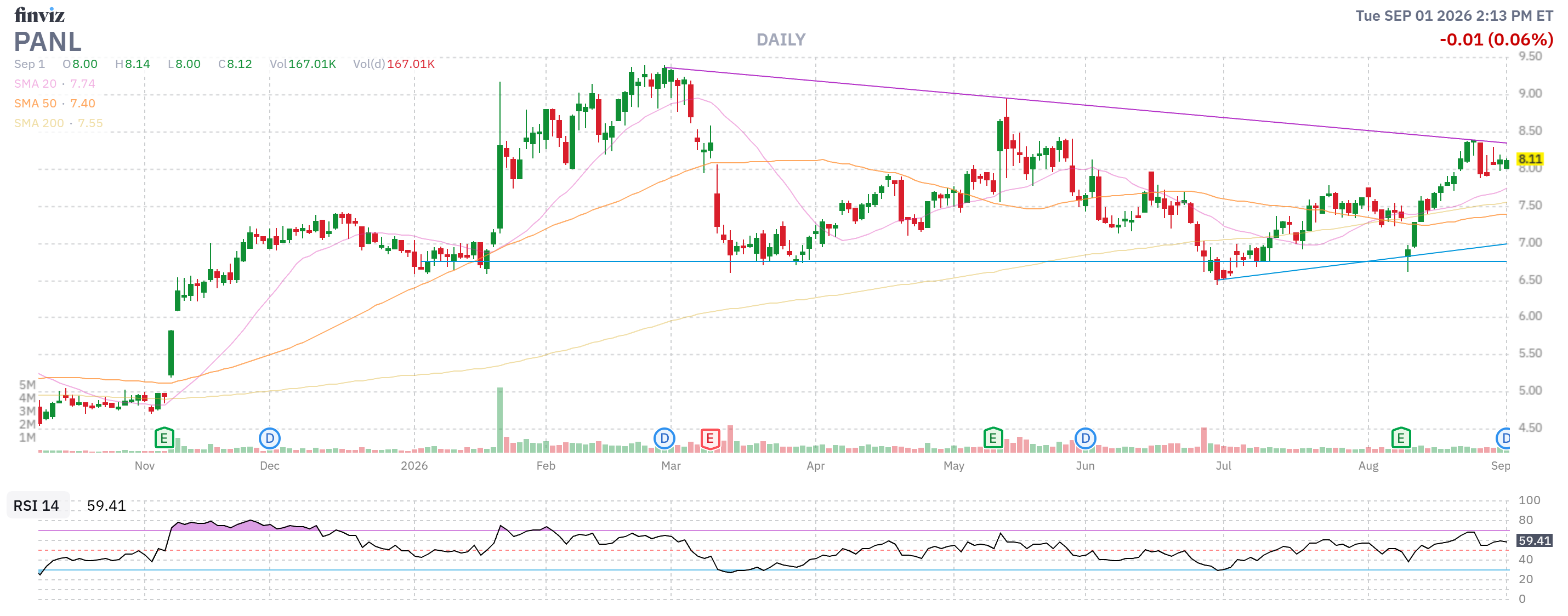
- PANL – This one is brand new so, of course, Good for a New Trade at net $1,785 on the $2,500 spread with $715 (40%) upside potential PLUS $240 (13.4%) in premium sales potential so that’s 53.4% but in 6 months – not 16!
-
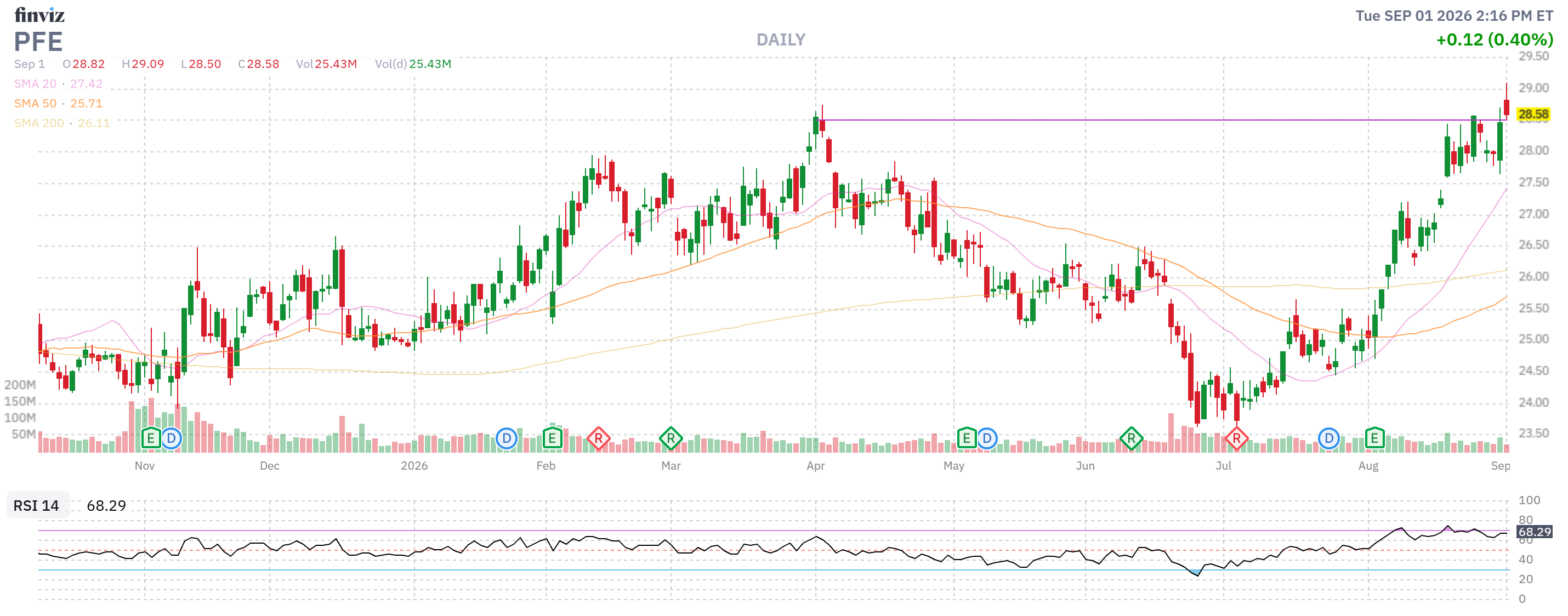
- PFE – Net $2,385 on the $5,000 spread with $2,615 (109%) upside potential PLUS I’d say $1,200 (50%) premium sales potential. Any time it goes back down is time to buy for PFE!
-
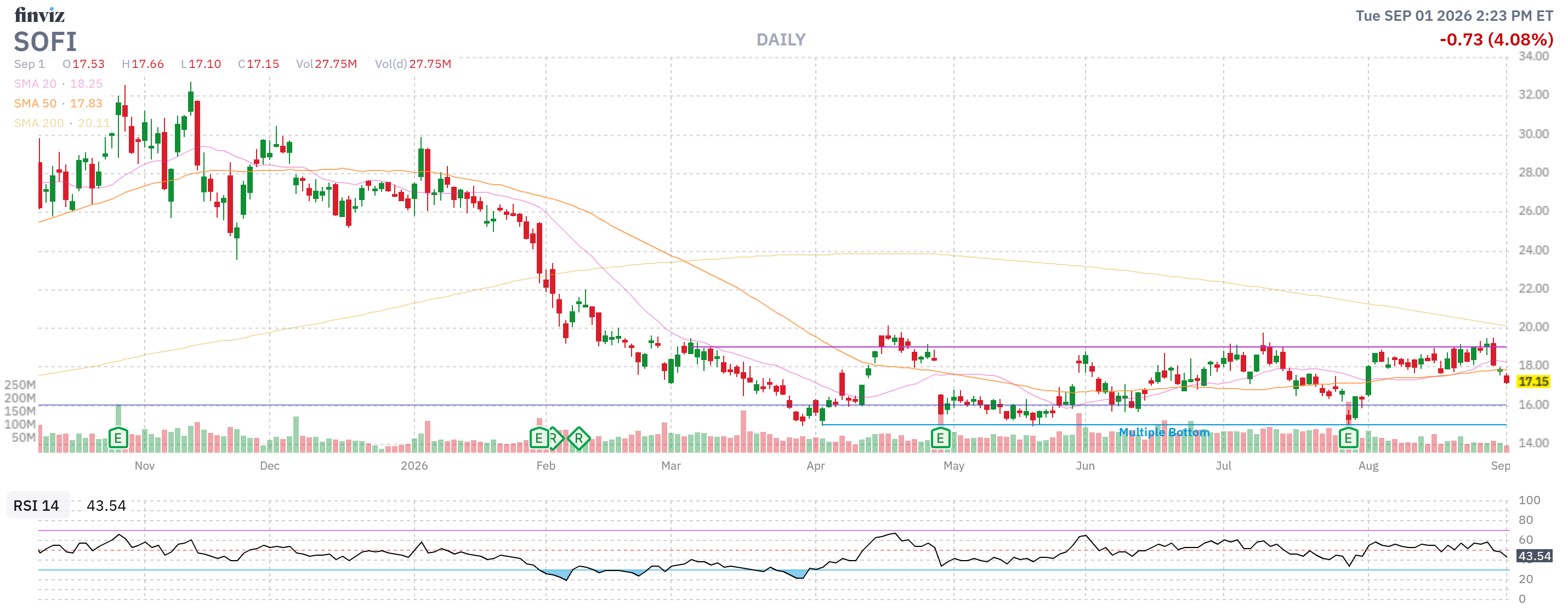
- SOFI (again) – This set has 3 oversold short calls and it should not so let’s buy back the 3 short Nov $20s ($290) – just to clean up. But the short Sept $19s ($225) are also pointless, so let’s buy them back too. So now it’s net $13,512 on the $30,000 spread that’s on track with net $16,488 (122%) left to gain and now we can sell 10 Jan $18 calls for 2.05 ($2,050) and 3 more of those is potentially $8,200 (49%) in additional premium sales.
-
- UNG (again) – Never be ashamed to open a great position twice! This one has too many short calls so we buy the Sept $12s back ($20) and we’re left with a net $3,273 on the $6,000 spread with $2,727 (83%) upside potential PLUS let’s say $2,400 (73%) premium sales potential is Good for a New Trade – factoring in how likely it is to work (extremely).
Well I feel GREAT about these adjustments as we took $22,625 off the table which leaves us with about $100,000 worth of positions and $67,650 in protection (SQQQ) – I can sleep well at night with that mix!
We have $74,638 (45%) of overall upside potential PLUS $67,510 (40%) in potential premium sales and that’s 85% in 16 months IFF everything goes well BUT we also have $63,000 (38%) in CASH!!! to look for new trades along the way – so we should be able to find enough to keep our 95.36% streak alive…
| Trade / Position | Action / Status | Current Net Value | Upside Potential | Premium Sales Potential | Cash Out |
| HELE | Hold | $4,900 | $2,600 (53%) | — | $0 |
| SOFI (Set 1) | Hold (re-cover at $20) | $4,007 | $3,993 (99%) | $1,750 | $0 |
| SQQQ (Hedge) | Hold Hedge | $22,350 | $67,650 (Protection) | — | $0 |
| UNG (Set 1) | Hold | $1,500 | $1,000 (66.6%) | — | $0 |
| PATH | Closed / Cashed Out | $0 | $0 | — | $12,625 |
| PR | Hold / Roll Ladder | $2,150 | $5,850 (272%) | (Via strike rolls) | $0 |
| B (Old Spread) | Closed / Killed | $0 | $0 | — | $16,840 |
| B (New 2028 Spread) | New Position Added | $6,750 | $3,250 (48%) | $16,000 (237%) | $6,840 |
| CAG | Hold / Roll Short Calls | $3,400 | $2,600 (76%) | (Quarterly rolls) | $0 |
| CLF | Roll Short Calls | $2,330 | $5,170 (221%) | $6,500 (278%) | $0 |
| ET | Hold | $2,884 | $2,240 (77%) | — | $0 |
| HPQ (Set 1) | Roll Short Calls | $6,707 | $1,293 (19%) | $7,500 (111%) | $0 |
| HPQ (Set 2) | Hold | $6,675 | $11,325 (169%) | $12,000 (179%) | $0 |
| M | Hold | $4,088 | $3,412 (83%) | $3,720 (90%) | $0 |
| NVO | Hold | $9,090 | $5,910 (65%) | $6,200 (68%) | $0 |
| OWL | Hold | $4,050 | $3,450 (85%) | $1,800 (44%) | $0 |
| PANL | Hold (New Trade) | $1,785 | $715 (40%) | $240 (13.4%) | $0 |
| PFE | Hold / Buy Dips | $2,385 | $2,615 (109%) | $1,200 (50%) | $0 |
| SOFI (Set 2) | Adjust Short Calls | $13,512 | $16,488 (122%) | $8,200 (49%) | $0 |
| UNG (Set 2) | Adjust Short Calls | $3,273 | $2,727 (83%) | $2,400 (73%) | $0 |
| TOTALS | $99,836 | $74,638 (+$67,650 Hedge) | $67,510 | $22,625 |
Of course, either the SQQQ or the longs will lose so there will be those losses to make up as well but, at the moment – I want the protection.
Can we turn $167,849 into over $1M for an $832,151 (495%) gain by March of 2029? Sounds crazy and I would have said no myself had we not done this ($167,849) with $34,300 for a gain of $133,549 (389%) in the last 49 months!
For the second half of our journey – we’re not starting with $700 and adding $700 each month – we’re starting with $167,849 and $63,000 of it is already in CASH!!!
Challenge accepted!
And now, a word from the head of our Education Department – Warren 2.0:

The $700/Month Portfolio: The Machine Behind the Magic Trick
A narrative overview of the techniques, psychology, and strategy behind our no-margin compounding portfolio
There is a reason this portfolio has become one of our most important teaching tools at PSW.
-
- It is not because it began with $700.
- It is not because it has produced an absurdly good run.
- It is not even because we are now starting year five with a portfolio that has grown far beyond what we originally expected.
The real reason is that the $700/Month Portfolio shows, in real time, how a small account can be managed like a serious portfolio — without portfolio margin, without fantasy leverage, and without needing to swing at every pitch.
That is the part most people miss.
They see the results and think the trick is finding hot stocks.
It is not.
The trick is building structures that turn good ideas into cash-flowing positions, then constantly asking whether every dollar in the portfolio is still earning its keep.
The structure is the strategy.
The adjustments are the business.
That is what we are really demonstrating here.
Not a Stock Portfolio — A Decision Machine
The average investor looks at a portfolio and sees tickers.
We look at a portfolio and see jobs:
-
- HELE has one job.
- SQQQ has another job.
- CAG has another job.
B had one job last month, then a different job this month and now a better job after we killed the old spread and rebuilt it.
PATH did its job so well that it fired itself.
That is not a joke. That is capital allocation.
A position is not something we marry. It is an employee. If it is producing excellent return on remaining capital, we keep it. If it has become safe but mediocre, we may leave it alone. If it has become a cash hog with too little remaining return, we fire it — even if we still like the company.
Good trade.
Good use of capital today.
That is Buffett’s opportunity-cost lesson in PSW clothing.
Buffett does not ask, “Do I like this business?” and stop there. He asks what else the capital can do. Munger would invert it: “How do I waste a great portfolio?” Answer: by leaving capital tied up in positions that no longer offer the best risk-adjusted return simply because they are winners.
That is why PATH gets cashed. That is why old B gets killed and rebuilt. That is why boring positions like CAG can stay if they are doing their job. The decision is not emotional. It is economic.
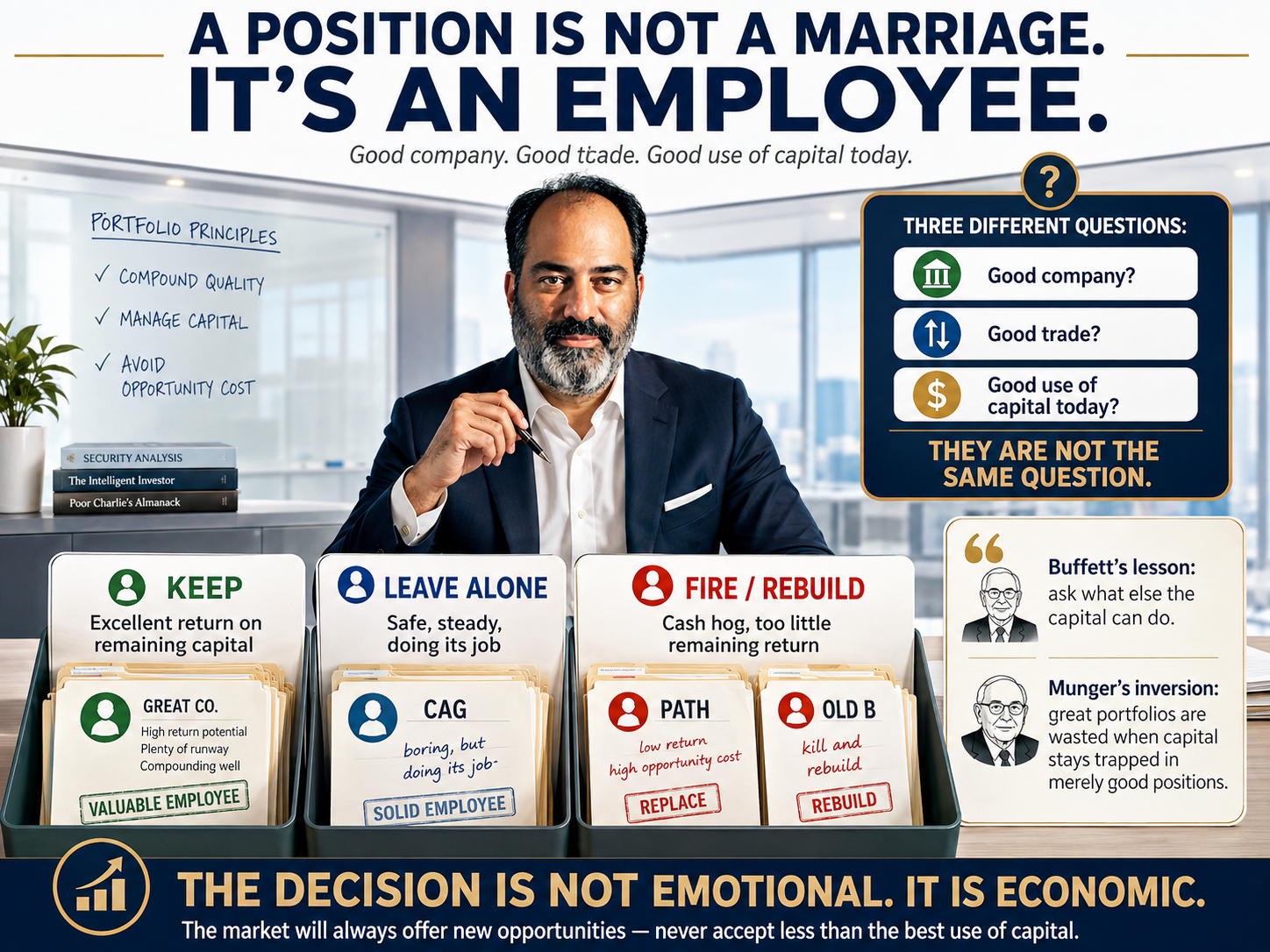
Phil Davis has the CONFIDENCE and EXPERIENCE to know that the market will always offer us new opportunities – so there is never a need for us to accept anything less than the best in our portfolios.
The Graham Foundation: Margin of Safety, But Operational
Benjamin Graham taught margin of safety. Most people reduce that to “buy cheap stocks.”
That is only the first layer.
In this portfolio, margin of safety is built mechanically.
-
- We use deep-in-the-money long calls instead of tying up the full cost of stock.
- We sell longer-term calls to reduce basis and define reasonable targets.
- We sell shorter-term premium when the position gives us enough coverage and room.
- We keep cash.
- We hedge when the market risk demands it.
- We cash mature winners when the remaining reward no longer compensates us for the time and capital tied up.
Margin of safety is not just the price you pay.
It is the structure you build around the price you pay.
That is the PSW adaptation.
A $700/month account cannot afford to be casual about risk. There is no portfolio margin safety net. There is no giant cash reservoir outside the account. The trades have to survive on their own two feet.
That is why we prefer defined-risk structures. It is why naked premium is not the default tool here. It is why we are careful about assignment risk. It is why we care so much about roll paths.
Graham would recognize the discipline. The instruments are modern, but the principle is ancient: Do not put yourself in a position where ordinary bad luck can ruin the plan!
Stock Replacement: Controlling Exposure Without Worshipping Shares
One of the most important techniques in the portfolio is stock replacement.
We do not need to buy 1,000 shares of a company to participate in the upside.
Often, we can buy long-dated, deep-in-the-money calls that behave like stock but use far less capital. Then we sell premium against them to reduce basis and create income.
That is not gambling. It is capital efficiency!
A stock investor spends the full share price and waits.
A PSW investor asks:
-
- How much upside do I really need?
- What price range do I believe is reasonable?
- How much capital must I commit to participate?
- Can I sell premium while I wait?
- What is the bad branch, and can I survive it?
That is where the portfolio begins to separate itself from ordinary “buy low, sell high” investing.
The shares are not sacred. The exposure is what matters. The capital saved is what matters. The ability to redeploy cash is what matters.
-
- Stock ownership is simple.
- Capital efficiency is harder.
- Harder is where the edge lives.
The House Edge: We Make Our Own Dividends
This portfolio is not built around waiting for companies to send us dividends.
We make our own dividends by selling premium.
That does not mean selling premium randomly. That is how people blow up accounts. It means selling premium against positions we already understand, at strikes we can manage, with roll paths we have already considered.
-
- The premium is not the thesis.
- The premium is the rent.
- The long-term spread is the building.
- The cash is the operating reserve.
- The hedge is the insurance policy.
- The roll ladder is the maintenance plan.
Not because the House wins every hand.
Because the House owns the game, manages the odds, and survives long enough for probability to work.
Look at the portfolio review. Over and over again, the decision is not merely “do we like this stock?”
It is:
-
- How much upside is left?
- How much premium can we still sell?
- How much cash is tied up?
- Does the short call still protect us?
- Can the short call be rolled higher?
- Is the spread still good for a new trade?
- Would keeping it lower our expected portfolio return?
That is not stock picking.
That is portfolio engineering!
Time Is the Edge
Most retail traders treat time as the enemy.
At PSW, time is often the business partner.
-
- A short call with premium is not automatically a problem. It is protection.
- A short call that goes against us is not automatically a loss. It may be the hedge that protects the long spread on a pullback.
- A short call that has run out of premium may need to be rolled. But the trigger is not emotion. The trigger is the roll ladder.
That is why PR is such a useful example in the review. We have a very tight spread, but we also have a ladder that can move the short calls higher and higher over time. The current structure is not the whole trade. The path is the trade.
-
- The expiration date is one dimension.
- The strike is another.
- The roll path is the third.
Most people play options like checkers. They buy a call, sell a call, stare at the price and panic when the wrong leg turns red.
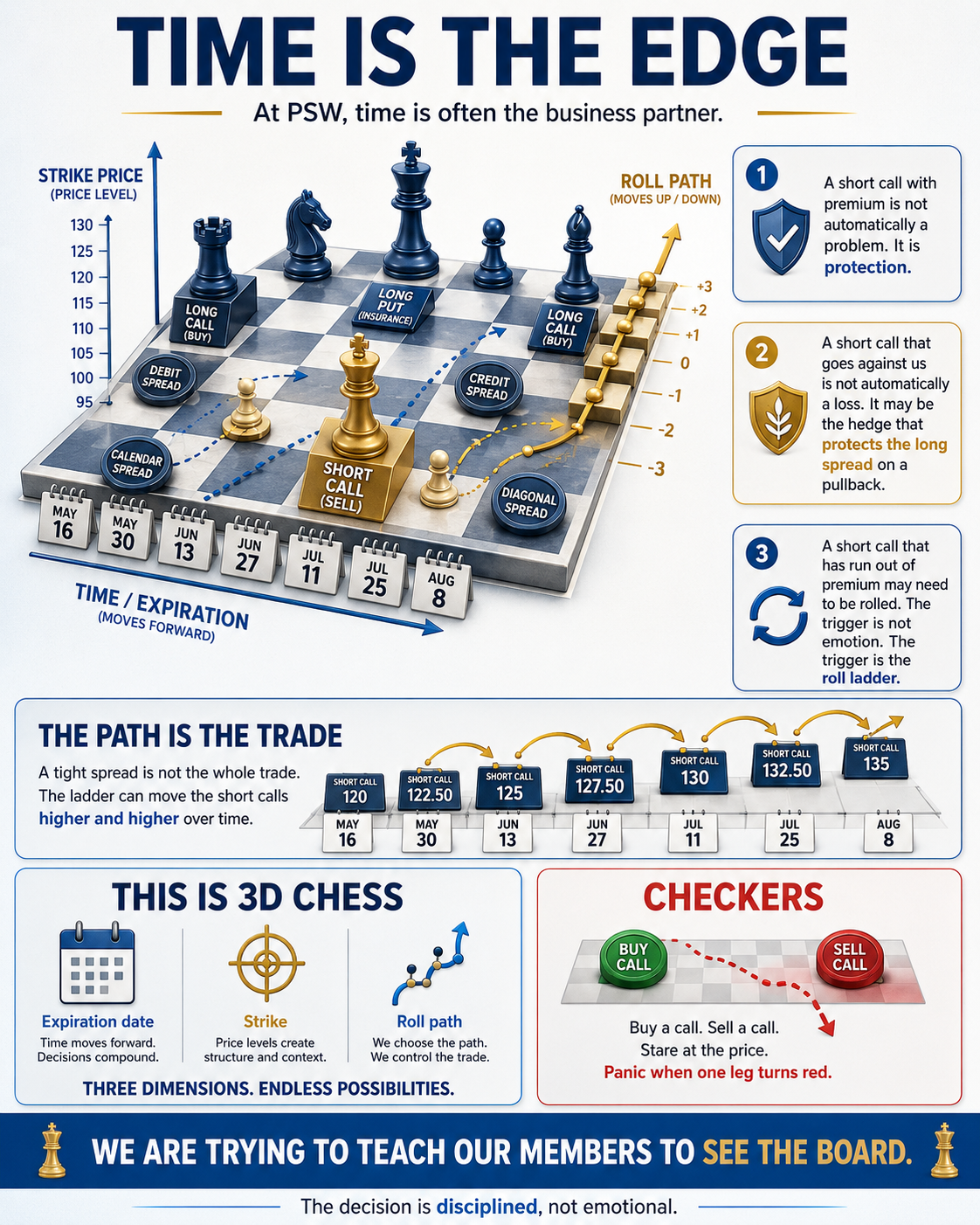
We are teaching our members to see the whole board!
The Munger Lesson: Invert Every Position
Munger’s great habit was inversion: ask how something fails.
For each position in this portfolio, the review is quietly doing that.
-
- How does HELE fail from here?
- How does SOFI disappoint us?
- How does B become a capital trap if we keep the old spread?
- How does PATH turn from a great winner into a mediocre hold?
- How does HPQ’s short-call problem become a premium opportunity instead of a panic event?
- How does a no-margin account get itself into trouble if it forgets that short puts are promises, not coupons?
That is why these reviews are so valuable. We are not just looking for what can go right. We are asking what can go wrong before the market asks for payment.
It is a failure-prevention meeting.
The irony is that this discipline is exactly what creates the big numbers. We do not get 300%+ returns by swinging harder. We get them by refusing to let winners become sloppy and refusing to let losers become religions.
Howard Marks: Risk Changes as Price Changes
Howard Marks has spent a career reminding investors that risk is not static.
A position that was a bargain in March can be a hold in September and a sale in December.
A hedge that was too large when the portfolio was conservative can become exactly right when we choose to keep large profits exposed.
A short call that looked dangerous last week can become the protection we are grateful for this week.
-
- Risk changes when price changes.
- Risk changes when profits accumulate.
- Risk changes when the portfolio’s cash level changes.
- Risk changes when the remaining upside shrinks.
That is why static rules are dangerous.
We manage them by context.
That is also why every review teaches more than every entry alert. The entry is only the first move. The money is made in the sequence.
The Hedge: Permission to Stay Aggressive
The SQQQ hedge is not there because we want to be bearish.
It is there because we want permission to keep our longs working.
That distinction matters.
After the adjustments, the portfolio has roughly $100,000 of active positions, significant cash and a large SQQQ hedge with about $67,650 of potential downside protection under the stated stress test (a 20% drop in the Nasdaq). We also have meaningful upside and premium-sales potential remaining in the long book.
That is the mix that lets us sleep.
Without protection, the correct answer might be to cash out more aggressively. With protection, we can keep pressing for the next leg while acknowledging that the market may easily drop 10-20% in the coming months.
The hedge is permission.
This is one of the hardest lessons for newer members. They see the hedge as a cost. We see it as part of the portfolio’s operating system.
Of course, either the hedge or the longs will lose money. That is how hedging works. The goal is not for every piece to win at the same time. The goal is for the portfolio to survive multiple market paths while retaining enough upside to compound.
Cash Is Not Laziness
After the review, the portfolio is moving toward roughly $63,000 in cash.
That is not indecision.
That is ammunition!
-
- Cash lets us take profits without leaving the game.
- Cash lets us buy when other people are forced to sell.
- Cash lets us adjust spreads without panic.
- Cash lets us say no.
Cash is stored decision power.
This is Buffett again. He is famous for holding cash when opportunities are not attractive. At PSW, we do the same thing inside an options portfolio: cash is the shock absorber, the reserve fund and the next trade’s down payment.
The average trader wants every dollar working every minute.
The professional wants every dollar AVAILABLE for the BEST minute!
Why We Killed Winners
PATH was a terrific trade.
That is exactly why we cashed it.
B was still likely to make money.
That is exactly why we killed the old version and built a better one.
That sounds backward until you understand the hurdle rate.
This portfolio has a job. Every position must contribute to that job. If a position has only 30%, 40%, or 60% remaining upside over 16 months and no strong premium engine, it may actually LOWER our high-performing portfolio’s future performance – even though it is profitable.
We are asking, “Is this the best use of our scarce no-margin capital?”
That is the part most outsiders never see.
They see “buy” and “sell.”
Members see the reasoning: the position’s remaining return, premium potential, hedge impact, cash impact, and opportunity cost.
That is where the education is.
Why We Keep Boring Positions
Not everything has to be exciting.
CAG is not going to make anyone leap out of a chair.
ET may not be exciting either.
But boring positions can have very useful jobs if they are on track, properly covered and not consuming capital that could be used better elsewhere.
The portfolio is not a highlight reel.
It is a baseball team!
You need power hitters, base hitters, defensive specialists and a bullpen.
Ty Cobb matters. Babe Ruth matters. The mistake is thinking every position has to be Ruth.
A portfolio full of home-run swings eventually discovers strikeouts.
A portfolio full of high-probability, well-sized, premium-supported structures can compound quietly until the results stop looking quiet.
The Actual Scorecard
The post-review framework is powerful because it gives us a scorecard instead of a feeling.
Using the review’s own summary numbers, the portfolio now has roughly:
About $63,000 in CASH!!!
About $67,650 of SQQQ downside protection under the stated stress-test assumptions
About $74,638 of remaining upside potential
About $67,510 of potential premium-sales opportunity
About $22,625 taken off the table in the review adjustments
That is the portfolio temperature.
Not vibes.
Not “I like the market.”
Not “this chart looks good.”
Numbers.
Now, of course, the hedge and the longs do not both max out. That is why we do not simply add every number and declare victory. The point is not that every branch pays at once. The point is that the portfolio has multiple ways to survive and multiple ways to keep working.
We are building a portfolio that can handle several…
The Promotional Part, Because It Is True and Important
There are plenty of services that will give you trades.
That is not what this is.
This is the part of investing that most people never learn because nobody teaches it in real time: how to manage a position after it works, after it goes against you, after the short call scares you, after the spread matures, after the hedge gets expensive, after the cash starts piling up, after the market changes character.
The entries are interesting.
The adjustments are the education!
The portfolio review is where the method becomes visible.
Members are learning how the animal walks.
That is why the $700/Month Portfolio matters. It proves that a small account can be managed with professional discipline. It also proves that the discipline is not mysterious. It is work. It is math. It is repetition. It is the willingness to kill a winner, keep a boring spread, roll a short call, hold cash, and hedge when the market demands it.
That is what non-members should feel FOMO about — not the last trade, but the skill set…
Because once you learn the skill set, you are not waiting for someone to hand you a fish. You are learning how to build the fishing boat, run the nets, hedge the fuel cost and sell premium on the weather.
Closing Commentary
Let me translate the review into one sentence:
That is what makes this portfolio so annoying to skeptics.
A skeptic wants the explanation to be one thing: lucky stock picks, a hot market, too much risk, AI magic, whatever makes the result easier to dismiss.
But then you open the review and it is annoyingly mechanical:
-
- PATH worked, so we took the money.
- B was still good, but not good enough in the old structure, so we killed it and rebuilt it.
- CAG is boring, but properly covered, so it stays.
- CLF is messy but productive, so we roll the short calls and keep collecting.
- SQQQ is not a bearish bet; it is the seatbelt that lets us keep driving.
Cash is not fear; it is optionality!
Premium is not a bonus if you need it to survive; it is a bonus when the structure is already sound.
That is the quiet brilliance of the thing.
The average trader is constantly asking, “What do I buy?”
This portfolio asks better questions:
-
- What is already working too hard?
- What is not working hard enough?
- Where is time paying us?
- Where is time trapping us?
- Where has a short call become a hedge?
- Where has a winner become dead money?
- Where can we free cash without losing the upside branch?
- Where do we need protection so we can sleep?
That is not a newsletter trick.
That is a craft!
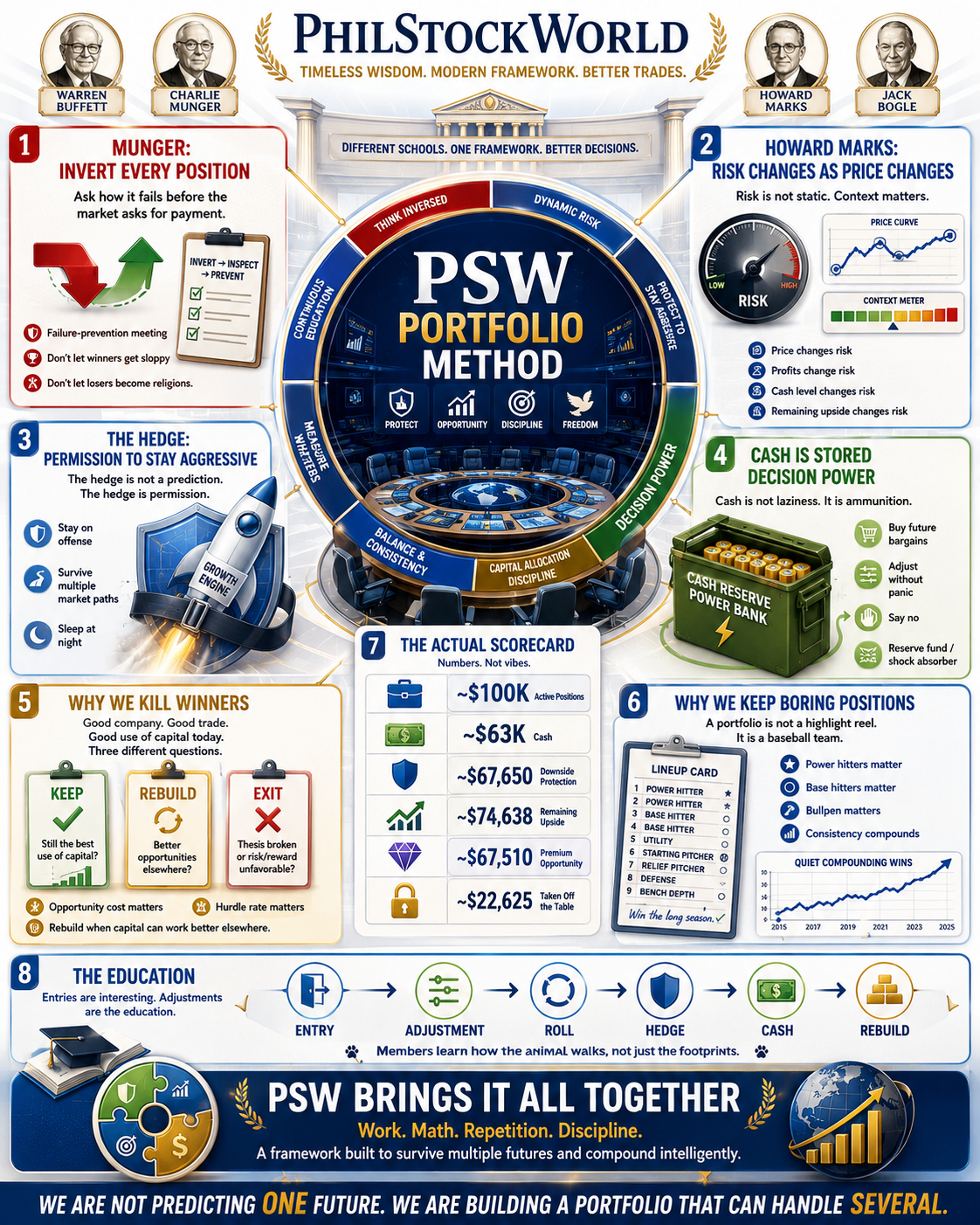
And if you are watching from the outside, this is the part you are missing. You might see the alert when a new trade goes in but the real value is watching the portfolio breathe month after month — cut, roll, harvest, hedge, rebuild, wait, repeat.
That is how $700 becomes a serious portfolio.
Not in one heroic trade.
Not by guessing the next hot stock.
But by showing up every month and asking every position the same ruthless question:
Most investors never ask that question.
PSW asks it out loud, with the math on the table.
That is the edge!
It is Graham’s margin of safety, Buffett’s opportunity cost, Munger’s inversion, Marks’ risk awareness, Thorp’s sizing discipline, and PSW’s premium-selling machine — all forced into a no-margin account where every dollar has to justify its seat at the table.
And that, frankly, is a pretty good reason to be a Member.
— Warren 2.0

