


Why would you pay full price for a stock when you can control the same upside for a 75% discount? Most retail traders treat the market like a casino, but the real pros know that long term leaps options strategies are the closest thing to owning the casino itself. It’s about shifting from a tenant mindset to a landlord mindset. You want the participation of a heavy-hitter without the soul-crushing capital requirements that keep your portfolio stagnant.
I know the frustration of watching Theta decay turn a winning thesis into a losing trade, or feeling paralyzed by which strike price actually makes sense for a two-year hold. It’s a common hurdle, especially with the federal funds rate sitting at 3.63% and the recent shift toward risk-based margin rules. This guide is your blueprint to mastering LEAPS with professional-grade precision. We’ll dive into selecting the right Delta to mimic stock ownership, using diagonal spreads to generate consistent income, and building a structural hedge that keeps you calm when the rest of the market panics.
Key Takeaways
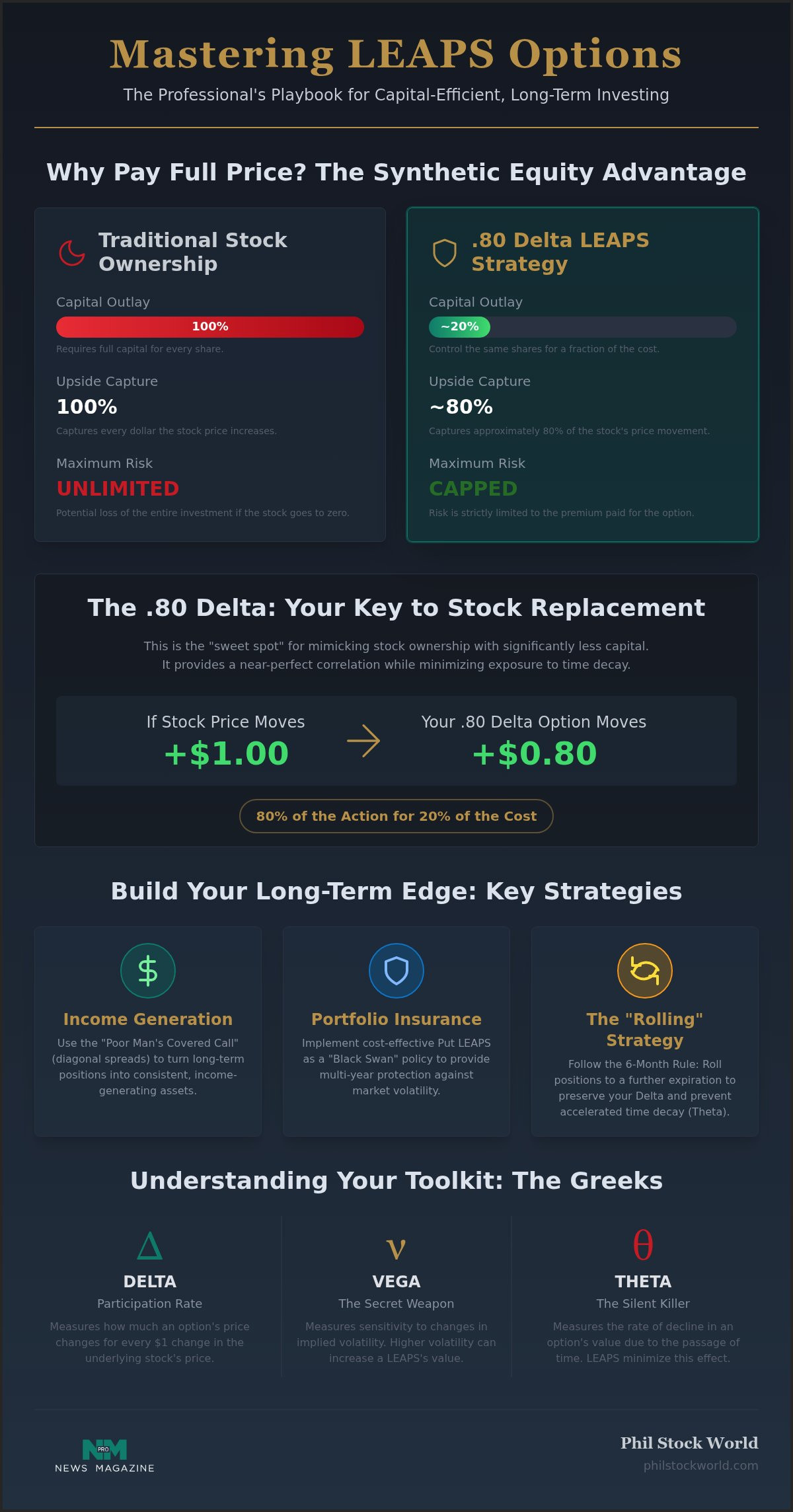
- Learn why the .80 Delta is the sweet spot for stock replacement, allowing you to capture the majority of price action for about 20% of the usual capital.
- Transform your long-term positions into income-generating assets by mastering the mechanics of the Poor Man’s Covered Call and diagonal spreads.
- Implement long term leaps options strategies to gain a structural edge, allowing you to profit from time decay instead of being its victim.
- Build a “Black Swan” insurance policy for your 2026 portfolio using cost-effective Put LEAPS that offer multi-year protection against market volatility.
- Leverage real-time market sentiment and Virtual Portfolio Reviews to ensure your strike prices and expirations are always optimized for the current macro environment.
Why LEAPS are the Smart Trader’s Alternative to Owning Stock
Owning a thousand shares of a high-flyer sounds great until you look at the capital outlay. For many, that’s a dream deferred. But long term leaps options strategies flip the script. By looking at the 12 to 39 month window, you aren’t just gambling on next week’s earnings call. You’re making a calculated, institutional-grade move. What are LEAPS options? Simply put, they are Long-Term Equity AnticiPation Securities that let you participate in a stock’s upside for a fraction of the price. While the average retail trader is sweating over five-day charts, you’re playing the long game. You’re using time as a buffer, not a ticking time bomb. By mastering long term leaps options strategies, you shift the odds in your favor.
The Synthetic Equity Advantage
Think of high-Delta LEAPS as synthetic equity. If you buy a call with a .80 Delta, your option gains roughly $0.80 for every $1.00 the stock moves. You get 80% of the action for often less than 20% of the cost. It’s the ultimate rent-to-own model. LEAPS act as a capital-efficient surrogate for stock ownership, allowing traders to control price action without the heavy burden of full equity costs. This leverage means you can spread your capital across five different positions rather than being tethered to just one. In a high-growth environment, this 5x exposure can turn a standard portfolio into a powerhouse.
Risk Mitigation vs. Outright Ownership
Stock owners face unlimited downside until the price hits zero. With LEAPS, your risk is strictly capped at the premium you paid. That’s it. In a 2026 market where the federal funds rate is 3.63% and volatility is the only constant, knowing your max loss provides a massive psychological edge. You stop being a reactive stock picker and start acting like a strategic positioner. You aren’t just hoping for the best; you’ve structurally guaranteed that a single “Black Swan” event won’t wipe out your entire net worth. This peace of mind allows you to stay in the trade when others are shaken out by temporary noise.
The Math of Selection: Choosing the Right Delta and Expiration
Avoid the extrinsic value trap. Extrinsic value is “fat” premium; it’s the price of time and volatility. If your LEAPS position is 50% extrinsic value, you’re starting the race with a massive handicap. You want your position to be mostly intrinsic value. This ensures that when the stock moves, your profit isn’t eaten alive by the slow burn of Theta. Time decay in LEAPS is remarkably slow until you hit the final six to nine months. While the 3.63% federal funds rate affects your cost of carry, the structural advantage of long-dated options usually outweighs the interest expense for savvy positioners.
Navigating the Greeks for Long-Term Success
Delta is your participation rate, but Vega is your secret weapon. Since LEAPS have so much time left, they are highly sensitive to changes in implied volatility. If you buy when the “fear index” is low and volatility spikes, your LEAPS can gain value even if the stock price stays flat. It’s like buying insurance when the sun is shining. Theta remains the silent killer. While it moves slowly in a two-year contract, it accelerates as you approach the one-year mark. You don’t want to be holding the bag when that curve turns vertical.
The “Rolling” Strategy for 2026
Success with long term leaps options strategies requires active management. Don’t just set it and forget it. We follow the 6-month rule: if your LEAPS has six months left until expiration, it’s time to roll it out to a further date. This preserves your Delta and prevents Theta from devouring your gains. Choosing between At-the-Money for max leverage and Deep-in-the-Money for safety depends on your personal risk tolerance. You can use virtual portfolio reviews to audit your strike selections and ensure you aren’t over-leveraged in a shifting market. To see how we apply these math-heavy decisions in a live market, check out the analysis at Phil Stock World.
The Poor Man’s Covered Call: Generating Income with LEAPS
Owning a LEAPS contract is like owning a piece of prime real estate. If you just let it sit there, you’re only hoping for property values to rise. Why not collect some rent instead? The Poor Man’s Covered Call (PMCC) is a diagonal spread that lets you do exactly that. By buying a long-term, deep-in-the-money call and selling short-term, out-of-the-money calls against it, you transform a directional bet into a recurring revenue stream. This is one of the most effective long term leaps options strategies for traders who want to lower their cost basis while waiting for a major move.
When the underlying stock stays flat or moves up slowly, you pocket the premium from the short calls. If the stock craters, that collected premium acts as a buffer, softening the blow to your long position. The real danger is the stock “mooning” and blowing past your short strike. If that happens, you might be forced to close the entire spread or roll the short call for a debit. To avoid being “called away,” always set your short strike at a level where the total spread value remains profitable if exercised. It’s about being a landlord, not a gambler.
Building Your Monthly Income Stream
The goal is simple: erode the cost basis of your LEAPS until the position is essentially a “free trade.” By selling monthly calls with a 30 to 45 day expiration, you can often recoup the entire extrinsic value of your long contract within a year. You aren’t looking for home runs with these short sells. You want base hits that consistently decay. For those looking to scale this into a broader portfolio approach, mastering advanced option trading strategies will help you navigate the nuances of spread management in a volatile 2026 market.
Managing the Spread Margin
Brokers treat PMCCs differently than standard covered calls because you don’t own the underlying shares. While the elimination of the “pattern day trader” designation under FINRA Rule 4210 simplifies intraday moves, you still need to watch your gap risk. Ensure your long strike is deep enough—usually a .80 Delta or higher—to cover the obligations of the short strike. The PMCC allows retail traders to act as “the house” by collecting rent. It provides a structural edge that traditional stock ownership simply cannot match, especially when margin interest rates at major brokerages hover around 10.00%. Using long term leaps options strategies properly means your capital works harder, smarter, and more efficiently.
Strategic Hedging: Using Put LEAPS to Insure Your Portfolio
Most traders wait for the storm to hit before they go looking for an umbrella. In a 2026 market defined by a 3.63% federal funds rate and shifting margin rules, that’s a recipe for a blown account. Long term leaps options strategies aren’t just for aggressive growth; they are your primary defense against “Black Swan” events. While monthly puts are a constant drain on your cash, a two-year Put LEAP offers a far more cost-effective way to sleep at night. You pay a higher premium upfront, but the daily time decay is significantly lower than the rapid erosion you see in short-term contracts.
Success in hedging requires understanding beta-weighting. You don’t just buy a random number of puts. You need to calculate how many contracts are required to offset the specific volatility of your holdings. If you’re heavy on high-beta tech, a single broad-market put won’t cut it. You also have to know when to take the win. If the market craters and your hedge is up 300%, don’t let it ride into the sunset. Take your profits and use them to buy the dip while the insurance is still valuable. Don’t let your protection expire worthless during a recovery just because you were too stubborn to hit the sell button.
Index LEAPS vs. Individual Puts
Choosing between hedging the SPY or QQQ and buying individual puts on high-flyers is a matter of precision. Index LEAPS protect you against a general market correction, but they might not save you if a specific sector gets hammered. Street-smart traders buy this insurance when the “fear index” is low and premiums are cheap. If you can calculate your break-even on a 20% market correction, you can trade with a level of confidence that “buy and hold” investors will never understand. It’s about pricing out the risk before the volatility spike makes the cost of insurance prohibitive.
The Collar Strategy for Long-Term Holds
If you want to protect your gains without spending a dime of new capital, the collar is your best friend. You combine a Put LEAP with a short-term covered call. The premium you collect from selling the call pays for the insurance of the put. It’s essentially a zero-cost hedge. You might cap your upside, but you’ve guaranteed your floor. This is how you stay in the game during volatile cycles without selling your core positions. To see these defensive moves executed with professional-grade precision, join our community at Phil Stock World for real-time trade alerts and expert analysis.
Executing LEAPS Strategies with Phil Stock World’s 2026 Insights
Charts tell you where the price has been, but they rarely tell you where the world is going. In a market where the federal funds rate is holding at 3.63% and global policy shifts overnight, static analysis is a relic of the past. To truly master long term leaps options strategies, you need to look beyond the candles. You need real-time sentiment and a deep understanding of the macro forces driving the tape. At Phil Stock World, we don’t just pick strikes; we analyze the economic engine. We prioritize the “Macro” before we ever touch the “Micro,” ensuring your long-term positions aren’t swimming against a tidal wave of bad policy or shifting fundamentals.
Trading with leverage is as much a psychological game as it is a mathematical one. Holding a position for two years requires a level of discipline that most retail traders simply haven’t developed. Our live trading rooms serve as a high-level discussion among peers, providing the calm confidence you need when volatility spikes. It’s about having a savvy, street-smart mentor in your ear when the headlines turn sour. You aren’t just buying a subscription; you’re joining a community of independent investors who value wit, transparency, and the kind of institutional knowledge that usually stays behind closed doors.
Real-Time Alerts and Strategy Adjustments
The “set and forget” mentality is a dangerous myth. Even the best long term leaps options strategies require active management to stay optimized. Whether it’s rolling a position to avoid the Theta acceleration curve or adjusting a diagonal spread after a surprise earnings beat, timing is everything. Our members get real-time trade alerts that cut through the noise. You can jump into live interactive sessions to discuss your specific LEAPS positions or leverage our sector-specific research to find the next high-conviction candidate. We provide the tools to help you stay ahead of the herd, not follow it.
Your Next Steps to Market Mastery
Mastering the market isn’t a destination; it’s a process of constant refinement. You can start by signing up for our daily market commentary to get Phil Davis’s raw, unfiltered take on the global economy. If you’re already holding positions and feeling unsure about your strikes, it’s time to audit your current strategy with a Virtual Portfolio Review. This isn’t about generic advice; it’s about precision auditing for the 2026 market environment. When you’re ready to stop being a tenant and start being the landlord of your portfolio, Join Phil Stock World today and start trading like “The House.”
Step Into the House: Your 2026 Trading Edge
The 2026 market doesn’t reward passive observers; it rewards those who understand structural leverage. By moving away from high-capital stock ownership and embracing long term leaps options strategies, you’ve unlocked a way to control the board with a fraction of the risk. We’ve explored why the .80 Delta is your magic number for stock replacement and how the Poor Man’s Covered Call lets you collect rent on your positions like a seasoned landlord. You’ve also seen how Put LEAPS act as the ultimate insurance policy when volatility is low.
Now it’s time to put these insights into action. You don’t have to navigate these complex spreads alone. With daily real-time trade alerts, exclusive access to Phil Davis’ market commentary, and interactive live trading rooms, you can refine your approach alongside a community of savvy peers. Stop playing the tenant’s game and start building a portfolio that works for you. Master LEAPS and more with a Phil Stock World Premium Membership. Your path to professional-grade precision starts with the right guidance. Let’s get to work.
Common Questions About LEAPS Options
What is the best Delta for a LEAPS call option if I want to replace stock?
Aim for a .80 Delta if your primary goal is synthetic equity. This specific strike price ensures that for every dollar the stock climbs, your position gains roughly eighty cents. It provides a high correlation to the underlying asset while keeping the extrinsic value relatively low. Choosing a lower Delta increases your leverage but also increases the risk that the stock won’t move enough to overcome time decay.
Do LEAPS options pay dividends like the underlying stock does?
LEAPS do not directly receive dividend payments because you don’t own the underlying shares. However, the market isn’t blind to these payouts. Expected dividends are factored into the option’s premium at the time you buy it. Call options are generally cheaper when a stock has a high dividend yield, while puts are more expensive. If you want actual cash in hand, you’ll need to sell short-term calls against your position.
How much capital do I really save by using LEAPS instead of buying shares?
You can typically control 100 shares of a high-priced stock for about 20% to 30% of the cost of buying the shares outright. This capital efficiency is the cornerstone of long term leaps options strategies. By freeing up 70% of your cash, you can diversify into other positions or keep a larger liquid buffer. It’s about maximizing your exposure without using traditional high-interest margin accounts that eat your returns.
When is the best time to sell or roll a LEAPS position to avoid Theta decay?
Don’t wait until the final months to make a move. The sweet spot for rolling or closing a LEAPS position is usually six to nine months before expiration. This is the point where Theta decay begins to accelerate vertically. By rolling your position out to a further year, you preserve your Delta and keep time on your side. It is always better to pay a small roll cost than to watch profits evaporate.
Can I use LEAPS in a retirement account like an IRA?
Most brokerage firms allow you to trade LEAPS in a retirement account like an IRA. Since LEAPS have a defined risk, they are often permitted even in conservative accounts where selling naked options is strictly banned. It is a powerful tool for growing a tax-advantaged account because you get massive leverage without the tax drag of frequent trading. Always check with your specific broker for their individual margin and option level requirements.
What happens to my LEAPS option if the underlying stock has a stock split?
A stock split is a non-event for your LEAPS position. The Options Clearing Corporation (OCC) adjusts the contract proportionally to ensure the total value remains the same. If a stock undergoes a 2-for-1 split, you’ll likely end up with two contracts at half the original strike price. Your participation in the company’s upside stays intact. It is a mechanical adjustment that requires no action on your part to maintain your exposure.
Is it better to buy deep-in-the-money or out-of-the-money LEAPS?
Deep-in-the-money LEAPS are almost always superior for long-term holds. They have higher Deltas and lower extrinsic value, which means they behave more like the stock itself. Out-of-the-money LEAPS are pure speculation. They rely entirely on a massive price swing to become profitable before time runs out. If you’re trading like “the house,” you want the high probability and low decay that comes with intrinsic value rather than gambling on low-probability miracles.
How does implied volatility affect the price of long-term options compared to monthlies?
Long-term options are much more sensitive to changes in implied volatility, a Greek known as Vega. Because there is so much time left on the clock, a small spike in market fear can significantly pump up the price of your position. This makes long term leaps options strategies particularly effective when you buy when the VIX is low. Monthly options are more sensitive to Gamma and Theta, making them much more volatile and harder to manage long-term.

