


Most traders are still chasing the 2024 tech ghost while the smart money is quietly moving into the “boring” sectors that actually have a heartbeat in 2026. With the 10-year Treasury yield sitting at a spicy 5.01 percent and Kevin Warsh’s Fed pushing rates to 4.00 percent, the old growth playbook is officially trash. It’s incredibly frustrating to get chopped up in sideways sectors or enter a position just as the rotation ends. You want to capture high-beta moves, but you often find yourself stuck in stagnant stocks. We understand that feeling of missing the party. That’s why identifying the best sectors for swing trading requires a move away from static watchlists and toward dynamic institutional flow.
We’re going to show you how to master the art of sector rotation to spot high-probability opportunities before the herd catches on. You’ll learn a repeatable system for sector selection that keeps you trading with the trend rather than fighting it. We’ll also explore how to use options to amplify these moves, allowing you to “be the house” even in a volatile macro environment. From the massive 45.8 percent YTD surge in Energy to the laggards in Communication Services, this guide provides the blueprint for auditing your exposure and finding the next big rotation.
Key Takeaways
- Stop chasing green candles; learn why institutional money cycles make yesterday’s winners today’s traps for the retail herd.
- Identify the best sectors for swing trading by mastering the four stages of the market cycle and capital flow mechanics.
- Navigate the 2026 landscape by balancing high-beta momentum in tech with the steady yield of energy and utilities.
- Optimize your execution using a mix of sector ETFs and individual leaders while leveraging options to maximize your “be the house” edge.
- Gain an insider’s advantage with real-time alerts and daily commentary that filters out mainstream noise to reveal true rotation points.
Beyond the Herd: Why Static Sector Lists Fail Swing Traders
Following a static list of the “top 10 sectors” is a fast track to a bruised brokerage account. By the time a sector becomes a mainstream media darling, the institutional “smart money” has usually already finished their accumulation phase. They’re looking for an exit, and retail traders rushing in to buy the breakout provide the perfect liquidity for that exit. This is the institutional pump and dump cycle in action. To find the best sectors for swing trading, you have to stop looking at where the money was yesterday and start looking at where it’s forced to go tomorrow. Swing trading isn’t about following the herd; it’s about anticipating where the herd will be stampeding next week.
The Lagging Indicator Trap
Mainstream financial outlets love to talk about what’s already working. They lure retail traders into exhausted trends by highlighting “hot” sectors that have already moved 20 percent or more. Entering at this stage is psychologically draining. You buy the peak, sit through a painful retracement, and eventually stop out right before the next leg up. Sector fatigue occurs when a trend’s momentum decelerates as early buyers begin liquidating into late-stage retail demand, effectively shortening the window for profitable swing trades. If you’re always chasing green candles, you’re essentially volunteering to be someone else’s exit strategy.
Trading the Friction, Not the News
The real opportunities in 2026 come from the friction created by massive macro shifts. With the 10-year Treasury yield hitting 5.01 percent and the Fed maintaining a hawkish 4.00 percent stance under Kevin Warsh, the capital landscape is shifting violently. This friction creates a tipping point where capital exits high-duration growth sectors to seek shelter in tangible assets or energy. Identifying these pivot points requires a forward-looking lens. You aren’t just looking for a stock that’s going up; you’re looking for the structural reason why an entire industry is about to catch a bid. Sentiment often creates the volatility, but the underlying economic friction provides the trend.
Success in this environment requires an “insider” edge that most retail tools simply can’t provide. You need to move beyond the noise and start positioning yourself like the house. Joining the Phil Stock World membership gives you access to the same real-time analysis and “Be the House” strategies that professional traders use to front-run these rotations. Instead of being the one providing liquidity to the pros, you’ll be the one waiting for the herd to arrive. It’s a fundamental shift in mindset that turns trading from a gamble into a calculated business move.
The Mechanics of Money Flow: Identifying High-Probability Rotations
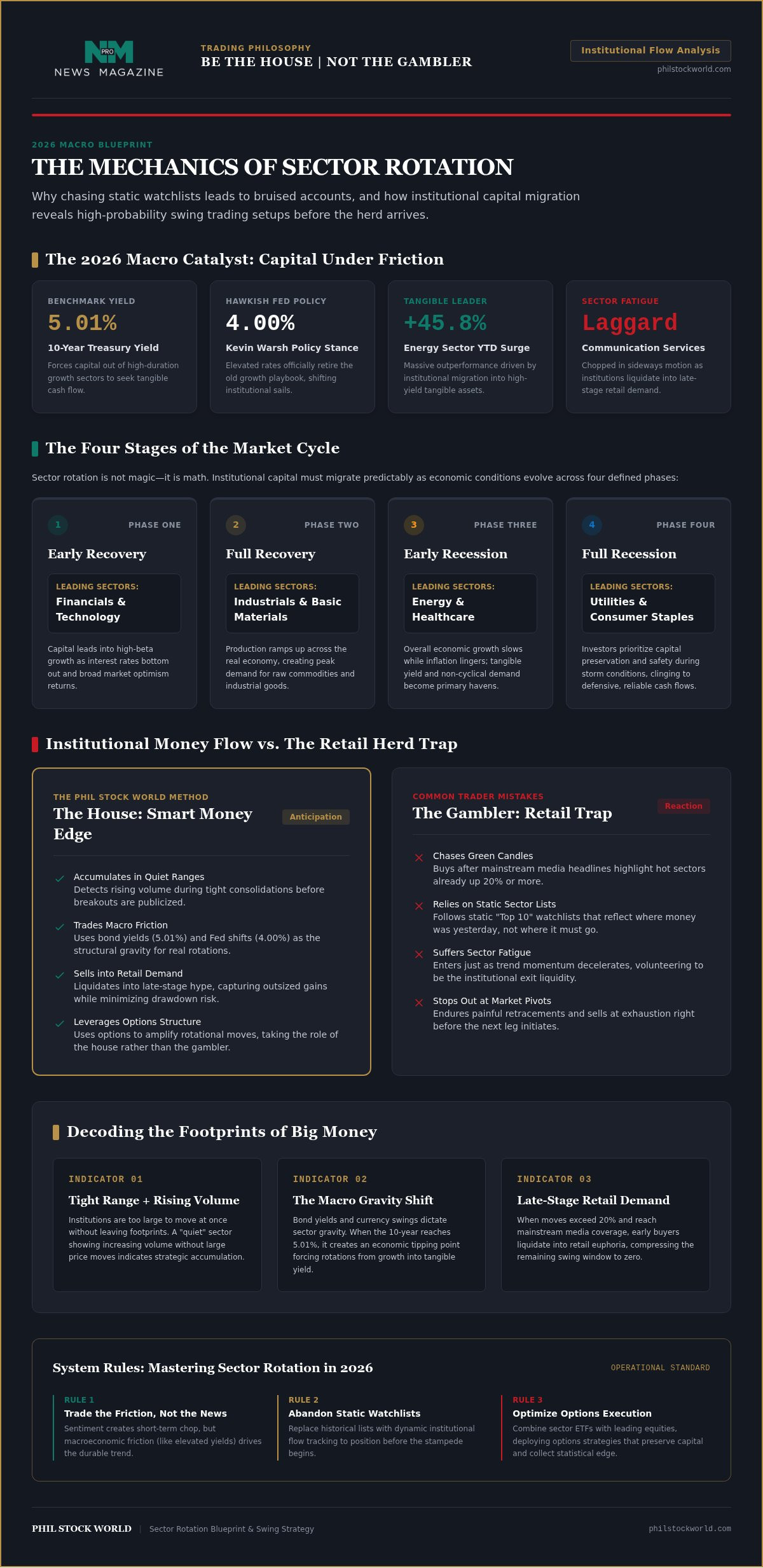
Sector rotation is the migration of capital between industries as institutional players adjust their sails to the prevailing economic winds. It’s not magic; it’s math. Big money is heavy, and it cannot enter or exit a position without leaving a visible footprint. To find the best sectors for swing trading, you must look for where capital is congregating before the breakout occurs. Understanding the four stages of the market cycle is your first step in this process:
- Early Recovery: Financials and Technology typically lead as interest rates bottom and optimism returns.
- Full Recovery: Industrials and Basic Materials take the baton as production ramps up and demand for raw goods peaks.
- Early Recession: Energy and Healthcare become the havens as growth slows and inflation often lingers.
- Full Recession: Utilities and Consumer Staples provide safety during the storm as investors prioritize defensive cash flows.
Volume analysis is the key to spotting this accumulation. When you see a “quiet” sector trading in a tight range on rising volume, that is the fingerprint of an institution building a position. Learning how to read market charts allows you to see these subtle clues before the price action explodes and the mainstream media starts reporting the move.
Inter-market Analysis: The Hidden Catalysts
Bond yields and currency fluctuations are the primary gravity for sector leadership. In September 2026, the benchmark 10-year Treasury yield tagged 5.01 percent, creating a massive headwind for high-duration tech multiples. This sparked a divergence where the Communication Services ETF (XLC) dropped 5.3 percent YTD, while the Energy sector (XLE) surged 45.8 percent. Commodities often act as the lead scout for the Industrial and Energy sectors; when crude oil prices climb, the rotation into energy stocks is rarely far behind. Spotting these divergences early is what separates the pros from the retail crowd.
The Institutional Footprint
Tracking the “Big Five”—Tech, Financials, Healthcare, Energy, and Consumer Discretionary—reveals where the broad market sentiment is shifting. During market corrections, defensive sectors like Utilities often become the best sectors for swing trading because they offer a combination of lower volatility and consistent institutional support. Institutional players often accumulate massive positions in dark pools to hide their hand, but eventually, that volume spills into the public tape as a precursor to a major trend. If your current strategy feels out of sync with these shifts, a Virtual Portfolio Review can help you audit your exposure and realign with these institutional flows.
The 2026 Power Players: High-Beta vs. Defensive Sectors
The 2026 market landscape has drawn a line in the sand. On one side, you have high-beta tech names that move like a caffeinated squirrel. On the other, the “Steady Eddies” of energy and utilities are quietly printing money for those who can handle a slower pace. Identifying the best sectors for swing trading right now requires understanding this split personality. With the benchmark 10-year Treasury yield hovering at 5.01 percent, the cost of capital is a real weight on growth. However, volatility is the swing trader’s best friend. If you aren’t sure where your current holdings land on this spectrum, a virtual portfolio review is a smart way to ensure you aren’t accidentally over-leveraged in a dying trend.
Technology & Innovation: The Volatility Engine
High-beta tech remains the ultimate playground for swing traders who crave price action. The artificial intelligence and semiconductor sub-sectors still offer the most explosive 3 to 10 day moves, but they’re sensitive to every hawkish whisper from Fed Chair Kevin Warsh. We’ve found that software companies often present cleaner chart patterns than hardware. Hardware is messy. It’s plagued by capex concerns and supply chain friction. Software scales. When trading these names, risk management is everything. You don’t “set and forget” a high-beta trade when the Fed is pushing rates toward 4.00 percent. You take your meat off the bone and move to the next setup.
The Defensive Pivot: Healthcare and Staples
When the broad market gets shaky, the smart money slides into healthcare and consumer staples. These aren’t just “boring” stocks; they are safety swings. In a year where the Communication Services sector has lagged at minus 5.3 percent YTD, defensive sectors provide a necessary hedge. Dividends act as a functional floor for price action. If a stock pays you to wait, institutional selling pressure tends to dry up much faster than in non-earning growth names. These sectors offer “safety swings” because their demand is inelastic. People still need medicine and groceries even if GDP growth projections sit at a modest 2.3 percent. Identifying these recession-proof trends is vital for maintaining a high win rate when the tech engine stalls.
Financials also present a unique tactical opportunity. As rates rise, bank margins theoretically expand, but the fear of a slowing economy keeps a lid on long-term breakouts. This creates a perfect range-bound environment. You buy the support of the XLF, ride it to the top of the range, and exit before the macro-economic reality sets in. It’s a calculated, rhythmic approach that ignores the noise of the headlines.
Tactical Execution: Swing Trading the Sweet Spot of Volatility
Picking the best sectors for swing trading is only half the battle; the other half is won or lost in the execution. Once you’ve identified a rotation, you must decide on your vehicle. Broad sector ETFs like the XLE or XLK offer a smoother ride with less idiosyncratic risk, making them ideal for capturing a general industry move. However, if you’re hunting for alpha, the individual sector leaders usually provide the most explosive price action. The key is to wait for the sector itself to hit a major support level before entering the individual stock. If the sector is facing a headwind, even the strongest stock will struggle to maintain its momentum.
We don’t just buy and hope. We use advanced option trading strategies to leverage these moves while keeping our risk strictly defined. Sustainable swing trading requires a minimum 3:1 risk-to-reward ratio. If you’re risking a dollar to make three, you only need to be right 33 percent of the time to break even. Most retail traders flip this on its head, taking small profits and letting their losers run. We do the opposite. We set our exits based on sector-wide resistance levels and we don’t blink when it’s time to take the meat off the bone.
Options as a Tactical Lever
Call spreads are our bread and butter for trading sector breakouts. By selling a higher-strike call against a long position, you lower your cost basis and define your maximum risk from the start. This “Be the House” approach allows you to profit even if the move is less aggressive than expected. Selling into strength is another vital habit. Don’t wait for the trend to roll over before you exit. Implied volatility is the swing trader’s best friend when it inflates the premiums you sell, but it becomes a ruthless enemy when it crushes the value of long options during a quiet sideways drift.
Position Sizing and Portfolio Balance
Never bet the farm on a single industry thesis. We follow a strict 1% Rule: don’t risk more than one percent of your total trading capital on any single trade. It’s also easy to fall into the trap of “fake diversification” by holding five different semiconductor stocks. In 2026, those are highly correlated; if the sector drops, they all drop. Balance your portfolio with non-correlated trades in defensive areas like Healthcare or Staples to buffer against broad market shocks. Manage your Theta (time decay) aggressively by avoiding short-term options that expire in less than 30 days unless the setup is undeniable. Unlock the full potential of these strategies with a Premium Membership to get real-time alerts on our latest sector plays.
Positioning Like the House: Using Phil Stock World to Front-Run the Market
Identifying the best sectors for swing trading is a high-stakes game of follow-the-leader, but the leader isn’t the guy on the news. It’s the institutional flow that moves before the headlines ever hit the wire. At Phil Stock World, our live trading rooms act as a real-time radar for these shifts. We don’t just talk about theory; we track the actual movement of capital as it happens. Our daily market commentary is built to ignore the “noise” that keeps most traders frozen in indecision. By focusing on the “Be the House” philosophy, we prioritize high-probability setups that offer a statistical edge over the long run. You get access to high-conviction trade alerts that focus on the sectors showing the strongest institutional accumulation, allowing you to enter positions before the retail crowd creates the peak.
The community advantage is a massive part of the equation. Trading can be a lonely endeavor, especially when you’re trying to decode complex macro-economic cycles on your own. Our members benefit from the collective experience of veteran traders who have navigated every market regime since 2006. This isn’t a classroom; it’s a high-level discussion among peers who are all focused on the same goal: capital preservation and consistent growth. You’ll learn to see the market through a more skeptical, savvy lens that prioritizes logic over emotion.
Cutting Through the Mainstream Noise
Mainstream financial media is often a lagging indicator masquerading as insight. We’ve found that “consensus” sector picks are frequently the most dangerous places to park your money because they are already crowded. Our independent research is fueled by a healthy skepticism of paid-to-play news cycles. We look for the friction points that the herd ignores. For instance, while most traders were stuck in the tech-heavy Communication Services sector as it dipped 5.3 percent YTD in 2026, our members were positioned for the massive rotation into Energy. That move resulted in a 45.8 percent gain for the XLE, a clear case of how front-running the rotation can lead to massive outperformance of the broader S&P 500.
Join the Inner Circle
In your first 30 days as a member, you’ll start to see the market footprints that were previously invisible. You’ll move beyond simple price action and start understanding the “why” behind every move. Our educational webinars are designed to help you master sector analysis and the option strategies that turn volatility into profit. This is your chance to stop being the liquidity for the big banks and start trading with the confidence of an insider. Stop following the herd and start trading like the house with Phil Stock World.
Stop Chasing Trends and Start Front-Running Rotations
The 2026 market doesn’t reward those who wait for the evening news. It rewards those who understand the structural friction of a 5.01 percent yield environment and the mechanics of institutional money flow. We’ve covered how identifying the best sectors for swing trading requires a shift from rearview mirror analysis to a forward-looking lens that tracks where capital is forced to move. Whether you’re navigating the high-beta tech engine or seeking shelter in defensive staples, your success depends on discipline and tactical execution.
Success isn’t about being right every time; it’s about managing risk and using options to tilt the odds in your favor. By positioning yourself like the house, you stop being the exit liquidity for the herd. Ready to trade with the pros? Join Phil Stock World and master sector rotation today. Benefit from 20+ years of market-beating analysis and real-time interactive trading rooms. You have the blueprint. Now, take the next step toward a professional, repeatable trading system. The market is moving, and you should be too.
Frequently Asked Questions
What are the best sectors for swing trading in 2026?
The best sectors for swing trading in 2026 are currently Energy and tangible asset sectors like Materials and Industrials. As of September 18, 2026, the Energy sector (XLE) leads the pack with a 45.8 percent year-to-date gain. High-beta technology remains a playground for volatility, but rising bond yields make it treacherous. Defensive sectors like Utilities and Healthcare also offer reliable safety swings when the market faces headwinds from a hawkish Federal Reserve under Chair Kevin Warsh.
How long should I hold a swing trade in a specific sector?
Most swing trades in a specific sector should be held for 3 to 15 days. This timeframe allows enough room for a sector-wide move to develop without exposing you to the long-term decay of option premiums. You aren’t looking for a multi-year marriage; you’re looking for a short-term date with a clear trend. If the rotation logic hasn’t played out within two weeks, it’s often time to cut the trade and move on.
Is it better to swing trade sector ETFs or individual stocks?
It’s better to swing trade sector ETFs if you want to capture a broad industry move with lower idiosyncratic risk. ETFs like XLF or XLE smooth out the noise of individual earnings reports or CEO scandals. However, if you’re hunting for higher beta and bigger percentage moves, individual sector leaders often outperform their parent indices. A balanced approach involves using ETFs for core exposure and individual stocks for high-conviction tactical plays in trending industries.
How do I know when a sector rotation is starting?
You can spot the start of a rotation by identifying a divergence between price and volume in a quiet sector. When a sector trades in a tight range on rising volume, it’s a sign of institutional accumulation. Another early warning sign is the relative strength of a sector compared to the S&P 500. If the broad market is flat but one sector makes higher lows, the smart money is already moving in before the headlines.
What is the best indicator for swing trading sector moves?
The best indicator for capturing sector moves is the Relative Strength Index (RSI) combined with ratio charts. By comparing a sector ETF like XLK against the SPY, you see exactly where capital is flowing in real-time. Moving averages, specifically the 20-day and 50-day, also serve as critical support and resistance levels for identifying entry points. We focus on these technical footprints to ensure we’re trading with the trend rather than fighting the market’s natural gravity.
Can I swing trade sectors with a small account?
You can absolutely swing trade sectors with a small account by utilizing options to define your risk and gain leverage. Instead of buying 100 shares of an expensive stock, you can use call spreads to control the same position for a fraction of the capital. This “Be the House” strategy allows you to participate in major sector moves without over-leveraging your portfolio. It’s about smart position sizing, not the absolute size of your bankroll.
What happens to swing trades during a market-wide correction?
During a market-wide correction, correlations often spike, meaning almost everything drops together. However, defensive sectors like Consumer Staples and Utilities typically fall less than high-beta tech. This is when swing traders pivot to safety swings or use put options to profit from the downside. A correction is often the precursor to a major sector rotation, as capital seeks new leadership once the dust settles and valuations reset. Staying nimble is the only way to survive these shifts.
How does interest rate policy affect sector selection for swing traders?
Interest rate policy is the primary gravity for sector selection. In 2026, with the Fed target range at 3.75 to 4.00 percent, high-duration growth sectors like Tech face significant cost-of-capital headwinds. Conversely, Financials often see expanded margins in a higher-rate environment, provided the economy stays out of a deep recession. Swing traders must monitor the 10-year Treasury yield, as its movements frequently dictate which sectors will catch the next institutional bid.

