


Why do most retail traders treat the Iron Condor like a lottery ticket when the world’s most successful institutions treat it like a casino’s insurance policy? You’ve probably felt the frustration of watching a “perfect” neutral setup get shredded by a sudden market spike, or perhaps you’re tired of seeing theta decay work against your long positions while your condors produce nothing but flat returns. It’s exhausting to follow generic tutorials only to realize they’ve left you unprepared for the moment the market actually moves.
We’re here to change that. By mastering iron condor trading for income, you can stop gambling on direction and start acting like the “House” that collects the premiums instead. You don’t need a crystal ball; you need a disciplined, math-based strategy that thrives on volatility rather than fearing it. This article breaks down how to transform this complex spread into a reliable monthly paycheck by utilizing the same professional tactics we use in our virtual portfolios. We’ll dive into the specific adjustments that turn a “tested” wing into a strategic opportunity and show you how to navigate the 2026 market with the calm confidence of a seasoned pro.
Key Takeaways
- Learn why the Iron Condor is the premier strategy for 2026’s range-bound markets, allowing you to profit from price stability rather than chasing direction.
- Master iron condor trading for income by exploiting the final 30 days of theta decay while using delta neutrality to keep your “House” edge balanced.
- Discover how selling overvalued options premium provides superior capital efficiency and more frequent cash flow than traditional quarterly dividend investing.
- Implement a professional execution blueprint that utilizes the “50% Rule” to book profits early and dodge late-cycle market spikes.
- Gain the confidence to manage trades under pressure by leveraging real-time commentary and insights from professional virtual portfolio reviews.
Beyond the Basics: Why Iron Condors are the Income Trader’s Secret Weapon
Most retail traders treat the stock market like a high-stakes horse race. They pick a winner, cross their fingers, and hope the finish line arrives before their capital runs out. But if you are interested in iron condor trading for income, you aren’t betting on who wins the race. You’re betting that the race stays on the track. In the choppy, range-bound environment of 2026, where global macro shifts keep indices bouncing between support and resistance, this strategy is the ultimate tool for extracting consistent cash from the noise.
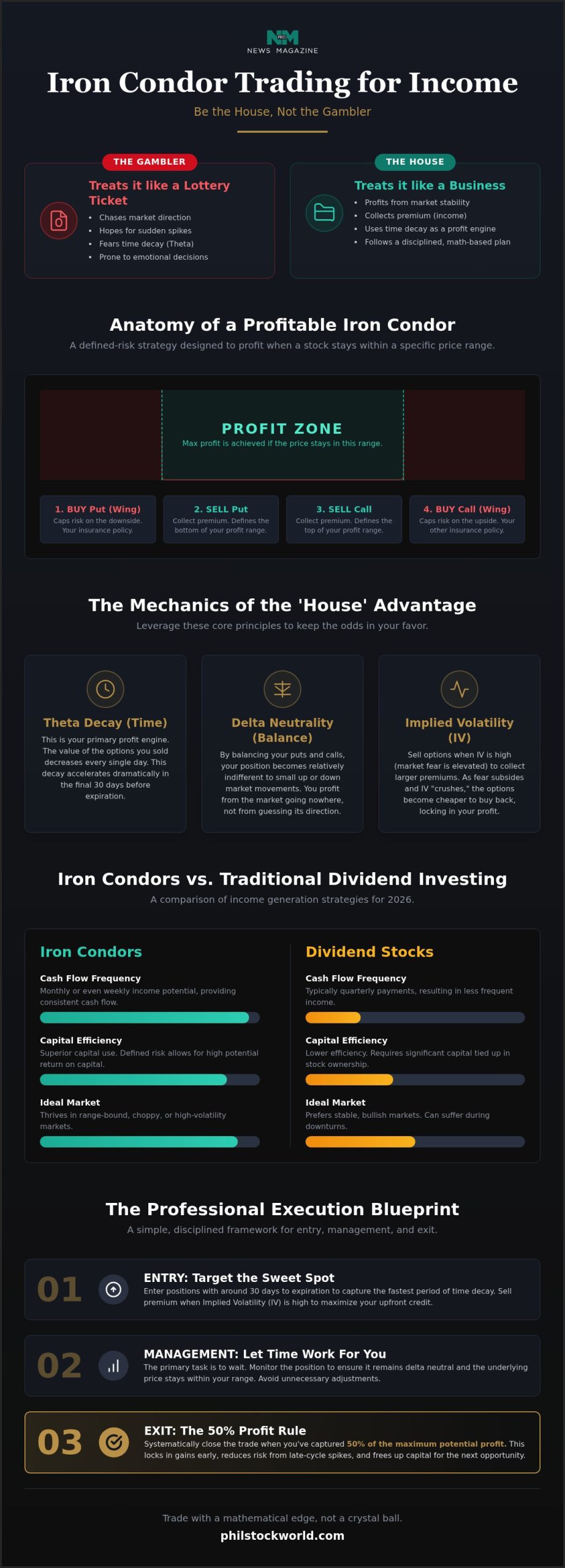
An Iron Condor is a four-legged options strategy created by selling a bear call spread and a bull put spread simultaneously. It sounds complex, but the logic is simple: you’re selling insurance to the gamblers who think the market is going to the moon or crashing to the floor. By taking the other side of those extreme bets, you collect a premium upfront. This moves you away from “buying hope” and puts you in the position of the “House,” where the math is tilted in your favor from the moment you click “trade.”
The real magic happens through theta decay. Think of theta as a leaking faucet. If you’re an options buyer, your bucket has a hole in it. If you’re the seller, you’re the one catching the drips. Every day that the market stays within your chosen range, the value of the options you sold decreases. That daily decay becomes your salary. While others sweat over every basis point move, you simply watch the clock do the heavy lifting for you.
The Four Legs of the Trade
To build this “House” edge, you sell a call and a put relatively far from the current price, then buy a further-out call and put as protection. These long “wings” act as catastrophic insurance, capping your risk so a single black swan event won’t blow up your account. The maximum profit occurs when the underlying asset settles comfortably between your short strikes at expiration, allowing every contract you sold to expire worthless while you keep the entire initial credit. It’s a structured, disciplined way to define your playground and get paid for staying inside the lines.
Income vs. Speculation
Selling volatility is fundamentally more consistent than picking a stock’s direction. Speculators need to be right about the “what” and the “when,” but income traders only need the market to stay “not too crazy.” This is where Probability of Profit (POP) becomes your guiding light. Instead of chasing a 100% gain on a 10% probability, we aim for steady, repeatable wins by utilizing advanced option trading strategies that prioritize high-probability outcomes. It’s about building a portfolio that generates cash flow regardless of the headline of the day.
The Anatomy of a Profitable Iron Condor: Mastering the ‘House’ Advantage
Success in iron condor trading for income doesn’t come from a lucky guess; it comes from understanding the mechanics that drive the trade. If you want to trade like the “House,” you have to stop looking at price charts and start looking at the Greeks. These mathematical variables are the levers you pull to ensure the odds remain in your favor. By maintaining delta neutrality, you create a position that is relatively indifferent to minor market swings. It’s like balancing a scale; as long as the market stays within your range, the scale stays level and the profits accrue.
Theta decay is your best friend in this process. While most traders fear the passage of time, we embrace it. The final 30 days of an option’s life are where time decay accelerates most rapidly. This is the period when you collect the most “rent” from the market. Additionally, you want to pay close attention to Vega. Selling premium when others are panicking allows you to capture higher Implied Volatility (IV). When the panic subsides and IV “crushes,” the value of the options you sold drops, allowing you to buy them back for a fraction of the price. This margin of error is your safety net. By setting strikes far enough out to withstand daily noise, you give the trade room to breathe.
Greek Management for Income
Think of Delta as your speedometer. It tells you how fast your position’s value will change relative to the underlying asset’s price. If your Delta gets too high on one side, it’s time to slow down and adjust. Theta is the daily income you earn just for showing up. It’s the steady drip of cash into your account. Finally, Vega represents your exposure to volatility. An IV crush is the ultimate gift for an income trader, as it instantly deflates the price of the “insurance” you sold to the market.
Selecting the Right Underlying Asset
Not all assets are created equal. We prefer high-liquidity indices like the SPX or NDX because they offer tighter spreads and more predictable behavior. Individual stocks are prone to “Earnings Roulette,” which are binary events that can blow past your strikes in seconds. Professional income traders avoid these traps. Deep liquidity is the number one defense in a fast-moving market because it ensures you can exit or adjust your position without getting slaughtered by the bid-ask spread. To see how these principles apply to real trades, you might find our virtual portfolio review helpful for navigating the noise.
Strategic Comparison: Why Iron Condors Beat Traditional Dividend Investing in 2026
Traditional dividend investing feels safe until a bear market eats your principal. In 2026, waiting three months for a meager payout isn’t enough to outpace the opportunity cost of stagnant capital. When you focus on iron condor trading for income, you shift from a quarterly trickle to a monthly paycheck. You’re also using capital far more efficiently. By utilizing margin, “The House” amplifies returns without needing the market to move an inch in any specific direction. If a dividend stock drops 10%, you’re in the red. If the market drops 10% but stays within your condor’s wings, you’re still booking a full profit.
You’ll see skeptics on forums claim that Iron Condors underperform over the long haul. They often cite the “17-year myth” of unmanaged results to discourage new traders. Here’s the catch: those depressing statistics are based on “set-and-forget” models that don’t account for macro shifts or implied volatility levels. We don’t trade like robots. We trade like the House. By actively managing positions and avoiding trades when IV is too low to pay for the risk, we flip the script on those generic, unmanaged statistics. Strategy beats blind automation every time.
Iron Condors vs. Covered Calls
Covered calls are the gateway drug for income seekers, but they’re inherently bullish. If the market slides, your shares lose value. Iron Condors are directionally agnostic. You don’t need a rally to win. Plus, those long protective wings act as a shield against the “tail risk” that wipes out covered call writers during sudden crashes. For anyone conducting a virtual portfolio review in 2026, the condor’s ability to thrive in choppy water makes it a superior core strategy for preserving and growing capital.
The Math of the ‘House’ Edge
Casinos don’t win because they’re lucky; they win because they have a positive Expected Value (EV). We achieve the same by identifying overpriced volatility. When the market prices in more fear than reality delivers, we sell that fear at a premium. Learning how to read market charts allows you to spot the “quiet zones” where price is likely to consolidate. It’s not about predicting the future. It’s about recognizing when the insurance the market is buying is way too expensive and being the one to sell it to them.
The Execution Blueprint: Entry, Management, and the ‘Get Out’ Signal
Execution is the bridge between a good idea and a growing account balance. In the 2026 market, volatility can shift in a heartbeat, so having a rigid entry and exit protocol is non-negotiable. To excel at iron condor trading for income, you must treat every trade with the cold, calculated precision of a casino manager. Don’t be a pig. The goal is consistent, repeatable cash flow, not a one-time jackpot that requires perfect market timing.
The “Sweet Spot” for entry typically lands around 45 days to expiration. At this stage, time decay is starting to ramp up, but you aren’t yet exposed to the violent price swings common in the final week of an option’s life. We target strikes at the 15 to 20 Delta range. This gives the market plenty of room to wiggle without immediately threatening your position. Once you’re in, follow the 50% Rule. If you’ve captured half of the maximum possible profit, book it and move on. Holding out for that last bit of premium is a gambler’s mistake. The House takes the win and resets the board.
When to Enter the Trade
Timing your entry is about reading the room. You want to sell when the crowd is nervous. Look for spikes in Implied Volatility (IV). When fear is high, the premium you collect is inflated, giving you a wider margin of error. Conversely, avoid “Low Vix” traps. If the VIX is dragging along the bottom, the risk-to-reward ratio is skewed against you. A simple Monday morning scan should involve checking the IV rank of your preferred indices. If the premium isn’t there, keep your powder dry. Discipline is just as much about the trades you don’t take as the ones you do.
Managing the ‘Tested’ Wing
Even the best setups will face a “Fire Drill” when the market makes a sudden move toward one of your short strikes. When a wing is tested, the professional move is to adjust, not pray. You can roll the untested side, the one the market is moving away from, closer to the current price. This allows you to collect more credit and re-balance your Delta. If the trend continues, you may need to roll the entire spread out in time for a net credit. However, every trader needs a hard stop. If the loss reaches a predetermined multiple of the credit received, kill the trade. Protecting your bankroll for tomorrow’s opportunity is the hallmark of a pro. To master these adjustments in real-time, consider joining our Premium Membership for live trading room access.
Scaling Your Income: How Phil Stock World Simplifies Complex Options Strategies
Mastering the mechanics of a trade is only half the battle. The other half is fought between your ears. Most retail traders fail at iron condor trading for income not because they don’t understand the math, but because they trade in a vacuum. When you’re alone and the market starts aggressively testing a wing, it’s easy to let panic override your plan. This is where “Gambler” mistakes happen. You might close a winning trade too early out of fear or hold a loser too long out of hope. Scaling your income requires a shift from isolated guesswork to a disciplined, community-supported process.
Professional trading is a team sport. By surrounding yourself with a network of savvy peers and mentors, you gain the “House” perspective exactly when you need it most. Real-time alerts and interactive discussions provide the clarity needed to navigate sudden volatility spikes without breaking your rules. It’s about moving past the fluff of academic theory and focusing on what actually puts cash in your account every month. We don’t just talk about Greeks; we apply them to live market conditions to ensure your capital is always working as hard as possible.
The Phil Stock World Advantage
Mainstream financial media is designed to generate clicks through fear and excitement, but that noise is toxic for an income trader. Our daily market commentary cuts through the sensationalism to provide granular, strategic analysis. We hold interactive sessions where we pull apart Iron Condors in real-time, showing you exactly how to adjust when the “noise” gets loud. This hands-on approach is why a Phil Stock World membership is the ultimate tool for those serious about trading like the House in 2026. You get to see the logic behind the trades before you ever put your own capital at risk.
Your Next Steps to ‘Being the House’
If you’re ready to start iron condor trading for income, start small. Position sizing is your primary defense against emotional decision-making. If a single trade is large enough to keep you awake at night, it’s too big. Use paper trading to master the mechanics and the “click-flow” of your brokerage platform, but don’t stay there too long. There is a psychological gap that only live trading can bridge. Once you feel the rhythm of the market with real skin in the game, you’ll realize that consistency beats “The Big Score” every single time. Focus on the process, manage your deltas, and let the house edge do the rest.
Claim Your Edge and Start Collecting the Market’s Rent
You’ve seen how the Iron Condor transforms from a complex spread into a disciplined engine for cash flow. By focusing on the math of the Greeks and ignoring the siren song of the “big score,” you move from being a customer of the market to being its landlord. Successful iron condor trading for income in 2026 requires more than just a set of strikes; it demands the tactical flexibility to adjust when the “noise” gets loud and the discipline to book profits early. You’ve got the blueprint, now you just need the right environment to execute it.
You don’t have to navigate these volatile waters alone. Joining a community of over 1,000 disciplined traders gives you the institutional-grade perspective needed to stay ahead of the herd. With access to veteran trader Phil Davis and real-time trade alerts in our live rooms, you can stop guessing and start executing with confidence. Start Trading Like ‘The House’—Join Phil Stock World Today to turn market volatility into your most reliable employee. It’s time to stop gambling on direction and start profiting from the passage of time.
Frequently Asked Questions
Is iron condor trading for income safe for beginners?
Iron condor trading for income is safe for beginners provided they understand the mechanics of defined risk before committing capital. Unlike selling naked options, this strategy uses long wings to cap potential losses from the start. It’s an excellent way to learn about theta decay and volatility without the danger of a margin call. Most beginners find success by starting small and using virtual portfolio reviews to audit their setups before going live.
How much capital do I need to start trading iron condors for income?
You don’t need a massive account to start, but you must cover the margin requirements for your spreads. For major indices in 2026, margin is typically the difference between your strike prices minus the credit received. If you trade 5-point wide spreads, your risk is roughly $500 per contract. Many traders find that a starting bankroll of $2,000 to $5,000 allows for proper diversification across a few high-probability positions.
What happens if the stock price moves past my short strike?
When price breaches a short strike, your position is “tested,” but it isn’t an automatic disaster. You have several professional options: you can roll the untested side closer to collect more credit, roll the entire trade out in time, or simply close for a managed loss. The key is to act before the price hits your long wing. This is where real-time alerts and community support become invaluable for maintaining your “House” edge.
Why do people say iron condors don’t work in the long run?
Critics often point to unmanaged backtests that ignore market context and implied volatility levels. People say they don’t work because they treat them as “set-and-forget” lotteries rather than actively managed income streams. If you sell premium when volatility is at historic lows, you aren’t being paid enough for the risk. Success comes from selling when fear is high and using disciplined profit-taking rules to exit before the market turns.
How often should I adjust my iron condor trades?
You should only adjust when your original trade thesis is threatened or your Delta balance shifts significantly. Most professional traders check their positions daily but only intervene if the price touches a short strike or if they’ve reached their 50% profit target. Over-adjusting can lead to “churning” your own account and racking up unnecessary costs. It’s about staying calm and letting the math of theta decay do the heavy lifting for you.
Can I trade iron condors in a retirement account (IRA)?
Yes, iron condors are generally permitted in IRAs because they are a defined-risk strategy. Since you buy protective wings, your broker doesn’t face the unlimited risk associated with naked selling. This makes it a popular choice for those looking to generate monthly cash flow within a tax-advantaged environment. Just ensure your brokerage account is approved for “Level 3” or “Spread” trading to execute these multi-leg orders without any technical hurdles.
What is the best time frame for an iron condor trade?
The “sweet spot” for most income traders is between 30 and 45 days to expiration. This window captures the steepest part of the theta decay curve while giving you enough time to manage the trade if the market moves against you. Trading too close to expiration, such as weekly options, increases “gamma risk,” where small price moves cause massive swings in your P&L. Stick to the monthly cycles for a smoother, more predictable income stream.
How does market volatility affect iron condor profits?
Volatility is the engine of this strategy. You want high Implied Volatility when you enter because it allows you to sell strikes further away from the current price for a higher premium. Once you’re in the trade, you want volatility to drop. This “IV crush” deflates the value of the options you sold, allowing you to buy them back cheaper. Understanding this relationship is the secret to building a consistent “House” advantage and keeping the odds in your favor.

