

What if you could stop guessing why your portfolio is bleeding and finally understand the invisible math that dictates every tick of an option’s price? Most retail traders treat the market like a slot machine, but the real money is made by those who own the casino. You’ve likely experienced the frustration of picking a winning stock only to watch your call option lose value because of a sudden drop in volatility or the relentless march of time. It’s a common pain point, especially with the VIX currently hovering around 15.84 and the recent elimination of the pattern day trader rule opening the floodgates for more intraday risk.
This deep dive into options Greeks explained for traders is designed to move you beyond dry formulas and into market mastery. We’ll show you how to harness Delta, Gamma, Theta, and Vega to transform your strategy from a series of hopeful bets into a calculated business. By the end of this guide, you’ll know how to predict price changes before they happen, avoid getting crushed by implied volatility after earnings, and manage your risk with the same precision as a professional desk. It’s time to stop being the gambler and start being “The House.”
Key Takeaways
- Learn why the Greeks are the actuarial tools of the market, allowing you to move beyond guessing and start trading with the mathematical edge of “The House.”
- Master the “Core Four” with options Greeks explained for traders who want to understand how Delta, Gamma, Theta, and Vega interact to drive every price move.
- Discover how to avoid the dreaded “IV crush” by timing your Vega exposure and leveraging Theta, ensuring time decay works for your profits instead of against them.
- Shift from buying lottery tickets to building high-probability positions by aligning your Delta exposure with your market bias and managing real-time risk.
- Gain the confidence to predict price changes before you hit the buy button by mastering the “hidden” costs that often trap retail investors.
Beyond the Math: Why the Greeks Are the Pulse of Your Portfolio
Most traders start by looking at a chart, picking a direction, and hitting the buy button. They assume that if the stock moves up, their call option will naturally follow suit. But the market isn’t that generous. In reality, direction is just one piece of a three dimensional puzzle. The Greeks are the variables that determine an option’s price sensitivity to specific market forces, and ignoring them is a recipe for a drained account. The Greeks are the actuarial tools of the options market.
Retail traders often get the direction right but the Greek math wrong. They buy a call, the stock ticks higher, yet the option price stays flat or even drops. This happens because they are fighting invisible forces like time decay and volatility. Understanding Options Greeks is what separates the people playing the games from the people running them. Professionals use these metrics to frame a “House Edge,” ensuring that even when they aren’t perfectly right on direction, the math still works in their favor.
The Casino Analogy: Trading Like the House
Professional trading is about the shift from predicting price to managing probabilities. This is where options Greeks explained for traders moves from boring theory to a vital survival skill. Think of the market as a casino. The retail public acts like the gamblers, buying “lottery tickets” in the form of out-of-the-money calls and hoping for a jackpot. They are constantly fighting against the clock.
The “House,” or the professional sellers, loves Theta and Vega. They get paid to wait. By selling premium, they leverage time decay as a consistent revenue stream. They don’t need a massive market move to win; they just need the status quo to persist. This disciplined approach allows you to build a portfolio that thrives on the very forces that usually wipe out beginners.
The Hidden Risks of Greek-Blind Trading
The “IV Crush” is perhaps the most painful nightmare for a novice. You might predict an earnings beat perfectly, see the stock jump 5%, and still wake up to a losing position. This occurs because Vega, the Greek tracking volatility, collapsed faster than the price move could compensate. Those “cheap” options you found? They were likely the most expensive in terms of Greek risk.
Cheap contracts often have a high “speed” of decay or require a move so large they are mathematically improbable. Balancing these risks requires a grasp of advanced option trading strategies that hedge one Greek against another. If you don’t know which Greek is currently driving your position’s value, you aren’t trading; you’re just crossing your fingers.
The Core Four: Deciphering Delta, Gamma, Theta, and Vega
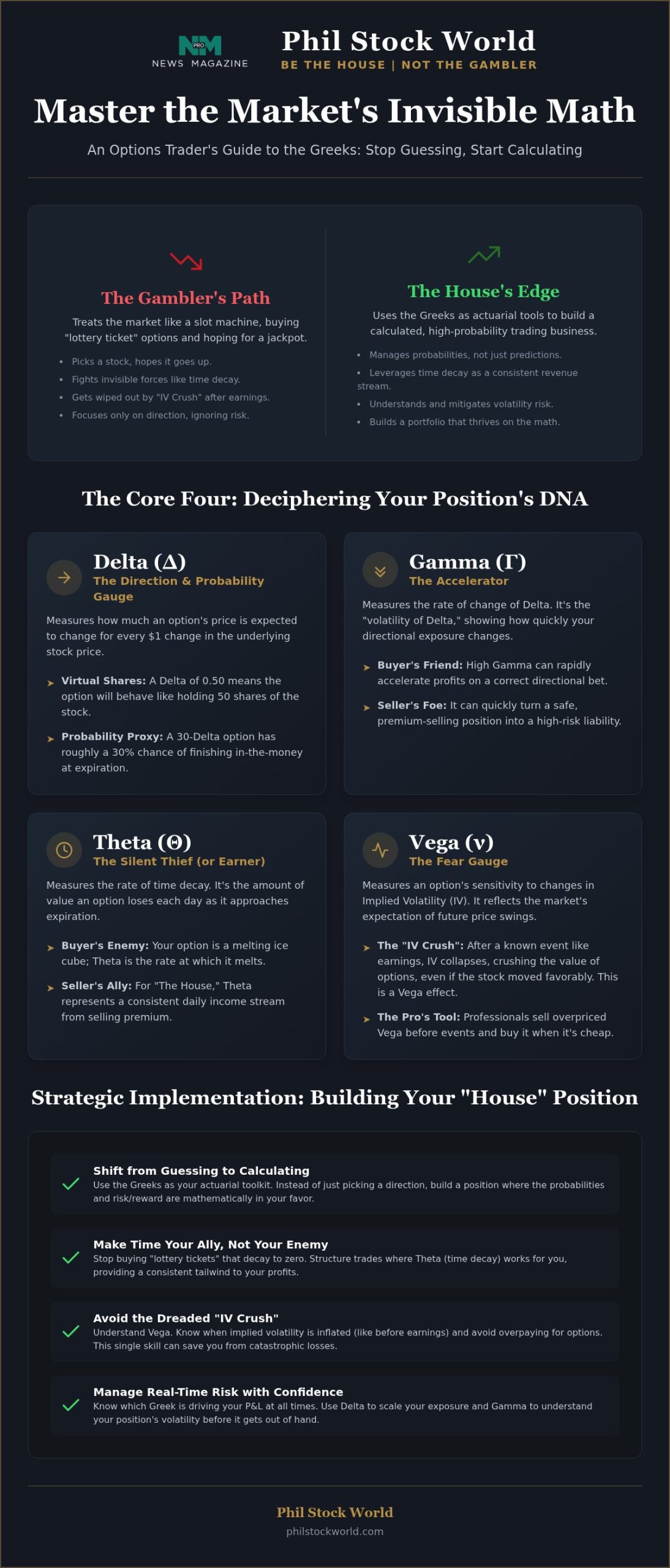
To trade like the house, you need to know the specific levers that move your money. The “Core Four” are the metrics that define your risk and potential reward in every contract. Delta is often the first one traders look at, but it’s more than just a price change metric. It’s your “virtual share” equivalent. If you have a Delta of 0.50, your contract behaves like 50 shares of the underlying stock. This allows you to scale your exposure without the massive capital requirements of owning the equity outright.
Delta and Gamma: The Speed and Acceleration of Price
Delta also serves as a rough shorthand for the probability of an option finishing In-The-Money (ITM). A 10-delta call is a long shot; a 90-delta call is almost a certainty. But Delta isn’t static. It moves as the stock price changes. This is where Gamma enters the chat. Gamma is the “accelerator” that makes your Delta move faster or slower as the stock price fluctuates.
Gamma is the friend of the buyer because it can turn a small move into a massive gain by ballooning the Delta. For the seller, it’s the enemy that can turn a safe position into a nightmare overnight. Put simply, Gamma is the “volatility of Delta.” For a deeper dive into these mechanics, Options Greeks Explained for Traders provides a solid foundation for your technical analysis. Understanding this relationship is vital for anyone who wants to master the speed of the market.
Theta and Vega: The Forces of Time and Fear
Theta is the silent thief. It represents the daily erosion of your option’s value. Time decay isn’t linear; it’s exponential. The last 30 days of a contract’s life are the most dangerous for buyers because the decay curve turns into a cliff. If you’re long, you’re bleeding. If you’re the house, you’re collecting that decay as profit. This is why professional sellers prefer shorter expirations to maximize their intake.
Vega measures the volatility factor. It’s essentially the “fear” in the market. When uncertainty spikes, Vega inflates premiums, making options more expensive regardless of where the stock price goes. This is why understanding these forces is critical for building income generating option strategies that profit from the collapse of fear or the passage of time.
Managing these variables simultaneously can feel like juggling chainsaws. If you want to see how these play out in real time, our Educational Webinars break down live setups through the lens of the Greeks, helping you move beyond theory and into actionable mastery.
Greeks in Motion: How Market Volatility and Time Decay Collide
Understanding the Greeks in isolation is a great start, but the real magic happens when you see them interact on a live screen. Most textbooks fail because they treat these variables like static lab specimens. In the wild, they are constantly fighting for control over your contract’s value. You might see a massive price jump where your Delta gains are completely erased by a collapsing Vega. This is the reality of options Greeks explained for traders who want to survive more than a single earnings cycle. It’s about managing the collision of forces, not just picking a direction.
Take the “Earnings Crush” as a prime example. Before a major report from a high-volume mover like Nvidia or Tesla, Implied Volatility (IV) sky-rockets. Everyone is buying protection or betting on a moonshot, driving up the price of every contract. Once the news is out, the uncertainty vanishes instantly. Even if the stock moves in your direction, the Vega collapse can be so violent that your “winning” trade still ends up in the red. Professionals avoid this by selling into that peak volatility, effectively becoming the ones who collect the “fear premium” from the gamblers.
We also have to consider the “forgotten Greek,” Rho. In the high-interest-rate environment of September 2026, with the 10-year Treasury Note yielding around 4.96%, Rho actually matters again. It measures sensitivity to interest rate changes. While usually negligible in a zero-rate world, the current cost of carry means that long-dated options are more sensitive to the Fed’s whims than they’ve been in decades. If you aren’t watching the 3-month Treasury Bill at 4.01%, you’re missing a piece of the pricing puzzle.
The Volatility Crush: Vega vs. Reality
Implied Volatility is a measure of expected future movement. When an event like an FOMC meeting or a product launch looms, IV spikes. This makes options “priced for perfection.” To profit from Vega collapse, you need to identify when IV is significantly higher than historical volatility. By selling credit spreads or iron condors during these peaks, you position yourself to profit when the “crush” happens. You aren’t betting on the news; you’re betting on the return to normalcy.
Theta Burn: The Cost of Waiting
Theta is the most predictable force in the market. It’s a relentless drain that accelerates as expiration approaches. This “Theta Cliff” is especially steep for short-dated 0DTE options, which have dominated 2026 trading volumes. Professional traders prefer to be on the selling side of this curve to capture the house advantage. However, even if you are a seller, you must understand how time decay interacts with your protection. For instance, when hedging with put options, the cost of that insurance is constantly being eaten by Theta. You have to decide if the peace of mind is worth the daily premium you’re paying to the market.
Strategic Implementation: Building a “House” Position Using Probabilities
Mastering the theory is one thing; putting it to work in a live account is where the money is made. To “Be The House,” you need a repeatable framework that filters out bad bets. This isn’t about guessing where the S&P 500 goes tomorrow. It’s about ensuring the math is on your side before you ever click “trade.” When we look at options Greeks explained for traders, we see a four-step checklist for professional-grade entry.
- Step 1: Determine Delta Exposure. Align your total Delta with your market bias. If you’re bullish, you want positive Delta. If you’re hedging, you want negative Delta to offset your stock holdings.
- Step 2: Check Vega. Ensure you aren’t buying into a “volatility peak.” Buying when the VIX is trading around 15.84 is a very different tactical decision than buying when it’s at 30. Don’t pay for “fear” that is about to evaporate.
- Step 3: Calculate Theta. Match your time horizon to the decay curve. If you expect a move in two weeks, don’t buy a contract that loses a massive chunk of its value every single day.
- Step 4: Use Gamma. Understand your “risk acceleration.” If the trade goes against you, Gamma will make your Delta, and your losses, grow faster.
Delta-Neutral Strategies
Market makers don’t care if the stock goes up or down. They profit from movement and volume by staying Delta-neutral. By balancing long and short positions, they neutralize price direction and focus on capturing Theta or Vega. You can do the same to protect your wealth. Balancing your “Portfolio Delta” ensures that a sudden market drop doesn’t wipe you out. If you’re unsure how your current holdings stack up, a virtual portfolio review is a vital tool for auditing your Greek exposure and finding the leaks in your strategy.
Position Sizing Based on Greeks
This is where most retail traders fail. They think position sizing is just about the dollar amount spent. That’s a mistake. Buying 10 contracts of a 0.10 Delta option is not the same as buying 1 contract of a 1.00 Delta option, even if the cost is identical. The 10 contracts carry massive Gamma risk. A small move against you will crush those “cheap” lottery tickets much faster than the deep-in-the-money contract.
Use Delta to calculate your “effective share” exposure. A 0.50 Delta contract on 100 shares is essentially 50 shares of stock. If you wouldn’t buy 5,000 shares of the actual stock, don’t buy 50 contracts of a 50-Delta option. The street-smart rule is simple: never over-leverage on high-Gamma trades. The acceleration works both ways, and it’s usually the downside that hits hardest. Ready to see these steps applied in a live market? Join our Premium Membership to watch us build these “House” positions in real-time.
Mastering the Odds: Real-Time Greek Analysis with Phil Stock World
Static education is a relic of a slower era. In a 2026 market where average daily volume has surged to 72.8 million contracts, reading a textbook about Delta isn’t enough to survive. You’re competing with sophisticated algorithms and a retail crowd that now controls 45% of the volume. If you’re still looking at Greeks in isolation, you’re already behind. This is why options Greeks explained for traders needs to be a living, breathing part of your daily routine. At Phil Stock World, we move past the “what” and get straight to the “how do I profit from this right now?”
Our approach isn’t about fancy software that just spits out numbers. Any broker can show you a Greek table. The real advantage is the institutional-grade logic we apply to those numbers. We focus on the “Be The House” philosophy, identifying where the odds are skewed in your favor and where they are a trap. It’s about seeing the market through the eyes of a savvy mentor rather than a corporate algorithm. We don’t just give you the data; we give you the perspective needed to use it.
The Live Trading Room Advantage
The Live Trading Room is the heartbeat of our community. During market hours, we provide real-time analysis of volatility and time decay as it happens. When the herd is panicking because of a sudden spike in the VIX or a Treasury yield shift, our members are looking for the “House” opportunity. We discuss how Greeks are interacting in the current tape, helping you spot when Vega is overpriced or when Theta is about to hit that exponential cliff. To get the full experience, securing a Phil Stock World membership is your ticket into the room where these decisions are made.
From Theory to Trade Alerts
We don’t just talk about the Greeks; we trade them. Every alert we send is filtered through a rigorous probability check. We aren’t chasing the next “moonshot” or buying lottery ticket calls that rely on pure luck. Instead, we focus on income-generating spreads that put the math on your side. Our members learn to love the slow, steady burn of Theta and the predictable collapse of Vega. It’s a methodical way to build wealth that prioritizes protection over gambling.
This is an exclusive club for those who value logic over hype. By joining our community, you’re choosing to operate outside the traditional corporate mold. You’ll gain access to market charts, analysis, and educational webinars that turn abstract data into a vivid narrative of opportunity. It’s time to stop gambling on direction and start mastering the odds with a street-smart edge.
Take Control of Your Market Edge
Trading without a deep understanding of the Greeks is like flying a plane without an instrument panel. You might stay airborne for a while, but eventually, the weather will change and you won’t know why you’re losing altitude. By mastering the relationship between price speed, time decay, and market fear, you move from being a retail gambler to a disciplined operator. You’ve learned how to size positions based on real exposure and how to avoid the trap of overpriced volatility. This journey through options Greeks explained for traders is just the beginning of your transition into “The House” mindset.
Success in the fast-paced 2026 market requires more than static charts; it demands a community that acts on logic rather than hype. With over 20 years of market-beating expertise, we provide the daily real-time alerts and interactive Live Trading Rooms you need to stay ahead of the curve. Don’t let another earnings season or Fed meeting catch you off guard. It’s time to trade with the confidence of an insider and the precision of a professional.
Join Phil Stock World and Start Trading Like “The House” Today. The market is always moving, and with the right tools, you’ll finally be ready to move with it.
Frequently Asked Questions
What are the 4 main Greeks in options trading?
The four primary Greeks are Delta, Gamma, Theta, and Vega. Delta measures price sensitivity, Gamma tracks the rate of Delta change, Theta quantifies time decay, and Vega monitors volatility sensitivity. These metrics are the actuarial tools that help you move beyond guessing and start trading with a professional edge. Understanding how these forces interact is the foundation of any high-probability strategy. Instead of focusing on price alone, savvy traders use these variables to quantify risk.
Which Greek is most important for day traders versus long-term investors?
Day traders typically focus on Delta and Gamma because they need to capture rapid price movements within a single session. Since they rarely hold overnight, Theta is less of a concern. In contrast, long-term investors or premium sellers prioritize Theta and Vega. They want to capture the “House” edge by letting time decay work in their favor while managing the impact of long-term volatility shifts on their portfolio. This distinction helps align your strategy with your specific time horizon.
How does Delta affect the price of my call option?
Delta represents the expected change in an option’s price for every $1 move in the underlying stock. For example, a call with a 0.50 Delta will theoretically gain $0.50 if the stock rises by $1. It also acts as a proxy for “effective shares.” Owning one call contract with a 0.60 Delta is mathematically similar to owning 60 shares of the stock. This allows for capital-efficient exposure while helping you manage position sizing with professional accuracy.
Why does my option lose value every day even if the stock doesn’t move?
This value loss is caused by Theta, which measures the rate of time decay. Options are wasting assets with a hard expiration date. Every day that passes reduces the probability of the option finishing in the money, so the “time value” of the contract erodes. This decay isn’t linear; it accelerates as you get closer to expiration. This is why buyers often struggle with “bleeding” positions while sellers thrive by collecting that daily premium as consistent income.
What is Gamma in options trading and why should I care?
Gamma is the “volatility of Delta,” measuring how much your Delta changes for every $1 move in the stock. You should care because Gamma dictates the speed of your gains or losses. High Gamma means your Delta can balloon quickly as the stock moves toward your strike price. While this can lead to explosive profits for buyers, it creates massive risk for sellers who might see a safe position turn into a losing trade almost instantly.
How does Vega change when market volatility increases?
Vega measures how much an option’s price will change based on a 1% shift in implied volatility. When market uncertainty or “fear” increases, Vega inflates the premium of both calls and puts. This means your option can gain value even if the stock price stays flat, provided volatility spikes. Conversely, when volatility collapses after an event like earnings, Vega can crush the option’s value regardless of the stock’s direction. It’s the primary metric of market sentiment.
Can I trade options without knowing the Greeks?
You can place trades without them, but you’re essentially gambling against people who have the actuarial tables. Without options Greeks explained for traders, you won’t understand why a winning stock pick resulted in a losing trade. Mastering these metrics allows you to stop guessing and start building positions with a mathematical edge. It transforms trading from a game of luck into a disciplined business. For families looking to instill this same analytical rigor in their children, they can explore Secondary 3 A-Mathematics Tuition to build a lifelong foundation in logic and problem-solving. Professionals never enter a trade without knowing which Greeks are driving the price.
To calculate Portfolio Delta, sum the Delta of every individual position to find your total “effective share” exposure. If your total Delta is 500, you’re essentially holding 500 shares of the S&P 500. To protect your stocks, add negative Delta through put options or short calls until you reach a “Delta-neutral” state. This balancing act is a core component of professional risk management and is frequently addressed during a Virtual Portfolio Review.

