


Why are you still buying lottery tickets when you could own the casino? Most traders are currently drowning in a flood of mainstream media noise, hunting for a reliable 2026 market outlook and trading recommendations while the S&P 500 hovers near 7,600 and the Federal Reserve keeps benchmark rates at a stinging 4.00%. It’s frustrating to feel like an outsider while institutional “smart money” seems to have a map you weren’t invited to see. If you’re tired of losing capital on directional bets that go nowhere in this choppy environment, you aren’t alone.
It’s time to stop gambling and start acting like the House by selling premium instead of buying it. You’ll discover how to cut through the static and apply high-probability strategies that thrive on time decay rather than just hoping for a lucky break. This guide provides a clear, actionable plan for your 2026 portfolio that leverages the latest regulatory shifts; we’ll also explore how to find your edge within a disciplined community of peers who value math over myths.
Key Takeaways
- Stop following the herd; we’ll show you why mainstream sentiment is a trap in the current 2026 macro landscape.
- Shift your mindset from gambling on direction to acting like the casino by harvesting time decay and variance risk premiums.
- Access our focused market outlook and trading recommendations to identify which AI and energy plays actually generate cash.
- Apply professional risk management techniques that prioritize position sizing so you can stay in the game for the long haul.
- Understand how real-time community insights and Premium Membership tools help you filter out the garbage and focus on high-probability setups.
The 2026 Market Landscape: Why Conventional Outlooks Leave Retail Traders Behind
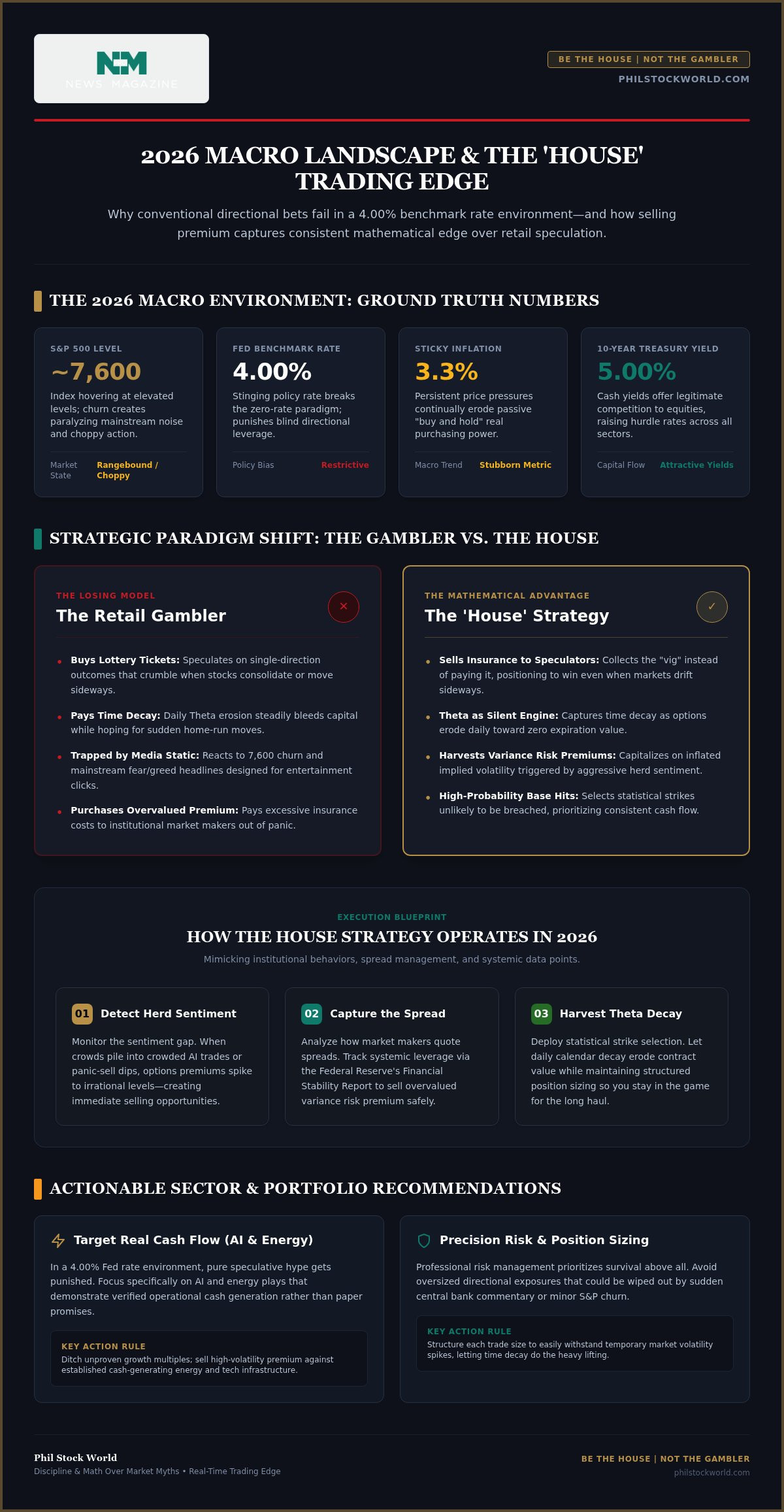
Conventional wisdom is usually just a polite way of saying “outdated information.” Wall Street thrives on selling you a 2026 market outlook and trading recommendations that look great in a glossy PowerPoint presentation but crumble under the weight of a 4.00% Fed funds rate. If you’re still waiting for a return to the zero-rate world of the past, you’re missing the reality of our current landscape. Inflation remains sticky at 3.3%, and the 10-year Treasury yield is staring down 5.00%. This isn’t a temporary blip; it’s the new operating environment. Relying on big-bank reports that are obsolete by the time they hit your inbox is a recipe for underperformance.
The mainstream media loves to scream about every minor tick in the S&P 500, which currently churns near the 7,600 level. They treat every press release like a tectonic shift, leaving retail traders in a state of constant overreaction. This creates a paralyzing amount of noise. You’re being fed a diet of fear and greed designed to keep you clicking, not profiting. To win in 2026, you have to separate the signal from the static. You need to stop being the gambler at the table and start being the one who owns the building. It’s about recognizing that most “news” is just entertainment for people who aren’t serious about their portfolios.
The 2026 Sentiment Gap
Understanding stock market sentiment analysis is your secret weapon for spotting when the herd has finally run out of steam. When everyone is piling into the same “sure thing” AI play or panic-selling a temporary dip, that’s your cue. Retail traders often get crushed because they react to the footprints left by institutional giants. Instead of fearing 2026 volatility, we see it as the fuel for our fire. High volatility isn’t a threat if you’re the one selling the insurance. Are you the gambler at the table, or the one owning the casino?
Macro Insights: Beyond the Headlines
Global policy isn’t just something for academics; it’s the direct driver of your daily P&L. While the “buy and hold” crowd watches their purchasing power erode under a high-rate regime, savvy traders look at the structural mechanics of the market. This includes understanding how market makers quote spreads and manage risk to keep the gears turning. By mimicking these institutional behaviors, you can capture the variance risk premium that directional gamblers leave on the table. You don’t need a 50-page PDF from a big bank to tell you that cash yields are finally attractive; you just need a street-smart perspective that prioritizes math over narratives.
The ‘House’ Strategy: How We Generate Consistent Trading Recommendations
Most traders treat the market like a high-stakes sports book. They pick a side, place a bet, and pray for a touchdown. That’s a losing game in a world where the Federal Reserve keeps benchmark rates at a stinging 4.00%. When we craft our market outlook and trading recommendations, we aren’t interested in picking winners by luck. We want to be the ones collecting the vig, not the ones paying it. By selling insurance to speculators who are desperate to protect their gains in a 7,600 S&P environment, we create a mathematical advantage that doesn’t depend on the market moving in a single direction.
We keep a close eye on the Federal Reserve’s Financial Stability Report to monitor systemic leverage and asset valuation pressures. When the herd gets too aggressive, options premiums spike. That’s our dinner bell. Instead of chasing speculative growth, we prioritize income generation by capturing the variance risk premium. This shift from gambling to professional management allows us to profit even when the market goes sideways or retreats slightly. It’s about building a portfolio that works for you, regardless of the daily headlines.
The Mechanics of Premium Selling
Every day you hold an option you’ve sold, time decay works in your favor. This is Theta, the silent engine of the “House” edge. We use advanced option trading strategies to select strikes that are statistically unlikely to be hit by the underlying asset. The House strategy is the systematic sale of overvalued options premium. We aren’t looking for home runs; we’re looking for consistent, high-probability base hits that compound over time.
The PSW Filter: How Recommendations are Vetted
We don’t just throw darts at a board. Every recommendation goes through a rigorous vetting process that combines fundamental value with technical timing. We ignore the “Trade of the Day” hype that litters social media. Our focus is on long-term sustainability and trades that can weather a sudden 25-basis-point rate hike. Our live interactive sessions allow us to stress-test these ideas in real-time before they ever become official alerts. If you’re looking for a more disciplined approach, checking out our Premium Membership options can help you filter the noise.
Sector Specifics: Actionable Recommendations for 2026’s Most Volatile Themes
Broad market outlook and trading recommendations often focus on the index level, but the real money in 2026 is made in the cracks between sectors. Energy and infrastructure are no longer just about “transition” buzzwords; they’re about raw scarcity. With 10-year Treasury yields hovering near 5.00%, capital is expensive. We look for companies with the pricing power to pass those costs directly to the consumer. In the technology space, the $670 billion AI CapEx boom has matured. We’ve moved past the “pick and shovel” hype to focus on software giants generating actual free cash flow. For traders looking to automate this search, TickerAI provides AI-powered stock opportunity discovery to pinpoint high-potential names. These are the names where we sell puts with high confidence, knowing we’d be happy to own the shares at a discount if the market wobbles.
Healthcare and biotech offer a defensive haven, but we don’t just buy and hope. We build an options “moat” by selling out-of-the-money calls against our positions. This generates income even if the sector stays flat. Consumer staples might seem “boring” to the retail crowd, but in a high-interest rate environment, their steady dividends and predictable earnings are beautiful. We treat these sectors like the anchor of our portfolio, using them to fund more aggressive plays elsewhere. It’s about balance and recognizing that a 2.3% GDP growth rate requires a more surgical approach than the “buy everything” era of the past decade.
Identifying the “laggards” that are actually undervalued gems is key to outperforming the S&P 500’s current 7,600 churn. Confirming these rotations requires a technical eye. Using how to read market charts allows us to see where institutional money is actually flowing before the headlines catch up.
| Sector | 2026 Volatility Outlook | Recommended Strategy |
|---|---|---|
| Energy | High (Supply Scarcity) | Cash-Secured Puts |
| Technology | Elevated (CapEx Focus) | Covered Call Writing |
| Healthcare | Moderate (Defensive) | Bull Put Spreads |
| Consumer Staples | Low (Income Play) | Diagonal Spreads |
Specific Trade Recommendations for 2026
When implementing these market outlook and trading recommendations, you must respect the house rules of risk. This means adhering to FINRA options account and margin requirements to ensure your leverage doesn’t become a liability during a sudden Fed-induced spike. We prefer using covered calls on tech giants that have proven their cash-flow mettle. For the consumer staples, we often use put spreads to hedge against sector-specific risks without tying up excessive capital. The “House” view on 2026 dividends is simple: don’t just collect the check; use the stock’s volatility to double your effective yield through smart premium selling.
From Analysis to Action: Implementing Recommendations with Precision Risk Management
Analysis is cheap; execution is where the money is made. You can have the most accurate market outlook and trading recommendations in the world, but if your risk management is sloppy, the 2026 market will eat you alive. The PSW Golden Rule is simple: never bet the farm on a single recommendation. Professionals know that position sizing is the secret sauce of longevity. Amateurs go “all in” on a hunch; we scale into positions to ensure one bad tick doesn’t blow up the year. If you find yourself sweating over a 1% move in the S&P 500 as it churns near 7,600, your position is simply too big.
A periodic virtual portfolio review is essential to audit your execution. It is easy to drift into bad habits when volatility spikes or when the Fed surprises the market with a 25-basis-point hike. Auditing your trades ensures you are still acting like the House, not a desperate gambler chasing losses. If you are ready to stop guessing and start managing your capital with institutional precision, it is time to join our community of disciplined traders.
The 5-Step Execution Framework
We don’t just click buttons based on a feeling. We follow a process. First, identify the macro context. Is the Fed leaning hawkish with rates at 4.00%? Second, select the “House” strategy that fits the current volatility. Third, size the position so a total loss wouldn’t ruin your week. Fourth, set your “Adjust, Don’t Exit” parameters. Instead of using a blunt stop-loss that gets triggered by noise, we use hedging to turn a potential losing trade into a “scratch” or even a win. Finally, execute with the cold discipline of a casino manager who knows the math is on their side.
Hedging as a Profit Center
Most retail traders view hedging as a cost. We view it as insurance we get paid to provide. The “Be the House” mindset means collecting premium while protecting your downside. In a 2026 market where the 10-year Treasury yield hovers near 5.00%, the cost of being wrong is high. Hedging allows you to manage the emotional roller coaster of market swings without panicking. You aren’t just reacting to the market; you’re anticipating the next move and pricing it into your favor. This approach transforms volatility from a threat into a consistent source of income.
Navigating 2026 with Phil Stock World: Your Real-Time Trading Edge
The 2026 market is a loud, messy place. If you are trying to find a reliable market outlook and trading recommendations by scrolling through social media or watching cable news, you are already behind. Those platforms thrive on chaos; we thrive on clarity. A Phil Stock World membership serves as the ultimate filter for this noise. It moves you away from the “what happened” and into the “what do we do about it.” This is where the transition from a standard member to a savvy trader begins. You aren’t just following a leader; you are learning to read the tape yourself.
Inside the Live Trading Room, theory meets reality. When the Fed announces a surprise move or a tech giant misses an earnings target, we don’t panic. We analyze. We look at the Greeks. We see where the premium is overvalued and where we can act as the House. This real-time environment is a high-level discussion among peers. It is intellectually stimulating and emotionally grounded. You are part of an insider’s club where complex information is shared with wit and transparency. Trading can be a lonely endeavor, but it doesn’t have to be.
Real-Time Alerts vs. Static News
Static news is a post-mortem. By the time you read an article on a major financial site, the move has already been priced in. Our alerts provide context and strategy, not just “buy” signals. We discuss the “why” behind every move, allowing for interactive Q&A during market hours. This is exactly why specialized research alternatives matter for serious traders. You need a specialized trading room that offers a unified, disciplined methodology rather than a mountain of contradictory opinions that lead to analysis paralysis.
Your 2026 Action Plan
The “House” outlook for 2026 is clear: volatility is your friend if you know how to price it. Stop being the gambler who pays for insurance and start being the one who collects the checks. Your action plan is simple. First, secure your education through our webinars. Second, use our market charts and analysis to identify high-probability setups. Third, engage with the community to sharpen your edge. The market outlook and trading recommendations we provide are designed to help you manage your portfolio with the calm confidence of a professional. Join the inner circle today and start trading with an edge that the mainstream crowd will never understand.
Own Your 2026 Trading Future
Success in this landscape isn’t about guessing the next headline or following the retail herd into overcrowded trades. We’ve explored how the “House” strategy flips the script by harvesting time decay and capturing the variance risk premium in a world of 4.00% interest rates. Navigating this environment requires more than just a standard market outlook and trading recommendations; it requires a shift in mindset from being a gambler to being a casino owner. By focusing on cash-flow winners and precise risk management, you can thrive regardless of where the S&P 500 drifts.
With over 20 years of market experience, we provide the tools you need to succeed. Our live interactive trading rooms offer real-time clarity, while our disciplined virtual portfolio tracking ensures we stay accountable to the math. It’s time to stop being the one placing the bets and start being the one who collects the premium. Join Phil Stock World today and start trading like “The House” in 2026. Let’s make this your most strategic and profitable year yet.
Frequently Asked Questions
What is the primary market outlook for 2026 according to Phil Stock World?
Our primary market outlook for 2026 centers on a “higher for longer” interest rate environment where the Federal Reserve maintains benchmark rates near 4.00%. We expect the S&P 500 to churn around the 7,600 level, driven by persistent inflation and high bond yields. This landscape creates a massive opportunity for premium sellers. Instead of betting on wild growth, we focus on capturing volatility and time decay as the “House” while the mainstream herd struggles.
How do your trading recommendations differ from standard analyst reports?
Most analyst reports offer static price targets that often become obsolete before they are published. Our market outlook and trading recommendations differ by focusing on strategy execution rather than just picking a direction. We emphasize the “how” of trading, such as selling covered calls and cash-secured puts to lower your cost basis. This methodology prioritizes consistent income generation and mathematical probability over the speculative guesswork found in traditional institutional PDF reports.
Can a beginner use “The House” trading recommendations effectively?
Beginners can absolutely use these recommendations, provided they are willing to shift their mindset from gambling to management. We provide the necessary educational webinars and market charts and analysis to bridge the knowledge gap. To gain experience without risking real capital, you can check out RookLedger for a free investing simulation platform. You don’t need to be a math genius, but you do need to understand the basics of time decay and risk management. Our community and live trading room offer a supportive environment where new traders learn to apply these professional strategies safely.
Options trading is the central pillar of our 2026 strategy. It is the tool that allows us to act as the “House” by selling overvalued insurance to speculative retail traders. We use multi-leg spreads and income-generating structures to create a high-probability edge. This approach allows us to profit in sideways or slightly down markets, which is essential when the 10-year Treasury yield stays near 5.00% and traditional stock appreciation feels sluggish.
How much capital is needed to follow a PSW virtual portfolio?
Our strategies are designed to be scalable, meaning you don’t need a massive account to get started. The key is strict position sizing; we never recommend betting a large portion of your capital on a single trade. Whether you are managing a small account or a large one, the goal is to keep your risk per trade consistent. A virtual portfolio review can help you audit your current holdings to ensure your capital is being used efficiently.
Is the 2026 market too volatile for retail trading recommendations?
Volatility is actually the fuel that makes our market outlook and trading recommendations so effective. While high volatility scares the average retail trader, it increases the premiums we collect as option sellers. The 2026 landscape, with its rapid shifts in Fed policy and tech CapEx cycles, provides the perfect environment for “The House” to thrive. We don’t fear market swings; we price them into our favor by acting as the insurance provider for the panicking herd.
How often are trading recommendations updated in the Live Trading Room?
Updates in the Live Trading Room happen in real-time to keep pace with global events. We maintain a brisk, responsive rhythm that connects macro policy changes directly to actionable trade adjustments. Because the 2026 market moves fast, we provide continuous commentary and alerts throughout the trading day. This ensures you are never left guessing when a sudden rate hike or geopolitical event shifts the underlying math of your current positions or future setups.
What happens if a recommendation doesn’t go as planned?
We follow a strict “Adjust, Don’t Exit” philosophy when a trade moves against us. Instead of using blunt stop-losses that often trigger on noise, we use professional hedging techniques to turn potential losses into “scratches” or modest wins. This might involve rolling a position or adding a counter-spread to neutralize risk. Our focus is always on protecting the downside and managing the emotional swings of the market through disciplined, mathematical adjustments rather than panic selling.

