


What if the “Strong Buy” list you’re staring at is actually a trap designed to keep you following a herd that’s already halfway out the door? When weighing seeking alpha vs philstockworld in 2026, the sheer volume of data can leave even the sharpest investors paralyzed. You’ve likely felt that sting of entering a trade based on a popular alert only to realize you’re the last one to the party. We’ve all been there, squinting at a screen and wondering if we’re missing the “why” that separates a winning strategy from a crowded disaster.
Choosing your edge isn’t just about comparing subscription costs. It’s about picking the cockpit that keeps you from flying blind when the market gets loud. You deserve a community that prioritizes risk management over hype and offers direct access to lead analysts rather than a faceless algorithm. We’ll explore whether you need Seeking Alpha’s massive library of quant data or Phil Stock World’s high-intensity live trading room to anchor your 2026 portfolio. You’ll discover a clear framework for managing risk and actionable options strategies that actually work when the indices start swinging.
Key Takeaways
- Learn why navigating the 2026 market requires moving past simple stock picks toward a holistic strategy that accounts for information overload.
- Compare the algorithmic precision of Seeking Alpha’s Quant system with the human-led, real-time tactical adjustments found in the Phil Stock World environment.
- Discover which platform provides the best defense for your capital by analyzing how seeking alpha vs philstockworld handle hedging and risk management during corrections.
- Identify your ideal investor profile to determine if you’re better suited for a massive crowdsourced library or an exclusive, high-intensity live trading room.
- Shift your focus from “what to buy” to “how to trade” by understanding the mechanics of income generation and the “trading like the house” philosophy.
Beyond the Paywall: The 2026 Landscape of Premium Market Research
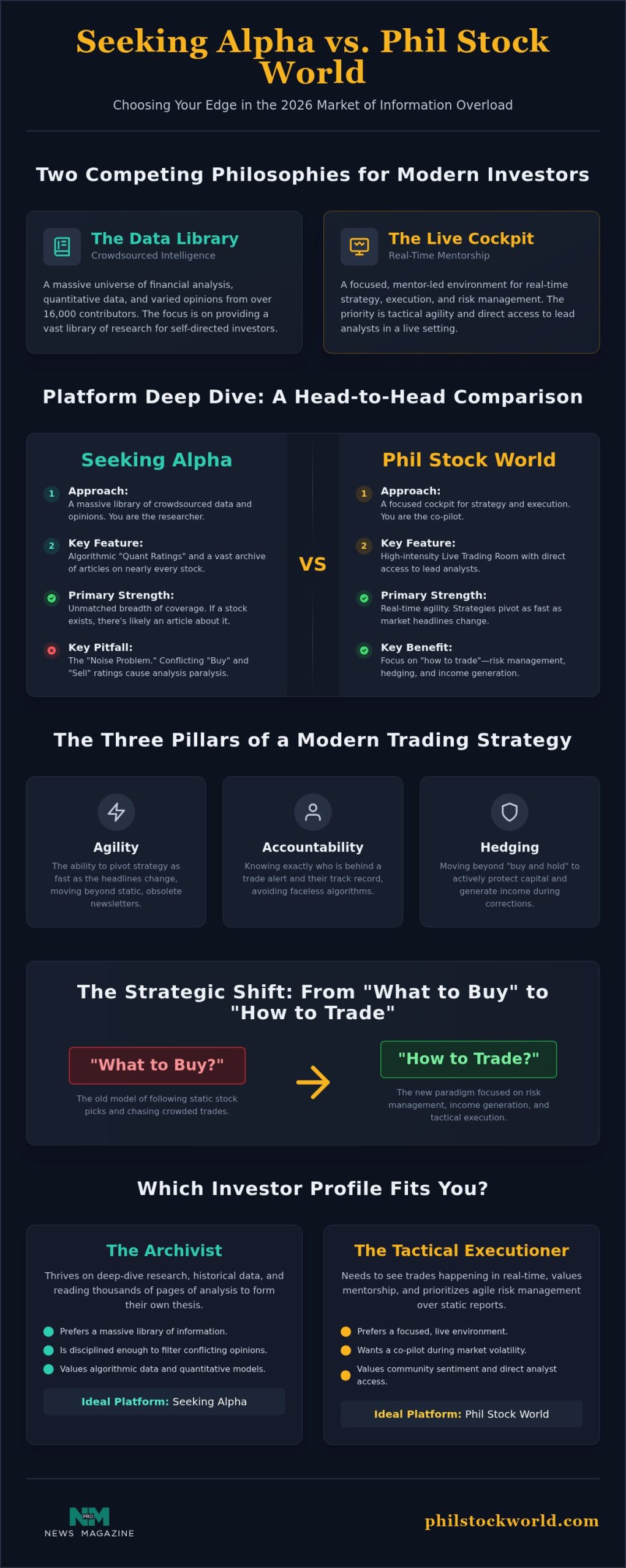
The 2026 market environment doesn’t suffer from a lack of information; it’s drowning in it. For the modern investor, the challenge has shifted from finding data to filtering out the noise that threatens to sink their portfolio. The psychological cost of analysis paralysis is real. When you’re staring at twenty conflicting buy signals from twenty different “experts,” you aren’t trading. You’re guessing. This is the core of the seeking alpha vs philstockworld debate: do you want a massive library of opinions, or do you need a focused cockpit for execution?
Why Retail Traders are Fleeing Free Platforms
Free platforms have become a minefield of “paid-to-play” narratives and social media hype that has effectively corrupted standard technical analysis. If you aren’t paying for the product, you are the product. Most free “research” is just a sophisticated marketing funnel for brokerage services or pump-and-dump schemes disguised as alpha. This realization has sent serious investors searching for unbiased financial research that prioritizes capital preservation over clicks. In 2026, premium research isn’t just a list of tickers. It’s the context that tells you why a trade makes sense and, more importantly, when it doesn’t. When the screen turns red, the human brain enters a state of high-alert panic. Without a clear framework, you’ll likely sell at the bottom and buy at the peak. This is why the “Library” model can be dangerous for the undisciplined; too many choices often lead to no choice at all.
The Rise of Specialized Trading Rooms
A static newsletter delivered to your inbox at 8:00 AM is often obsolete by noon in 2026’s volatile environment. Data providers like Seeking Alpha offer an incredible depth of historical data and crowdsourced sentiment, but they often lack the real-time agility required to navigate sudden policy shifts or flash crashes. There’s a fundamental difference between a data provider and a strategy mentor. While one gives you the ingredients, the other stands in the kitchen with you as the heat rises. Specialized trading rooms have gained traction because they offer community-driven sentiment analysis and direct interaction with lead analysts. It’s the difference between reading a flight manual and having a co-pilot who has actually flown through a storm.
In this new landscape, traders are prioritizing three key elements:
- Agility: The ability to pivot strategy as fast as the headlines change.
- Accountability: Knowing exactly who is behind a trade alert and their track record.
- Hedging: Moving beyond “buy and hold” to “protect and generate income.”
Choosing between these two platforms requires an honest audit of your own trading personality. Are you an archivist who thrives on reading thousands of pages of analysis, or are you a tactical executioner who needs to see the trade happening in real-time? As we dive deeper into the comparison, we’ll see how these two platforms approach these pillars differently. First, let’s look at the sheer scale of the world’s largest crowdsourced investment community.
Seeking Alpha: The Power and Pitfalls of Crowdsourced Intelligence
Seeking Alpha is the undisputed behemoth of the financial research world. With over 16,000 contributors, it functions as a massive, living library of market sentiment. It’s a place where you can find an analysis of a micro-cap biotech firm just as easily as a deep dive into Apple’s latest earnings. The platform offers a tiered entry point, ranging from the $299 annual Premium subscription to the high-end Pro tier at $2,400. They’ve also leaned heavily into their “Alpha Picks” service, which retails for $499 a year, aimed at those who want the research done for them. However, the sheer scale of the ecosystem creates a unique set of challenges. When you’re evaluating seeking alpha vs philstockworld, you’re choosing between a sea of voices and a singular, focused strategy.
The “Noise Problem” is perhaps the most significant hurdle for the self-directed investor. It’s not uncommon to search for a ticker and find three different authors with three different ratings; one shouting “Strong Buy” while another warns of a “Sell” trap. This leads to a specific type of analysis paralysis. While SA’s Quant Ratings have shown impressive historical performance, boasting a 163.88% cumulative return over the five years ending in May 2026, these ratings are inherently backward-looking. They crunch historical data to predict future movement, which often works until the moment it doesn’t. If you find yourself overwhelmed by the data, attending educational webinars can help you learn how to filter the signal from the static.
Strengths: The Ultimate Research Library
If you love the “hunt,” SA is your playground. It provides unrivaled access to earnings call transcripts and SEC filings in a clean, searchable format. Their dividend safety scores are a gold standard for passive income seekers, providing a quick health check on whether a company can actually afford its payout. The peer-to-peer comment section is also a goldmine; often, the most valuable “bear case” isn’t in the article itself but in the heated debate happening in the comments below it.
Weaknesses: The Herd and the Lag
The platform’s structure can inadvertently foster the dangers of groupthink in financial markets, especially when a popular stock develops a cult-like following. This herd mentality can blind you to brewing trouble. Furthermore, quant-based systems often struggle with “Black Swan” events because they rely on patterns that no longer apply. If you’re looking for actionable risk management for options, you’ll find SA’s library surprisingly thin on the ground. It tells you what to buy, but it rarely shows you how to protect that position when the floor falls out.
Phil Stock World: Why Live Trading Rooms Beat Static Stock Lists
Algorithms don’t sweat. They also don’t pivot when a global event breaks the model. While a University of Kentucky academic study has validated the historical effectiveness of Seeking Alpha’s quantitative research, there is a distinct limit to what a backward-looking data set can do for you in a live session. This is the central friction in the seeking alpha vs philstockworld debate. One platform offers a library of what has already happened; the other provides a cockpit for what is happening right now. Phil Davis doesn’t hide behind a faceless algorithm. He’s in the room, taking the same heat as you are, and explaining the logic behind every move. This level of direct interaction transforms trading from a solitary, guessing game into a disciplined, professional operation.
The Cockpit Experience: Real-Time Strategy Adjustments
The difference between a winning trade and a “bag-holder” scenario often comes down to five minutes of reaction time. PSW members don’t wait for an article to be edited and published to know why the market just spiked. They use live alerts to navigate intraday volatility as it unfolds. These interactive trading sessions build better habits because they force you to look at the macro footprints of the herd rather than just a single ticker. You aren’t just getting a fish; you’re watching the captain navigate the storm. It’s about moving from “I think this might happen” to “I am executing this hedge now because the macro data just shifted.”
Strategy over Tickers: The ‘Be the House’ Philosophy
Most retail traders treat the market like a casino, but at Phil Stock World, the goal is to be the house. This philosophy focuses on advanced option trading strategies designed for consistent income generation rather than chasing the next “moon” shot. It’s a transition from being a gambler to being a disciplined manager of capital. Transparency is the bedrock here. Every trade is tracked in virtual portfolios, allowing for total accountability. If a strategy isn’t working, it gets audited. Through Virtual Portfolio Reviews, members can identify where they are leaking capital and adjust their position sizing before a small mistake turns into a portfolio-killing disaster. This isn’t about following the herd; it’s about staying ahead of it by staying disciplined.
Strategy Execution: Comparing Quant Ratings to Real-Time Mentorship
An algorithm makes for a fantastic librarian, but it’s a mediocre bodyguard when the market starts swinging a sledgehammer. In the seeking alpha vs philstockworld showdown, the winner isn’t decided by who has more data. It’s decided by who helps you keep your capital during a correction. Seeking Alpha’s Alpha Picks provides a curated list of high-conviction stocks based on historical performance. It’s clean and efficient. But can you ask the algorithm why it isn’t adjusting for a sudden interest rate hike? You can’t. At Phil Stock World, accessibility is the core feature. If a trade alert goes out and you don’t understand the logic behind the spread, you ask the person who wrote it in real time. While SA offers a static education center, PSW provides educational webinars that let you see the strategy in action, ensuring you understand the “why” before you risk a single dollar.
The Battle of the Portfolios
Paper gains on a static list look great in a marketing brochure, but they don’t pay the bills. The gap between a “Strong Buy” rating and a realized profit is often filled with the “Greeks.” While SA focuses on simple stock screening, PSW members are busy managing Delta, Gamma, and Theta. A Virtual Portfolio Review acts as a cold, hard audit of your strategy. It’s where you find out if you’re actually “trading like the house” or just gambling with a more expensive set of tools. Accountability matters in the 2026 market. Every trade in the PSW room is tracked and reviewed, whereas the “wisdom of the crowd” model often allows for authors to quietly move on from a bad call without a post-mortem analysis. This transparency ensures that you are learning from both wins and losses, rather than just chasing the next shiny ticker on a list.
Cost vs. Value: ROI on Your Subscription
Let’s talk numbers without the corporate fluff. Seeking Alpha Premium sits at $299 per year, while the Pro tier jumps to $2,400. That’s an accessible entry point for research, but it doesn’t account for the cost of “noise,” specifically the losses incurred from conflicting picks or late exits. Calculating the ROI of seeking alpha vs philstockworld depends on your trading volume and your need for risk management. A Phil Stock World membership requires a larger commitment, with tiers ranging from $99 to $995 per month. The ROI here isn’t just found in a winning ticker. It’s found in the bad trades you didn’t take and the hedges that saved your portfolio during a 5% intraday drop. In a sideways or volatile market, the ability to generate consistent income through options mentorship pays for itself significantly faster than a static list of ratings. If you’re ready to stop chasing tickers and start building a resilient strategy, explore our Premium Membership options today.
Joining the Insider Club: Which Platform Fits Your 2026 Goals?
The final verdict on seeking alpha vs philstockworld isn’t about which site is “better” in a vacuum. It’s about which tool fits your hand. If your primary goal is to act as a financial librarian, curating a massive database of historical filings and crowdsourced opinions, Seeking Alpha is an unbeatable resource. It’s built for the investor who wants to spend hours data-mining to find that one undervalued micro-cap. However, if your goal is to stop being a spectator and start being a tactical executioner, you need a cockpit, not just a library. Phil Stock World is designed for those who want to trade like the house, focusing on income generation and capital preservation through a disciplined trading approach that algorithmic lists simply can’t replicate.
Making the Choice: The 3-Question Litmus Test
Before you commit your capital to a subscription, put your trading personality through this quick filter. Your answers will dictate which platform will actually move the needle for your portfolio in 2026.
- Question 1: Do you prefer solitary data-mining or real-time strategic discussion? If you thrive on deep-dive reading, SA is your home. If you want to talk through a trade while the tape is moving, PSW is the answer.
- Question 2: Are you trading stocks for growth or options for income? Seeking Alpha excels at identifying “Strong Buy” growth tickers. Phil Stock World specializes in complex spreads designed to profit even when the market stays flat.
- Question 3: How much do you value direct access to a mentor? If you’re fine with faceless quant ratings, stick with SA. If you want to ask Phil Davis himself why he’s adjusting a hedge, you belong in the PSW room.
Getting Started with the ‘House’ Advantage
Your first week at Phil Stock World isn’t about jumping into the deep end without a life jacket. It starts with orientation. You’ll spend those first few days observing the live chat, attending educational webinars, and learning the “Be the House” vocabulary. Integration is seamless; you don’t need a specialized broker to follow the alerts. You simply take the real-time strategy adjustments and apply them to your existing workflow. The focus is on habit-building. By the time you schedule your first Virtual Portfolio Review, you’ll stop looking at the market as a series of random events and start seeing it as a predictable system of risk and reward. Don’t settle for being the last person to hear about a “crowded” trade. Join the Phil Stock World community and start trading with an edge today.
Mastering Your Market Entry in 2026
The 2026 market doesn’t reward those who simply follow the crowd. It rewards those who have a plan. We’ve analyzed the massive research library of Seeking Alpha and compared it to the high-intensity, live execution environment of Phil Stock World. While one offers a deep dive into historical quant data, the other provides a real-time cockpit for steering through today’s volatility. The choice between seeking alpha vs philstockworld ultimately comes down to whether you want to read about the market or actually trade it with a professional edge.
Success requires moving beyond static stock lists and embracing a strategy that prioritizes income generation and capital protection. With direct access to Phil Davis, real-time options trade alerts, and interactive virtual portfolio reviews, you can finally stop guessing and start executing with confidence. It’s time to step out of the library and into the room where the trades actually happen. Take Control of Your Portfolio with Phil Stock World Membership. Your evolution from a retail researcher to a strategic trader starts today. Let’s get to work.
Frequently Asked Questions
Is Seeking Alpha Premium worth the cost for active traders?
Seeking Alpha Premium is worth the investment if you thrive on deep-dive research and fundamental data. For $299 annually, you get access to 16,000 contributors and proprietary Quant Ratings. However, active traders comparing seeking alpha vs philstockworld often find that while SA is a great library, it lacks the real-time tactical adjustments needed for volatile markets. It’s an archival research tool, not a live execution cockpit for intraday moves.
How does Phil Stock World differ from a standard options newsletter?
Phil Stock World isn’t a static email service that arrives after the market has already moved. Unlike a standard options newsletter, it offers live trading rooms where you watch strategies unfold in real time. You get direct access to Phil Davis and a community that focuses on “trading like the house.” This means generating income through spreads and hedging rather than just chasing speculative directional bets.
Can I use Seeking Alpha and Phil Stock World together?
Using both platforms together is a common strategy for sophisticated investors. Seeking Alpha serves as a massive database for SEC filings, earnings transcripts, and dividend safety scores. Once you’ve identified a potential ticker there, you can bring it into the Phil Stock World community to determine the best options strategy or hedge. This combination pairs deep historical data with professional execution and real-time risk management.
Does Seeking Alpha provide real-time trade alerts?
Seeking Alpha doesn’t offer a live, interactive alert system comparable to a professional trading room. While their Alpha Picks service sends out bi-monthly stock recommendations, these are static lists based on historical quant data. In the seeking alpha vs philstockworld comparison, PSW provides the real-time “why” behind every move as it happens. If you need to pivot a position during an intraday crash, a static list won’t help you.
What is the success rate of the Phil Stock World virtual portfolios?
Every trade within the Phil Stock World virtual portfolios is tracked with total transparency for accountability. We don’t hide the “losers” or only highlight the “moon shots.” The focus is on long-term income generation and capital preservation. By using virtual portfolio reviews, members can audit their own strategies to ensure they are following the “be the house” philosophy. This systematic approach aims for consistency rather than gambling.
Is Phil Stock World suitable for beginner traders?
Beginners are welcome at Phil Stock World, though they should expect a learning curve. The community is built on peer learning and direct mentorship, which helps new traders avoid the expensive rookie mistakes common on free social platforms. By attending educational webinars and participating in the live chat, beginners can learn advanced options mechanics in a supportive environment. It’s about building a professional foundation from day one rather than following a herd.
How much time do I need to spend in the live trading room daily?
You don’t need to be glued to your screen all day to benefit from the community. While the live trading room is active throughout market hours, many members use real-time alerts to stay informed of major strategy shifts. You can spend thirty minutes a day reviewing market commentary and virtual portfolios or stay for the full session for deep-dive analysis. The platform is designed to keep pace with your schedule.
Does Seeking Alpha offer options trading strategies?
Seeking Alpha offers options content primarily through crowdsourced articles written by individual contributors. These pieces vary wildly in quality and strategy; they often lack a unified framework for risk management. While you can find ideas there, the platform isn’t built for options execution. Phil Stock World fills this gap by providing a dedicated environment for complex hedging and income-generating spreads that are audited and discussed in real time.

