


What if you could stop treating your portfolio like a lottery ticket and start running it like a casino? Most investors spend their nights staring at the ceiling, worrying that a sudden market correction will wipe out years of progress. It’s frustrating to watch paper gains evaporate while you’re paralyzed by the high cost of traditional put options or the sheer complexity of downside protection strategies for stocks. You’ve worked too hard to let a 17.38 VIX reading or a shifting Federal Funds rate dictate your financial future.
I agree that the traditional buy and hold mantra feels increasingly like buy and pray in this 2026 environment. That’s why we’re going to master the professional frameworks used to neutralize volatility and preserve your capital without ever exiting your favorite long-term positions. We’re going to break down how to structure your portfolio so you’re always playing with an edge, moving from a broad observation of risk to the granular execution of sophisticated, cost-effective hedges that keep you in the game regardless of market direction.
Key Takeaways
- Move beyond the “Buy and Hold” myth by understanding why 2026’s macro-economic shifts demand a more active, defensive posture.
- Explore the core mechanics of downside protection strategies for stocks, including how to use collars to effectively finance your own portfolio insurance.
- See why staying in the market with a hedge is mathematically superior to sitting in cash and missing the most profitable recovery cycles.
- Learn how to audit your portfolio’s beta-weighted exposure to identify hidden risks before the next market correction hits.
- Identify the common pitfalls of solo hedging and how professional guidance can transform complex tools into a reliable shield for your wealth.
The Reality of Market Volatility in 2026: Why ‘Buy and Hold’ is a Dangerous Myth
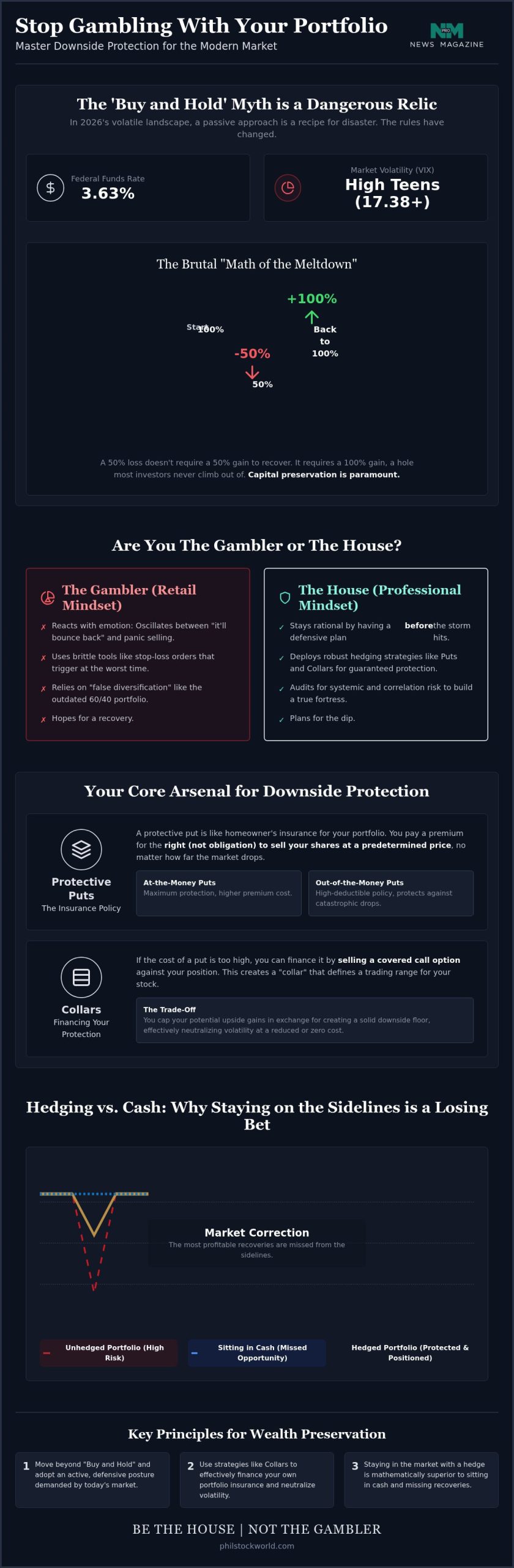
The market in September 2026 isn’t the same beast we fed in the early 2020s. With the Federal Funds rate hovering at 3.63% and the VIX consistently tagging the high teens, the “set it and forget it” approach has become a recipe for disaster. Volatility is no longer a guest; it’s the landlord. While “The Herd” panics every time a headline shifts or a Fed governor sneezes, “The House” stays calm because they’ve already built the floor. This isn’t about being a perma-bear. It’s about being a realist who understands that the landscape has shifted toward extreme concentration in AI-driven assets and geopolitical instability.
Let’s talk about the brutal “Math of the Meltdown.” If your portfolio takes a 50% haircut, you don’t just need a 50% recovery to get back to zero. You need a 100% gain. That’s a hole most investors never climb out of. This is why capital preservation isn’t just a defensive move; it’s the primary engine of long-term wealth. By implementing downside protection strategies for stocks, you aren’t just playing defense. You’re ensuring you always have the chips to play the next hand when the market eventually finds its footing.
The Psychological Trap of Passive Investing
Retail traders often freeze when the red bars start stacking up on their screens. They oscillate between “it’ll bounce back” and “get me out at any price,” eventually making emotional mistakes at the worst possible times. This emotional whiplash is exactly what “The House” avoids by having a plan before the storm hits. Successful traders don’t hope for a recovery; they plan for the dip. Downside protection is the proactive management of risk that allows you to stay rational when everyone else is losing their minds.
Correlation Risk: When Everything Falls Together
The old 60/40 portfolio is effectively a relic in this high-volatility environment. In 2026, we’re seeing “false diversification” where tech-heavy indices and supposedly safe bonds often move in lockstep during a liquidity squeeze. You can’t just hide in a broad index fund and expect a smooth ride when a handful of AI stocks carry the entire weight of the market. To survive, you need to utilize macro market insights to spot systemic risks before they cascade into a full-blown rout. This is where Portfolio Insurance concepts become vital. Using downside protection strategies for stocks helps you decouple your wealth from the general market noise, allowing you to profit when others are merely trying to survive.
The Core Arsenal: Primary Downside Protection Strategies
While some advisors suggest stop-loss orders as a safety net, “The House” knows better. Stop-losses are notoriously brittle. They don’t protect you against a gap-down opening, and they often force you to sell at the absolute bottom just before a reversal. Instead, we use professional downside protection strategies for stocks that provide a guaranteed floor without forcing you out of the trade. This is about maintaining control when the market tries to take it away.
Protective Puts: The Insurance Policy Model
Think of a protective put as your portfolio’s homeowner’s insurance. You pay a premium to ensure that no matter how far the market drops, you can still sell your shares at a predetermined strike price. A put option gives you the right, but not the obligation, to sell at a set price. Choosing your strike price is a balance of risk and cost. An “at-the-money” put offers maximum protection but carries a higher premium, while an “out-of-the-money” put acts like a high-deductible policy, protecting only against catastrophic failure. It’s a binary choice: how much of a drawdown can your ego, and your bank account, actually handle?
Collars and Spreads: Reducing the Cost of Protection
If the cost of pure insurance feels too steep, you can offset that expense by selling a covered call against your position. This creates a “collar.” You’re essentially capping your potential upside to pay for your downside floor. In the 2026 market, with the Federal Funds rate at 3.63%, the “zero-cost” collar is a bit of a misnomer; there’s always a trade-off in opportunity cost. However, it remains a powerful way to neutralize volatility. You can further refine these moves by using advanced option trading strategies to time your entries when the VIX is low and premiums are cheap.
For shorter-term threats, a bear put spread offers a more surgical strike. By buying a put and selling a lower-strike put, you lower your total cost while still protecting a specific range of loss. Timing these moves depends heavily on the VIX. In September 2026, with the VIX trading in the low 17s, protection is reasonably priced. If you wait until the VIX spikes to 30, you’re buying insurance while the house is already on fire. If you’re unsure how these pieces fit into your specific holdings, a Virtual Portfolio Review can help you audit your current exposure and find the leaks.
Hedging vs. Cash: Why Staying on the Sidelines is a Losing Bet
When the market starts looking like a crime scene, the instinct to liquidate everything and hide in cash is overwhelming. It feels safe. It feels quiet. But for the serious investor, cash isn’t a strategy; it’s a surrender. Sitting on the sidelines might protect you from the red days, but it also guarantees you’ll miss the explosive recovery days that happen when you least expect them. In the 2026 market, where AI-driven volatility can spark a 5% rally in a single afternoon, being “out” is often more expensive than being “wrong.”
The “House” approach is different. Instead of exiting your positions, you stay invested while using math to mitigate the delta of the move. By layering on downside protection strategies for stocks, you can maintain your long-term exposure while neutralizing the immediate impact of a sell-off. Professionals often use synthetic positions, like LEAPS or bull call spreads, to control large blocks of stock with significantly less capital at risk. This allows you to keep your “skin in the game” without risking your entire bankroll on a single roll of the dice.
The Opportunity Cost of Market Timing
Statistical evidence consistently shows that missing just the ten best trading days over a decade can slash your total returns by more than half. Market timing is a loser’s game because the best days almost always follow the worst days. When you use downside protection strategies for stocks, you gain the psychological fortitude to stay the course. You don’t need to guess the bottom because your floor is already set. If you’re feeling paralyzed by your current exposure, a virtual portfolio review can help you determine if you’re actually over-leveraged or just under-hedged.
Inflation and the ‘Hidden’ Loss of Cash
There’s a “hidden” tax on safety that many retail traders ignore. With inflation still a persistent theme in 2026, holding large amounts of idle cash means you’re accepting a guaranteed loss in purchasing power every single day. It’s a slow bleed that erodes your wealth just as surely as a market dip. A savvy mentor knows that cash is a stagnant pond while a hedged portfolio is a controlled river. By using hedged dividend strategies, you can continue to harvest income from your shares while using options to protect the principal. This keeps your capital productive and your growth trajectory intact, even when the broader indices are sideways or sinking.
Step-by-Step: Constructing Your First Portfolio Hedge
Constructing a hedge isn’t a one-time event; it’s an ongoing architectural project. Professionals don’t just “buy a put” and walk away. They build a structure. First, you must audit your current beta-weighted exposure to see what you’re actually risking. If your portfolio is heavy on high-flying AI names, a small dip in the broad market could be a landslide for your holdings. Second, determine your “Pain Threshold.” This is the specific dollar amount or percentage drawdown you can afford to lose before your long-term goals are compromised. Once you know your number, you can select the right index-based instrument, such as SPY for broad large-caps, QQQ for tech, or IWM for small-caps, to act as your primary shield.
Third, never buy all your insurance on the same day. You scale into your downside protection strategies for stocks just as you scale into a long position. If the market is at all-time highs and sentiment is euphoric, you might layer in 25% of your intended hedge. If support levels start to crumble, you add more. Finally, you must monitor and adjust. Market sentiment in 2026 shifts rapidly with every FOMC whisper. If the technicals change, your hedge must change with them. Get the real-time adjustments you need with a Premium Membership to see how we scale our own hedges in a live environment.
Beta-Weighting: Understanding Your Real Risk
Owning ten different tech stocks isn’t diversification; it’s a concentration trap. If they all have a high correlation to the Nasdaq, they will all fall together. Beta-weighting allows you to see your portfolio as a single number relative to an index. For example, if your portfolio has a beta of 1.5 relative to the SPY, a 10% market drop will likely result in a 15% hit to your account. You can use how to read market charts to identify key support levels where your specific stocks might break down, allowing you to trigger your hedges with surgical precision rather than blunt guesswork.
Scaling and Management: The Pro Approach
“Set it and forget it” is for slow cookers, not for downside protection strategies for stocks. Badly managed hedges can suffer from the “Rule of 72” in reverse. Small, consistent losses from buying over-priced protection can slowly bleed your account dry. To avoid this, pros “roll” their protection forward. If the market drops and your put options gain value, you might sell those profitable puts and buy new ones at a lower strike price. This locks in gains from the hedge while maintaining a consistent floor for the future. It’s about keeping your protection cost-effective and responsive to the current 17.38 VIX environment.
Beyond the Basics: Why Professional Guidance Beats Solo Speculation
The theory behind downside protection strategies for stocks is simple enough to explain in a few paragraphs, but the execution is where the wheels usually fall off for the retail trader. It’s easy to talk about buying puts when the VIX is at 14. It’s a different story entirely when the market is gapping down 2% at the open and your screen is a sea of red. The “DIY” trap is real. Most solo traders either over-hedge, which slowly bleeds their capital through expensive premiums, or they freeze during a correction and wait too long to buy insurance. By the time they act, the cost of protection has skyrocketed, effectively locking in a loss.
Professional guidance isn’t about having a crystal ball; it’s about having a disciplined, repeatable framework. “The House” doesn’t gamble on direction. It manages risk through math and community intelligence. When you’re part of a savvy group of traders, you benefit from collective wisdom that helps you stay calm when the herd is stampeding toward the exits. Real-time alerts allow you to pivot your positions before the news cycle has even finished typing the headline. In the 2026 landscape, the best downside protection isn’t just an option contract. It’s a disciplined, educated mindset that refuses to be bullied by market volatility.
The Insider Advantage in a Retail World
Institutional traders want you to stay unhedged, emotional, and reactive. They profit from the “buy and pray” crowd that panics at the bottom and buys at the top. Phil Stock World operates outside this traditional corporate mold to provide the kind of unbiased financial research that big banks often keep for their own desks. Our live trading rooms aren’t just for calling out trades. They’re for mastering the “rhythm” of the market. You learn to see the footprints of the big players and understand when they are quietly hedging their own books, giving you the signal to do the same before the price action confirms the move.
Your Next Move: Auditing Your Strategy
If you’re still watching your paper gains evaporate every time there’s a 3% correction, it’s time to stop guessing. You need to stress-test your current holdings against the reality of the 2026 macro environment. There is a massive difference between “news,” which is designed to grab your attention, and “actionable intelligence,” which is designed to protect your capital. Your next move should be to move beyond theory and into execution. Whether you’re looking for a Virtual Portfolio Review to audit your existing risk or a Premium Membership to get real-time hedging adjustments, the goal is the same: stop being the gambler and start being “The House.” Join our community to navigate the 2026 market with wit, transparency, and a professional edge.
Stop Being the Gambler: Your 2026 Portfolio Blueprint
Navigating the 2026 market requires more than just a hopeful outlook. It demands a structural shift from passive observer to active manager. By mastering downside protection strategies for stocks, you’ve learned that volatility isn’t a threat to be feared but a tool to be managed. Whether you’re layering collars to cap costs or auditing your beta-weighted exposure, the goal remains the same. You want to preserve your capital so you’re always ready for the next explosive rally.
Don’t let the next VIX spike catch you off guard. Real wealth isn’t built by guessing the bottom; it’s built by staying in the game with a professional edge. You can gain access to Phil Davis’s daily live trading room and receive real-time trade alerts to navigate 2026 market volatility with confidence. New members even get an exclusive Virtual Portfolio Review to stress-test their current holdings. Stop guessing and start trading like ‘The House’-Join Phil Stock World today. Your future self will thank you for the discipline you show today.
Frequently Asked Questions
What is the best downside protection strategy for a small stock portfolio?
For a smaller account, index-based hedges using SPY or QQQ options are often the most efficient choice. Buying individual puts for every stock in a ten-position portfolio is expensive and exhausting to manage. A single, well-timed index put acts as a blanket for your entire account. It provides broad protection against systemic crashes without requiring the high capital outlay of multiple individual option chains.
How much does it typically cost to hedge a portfolio with options?
Cost varies based on the CBOE Volatility Index (VIX), but most professionals budget between 1% and 3% of their portfolio value per quarter for insurance. In September 2026, with the VIX trading around 17.38, premiums are relatively balanced. You can significantly reduce this out-of-pocket expense by selling covered calls to create a collar, which uses the market’s own premium to pay for your floor.
Can I protect my stocks without using options at all?
A protective put is a guaranteed shield, while a stop-loss is often a trap. If a stock gaps down 15% overnight, a stop-loss order will execute at the first available price, potentially locking in a much larger loss than you intended. A put option gives you the legal right to sell at your chosen strike price regardless of where the market opens, providing true insurance against catastrophe.
How do I know when it’s time to put on a hedge?
The best time to buy insurance is when the sun is shining and the VIX is low. Professionals monitor macro indicators, such as the 3.63% Federal Funds rate and technical resistance levels on major charts, to spot brewing trouble. You want to layer in your protection when the “herd” is euphoric and premiums are cheap, rather than waiting until a correction has already begun and costs have spiked.
Is downside protection worth it if the market keeps going up?
Yes, because hedging provides the psychological fortitude to stay invested in your winning positions. You don’t regret your car insurance just because you didn’t have an accident this month. If the market continues its rally, your long positions will grow in value while the hedge expires. That small premium is the price of the peace of mind that prevents you from panic-selling during minor pullbacks.
What are the most common mistakes beginners make when hedging?
Beginners often fall into the trap of over-hedging or waiting too long to act. Buying too much protection can eat your entire profit margin, turning a winning year into a flat one. Many also wait until the VIX is screaming before looking for downside protection strategies for stocks. Finally, failing to “roll” or adjust the hedge as the market moves can leave you with a floor that is no longer relevant.
How does ‘The House’ mentality differ from traditional risk management?
Traditional risk management focuses on avoiding losses, while ‘The House’ focuses on pricing and managing them. “The House” doesn’t gamble on market direction; it uses mathematical frameworks to ensure an edge regardless of the outcome. Instead of being a victim of volatility, you become the casino that profits from the churn. It’s a shift from being a reactive gambler to a proactive, disciplined operator who understands that risk is just another variable to be managed.

